Gas or battery equipment: price the whole working session
Choose gas or battery equipment from the job duration, actual load, charging access and total package cost. Time a normal session before buying. A yard’s acreage does not establish whether one battery finishes, and a high maximum voltage does not prove more usable runtime or power.
Use runtime at the required setting
EGO’s LB7650/LB7654 page lists 15 minutes on turbo and 150 on low with the recommended 5.0Ah pack. Those figures cannot be exchanged. A 45-minute task needing continuous turbo represents three of the published 15-minute pack portions before allowing for real conditions.
Price the equipment you will need
In a hypothetical comparison, a $250 bare tool plus two $180 batteries and a $100 charger totals $710. A $400 gasoline tool plus $40 of approved fuel equipment totals $440 initially. The $270 difference excludes electricity, fuel, maintenance and future battery replacement; it does not establish which costs less over its life.
| Battery plan | Gasoline plan |
|---|---|
| Approved tool, pack and charger compatibility | Required fuel and engine-oil arrangement |
| Load-dependent runtime and spare packs | Tank runtime and safe cool/refuel process |
| Charging access and storage instructions | Fuel storage and engine service |
| Cutting gear, guards and noise still apply | Cutting gear, guards, exhaust and noise apply |
Existing packs can change the purchase cost only if the new tool and charger approve them. A connector that fits through an unofficial adapter is not proof of system compatibility. Battery equipment still needs blade, chain, filter or other tool-specific maintenance.
Check the rule that applies to the location
CARB’s SORE amendments page distinguishes new-engine emission standards from possession, use and repair of existing compliant equipment. Its manufacturing rules and timelines do not establish a city’s blower operating hours or every retailer’s inventory status.
Verify local use rules and product availability for the actual work address. Choose an operating plan that also accounts for storage, noise, exhaust, weather and the physical effort of carrying the configured tool.
Gas vs. battery, for your yard specifically
Choose gas or battery equipment around the length and frequency of your actual jobs, access to charging, local use rules and the tools you already own. A short weekly trim favors a charged pack; long sessions need enough spare energy or fuel to finish. Compare complete packages with the batteries, charger or fuel equipment you will need.
Time one normal mowing, trimming or blowing session. Allow for the longest part of the job before choosing a battery size or spare pack. Compare runtime, maintenance and battery-platform compatibility once the workload is clear.
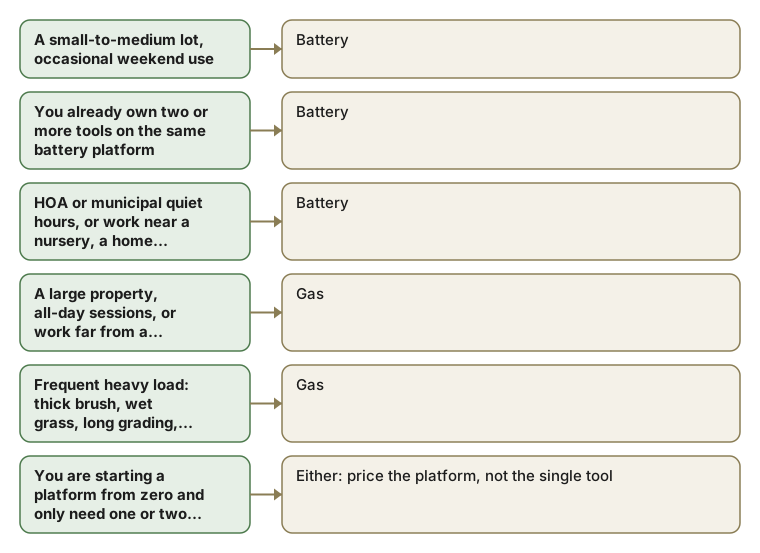
| Your situation | Fits best | Why |
|---|---|---|
| A small-to-medium lot, occasional weekend use | Battery | Runtime comfortably covers the job; no fuel storage or mixing between uses. |
| You already own two or more tools on the same battery platform | Battery | Every additional tool shares packs you already own: the platform, not the tool, is the purchase. See the platform note on Compare. |
| HOA or municipal quiet hours, or work near a nursery, a home office, or neighbors close by | Battery | Substantially quieter in operation, with no idling noise between tasks. |
| A large property, all-day sessions, or work far from a charging point | Gas | A fuel can travels; a charger and spare packs add real weight and cost for sustained use. |
| Frequent heavy load: thick brush, wet grass, long grading, sustained hard cuts | Gas | Power stays consistent under sustained load; a battery pack draws down faster the harder it works. |
| You are starting a platform from zero and only need one or two tools | Either: price the platform, not the single tool | A battery platform is a longer commitment than one gas tool; compare the cost of the tools you will realistically add, not just the first one. |
The property-size line, roughly
There is no hard acreage cutoff, because load and session length matter more than raw lot size, but the practical pattern most owners land on is this: under about a quarter acre with moderate obstacles, battery covers the job on a single charge for nearly every handheld class. Past roughly half an acre to an acre, or with heavy vegetation, sessions start running long enough that either a second pack or a longer charge cycle becomes a real interruption: the point where gas's minute-long refuel starts to matter more than the noise and fuel-storage trade-offs it carries.
California equipment standards and local use rules
CARB’s small off-road engine fact sheet sets zero-emission standards for most newly manufactured small engines from model year 2024. It also says the rules do not prohibit possession, use or repair of existing CARB-compliant equipment, and certified inventory may still be sold.
A city’s blower-use restriction or quiet hours is a separate check. Verify the rules where the work will happen before buying gas equipment.
Gas vs. battery, for your yard specifically: questions
How big does my yard need to be before gas makes more sense than battery?
There is no hard acreage cutoff: session length and load matter more than raw lot size. Under about a quarter acre with moderate obstacles, battery covers nearly every handheld class on a single charge. Past roughly half an acre to an acre, or with heavy vegetation, sessions start running long enough that gas’s minute-long refuel starts to matter more than the noise and fuel-storage trade-offs it carries.
I already own some battery tools: does that change the gas-vs-battery decision?
Existing compatible batteries and a charger can change the purchase cost: compare an approved bare tool with a complete new gas-tool package. Confirm that the exact packs and charger are approved for the new tool, then allow for the charge or spare capacity needed to finish the job. Owning a pack is useful only if that complete working arrangement meets the task.
Are gas leaf blowers banned near me?
Federal small-engine rules and California’s new-engine certification standards are separate requirements. CARB distinguishes new equipment from continued use and repair of existing compliant machines. City blower-use rules and quiet hours also vary; check the rules where you will work.
Is starting a battery platform from zero ever more expensive than just buying gas tools individually?
It can be, for the first one or two tools, since a battery tool's pack and charger cost is bundled into a higher upfront price compared to an equivalent gas tool bought alone: the economics flip in battery's favor as more tools are added to the same platform and share those packs. Price the platform against how many tools you'll realistically add, not the cost of the first tool in isolation.
Does starting a battery platform lock me into one brand for every future tool?
Effectively yes, since battery packs are not standardized across manufacturers: every additional tool on the same voltage platform shares the packs and charger you already own, but a tool from a different brand needs its own separate platform. This is exactly the commitment the guide and the Compare cluster describe as "the platform, not the tool, is the purchase."
Does cold weather change the gas-versus-battery decision for my yard?
It can tilt the practical balance toward gas for winter-specific equipment like snow blowers, since cold reduces a battery pack's usable capacity while a gas engine's output is comparatively less affected: for equipment used primarily in warmer months, this factor matters less to the overall decision.
If quiet hours are only a concern for early morning work, does that alone justify choosing battery?
It's one legitimate factor among several the guide weighs, not an automatic override, if the rest of your situation (a large property, heavy sustained load, all-day sessions) otherwise points toward gas, working around a specific quiet-hours window by scheduling gas equipment outside those hours may be simpler than switching the whole platform to battery for one scheduling restriction.
Does the type of vegetation in my yard (thick brush vs. maintained lawn) affect the gas-vs-battery decision?
Yes: the guide notes that frequent heavy load, such as thick brush, wet grass, or sustained hard cuts, favors gas because power stays consistent under sustained load while a battery pack draws down faster the harder it works. A maintained lawn with routine, lighter-duty trimming and mowing is exactly the scenario where battery's runtime comfortably covers the job.
Do local emissions or noise rules ever apply differently to a rented gas tool than a purchased one?
No: a municipal noise ordinance or a restriction on gas-powered equipment applies to the equipment's use, not its ownership status, so a rented gas leaf blower or trimmer is subject to the same local rules as one you own. Check local ordinances the same way regardless of whether the equipment is rented or purchased.
Does buying a more expensive, higher-voltage battery platform close the gap with gas for heavy sustained work?
Partially: higher-voltage platforms (60V, 80V and up) deliver more sustained power and typically better runtime than lower-voltage ones, narrowing the gap for moderately heavy work. For all-day sessions or the heaviest sustained loads, gas's advantage (a fuel can that travels, versus finite pack capacity regardless of voltage) remains, though the threshold at which gas clearly wins shifts higher with a more capable battery platform.
Compare
Gas vs. battery outdoor power equipment: what trades
Not "which is better": five specific things that trade against each other, class by class.
Gas and battery versions of the same tool class, trimmers, blowers, chainsaws, mowers, are built to different standards for a reason: a gasoline engine and a lithium battery pack fail differently, and the safety specifications that govern each (ANSI/OPEI B175-series for gas handheld tools, UL 62841-1 and UL 62133 for battery equipment) reflect that. Compare the operating mechanisms, not "which is better," because the two trade specific, predictable things against each other, runtime for refuel speed, instant torque for sustained load capacity, no starting procedure for a pack that fades in the cold, and which side of each trade matters depends entirely on how the tool is used, not on a general preference for one power source over the other. The specification comparison lists five factors that trade in opposite directions, class by class, rather than treating gas and battery as a single "better or worse" spectrum.
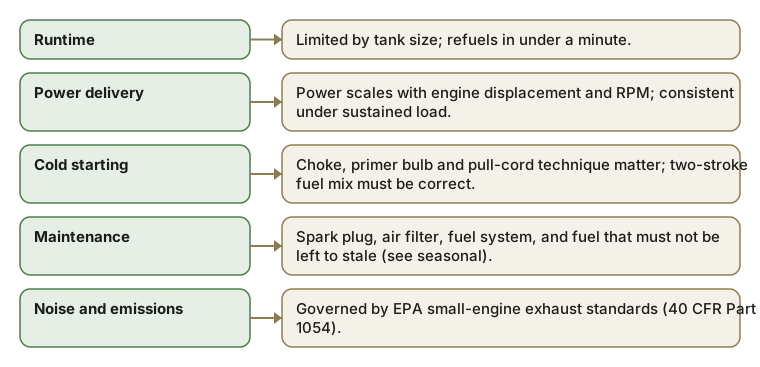
| Factor | Gas | Battery |
|---|---|---|
| Runtime | Limited by tank size; refuels in under a minute. | Limited by pack capacity; a spare pack swaps as fast as a refuel, an empty one does not. |
| Power delivery | Power scales with engine displacement and RPM; consistent under sustained load. | Full torque is available instantly, but sustained heavy load draws the pack down faster. |
| Cold starting | Choke, primer bulb and pull-cord technique matter; two-stroke fuel mix must be correct. | No starting procedure; cold weather still reduces a lithium pack’s usable capacity. |
| Maintenance | Spark plug, air filter, fuel system, and fuel that must not be left to stale (see seasonal). | Little routine maintenance; pack capacity degrades with charge cycles and age instead. |
| Noise and emissions | Governed by EPA small-engine exhaust standards (40 CFR Part 1054). | No tailpipe emissions at the point of use; substantially quieter in operation. |
Where the two are not interchangeable yet
For occasional residential use across most handheld classes, battery equipment now covers the job well. Two situations still favor gas specifically: all-day commercial or professional use where pack-swapping adds up to real downtime, and any job in a location without a charging point for the duration of the work: a chainsaw used deep in the woods for a full day, for instance, where a gas can travels but a charger does not.
Battery packs are not interchangeable across brands
A battery pack built to UL 62133 is safety-tested as a system with its own charger and tool line; packs are not standardized across manufacturers the way, say, chainsaw chain pitch is. Buying into a battery platform is a longer-term commitment than buying one gas tool, because every additional tool on the same platform shares the packs you already own, and every tool on a different platform needs its own.
- Outdoor Power Equipment, Internal Combustion Engine-Powered Hand-Held Chain Saws, Safety and Environmental Requirements: Outdoor Power Equipment Institute / ANSI, ANSI/OPEI B175.1-2012 (with A1-2014).
- Outdoor Power Equipment, Internal Combustion Engine-Powered Handheld and Backpack Blowers and Blower-Vacuums, Safety Requirements and Performance Testing Procedures: Outdoor Power Equipment Institute / ANSI, ANSI/OPEI B175.2-2012.
- Outdoor Power Equipment, Internal Combustion Engine-Powered Hand-Held Grass Trimmers and Brushcutters, Safety and Environmental Requirements: Outdoor Power Equipment Institute / ANSI, ANSI/OPEI B175.3-2013.
- Electric Motor-Operated Hand-Held Tools, Transportable Tools and Lawn and Garden Machinery, Safety, Part 1: General Requirements: UL Standards & Engagement / IEC / CSA, UL 62841-1 (harmonized with IEC 62841-1).
- Secondary Cells and Batteries Containing Alkaline or Other Non-Acid Electrolytes: Safety Requirements for Portable Sealed Secondary Cells : UL Standards & Engagement / IEC, UL 62133-2 (harmonized with IEC 62133-2, lithium systems).
- Control of Emissions from New, Small Nonroad Spark-Ignition Engines and Equipment: U.S. Government Publishing Office (eCFR), 40 CFR Part 1054.
Gas vs. battery outdoor power equipment: questions
Which is cheaper over time, gas or battery?
It depends on how many tools you run on one platform. A single battery tool usually costs more upfront than an equivalent gas tool for the same reason a spare battery pack costs real money; but every additional tool added to an existing platform shares packs and a charger you already own, which changes the comparison substantially. Gas carries an ongoing fuel and stabilizer cost and, on most classes, more routine maintenance: see the seasonal cluster for what that maintenance involves.
Do battery tools have enough power for real yard work now?
For most residential handheld classes, yes: battery equipment has closed most of the practical gap for occasional-to-regular residential use. It has not closed the gap for two specific situations: all-day commercial or professional use, where pack-swapping adds real downtime, and any job with no access to a charging point for the duration of the work.
Can I mix gas and battery tools in the same yard?
Yes: there is no reason to standardize on one power source across every tool class. A common, defensible pattern is battery for the handheld tools used briefly and often (trimmer, blower) and gas for whichever single tool does the heaviest, most sustained work on that specific property, such as a mower on a large lot.
What safety standards govern gas versus battery outdoor power equipment?
The ANSI/OPEI B175-series standards govern gas handheld tools, while UL 62841-1 and UL 62133 govern battery-powered equipment and the battery cells themselves. Both reflect that a gasoline engine and a lithium battery pack fail in different ways, which is why the two technologies aren't certified against the same standard even for the same tool class.
Why does cold weather affect a battery tool even though it has no starting procedure?
Because cold temperature physically reduces a lithium battery pack's usable capacity, independent of any starting sequence: there's no choke or primer bulb to manage, but a pack that delivers a full afternoon's runtime in summer may fall well short of that in freezing conditions. Gas equipment has the opposite cold-weather problem: starting technique and correct fuel matter, but once running, output doesn't meaningfully change with temperature.
Does battery equipment produce any emissions at all?
Not at the point of use: there's no tailpipe emissions from a battery tool while it's running, unlike gas equipment, which is governed by EPA small-engine exhaust standards (40 CFR Part 1054). Battery equipment is also substantially quieter in operation, which matters for noise-restricted neighborhoods and time-of-day mowing rules.
Why can't I use a battery pack from one brand's tool in another brand's tool?
A battery pack built to UL 62133 is safety-tested as a complete system together with its specific charger and tool line, and packs are not standardized across manufacturers the way, for example, chainsaw chain pitch is. This makes committing to a battery platform a longer-term decision than buying a single gas tool, since every additional tool on the same platform shares packs you already own.
Does a gas tool's power output stay consistent as its fuel tank empties?
Yes: unlike a battery pack, which delivers reduced output as it depletes, a gas engine's power scales with displacement and RPM and stays consistent under sustained load regardless of how much fuel remains in the tank, right up until the tank runs dry.
Is a spare battery pack a real substitute for a full tank of gas on a long job?
For most residential jobs, yes: swapping a charged spare pack takes about as long as refueling. It stops being an adequate substitute for all-day commercial or professional use, where the cumulative pack-swapping and recharging time adds up to real downtime that a gas tool's minute-long refuel does not.
Does a two-stroke gas engine need different maintenance than a four-stroke one, for this comparison?
Yes: a two-stroke handheld tool needs correctly mixed fuel (oil blended into the gasoline at a specific ratio) in addition to the spark plug, air filter and fuel-system upkeep every gas engine needs, while a four-stroke keeps oil in a separate sump changed on its own schedule. Either way, gas equipment's maintenance list is longer than a battery tool's, which needs essentially none beyond charging and eventual pack replacement.
For which specific tool classes has battery power most fully replaced gas as the practical default?
Handheld classes used briefly and often, trimmers and blowers most clearly, where runtime demands are modest and pack-swapping is rarely disruptive. Sustained, heavy-duty classes like a mower on a large lot, or any all-day professional use, are where gas retains a clearer practical advantage today.
Does a battery pack lose capacity permanently over time, the way it does temporarily in cold weather?
Yes, and this is a separate mechanism from cold-weather reduction: a lithium battery pack's maximum capacity degrades gradually with charge cycles and age regardless of temperature, which is the main long-term maintenance cost battery equipment carries in place of the spark plug, air filter and fuel-system upkeep a gas engine needs.