Identify a replacement belt by part number, profile and duty
Start with the equipment’s exact replacement belt number and routing diagram. Confirm profile, length convention and construction before substituting a dimensional belt. A worn belt’s measured circumference is supporting evidence, not proof of the original specification, and matching length alone does not establish deck or clutch compatibility.
Read the catalog’s length convention
The Gates power-transmission catalog lists 4L380 at 38.00 inches under its stated length column. That does not make every belt with “38” in its code the same size. Classical, fractional-horsepower and ribbed belt designations use different conventions.
If one catalog specifies 38 inches outside and another specifies 38 inches effective length, subtracting the two labels gives zero but proves no dimensional equality. Read the section diagram and conversion for those exact products before comparing.
| Item | Confirm |
|---|---|
| OEM number | Exact model, serial and fitted assembly |
| Profile | Width, angle and rib/vee arrangement |
| Length | Inside, outside, pitch or effective basis |
| Construction | Approved clutching and reverse-flex duty |
| Routing | Every pulley, guide and tensioner position |
One family can contain different belts
The 2013 Troy-Bilt Storm parts book lists standard auger belt 954-04050 and four-way large-block alternative 954-04195. Both occur in one booklet; that is not an interchange statement.
In a Toro Recycler owner report, drive engagement persisted after replacing the transmission. The owner then reported success with a differently sized OEM belt despite the prior replacement’s fit claim. This is a documented case, not evidence that every drive fault is a belt fault.
Find the reason for damage
Inspect authorized access areas for damaged pulleys, guides, contamination and incorrect routing with power isolated. Fraying or glazing can guide inspection but does not uniquely identify one failure.
Do not clean a belt with an unspecified solvent, pry a spring-loaded tensioner by hand or measure around exposed rotating pulleys. Follow the actual removal and adjustment procedure and retain all guards before testing.
PT-04 · Parts
Belts: how a v-belt is sized
The instinctive way to size a replacement belt, lay the old one flat and run a tape round it, produces the wrong answer twice over. A failed belt has stretched, so it is longer than the one you need, and belt lengths are quoted by convention rather than by the measurement you just took. The fractional-horsepower series (3L, 4L, 5L) is quoted by outside length in inches, while the classical series (A, B, C) is quoted by an effective length that is not the outside measurement, which is why an A36 and a 4L380 can be the same belt under two numbers.
The reliable route is the number molded into the belt’s flat face, which survives filth and needs only a rag and some solvent to read.
Why measuring the old belt with a tape gives the wrong answer
A belt that has failed has usually stretched, and a belt that has been running on a deck for three seasons has stretched even if it has not failed. Laying it flat and running a tape around the outside therefore measures a belt that is longer than the one you need. And adds a second error, because belt lengths are quoted by convention rather than by the outside circumference.
The reliable route is the number molded into the belt itself, which survives on the flat face of most belts even when they are filthy: clean it with a rag and solvent and read it. Failing that, measure round the pulleys with the tensioner in its normal running position, not round the belt.
Profile
The cross-section letter
A, B, 3L, 4L, 5L and so on. Sets the width and angle of the vee.
Length
Quoted by convention
Outside length for fractional-horsepower belts, effective or pitch length for classical ones.
Type
Standard or specialist
A deck belt is often a specialist part, not a general-purpose v-belt in the same size.
The profile letter, and the two length conventions
A v-belt's cross-section is described by a letter. The fractional-horsepower series, 3L, 4L and 5L, is quoted by outside length in inches: a 4L360 is a 4L-section belt 36 inches around the outside. The classical series, A, B, C, is quoted by an effective or inside length that is not the outside measurement, so an A36 and a 4L380 can be interchangeable belts described by two different numbers.
That single fact is behind most belt confusion at a counter. It is also why the molded number is worth the two minutes of cleaning: it removes the convention problem entirely.
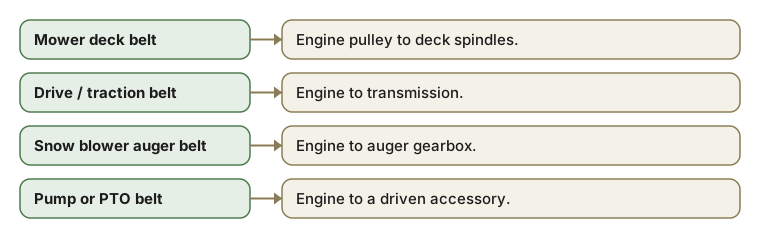
| Belt | Job | What to know |
|---|---|---|
| Mower deck belt | Engine pulley to deck spindles. | Runs over idlers and often around a backside idler, so it flexes both ways. Frequently a specialist belt rather than a general-purpose v-belt. |
| Drive / traction belt | Engine to transmission. | Engaged by a tensioner rather than a clutch on most machines, so it slips every time you set off. It wears faster than the deck belt. |
| Snow blower auger belt | Engine to auger gearbox. | Engaged and disengaged constantly. Glazing and a burned smell usually mean the tensioner or the brake is not fully releasing. |
| Pump or PTO belt | Engine to a driven accessory. | Length depends on the exact pulley arrangement; a substitution one size out will not tension. |
Why a general-purpose belt often fails on a deck
A mower deck belt routinely runs around backside idlers, which flexes it in the opposite direction to normal, and it changes direction several times in one loop. Belts built for that duty use different cord and cover construction from a plain v-belt of the same nominal size. A hardware-store belt in the right dimensions will often fit and run, and then fail early, which is where the impression that "belts do not last" comes from.
Before fitting any belt, look at why the old one failed. A belt that is glazed and hard was slipping; a belt frayed on one edge was misaligned or riding a damaged idler; a belt cut cleanly hit something. Fitting a new belt without finding the cause means fitting another one shortly afterwards.
Routing is the part people photograph too late
Deck belt routing on a ride-on is not obvious, and it is frequently the difference between a thirty-minute job and an afternoon. Most decks have a routing diagram printed on the deck itself or under the seat; if yours does not, photograph the belt in place, from two angles, before anything comes off. Note which side of each idler the belt passes and which idlers contact the flat back of the belt rather than the vee.
Spring-loaded tensioners store enough energy to injure a hand. Release them with the correct tool or a length of bar rather than by hand, and keep fingers out of the closing side.
Belts: questions
Why does measuring my old belt with a tape give the wrong length?
Two reasons. A failed or worn belt has stretched, so it is longer than the one you need, and belt lengths are quoted by convention rather than by the outside measurement you just took. The reliable route is the number molded into the belt’s flat face, which survives filth, clean it with a rag and solvent and read it, or measure around the pulleys with the tensioner in its normal running position.
What do the belt profile letter and length numbers mean?
The profile letter gives the cross-section. The fractional-horsepower series (3L, 4L, 5L) is quoted by outside length in inches, while the classical series (A, B, C) is quoted by an effective length that is not the outside measurement. That is why an A36 and a 4L380 can be the same belt described two ways, and it is behind most of the confusion that happens at a parts counter.
Why did my new mower deck belt fail so quickly?
Probably a general-purpose belt in the right size doing a job it was not built for. A deck belt runs around backside idlers, which flex it the opposite way to normal, and it changes direction several times per loop, so it needs different cord and cover construction than a plain v-belt. A hardware-store belt in the right dimensions fits, runs and fails early, and always find why the old one failed before fitting a new one.
How do I get the deck belt routing right on a riding mower?
Photograph the belt in place from two angles before anything comes off, and note which side of each idler it passes and which idlers touch the flat back rather than the vee. Most decks also carry a routing diagram on the deck or under the seat. Release spring-loaded tensioners with a bar or the correct tool rather than by hand, since they store enough energy to injure a hand.
Do you have belt size charts for Snapper, Ariens, Troy-Bilt, Briggs & Stratton or Ryobi machines specifically?
Whatever brand is on the machine, the belt’s own profile letter and length number, molded into its flat face, or a direct pulley-center measurement with the tensioner in its running position, is the reliable route: see the two questions above for how to read each.
What is the difference between the fractional-horsepower belt series and the classical series?
The fractional-horsepower series (3L, 4L, 5L) is quoted by outside length in inches, a measurement you could take directly off the belt with a tape if it weren't stretched. The classical series (A, B, C) is quoted by an effective length, a conventional figure that is not the same as the outside measurement, which is exactly why an A36 and a 4L380 can be the same physical belt described by two entirely different numbering conventions.
Why does a belt need to be measured with the tensioner in its normal running position?
Because a spring-loaded tensioner changes the effective distance between pulleys depending on its position, and measuring with it retracted or extended from its normal running position gives a length that doesn't match what the belt needs to span once installed and tensioned correctly.
What happens if I install a belt that is slightly too long for my mower deck?
A too-long belt won't achieve proper tension even with the tensioner at its full travel, leading to slipping, premature wear, and reduced power transfer to the blades: it can also be more prone to jumping off a pulley during operation, since insufficient tension makes it easier to dislodge from its groove.
Can a v-belt be repaired instead of replaced if it's just glazed or slightly worn?
Glazing (a shiny, hardened surface from slipping) is generally not repairable and indicates the belt should be replaced. It changes the belt's grip on the pulley in a way that worsens the slipping that likely caused the glazing in the first place, rather than a wear pattern that stops once corrected.
How do I know if a belt problem is caused by the belt itself or by a misaligned pulley?
Inspect the wear pattern on the removed belt, even wear across the belt's width suggests a straightforward age or tension issue, while wear concentrated on one edge, or a belt that keeps walking toward one side of a pulley, points toward pulley misalignment as the actual root cause, which will damage a correctly sized replacement belt the same way if left unaddressed.
Does a belt's profile letter tell me anything about which machines it fits?
Not directly: the profile letter (3L, 4L, 5L, A, B, C) describes the belt's cross-sectional shape and size, which must match the pulley grooves it runs in, but it says nothing on its own about which brand or model of machine uses that profile. Matching profile and length to your specific pulleys and running clearance is what determines fitment, not the letter by itself.
Can I substitute a cogged (notched) belt for a plain v-belt if the profile and length match?
Generally yes for the same profile and length, since the cogs improve flexibility around small-diameter pulleys without changing the belt's outer engagement dimensions, but check the original equipment's specification first, since some deck designs rely on a plain belt's specific construction for backside-idler flexing in a way a cogged belt's notches could affect differently.