Find equipment and engine IDs before ordering parts
Record the equipment model and serial plus the engine’s separate identity before ordering parts. The equipment number selects deck and chassis parts; the engine number selects engine parts.
A pressure-washer pump may need a third lookup. Photograph and transcribe each full label, including type, specification, suffixes and leading zeroes.
Look for a stamped engine number as well as a sticker
Briggs & Stratton’s identification guide describes model, type and code stamped into the engine, including the OHV rocker cover on many horizontal-shaft engines. Other locations vary by engine design. Do not remove a hot muffler or safety guard simply to search for a number.
| Identifier | Use |
|---|---|
| Equipment model and serial | Frame, controls, deck and manufacturer campaigns |
| Engine model, type/spec and code | Engine manual, parts and build distinctions |
| Pump or transmission identity | Component-specific service and replacements |
| Emission family | Emissions-related identification, not a complete parts order |
A production code is different from a model
The Briggs numbering guide decodes example 01061201 as June 12, 2001, with the final digits identifying the assembly line. It is a manufacturer-specific example, not a decoder for Honda, Kohler or every equipment serial.
Husqvarna’s support FAQ gives an 11-digit handheld example with a four-digit year and two-digit production week. Its format differs from the Briggs date code. Copy a complete number before attempting to interpret it.
When a label is unreadable
Check stamped numbers, purchase paperwork and old photographs. Give a parts specialist clear views of the machine, engine and any remaining identifiers. A casting number may narrow a component family but is not proof of a complete engine specification.
Measure a removed part only as supporting evidence. Blade dimensions do not establish safe material or fit, and a plug that threads in may have the wrong reach or heat range. Do not order a safety-critical substitute solely from appearance.
For a used mower with a replacement engine, keep both the mower’s serial and the replacement engine’s number. The original equipment parts book may describe an engine that is no longer fitted. Use the recall guide with the actual model and serial.
Where the model and serial numbers are
Almost every parts-ordering failure starts here. A machine carries at least two identification plates and usually three, they are fitted in different places, and they answer different questions: the equipment plate covers the deck, belts, blades and frame, while the engine plate covers the plug, filters, carburetor and oil. Order a carburetor against a mower’s model number and you will get the wrong one.
The rule that requires it says it must stay readable for the engine’s entire life.
Where each plate is fitted
There is no single convention, but there are strong habits by class, and they follow from where a label can survive weather, vibration and grass. The engine plate is normally on a flat, sheltered face of the engine shroud or the blower housing; the equipment plate is normally on a structural part that does not get replaced.
| Machine | Equipment plate | Engine plate |
|---|---|---|
| Walk-behind mower | Under the rear flap, on the deck, or on the deck rim near the handle mounts. | On the blower housing or the shroud above the recoil starter. |
| Riding mower | Under the seat, on the frame beneath the seat pan, or on the frame rail. | On the engine shroud, visible with the bonnet or engine cover lifted. |
| Snow blower | On the rear of the auger housing, or on the frame behind the engine. | On the shroud, often facing the operator. |
| Chainsaw / trimmer / blower | One plate only: engine and machine are one product. | Molded or printed on the housing near the handle or under the starter cover. |
| Pressure washer | On the frame or the rear panel; the pump usually has its own separate plate. | On the engine shroud. |
| Generator | On the control panel or the frame; this plate carries the wattage ratings. | On the engine shroud, behind or beside the panel. |
| Log splitter / tiller / chipper | On the beam, the frame or the tine housing. | On the engine shroud. |
When the plate has worn away
Adhesive labels on a machine that lives outdoors do not last, and a plate that has been pressure-washed a few times is often blank. Work down this list:
-
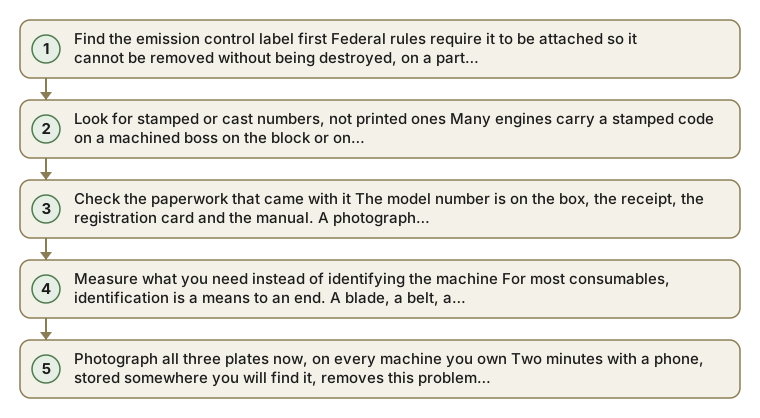
Find the emission control label first
Federal rules require it to be attached so it cannot be removed without being destroyed, on a part not normally replaced, and to stay readable for the engine’s entire life. It very often survives when the others have gone, and it carries displacement, emission family and model year. See reading the emission control label.
-
Look for stamped or cast numbers, not printed ones
Many engines carry a stamped code on a machined boss on the block or on the cylinder shroud flange. Cast numbers on the block itself identify the casting, which narrows the family even when nothing else is legible.
-
Check the paperwork that came with it
The model number is on the box, the receipt, the registration card and the manual. A photograph of the manual’s cover is often the whole answer.
-
Measure what you need instead of identifying the machine
For most consumables, identification is a means to an end. A blade, a belt, a chain and a plug can all be specified by measurement. That is what the parts pages are for, and it is more reliable than a guess at a model number.
-
Photograph all three plates now, on every machine you own
Two minutes with a phone, stored somewhere you will find it, removes this problem permanently. Do it before the next season, not during the repair.
What to record, and in what form
A useful record is a photograph plus a typed transcription, because photographs of curved, greasy plates are frequently unreadable later and because a typed string can be searched. Transcribe exactly what is printed, including spaces and hyphens: engine model numbers are frequently split into model, type and code or trim fields, and the second field is the one that distinguishes two engines that share a model number and take different carburetors.
Serial numbers are how recalls are scoped. A recall notice will name a model and a range of serials, and without the serial you cannot tell whether your machine is inside it. That alone is a reason to have the numbers written down: see checking a recall.
The retailer variant problem
The same machine is frequently sold under several model numbers, because large retailers specify their own variants of a manufacturer's design, a different deck material, a different engine, a different color, and each variant gets its own number. Two machines that look identical on a shop floor can take different belts.
This is why "it looks like mine" is not identification, and it is the reason to order against the number on the plate rather than against a photograph. It also cuts the other way, usefully: when a part is unobtainable under one variant's number, the underlying component is often standard, and a measurement will find it.
Where the model and serial numbers are: questions
Where is the engine number on a lawn mower?
On the blower housing or the engine shroud above the recoil starter, on a flat sheltered face where a label survives weather and grass. The equipment plate is separate, usually under the rear flap or on the deck rim near the handle mounts, and it is the engine plate, not that one, that specifies the spark plug, the carburetor and the filters you will order.
How do I identify a machine when the sticker has worn off?
Work down a list. Find the federal emission label first, since it is built to last and carries displacement, family and year; look for stamped or cast numbers on the block; check the box, receipt, registration card or manual; and where you only need a consumable, measure the part instead of identifying the machine, because a blade, belt, chain or plug can each be specified by measurement.
Why did the part not fit even though I used my model number?
Almost always because the wrong plate was used. Ordering a carburetor, plug or filter against the equipment model number instead of the engine’s own model, type and code gets a part for a different engine. Retailer variants make it worse: the same-looking machine is sold under several numbers with different belts, so "it looks like mine" is not identification and a plate reading is.
What should I record from each machine, and in what form?
Photograph all three plates and also type out exactly what is printed, including spaces and hyphens, because photos of curved greasy plates are often unreadable later and a typed string can be searched. Record the model, type and code separately, the second field distinguishes two engines that share a model number and take different carburetors, and keep the serial, since recalls are scoped by it.
Where is the identification plate on a generator?
The equipment plate is on the control panel or the frame, and it is the plate that carries the wattage ratings, running and starting watts, in addition to the model and serial number. The engine plate is separate, on the engine shroud behind or beside the control panel, and is what specifies the plug, filters and carburetor.
Where is the identification plate on a chainsaw or trimmer?
One plate only, since the engine and machine are a single product on handheld equipment: molded or printed on the housing near the handle or under the starter cover. There is no separate equipment plate to distinguish from the engine plate on this class of machine.
What is a "retailer variant" and why does it complicate finding the right part?
A retailer variant is a version of a manufacturer's base design specified by a large retailer for its own store, a different deck material, engine, or color, that gets its own separate model number even though it looks identical to other variants on a showroom floor. Two visually identical machines under different retailer variant numbers can take different belts, which is why ordering against the actual plate rather than a photograph matters.
Does the model number on the box or receipt always match the plate on the machine itself?
It should, but paperwork and plates can occasionally diverge due to a mid-production running change or a clerical error at the point of sale: the plate physically on the machine is the more authoritative source when the two disagree, since it describes the actual unit you have rather than what was ordered or invoiced.
Why does a stamped or cast number on the engine block matter if the label has worn off?
Because stamped and cast markings are physically part of the metal casting rather than an adhesive or printed sticker, so they survive weathering, pressure washing and years of outdoor use that erase adhesive labels. A cast number identifies at minimum the casting family, which narrows down the engine even when no other identification survives.
Should I record identification numbers even for a brand-new machine I just bought?
Yes: the two minutes it takes right after purchase, while every plate is pristine and legible, is far cheaper than trying to recover the same information years later from a worn, pressure-washed machine. This is exactly the habit the guide recommends building before the next season, not during a repair when the information is needed.
Does a snow blower's identification plate location differ from a mower's?
Yes: a snow blower's equipment plate is typically on the rear of the auger housing or on the frame behind the engine, while a mower's is usually under the rear flap, on the deck, or on the deck rim near the handle mounts. Each class of machine has its own typical locations driven by where a label can survive that machine's specific exposure to weather and debris.
Can an engine’s emission-control label be missing or damaged?
It shouldn't be, since federal rule requires every covered small nonroad spark-ignition engine to carry one. A missing label on an otherwise normal machine is unusual enough to be worth double-checking every likely surface (shroud, blower housing, cylinder area) before concluding it was never applied, since it is specifically designed to be hard to remove without destroying it.