Check an equipment recall by model, serial and repair status
Check the exact model, serial or date code and documented repair status against the official recall notice. A matching model name alone is not enough, and an empty search result does not prove a machine is clear. Follow the campaign’s stop-use and remedy directions before operating, buying or selling affected equipment.
Search notices, then verify the unit
Use a broad product or brand term here, or open the CPSC database. Results search recall titles; a serial may appear only in the full notice or manufacturer lookup. If the search is unavailable, use the official site directly.
A real model can have a noncontinuous serial list
The 2025 Ariens snowthrower notice directs owners to the manufacturer’s unit list. In the published Ariens lookup, model 921069 serial 1654 appears under stop-use units, while serial 1684 appears under repaired units. Those statuses were checked October 18, 2026 and can change after repairs.
| Record | Purpose |
|---|---|
| Equipment model and serial | Identify the actual unit |
| Engine or component ID if named | Match component-specific campaigns |
| Full notice and campaign number | Separate similar or reannounced campaigns |
| Repair documentation | Confirm this remedy was completed on this unit |
The difference between those two serials is 30, but treating all intermediate numbers as one unrepaired range would misstate the manufacturer’s list. Use the exact current lookup and ask the manufacturer to resolve missing or conflicting records.
Used equipment needs the same check
CPSC’s buying-and-selling guidance addresses recalled products and the specified remedy. A prior owner’s assurance or an old receipt is not proof that a later campaign was completed. Check relevant earlier and reannounced notices separately.
Contact the campaign’s listed manufacturer if a remedy is difficult to obtain. Do not invent an expiry date or assume a kit fitted for one notice satisfies a different hazard. For an unsafe event outside a known recall, preserve the facts and report it through the manufacturer and appropriate regulator.
Checking a recall
A recall names a manufacturer, a product, one or more model numbers and almost always a range of serial or date codes, because a fault normally originates in a production window rather than in every unit ever built. That scoping is why the serial number matters: a model number appearing in a notice does not by itself tell you whether your machine is affected. In the United States the Consumer Product Safety Commission publishes announced recalls in a searchable database, remedies are free to the consumer and generally carry no deadline, and a machine that has sat unused for years is still eligible.
The gap in the system is second-hand equipment, which carries no registration path and therefore never gets contacted.
How a recall is scoped
A recall names a product, a manufacturer, one or more model numbers and, nearly always, a range of serial or date codes. The notice names that production range because a fault usually originates in a production window rather than in every unit ever built, so the notice identifies the window. Without your machine's serial number you cannot tell whether it falls inside one.
Model
Which product
From the equipment plate, not the engine plate.
Serial
Which units
The range that decides whether yours is affected.
Remedy
What happens next
Usually a free repair, replacement part or refund. There is normally no time limit.
Getting those numbers written down is the practical half of this, and it is covered on Locate model plates and engine IDs. Do it for every machine you own, once, and this becomes a five-minute check rather than a project.
Where to look
In the United States, the Consumer Product Safety Commission publishes announced recalls and corrective actions in a searchable database at cpsc.gov/Recalls. Search by product type as well as by brand: recalls are frequently issued by the company that made the component or the finished machine, which is not always the brand on the shroud.
Search CPSC recall titles right here
Live, not cached: every search below queries the CPSC's public database directly from your browser, the same one cpsc.gov/Recalls itself uses. Nothing you type is sent to us. Search a product type ("generator," "chainsaw," "riding mower") rather than a full model number for the best chance of a match.
-
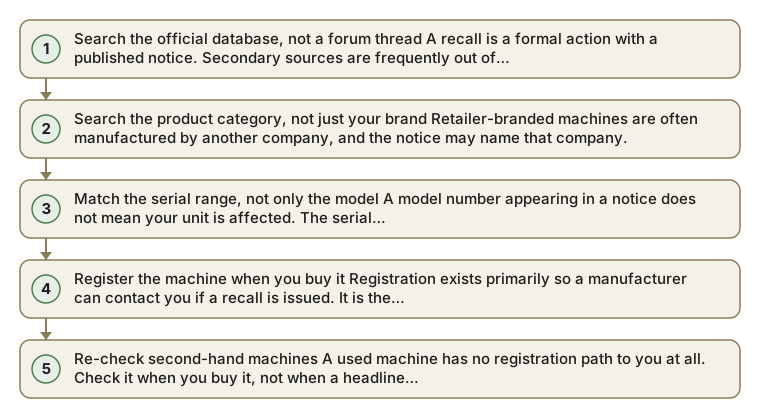
Search the official database, not a forum thread
A recall is a formal action with a published notice. Secondary sources are frequently out of date or describe a different scope.
-
Search the product category, not just your brand
Retailer-branded machines are often manufactured by another company, and the notice may name that company.
-
Match the serial range, not only the model
A model number appearing in a notice does not mean your unit is affected. The serial range is the scope.
-
Register the machine when you buy it
Registration exists primarily so a manufacturer can contact you if a recall is issued. It is the only mechanism that reaches you without you looking.
-
Re-check second-hand machines
A used machine has no registration path to you at all. Check it when you buy it, not when a headline appears.
Second-hand equipment is where recalls slip through, and it is a large share of this market. A machine bought privately carries no registration, no paperwork and often no memory of whether a remedy was ever applied. Five minutes with the model and serial number at the point of purchase closes that gap permanently.
What a remedy usually looks like
| Remedy | What it means in practice |
|---|---|
| Free repair | A part is replaced or modified, usually at an authorized service center or with a kit sent to you. |
| Replacement part | A component is shipped to you with instructions. Common where the fix is a fuel line, a guard or a switch. |
| Full replacement or refund | Used where the fault cannot be corrected in the field. |
| Stop-use notice | The instruction is to stop using the product immediately and contact the manufacturer. Take this literally. |
Remedies are free to the consumer and normally have no deadline. A machine that has been sitting unused for years is still eligible, and so is one bought second-hand.
Reporting a problem that is not yet a recall
Recalls begin with reports. If a machine has behaved dangerously in a way that looks like a design or manufacturing fault rather than wear or misuse, that is worth reporting to CPSC as well as to the manufacturer, and the report becomes part of the record that identifies a pattern across many units. This is also the reason to keep a note of what happened while it is fresh: a specific description of the failure is worth far more than a general one.
Checking a recall: questions
How do I check if my power equipment is under recall?
Search the official Consumer Product Safety Commission database at cpsc.gov/Recalls by product category as well as by brand, because recalls are often issued by the company that made the component or the finished machine rather than the brand on the shroud. Match your machine’s serial number against the recalled range, not just the model number, since the serial range is what defines whether your unit is affected.
Why do I need the serial number to check a recall?
Because a fault usually originates in a production window rather than in every unit ever built, so a recall names a model and a range of serial or date codes, and a model number appearing in a notice does not by itself mean your machine is affected. Without the serial you cannot tell whether yours falls inside the range, which is why writing the numbers down for every machine turns this into a five-minute check.
Do recalls cost me anything or expire?
No, on both counts, in the normal case. Remedies are free to the consumer, usually a free repair, a replacement part, or a full replacement or refund where the fault cannot be fixed in the field, and they generally carry no deadline. A machine that has sat unused for years is still eligible, and so is one bought second-hand; a stop-use notice, however, should be taken literally and acted on immediately.
Why are second-hand machines the ones that slip through recalls?
Because a used machine bought privately carries no registration path to the buyer, so the manufacturer has no way to reach them if a recall is issued, and it often comes with no paperwork and no memory of whether a remedy was ever applied. Registration exists mainly so a maker can contact you about a recall, so check any second-hand machine’s model and serial at the point of purchase, not when a headline appears.
Why should I search a recall database by product category as well as by the brand printed on my machine?
Because retailer-branded machines are frequently manufactured by a different company than the name on the shroud, and a recall notice may name that manufacturing company rather than the retail brand. Searching only by the visible brand name can miss a notice filed under the actual manufacturer's name.
What are the four common types of recall remedy?
A free repair (a part replaced or modified, often at an authorized service center), a replacement part shipped to you with instructions, a full replacement or refund where the fault can't be corrected in the field, and a stop-use notice instructing immediate cessation of use: the last of which should be followed literally rather than treated as a suggestion.
Should I report a dangerous equipment failure even if it hasn't officially been recalled yet?
Yes: recalls begin with reports, and a specific, detailed description of a failure that looks like a design or manufacturing fault (rather than ordinary wear or misuse) becomes part of the record CPSC uses to identify a pattern across many units. Reporting to both CPSC and the manufacturer while the details are fresh is more useful than a vague, delayed report.
Is there a time limit on when I can use a recall remedy after a notice is issued?
Generally no: remedies are free to the consumer and normally carry no deadline, so a machine that has sat unused for years since a recall was issued is typically still eligible for the free repair, replacement part, or refund named in the original notice.
Does registering a new machine at purchase make a difference if I never experience a problem?
If no fault ever surfaces on that model, registration makes no practical difference, but its entire purpose is to give the manufacturer a way to reach you specifically if a recall is later issued, which is the one scenario where an unregistered owner has no path to being notified at all.
Can a recall be issued for a component, like an engine, rather than for the whole machine?
Yes: since a recall is often issued by the company that made a specific component (commonly the engine) rather than by the brand of the finished machine, a component-level recall can affect equipment sold under many different equipment brands that all happened to use the same engine or part from the same production window.
Where can I find the equipment and serial number plates my recall check depends on?
The usual locations by machine class are covered on the finding-model-and-serial-numbers page. Generally the equipment plate is on a structural, non-replaced part, while the engine plate is on the engine shroud. Recording both, for every machine you own, is what turns a recall check into a five-minute lookup rather than a search through old paperwork.
Does a recall notice ever apply to a machine bought outside the United States?
Consumer Product Safety Commission's database specifically, which tracks recalls for products sold in the U.S. market: equipment bought or used in a different country falls under that country's own regulatory body and recall process, which the guide does not cover.
Why does the search sometimes return nothing for a machine I know was recalled?
The search matches recall titles, and a title usually names the manufacturer and the product category rather than a specific model number, so a very narrow search ("XYZ model 4400 recall") often returns nothing where a broader one ("generator" or the brand name alone) finds it. Titles also only go back as far as CPSC’s own database, and a very old recall may be indexed differently or not searchable by the same terms it was announced with.