Generator carbon monoxide: outdoor placement and emergency action
Run portable generators outdoors only, at least 20 feet from homes and buildings, with exhaust directed away from doors, windows and vents. Never use one in a garage or other enclosed space, even with doors open. If CO poisoning is suspected, get to fresh air and call 911; do not return inside to investigate.
Plan around every building, not only your own
CPSC’s 2026 storm guidance gives the 20-foot separation and exhaust-direction instructions. A CO shutoff does not make an indoor or close-to-window location safe. Use battery-operated or battery-backed CO alarms as directed, including outside sleeping areas.
For an example placement25 feet from your house but12 feet from a neighbor’s building, the neighbor-side distance fails the stated20-foot guidance by eight feet. Measuring from only the building you intend to power misses that exposure.
| Check | Required decision |
|---|---|
| Enclosure | Outdoors; an open garage door does not qualify |
| Buildings | Check your own and neighboring structures |
| Exhaust path | Keep it away from doors, windows and vents |
| Weather | Use only the generator’s approved protection arrangement |
| Indoor alarms | Working battery-powered or battery-backed protection |
Know the symptoms without waiting for a pattern
CDC lists headache, dizziness, weakness, upset stomach, vomiting, chest pain and confusion among common symptoms. CO is odorless and colorless; smell cannot establish safety. Do not wait until several people feel ill or symptoms become severe.
NIOSH’s emergency guidance says to get to fresh air, seek medical help immediately and call emergency services. Do not go back into a hazardous area to switch equipment off or attempt an unprotected rescue.
Keep the operating plan within the manual
Plan cord routing and safe weather protection before an outage. Do not move a generator closer to shorten a cord or drape a tarp over a running unit. Stop and allow it to cool before refueling under its instructions.
A fixed standby system has its own approved installation and clearances; a portable-generator diagram does not design that installation. The standby planning guide lists the information to obtain from an installer.
Generators and carbon monoxide
This is the hazard that kills people, and it does so mostly through a single class of decision: putting the machine somewhere sheltered. A garage with the door open is not outdoors. It is a roofed volume with three walls that fills with exhaust faster than the opening clears it, and the gas then moves into the house through the connecting door or the floor above.
The same applies to a covered porch, a carport, a breezeway and a shed. Carbon monoxide is odorless, and because it can impair oxygen delivery before its danger is recognized, the early symptoms include confusion, which degrades exactly the judgement that would otherwise get you out of the building. The control is placement, and a CO shutoff is a backstop rather than a permission.
A portable generator belongs outdoors, well away from doors, windows and vents, with the exhaust directed away from any building. Not in a garage with the door open. Not on a covered porch.
Not in a shed, a breezeway, a carport or a basement, including during a storm, which is exactly when the temptation is strongest.
Why an open garage is not outdoors
Carbon monoxide is colorless and odorless and is produced by any gasoline engine. A garage with the door open is still a partially enclosed volume with a roof and three walls, and the exhaust of a running generator fills it faster than the opening can clear it. The gas then moves into the house through the connecting door, the ceiling of the room above, or any shared cavity.
The other failure that recurs is placement near the building rather than in it: a generator running a few feet from an open window, beneath a soffit vent, or beside a basement window well. Exhaust that reaches an opening reaches the inside.
What the symptoms do to your judgement
Carbon monoxide binds to hemoglobin in preference to oxygen, so the effect is impaired oxygen delivery and other toxic effects; shortness of breath can also occur. The early symptoms are headache, dizziness, nausea, weakness and confusion, and confusion is the one that matters, because it degrades the very judgement that would otherwise get you out. People have been found having tried to fix a machine while being poisoned by it.
If more than one person in a building feels unwell at the same time, or if symptoms improve when you go outside and return when you go back in, treat it as carbon monoxide. Get everyone out into fresh air first and call emergency services from outside. Do not go back in to switch anything off.
What the standards require, and what CPSC has proposed
Two voluntary standards address this directly. ANSI/PGMA G300, published in 2018, and UL 2201, whose second edition was published the same year, both require a system that shuts the generator down when carbon monoxide accumulates around it. They take different approaches: UL 2201 combines a shutoff with reduced engine-out CO emissions, and a 2022 CPSC staff report concluded that combination is more effective than the shutoff requirements of G300 alone.
Because compliance with either standard is voluntary, machines on the market vary. CPSC published a proposed mandatory safety standard for portable generators in the Federal Register in April 2023. When buying, the presence of a CO shutoff, and which standard it is built to, is a specification worth looking for in the same way you look at wattage.
How far from the house, and where
FEMA's Ready.gov puts the placement rule in one line: generators are for use outdoors only, at least 20 feet from windows. The distance and the open air are the control, which is why a cord long enough to reach is cheaper than any other fix.
| Question | Guidance |
|---|---|
| Where may a generator run? | Outdoors only. |
| How far from windows? | At least 20 feet. |
| Is an open garage or covered porch outdoors? | No. Those spaces hold exhaust, so the machine belongs in open air beyond the 20 feet. |
| Question | Answer |
|---|---|
| Does a shutoff make it safe to run indoors? | No. It is a backstop against a mistake, not a permission. The gas is produced either way; the shutoff acts once it has already accumulated. |
| Does it protect a neighboring building? | It senses CO around the generator, not inside your house. Placement remains the control. |
| Should the house have CO alarms as well? | Yes, and battery-backed ones, since the reason a generator is running is that the power is off. |
| Does a standby generator remove the hazard? | It relocates it. A fixed installation has specified clearances from openings for the same reason, and they are part of the installation, not a suggestion. |
Placement, refueling and the practical routine
-
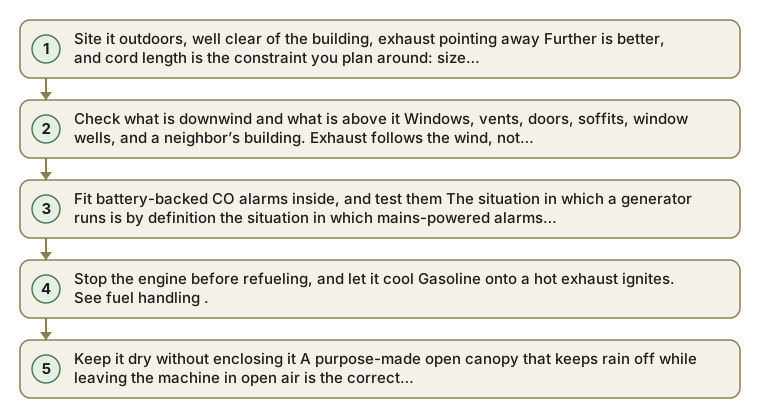
Site it outdoors, well clear of the building, exhaust pointing away
Further is better, and cord length is the limits you plan around: size the cord with the cord calculator rather than moving the generator closer.
-
Check what is downwind and what is above it
Windows, vents, doors, soffits, window wells, and a neighbor’s building. Place the generator so changing wind cannot carry exhaust into occupied spaces.
-
Fit battery-backed CO alarms inside, and test them
The situation in which a generator runs is by definition the situation in which mains-powered alarms are dead.
-
Stop the engine before refueling, and let it cool
Gasoline onto a hot exhaust ignites. See fuel handling.
-
Keep it dry without enclosing it
A purpose-made open canopy that keeps rain off while leaving the machine in open air is the correct answer. A tarpaulin over a running generator is not.
- Safety and Performance of Portable Generators: Portable Generator Manufacturers Association / ANSI, ANSI/PGMA G300-2018.
- Standard for Safety for Carbon Monoxide (CO) Emission Rate of Portable Generators : UL Standards & Engagement / ANSI, UL 2201, second edition (2018).
- Safety Standard for Portable Generators (notice of proposed rulemaking): U.S. Consumer Product Safety Commission / Federal Register, 88 FR, published April 20, 2023.
- Power outages: what to do before, during and after: U.S. Department of Homeland Security (FEMA), Ready.gov.
Generators and carbon monoxide: questions
Why can I not run a generator in the garage with the door open?
Because an open garage is still a roofed volume with three walls that fills with exhaust faster than the opening can clear it, and the carbon monoxide then moves into the house through the connecting door or the floor above. The same applies to a covered porch, a carport, a breezeway or a shed. A generator belongs outdoors, well clear of the building, with the exhaust pointed away from it.
Does a CO shutoff make a generator safe to run indoors?
No. A carbon-monoxide shutoff does not permit indoor or enclosed operation. The gas is produced either way, and the shutoff only acts once it has already accumulated around the machine.
It also senses carbon monoxide around the generator, not inside your house, so placement stays the control. Fit battery-backed CO alarms indoors too, since a generator runs precisely when the power, and any mains-powered alarm, is off.
How do I know if I have carbon monoxide poisoning?
The early symptoms are headache, dizziness, nausea, weakness and confusion, and because CO can impair oxygen delivery before its danger is recognized, they can arrive without obvious warning. Two patterns are the tell: more than one person in a building feeling unwell at once, or symptoms that ease outdoors and return indoors. If you suspect it, get everyone into fresh air and call emergency services from outside: do not go back in.
What CO safety standards should I look for when buying a generator?
Two voluntary standards address it: ANSI/PGMA G300 and UL 2201, both requiring an automatic shutdown when carbon monoxide builds up around the unit. A 2022 CPSC staff report found UL 2201’s approach, a shutoff combined with lower engine-out CO, more effective than the shutoff alone, and CPSC proposed a mandatory standard in April 2023. Treat the presence and type of CO shutoff as a specification worth checking alongside wattage.
Why is it dangerous to run a generator on a covered porch even in an open-air setting?
A covered porch still has a roof and typically walls on multiple sides, which traps exhaust the same way a garage with the door open does. The covering prevents the exhaust from dispersing the way it would in open air, and the trapped gas can then move into an adjoining house through a connecting door or shared wall.
Does opening windows near a running generator make it safer to place closer to the house?
No: an open window is exactly the kind of opening exhaust reaches and enters through, so a generator placed near an open window is more dangerous, not safer, than one placed away from any opening. Windows, vents, doors, soffits and window wells are all listed as things to check what is downwind of and above, precisely because they are entry points.
Does a standby generator eliminate the carbon monoxide hazard the way it avoids other portable-generator inconveniences?
No: it relocates the hazard rather than removing it. A fixed standby installation still produces carbon monoxide and has specified clearances from windows, doors and vents as part of its permitted installation, follow those clearances as part of the permitted installation.
What is the difference in effectiveness between ANSI/PGMA G300 and UL 2201 for carbon-monoxide protection?
A 2022 CPSC staff report concluded that UL 2201's approach, combining an automatic CO shutoff with reduced engine-out CO emissions, is more effective than G300's shutoff-only requirement. Both are voluntary standards, so checking which one (or both) a specific generator model is built to is worth doing before purchase.
Why does confusion matter so much as a carbon monoxide symptom compared to the other early symptoms?
Because confusion specifically degrades the judgment a person needs to recognize the danger and get to fresh air. Headache, dizziness, nausea and weakness are all symptoms a person can still act on, but confusion can prevent someone from connecting their symptoms to the actual cause, which is why people have been found attempting to fix a malfunctioning machine while being poisoned by it.
Do carbon monoxide alarms need to be plugged into wall power to work during a generator-related outage?
No, and this matters specifically for this hazard: battery-backed CO alarms are the correct choice because the situation in which a generator is running (a power outage) is, by definition, the same situation in which a mains-powered-only alarm would be dead and unable to warn anyone.
Is CPSC's proposed mandatory generator safety standard already in effect?
As of the guide's sourcing, CPSC published a proposed mandatory standard in the Federal Register in April 2023: a proposal is a step toward a binding rule, not the rule itself, so that dated proposal is not itself evidence that a final mandatory rule is in force, which is why checking for it as a buyer-side specification still mattered.
Does wind direction matter when deciding where to place a portable generator?
Yes: checking what is downwind of the generator, not just what is nearby, matters because exhaust follows the wind rather than staying where the machine points. A generator angled away from a window on a still day can still direct exhaust toward that same window once the wind shifts, so placement should account for the range of wind directions likely during the time it will run, not just the conditions at the moment it's set up.