Plan a standby generator: fuel rating, transfer and service
A fixed standby generator needs a site-specific electrical, fuel and installation plan. Obtain the load calculation, usable output on the chosen fuel and transfer/load-management design before selecting a unit. Automatic starting does not guarantee every circuit can run together or remove the need for maintenance and outage monitoring.
Use the rating for the exact model and fuel
The cited Generac standby brochure lists a 22/19.5 kW LP/natural-gas combination. That is 2.5 kW less on natural gas in that documented configuration, about 11.4 percent below its 22 kW LP figure. Do not apply this older brochure’s ratio to every newer 22 kW model.
Fuel pressure, pipe sizing, available supply and installation conditions also need verification. A seller’s largest headline rating is not the installed output specification. Ask the installer to identify the model/specification sheet used in the calculation.
Document what transfers and what sheds
| Item | Record |
|---|---|
| Load calculation | Loads, starts, fuel rating and assumptions |
| Transfer design | Circuits supplied, equipment rating and isolation |
| Load management | Which loads shed and the restart order |
| Site | Required clearances, exhaust, access and local approvals |
| Service | Hour and calendar limits, battery and exercise instructions |
UL’s transfer-switch information describes testing and certification for transfer equipment. The installed system still needs the applicable design, permits and inspection; a certified component alone does not verify the wiring, fuel or site.
Exercise is one check, not proof of a whole outage
A no-load exercise can show that the machine starts without proving fuel delivery under full load or correct transfer behavior. Follow the manufacturer and installer’s scheduled tests. Do not disable a fault indication or enter live electrical compartments to test it.
Keep service records using both run hours and dates. Starting batteries, filters and other requirements vary by model; a blanket weekly exercise or universal battery replacement age is not a substitute for its manual.
For medically essential equipment, arrange a separate continuity plan with the equipment provider. A residential standby installation can still fail, run out of fuel or need shutdown for service during a long outage.
Standby generators
A standby generator is a fixed installation rather than a purchase you carry home: an engine and alternator wired permanently into the building through an automatic transfer switch, fed from a gas main or a propane tank. What you are buying is mostly the transfer switch and the automation around it. The ability to be somewhere else when the power fails.
Sizing is done against a load calculation in kilowatts, not against a list of appliances, and the two normal answers are a large unit carrying everything or a smaller unit with load shedding. Ownership is a weekly exercise cycle, an oil service by run hours, and a starting battery that is the single most common reason one of these fails to start when it is finally needed.
What the transfer switch does, and why it is the real product
A standby generator is a permanently installed engine and alternator, wired to the building through an automatic transfer switch and fed from natural gas or a propane tank. The transfer switch is what separates it from a portable unit on a cord: it senses the utility supply failing, waits a few seconds to confirm it, starts the engine, waits for it to come up to speed, and then physically moves the building's load from the utility to the generator. When utility power returns it holds the changeover for a few minutes to make sure the return is real, transfers back, and lets the engine run a cool-down before stopping.
Every part of that sequence is a mechanical interlock rather than a preference. The switch cannot connect both sources at once, which is the same protection an interlock kit gives a portable installation, achieved automatically.
Sizing is a calculation, not a wish list
Standby units are rated in kilowatts and sized against a load calculation, not against the list of things you would like to keep running. Two approaches are used.
A whole-house installation sizes the unit for the calculated service load and switches everything. A managed-load installation uses a smaller unit with load-shedding modules that drop the air conditioner or the electric range when a larger load starts, which is usually the cheaper way to get an acceptable result.
| Decision | Portable | Standby |
|---|---|---|
| Starts | You start it, outdoors, in the weather. | Automatically, seconds after the outage. |
| Fuel | Gasoline or propane cylinders you have to have on hand. | Natural gas main or a fixed propane tank. |
| Runs for | A tank at a time, refueled by hand with the engine off. | As long as the fuel supply lasts. |
| Connection | Cords, or a manual transfer switch / interlock. | Automatic transfer switch, permanently wired. |
| Permits | None to own; electrician work only if a switch is fitted. | Electrical and gas work, inspected, plus siting rules. |
| Maintenance | Fuel management between outages. | A scheduled exercise cycle plus oil and filter service by hours. |
| Fails because | Stale fuel in the carburetor. | The battery, more often than the engine. |
The exercise cycle, and the battery
A standby generator runs itself for a set period every week or every two weeks. That cycle exists to circulate oil, keep seals wet, burn off condensation and, most importantly, prove that the machine still starts. Owners who disable the exerciser because it is noisy have removed the only thing that would have told them the unit was not going to start.
The most common reason a standby generator fails to start is not the engine at all. It is the starting battery, which sits on a trickle charger for years and dies quietly.
A battery that starts the unit on a warm exercise cycle can be unable to crank it at −10 °C in February. Batteries are a scheduled replacement item; see starting batteries for how they are specified and what the group number means.
What to ask an installer
-
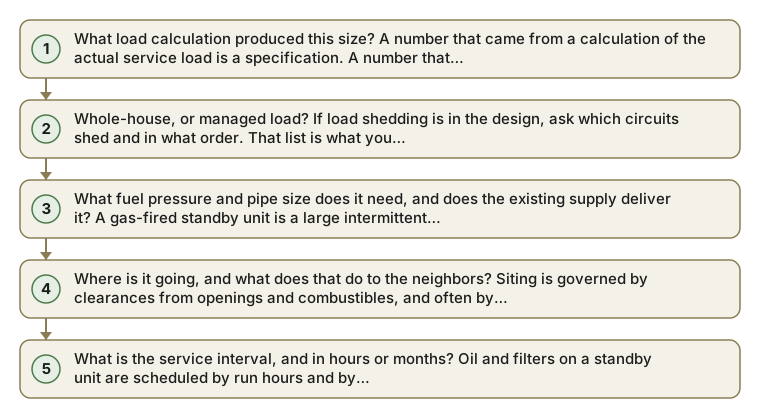
What load calculation produced this size?
A number that came from a calculation of the actual service load is a specification. A number that came from the square footage of the house is a guess with a decimal point.
-
Whole-house, or managed load?
If load shedding is in the design, ask which circuits shed and in what order. That list is what you will live with during an outage.
-
What fuel pressure and pipe size does it need, and does the existing supply deliver it?
A gas-fired standby unit is a large intermittent load on a gas system. An undersized supply line shows up as a unit that runs until the furnace fires and then stumbles.
-
Where is it going, and what does that do to the neighbors?
Siting is governed by clearances from openings and combustibles, and often by local noise limits and setbacks. This is the part that gets discovered late.
-
What is the service interval, and in hours or months?
Oil and filters on a standby unit are scheduled by run hours and by calendar, whichever comes first. Ask the installer for the run-hour and calendar maintenance intervals before purchase.
Compare outage duration, connection and installed cost
A standby unit is worth its cost when outages are frequent enough or long enough that being present to run a portable is the binding limits: a house with a well and a septic pump, a home office, a medical need, a property that is empty for weeks. Where outages are rare and short, a sized for the actual load portable and an interlock kit deliver most of the benefit for a fraction of the money. The dividing line is usually not wattage.
It is whether anyone will be home to start it.
- National Electrical Code, Chapter 9, Table 8: Conductor Properties (DC resistance at 75 °C) : National Fire Protection Association, NFPA 70, Chapter 9, Table 8.
- Optional Standby Systems : National Fire Protection Association, NFPA 70 (National Electrical Code), Article 702.
- Grounding and Bonding : National Fire Protection Association, NFPA 70 (National Electrical Code), Article 250.
- Standard for Transfer Switch Equipment: UL Standards & Engagement, UL 1008.
- Stationary Engine Generator Assemblies : UL Standards & Engagement, UL 2200.
- Installation and Use of Stationary Combustion Engines and Gas Turbines : National Fire Protection Association, NFPA 37.
Standby generators: questions
How is a standby generator sized?
In kilowatts, against a load calculation of the building’s actual service load, never against a wish list of appliances. A whole-house design carries everything; a managed-load design uses a smaller unit with load-shedding modules that drop the air conditioner or the electric range when a larger load starts, which is usually the cheaper route to an acceptable result during an outage.
Why will my standby generator not start when the power fails?
The most common cause is not the engine but the starting battery, which sits on a trickle charger for years and dies quietly. A battery that cranks the unit on a warm exercise cycle can fail to turn it at minus ten degrees in February. The second cause is a disabled exercise cycle, which is the only routine that would have warned you the unit was not going to start.
What does a standby generator’s weekly exercise cycle check?
It runs the engine for a set period to circulate oil, keep the seals wet, burn off condensation, and most importantly prove the machine still starts before you need it. Owners who switch the exerciser off because it is noisy have removed the one thing that would have revealed a fault in advance, which is why a disabled exerciser is a frequent hidden cause of a no-start.
Do I need a transfer switch, and what does it do?
Yes; on a permanent installation the transfer switch and its automation are most of what you are buying. It senses the utility failing, starts the engine, moves the building’s load from the utility to the generator, and reverses the process when utility power returns, and it physically prevents both sources from being connected at once, the same protection an interlock gives a portable install.
Should I buy a standby generator or a portable one?
A standby unit earns its cost when outages are frequent or long enough that having to be home to run a portable is the real limits: a well and septic pump, a home office, a medical need, or a property left empty for weeks. Where outages are rare and short, a sized for the actual load portable plus an interlock kit delivers most of the benefit for a fraction of the money.
What size standby generator do I need to run my house?
Size it from a load calculation of the building’s actual service load, in kilowatts, never from square footage or a guess at "the whole house." A whole-house design carries the full calculated load; a managed-load design uses a smaller, less expensive unit with load-shedding modules that drop a large intermittent load, such as an air conditioner or electric range, whenever something bigger starts. An installer should show you the load calculation, not just quote a size.
What size or sizing chart applies to a residential vs. a commercial standby generator?
The same load-calculation method regardless of whether a unit is marketed as "residential" or "commercial": an installer totals the building’s actual circuits, or the circuits a managed-load design will cover, in kilowatts, and sizes the unit and transfer switch against that total. There is no separate published sizing chart for either category. A commercial installation simply has a larger, three-phase-capable load to calculate, not a different method; both are sized from the panel, not from a square-footage guess.
Is a standby generator the same thing as an emergency generator?
"Emergency generator" is not a distinct product class. It is used loosely for either a standby unit or a portable one kept for outages, so the term itself does not tell you which you are looking at. The real distinction is standby (a fixed installation with an automatic transfer switch, covered here) against portable (wheeled, manually connected through an interlock kit, covered on the portable generators page).
What are the grounding requirements for a standby generator?
NFPA 70 (National Electrical Code) Article 250 governs grounding and bonding for the installation, and how it applies depends on whether the transfer switch is a switched-neutral design (the generator becomes a separately derived system, needing its own grounding electrode) or a solidly-neutral design (it typically does not). That distinction is exactly why this is licensed-electrician work rather than a DIY grounding rod driven next to the pad: get it wrong and a fault can go undetected instead of tripping the breaker meant to catch it.
What are the location, clearance and set-back requirements for a standby generator?
Clearance from windows, doors, fresh-air intakes and the property line is set by three things together: the unit’s own listing under UL 2200, NFPA 37’s rules for stationary combustion engines, and the local fire code or zoning ordinance adopted where the property sits, which is why no single number applies everywhere. An installer pulls the permit against the local code; no universal setback distance exists.
Does a standby generator increase home value?
Real estate sources in outage-prone regions frequently list a standby generator as a feature buyers ask about, but the effect, where it exists, varies too much by region, outage history and local buyer expectations to state as one number. A local real estate agent familiar with recent comparable sales is a better source for that figure than any national reference.
What oil should I use in a standby generator?
Follow the engine manufacturer’s own manual rather than a general rule: most air-cooled standby engines specify a conventional or synthetic oil by SAE grade and API service category the same way any other small engine does (see oil grades and service categories), and some larger liquid-cooled standby units use an automotive-style oil closer to a car engine’s. A synthetic multigrade is the common recommendation where the unit sits outdoors year-round and has to start reliably at whatever temperature an outage happens to arrive at.
What is the price and sizing for an electric-start standby generator?
Electric start is standard on nearly every standby generator, since the whole point of the category is starting automatically without anyone present, so "electric-start" is not really a separate class with its own size or price band, the load-calculation sizing method and the site’s general cost guidance above both apply the same way regardless. What does vary is engine cooling (air-cooled versus liquid-cooled) and fuel type (natural gas versus propane), which affect size and installation cost more than the starting method does.
How much does it cost to install a standby generator at home, and how big of one do I need?
Size follows the same load calculation: total the circuits a whole-house or managed-load design will cover, in kilowatts, rather than guessing from square footage. Ask an installer for both together, a load calculation and a written quote itemizing the unit, the transfer switch and the labor, before comparing anything on price.
Is there a standby generator sizing chart or calculator?
The arithmetic is the same running-and-starting-watts logic the portable sizing calculator works, scaled to kilowatts and run against the building’s full service panel rather than a chosen circuit list, but a standby unit is normally sized from a licensed installer’s load calculation, not a chart, because it has to account for the specific panel, code requirements and any load-shedding design in a way a generic table cannot.
Which standby generator is the quietest?
What is true in general is that sound output on a standby unit is driven mostly by enclosure design and engine speed rather than by brand, and a unit’s own published decibel rating at a stated distance is the number to compare, not a marketing claim of "quiet."
What is the average installation cost for a standby generator?
An average installation cost would mislead more than it informed, because the true drivers: kilowatt size from the load calculation, whether the electrical panel needs upgrading, the length of gas-line run, and local permit fees: vary by property more than they vary by brand. Get a written, itemized quote from a licensed installer against your own load calculation instead of comparing to a published average.
Is there a standby generator sizing guide for homes?
The guide is the load calculation, not a chart: an installer totals the building’s actual circuits (or the circuits a managed-load design will cover) in kilowatts and sizes the unit and transfer switch against that total, the same running-versus-starting-watts logic as a portable generator but applied to the whole panel. A square-footage rule of thumb is not a substitute for that calculation.
Is there a Generac sizing calculator, and how much do Generac home generators cost installed?
The load-calculation method above is the same regardless of brand, and an installer runs it against the building’s actual panel rather than a generic chart. For cost, get a written, itemized quote from a licensed installer against your own load calculation instead of a published brand-specific average, for the reasons covered above.
What are the code requirements for a standby generator?
NFPA 70 (National Electrical Code) Article 702 governs the electrical installation and Article 250 governs grounding and bonding; NFPA 37 and the unit’s own UL 2200 listing govern clearance from the structure; and the local building or fire code layers its own permit and inspection requirements on top of all three. No single code covers the whole installation, which is why a licensed installer pulling the local permit, not a general answer, is what confirms compliance.
Is a standby generator different from a backup generator?
"Backup generator" is not a distinct product class, the same way "emergency generator" is not: people use it loosely for either a standby unit or a portable one kept for outages. The distinction that matters is standby (a fixed installation with an automatic transfer switch) against portable (wheeled, connected manually through an interlock kit), regardless of which generic name gets used for either.
Is a standby generator or a solar-plus-battery system better for backup power?
They fail differently, which is the real comparison. A standby generator runs as long as its fuel supply lasts and delivers full rated power on demand regardless of weather, but depends on that fuel being available and the engine starting. A solar-plus-battery system produces no exhaust and needs no fuel delivery, but its battery capacity is fixed and its recharge rate depends on sunlight, so a multi-day outage with poor sun can run it down faster than it refills.
A whole-house solar-plus-battery system sized for multi-day autonomy is also typically a larger upfront investment than an equivalent-capacity standby generator installation.
What size propane tank does a standby generator need?
Sized from the generator’s fuel consumption rate at rated load (published on its own spec sheet, typically in cubic feet of gas per hour) against how many hours of unattended runtime you want between refills or deliveries, not a single tank size that fits every installation. A propane supplier sizing the tank needs that consumption figure and your target runtime, the same way an electrician needs the load calculation; this is a calculation done against the specific unit, not a published class-level number.