Compare tool batteries by nominal energy and approved fit
Compare battery energy using nominal voltage and amp-hours, then verify the tool and charger approve that exact pack. Watt-hours help compare stored energy; they do not prove equal runtime, peak power or compatibility. Check whether a voltage label is nominal or a maximum marketing figure before multiplying.
Use nominal voltage in the energy calculation
DEWALT’s DCB205 page identifies a 5Ah pack marketed as 20V MAX and states 18V nominal. Using nominal voltage gives 18 × 5 = 90 Wh. Multiplying the maximum label by 5 instead gives 100 Wh, about 11 percent higher.
The calculation estimates nominal stored energy. A measured full-discharge test would also capture the effects of temperature, age, load and cutoff behavior on usable energy. A pack with twice the amp-hours on the same platform need not deliver exactly twice the working time in every tool; compare results under the same working conditions.
Energy does not establish fit or sustained output
| Question | Evidence |
|---|---|
| Will it fit safely? | Exact approved pack/tool/charger list |
| How much nominal energy? | Nominal volts × rated amp-hours |
| Can it sustain the load? | Manufacturer/tool test with that pack |
| How long will it run? | Same task, setting and operating conditions |
| How should it be stored? | Specific pack and charger instructions |
Do not infer power capability from watt-hours alone. Cells, electronics and thermal limits affect output. An unofficial adapter can bypass communication or protection even if the contacts connect.
Storage instructions can be brand-specific
EGO’s European battery support describes automatic discharge to 30 percent after 30 days. That storage behavior applies to the named EGO product family. Other lithium packs can have different instructions, so read the guidance supplied with the actual regional pack before choosing a storage charge level.
Age, use and storage conditions can all affect a pack; unused time is not proof it remains new. Stop using or charging a damaged, swollen, leaking or unusually hot pack and follow manufacturer handling instructions. Do not dismantle it, bridge contacts or attempt a forced-charge workaround.
For an operating-cost and spare-pack decision, use the gas-versus-battery purchase comparison. Keep that job-duration choice separate from identifying an approved replacement battery.
Battery and cordless equipment
A battery platform has a marketed voltage class and a manufacturer-defined battery interface. Verify approved tool and charger combinations before buying a pack.
Compare nominal stored energy in watt-hours by multiplying nominal voltage and amp-hours, then check the tool’s actual load and operating limits. That energy comparison is useful across packs, while measured runtime and peak output still depend on the complete tool and battery combination.
Voltage is a platform, not a power rating
Manufacturers sell battery tools in a platform with a defined battery interface and compatible trimmers, blowers, mowers and saws. Labels such as 20V, 40V, 60V and 80V describe marketed voltage classes; check each manufacturer’s definition before treating a number as nominal voltage. DEWALT explains that 20V MAX is its maximum initial unloaded voltage and 18V is nominal.
The label alone cannot establish tool power, measured runtime or cross-brand fit. Two tools marketed at the same voltage can deliver different output under the same task.
Runtime depends on usable pack energy and the tool’s electrical demand. Nominal voltage and amp-hours together describe stored watt-hours; cells, protective electronics, the motor and controller also limit delivered power. A platform’s marketing voltage alone leaves those details unresolved.
Nominal voltageV
Names the platform
Decides which batteries and chargers fit the tool. Not comparable brand to brand.
Amp-hoursAh
Names the pack, not the platform
Runtime scales with this. A 40V/4.0Ah pack outlasts a 40V/2.0Ah pack roughly two to one.
Watt-hoursWh
Volts × amp-hours
The one figure that is comparable across brands and platforms.
Watt-hours (volts multiplied by amp-hours) is the number that compares energy stored, across brands and across voltage platforms, the same way running watts compares two generators regardless of their surge rating. A 20V/6.0Ah pack (120 Wh) and a 40V/3.0Ah pack (120 Wh) store the same energy even though neither the voltage nor the amp-hour figure alone suggests it.
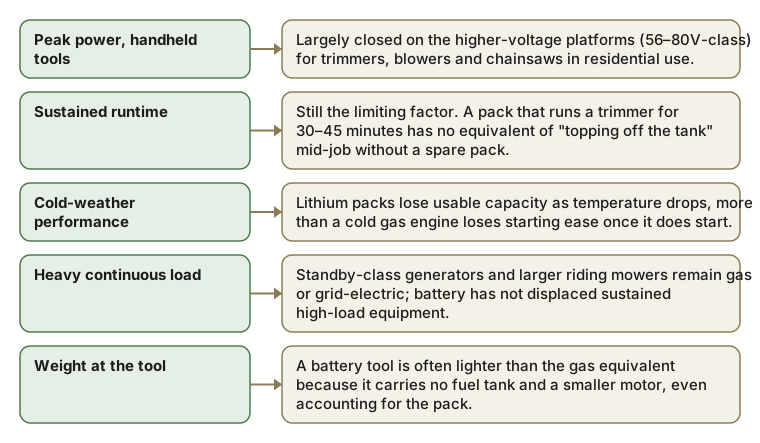
What limits a battery tool against its gas equivalent
| Factor | Where things stand |
|---|---|
| Peak power, handheld tools | Largely closed on the higher-voltage platforms (56–80V-class) for trimmers, blowers and chainsaws in residential use. |
| Sustained runtime | Still the limiting factor. A pack that runs a trimmer for 30–45 minutes has no equivalent of "topping off the tank" mid-job without a spare pack. |
| Cold-weather performance | Lithium packs lose usable capacity as temperature drops, more than a cold gas engine loses starting ease once it does start. |
| Heavy continuous load | Standby-class generators and larger riding mowers remain gas or grid-electric; battery has not displaced sustained high-load equipment. |
| Weight at the tool | A battery tool is often lighter than the gas equivalent because it carries no fuel tank and a smaller motor, even accounting for the pack. |
The pack is a wear part with its own failure mode
Lithium-ion capacity can decline through cycling and calendar aging during storage. The Department of Energy’s lithium-ion assessment, page 9, identifies extended storage at high state of charge as a driver of calendar capacity fade.
Its grid-storage discussion explains the aging mechanism; it does not prescribe a storage percentage or service-life promise for every garden-tool pack. Heat and the conditions in a garage also matter when following the pack’s storage instructions. EGO’s product-family guidance describes discharge to 30 percent after 30 days.
Use the instructions for the actual pack instead of applying that setting to every brand. Keep the pack out of direct summer heat and avoid leaving it fully charged or deeply discharged for extended storage unless its own instructions call for a particular procedure.
Exact retention and service-life figures remain pack-specific, so an unused pack cannot be assumed to retain its original capacity.
The pack and charger are certified as a system to UL 62133-2 for the cell chemistry and UL 62841-1 for the tool as a whole, which is the harmonized standard covering electric and battery hand-held tools and lawn-and-garden machinery: the same standard a corded electric hedge trimmer or blower is certified to, distinct from the combustion-engine standards (the OPEI B175 series) that govern the gas equivalents elsewhere on this site.
A damaged, swollen or physically crushed lithium-ion pack is a fire risk that can ignite with no further trigger. A pack that has been dropped hard, run over, or exposed to fire or extreme heat should be taken outside, kept away from anything combustible, and not recharged or used again: treat it as compromised rather than testing it.
Buying across a platform, not a single tool
Because the battery and charger are the expensive part of a first purchase, the practical decision is which platform to commit to rather than which single tool to buy. A second and third tool bought bare, without a battery, is usually far cheaper than the first kitted tool. Before committing, check how many tools you are likely to want on that platform over several years and whether the manufacturer has kept the battery interface consistent across its own product generations; a platform that changes its pack shape stops being a platform for the tools you already own.
- Electric Motor-Operated Hand-Held Tools, Transportable Tools and Lawn and Garden Machinery, Safety, Part 1: General Requirements: UL Standards & Engagement / IEC / CSA, UL 62841-1 (harmonized with IEC 62841-1).
- Secondary Cells and Batteries Containing Alkaline or Other Non-Acid Electrolytes: Safety Requirements for Portable Sealed Secondary Cells : UL Standards & Engagement / IEC, UL 62133-2 (harmonized with IEC 62133-2, lithium systems).
Battery and cordless equipment: questions
Does a higher voltage battery tool mean more power?
Not by itself. A platform label identifies a marketed voltage class, while compatibility follows the manufacturer’s approved pack, tool and charger list.
First check whether the label states nominal voltage or maximum unloaded voltage. Two tools marketed at the same voltage can still differ in delivered output and runtime under the working load.
Estimate nominal stored energy from nominal voltage multiplied by amp-hours. Working runtime also depends on usable capacity, tool load, temperature and cutoff behavior; delivered power depends on the cells, electronics, motor and controller as well.
What is the difference between amp-hours and watt-hours on a battery?
Amp-hours (Ah) rates the pack alone and only compares packs on the same voltage platform. Watt-hours (Wh) is volts multiplied by amp-hours, and it is the one figure that compares energy stored across brands and voltage platforms: a 20V/6.0Ah pack and a 40V/3.0Ah pack both store 120 Wh even though neither the voltage nor the amp-hour number alone suggests it.
Has battery power caught up to gas for outdoor equipment?
Battery equipment covers handheld work and also includes riding mowers: EGO’s Z6 is a battery-powered zero-turn example. Compare the actual workload, approved pack combination and charging arrangements for the model.
A riding machine is not automatically gas-powered, and a voltage label cannot establish sustained runtime. For long sessions, compare the charging or spare-pack plan with the fuel stops an alternative machine requires.
How should I store a lithium battery pack over winter?
A lithium pack can lose capacity through both cycling and calendar aging while stored; a season without use does not preserve it automatically. Follow its own storage-charge and temperature instructions, keep it away from direct summer heat, and avoid leaving it fully charged or deeply discharged for long periods unless the manufacturer specifies otherwise.
A pack that has been dropped hard, crushed or exposed to fire needs the manufacturer’s damaged-battery handling guidance. Stop using or charging it and avoid testing whether it still works.
Is battery compatibility the same across every tool on a cordless platform?
Check the manufacturer’s approved battery, tool and charger combinations for the exact models. A matching voltage label and physical mount alone do not establish that every pack powers every tool. DEWALT’s published adapter restrictions give a concrete example: its approved adapter has named battery and tool exclusions, and the older charger cannot charge newer packs through that adapter.
Cross-brand packs also use different mounts, communication contacts and battery-management arrangements. Choose an expressly approved combination instead of inferring compatibility from a shared voltage number or forcing a pack onto a tool.
This check matters when buying a bare tool to use with batteries already owned.
Why does a battery pack lose capacity faster in a hot garage than in a cool space, even when it isn't being used?
Heat is the single largest accelerant of lithium-ion capacity loss regardless of whether the pack is in active use: a pack sitting fully charged in a hot garage all summer degrades measurably faster than the same pack stored at a partial charge in a cool space, which is why storage temperature matters as much as charge level for long-term pack health.
What safety standards govern a battery pack and its charger?
The pack and charger are certified as a system to UL 62133-2 for the cell chemistry itself, and UL 62841-1 for the tool as a whole: the same harmonized standard that governs corded electric hand-held and lawn-and-garden tools, distinct from the combustion-engine OPEI B175 series that governs gas equivalents.
What should I do if a lithium battery pack is dropped, crushed, or exposed to fire?
Treat it as compromised rather than testing whether it still works. A damaged, swollen, or physically crushed pack is a fire risk that can ignite with no further trigger. Take it outside, keep it away from anything combustible, and do not recharge or reuse it.
Can a manufacturer change its battery platform's pack shape and strand existing tools?
Yes, and this is a real risk worth checking before committing to a platform, if a manufacturer changes its battery interface across product generations, tools bought under an older interface may no longer accept new packs, effectively ending that platform's usefulness for tools you already own even though the brand name continues.
Does cold weather affect a battery tool's starting behavior the way cold affects a gas engine?
The mechanism is different but the outcome is comparable: a gas engine's starting difficulty in cold weather comes from fuel and lubrication behavior, while a lithium pack simply loses usable capacity as temperature drops, delivering less runtime and sometimes reduced power even though there's no "starting" step to fail the way a gas engine has.
Is a corded electric tool ever a better choice than a battery tool on the same platform question?
Yes, specifically for tools used near a reliable power source with no need for mobility: a corded electric tool has unlimited runtime and needs no pack investment or charging management at all, trading that convenience for being tethered to an outlet and a cord that has to be kept clear of the tool's cutting path.