Choose small-engine oil by viscosity and service category
Match both the oil viscosity and performance category in the engine manual. An SAE label such as 10W-30 describes viscosity; an API category describes performance requirements. A newer API category does not authorize a different viscosity, a longer oil-change interval or use in an unrelated pump or fuel mixture.
Read the two labels separately
API’s motor-oil guide explains the service symbol and viscosity marking. The W portion of a multigrade concerns cold-temperature behavior; the second grade concerns high-temperature viscosity. Two oils sharing a “30” grade are not identical products or interchangeable in every machine.
| Question | Evidence to use |
|---|---|
| Correct viscosity? | Engine temperature/viscosity chart |
| Required performance? | Engine specification and API marking |
| Approved extended interval? | Exact manufacturer conditions and filter requirement |
| Correct quantity? | Actual level procedure, not bottle size |
API’s category guidance explains backward compatibility for automotive gasoline categories and warns that some diesel categories are not interchangeable. That scope matters: follow the small-engine maker’s actual instructions instead of treating an alphabetic comparison as universal approval.
Quantity is a separate decision
The cited TimeCutter manual gives 2.4 liters nominal capacity and directs an initial fill of about 80 percent before gradual additions to Full. The arithmetic is 1.92 liters initially, with the final amount determined by its level check.
Residual oil and filter service affect refill quantity. An oil package labeled with the right grade can still be too large or too small for the job. Never overfill to empty a container.
Keep the other lubricants separate
Two-stroke premix oil, chainsaw bar oil and pump crankcase oil serve different systems. Use the product type named for that system. Four-stroke engine oil is not automatically suitable to mix into gasoline.
Track hours and calendar time, applying the earlier limit and severe-service requirements from the manual. Clean-looking oil and a synthetic label do not extend an interval. For the exact model, use the capacity and plug lookup before service.
Oil grades and service categories
Two labeling systems appear on every bottle of engine oil and they answer different questions. The SAE grade, defined by SAE J300, is a viscosity classification: a single number such as SAE 30 specifies behavior at high temperature only, while a multigrade such as 10W-30 adds a cold-temperature classification in front of it, which is what governs how quickly the oil circulates on a cold start. The API service symbol on the bottle carries a service category letter pair, the viscosity grade and any conserving claim.
Small air-cooled engines are considerably harder on oil than a car engine is, they run hotter, hold far less of it, and most domestic ones have no filter at all, which is why the change interval is short and why the specification is worth reading.
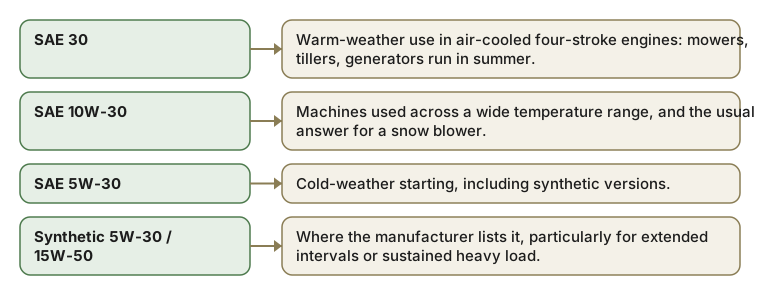
What SAE 30 and 10W-30 specify
Engine oil viscosity grades come from SAE J300. A single-grade oil such as SAE 30 is specified at high temperature only. A multigrade such as 10W-30 carries two figures: the number before the W is a low-temperature classification governing how the oil behaves when cold, and the number after it is the same high-temperature grade as the single-grade oil.
A 10W-30 and a straight 30 behave alike once the engine is hot; they differ entirely in how readily the oil pumps and circulates at start-up in the cold.
| Grade | Where it suits | Note |
|---|---|---|
| SAE 30 | Warm-weather use in air-cooled four-stroke engines: mowers, tillers, generators run in summer. | The traditional small-engine grade. Poor at low temperature; it does not circulate quickly on a cold start. |
| SAE 10W-30 | Machines used across a wide temperature range, and the usual answer for a snow blower. | Some manufacturers note higher oil consumption in hot weather with a multigrade in an air-cooled engine. |
| SAE 5W-30 | Cold-weather starting, including synthetic versions. | Common on winter equipment and on newer engines that specify it. |
| Synthetic 5W-30 / 15W-50 | Where the manufacturer lists it, particularly for extended intervals or sustained heavy load. | Follow the machine’s own list. Synthetic is not automatically approved in every engine. |
The grade is a machine-specific specification and it is printed in the manual and often on the engine itself. SAE grade describes viscosity; the engine manual specifies the grade to use. Where the manual and a general rule disagree, the manual wins: it is describing clearances and an oil system the guide cannot see.
Reading the API donut
The circular symbol on a bottle of engine oil is the API service symbol, and it has three parts. The top segment gives the service category: a two-letter code such as SN or SP for gasoline engines, where a later second letter is a newer, more demanding specification. The center gives the SAE viscosity grade.
The lower segment states any energy-conserving or resource-conserving claim.
Top
Service category
SN, SP and so on. Later letters are newer specifications.
Center
SAE viscosity grade
SAE 30, 10W-30, 5W-30: the J300 classification.
Bottom
Conserving claim
Present only where the oil qualifies. Not relevant to most small engines.
For small engines the practical rule is that the category must be at least what the manufacturer asks for. Categories are generally backwards-compatible for gasoline engines, so a newer category oil usually supersedes an older requirement, but an engine that specifies a particular category and grade is specifying both, and the viscosity is the half people substitute carelessly.
Why air-cooled engines are fussier than a car is
Three things separate a mower engine from a car engine, and all three make the oil work harder. It is air-cooled, so it runs at a higher and much less regulated temperature. It holds a very small quantity of oil, often well under a liter, so there is less oil to absorb heat and contamination.
And most domestic small engines have no oil filter at all, so everything the oil picks up stays in it until it is drained.
That is why small-engine oil-change intervals are short, why the first change on a new machine is normally much earlier than the ones after it, and why "it still looks clean" is a poor test on an engine with no filter. Run hours matter more than calendar time, but for a domestic machine the season is the practical unit.
Two-stroke oil is a different product entirely
Two-stroke oil is designed to burn. It is rated by systems intended for its application, and the distinction that matters to an owner is air-cooled against water-cooled: outboard oils carrying a TC-W3 rating are formulated for water-cooled marine engines running far cooler than a chainsaw does, and are not a substitute in air-cooled equipment. Use a two-stroke oil that names air-cooled equipment, and mix it at the ratio the machine specifies using the fuel mix calculator.
Bar and chain oil is a third product again: a tacky oil designed to cling to a moving chain at speed. It is not engine oil, it is not mixed with anything, and it goes in its own tank.
- Engine Oil Viscosity Classification : SAE International, SAE J300.
- Engine Oil Licensing and Certification System: service categories and the API donut: American Petroleum Institute, API 1509.
Oil grades and service categories: questions
What is the difference between SAE 30 and 10W-30?
SAE 30 is specified at high temperature only; 10W-30 adds a low-temperature classification, the number before the W, which governs how readily the oil pumps on a cold start. The two behave alike once the engine is hot and differ entirely when cold, which is why a snow blower typically calls for a multigrade while a summer mower often runs a straight 30 without trouble.
How do I read the API donut on an oil bottle?
The circular API service symbol has three parts: the top segment gives the service category, a two-letter code such as SN or SP where a later second letter is a newer, more demanding specification; the center gives the SAE viscosity grade; and the bottom states any energy-conserving claim. For a small engine the category must be at least what the manufacturer asks for, and categories are generally backward-compatible.
Why do small engines need their oil changed so often?
Because three things make the oil work harder than in a car: the engine is air-cooled and runs hotter and less regulated, it holds very little oil, often well under a liter, and most domestic small engines have no oil filter at all, so everything the oil collects stays in it until you drain it. That is why the interval is short and why "it still looks clean" is a poor test on these engines.
Can I use outboard or car oil in my chainsaw?
No. Outboard TC-W3 oil is formulated for water-cooled marine engines running far cooler than an air-cooled chainsaw, and car engine oil is not two-stroke oil at all. Use a two-stroke oil that names air-cooled equipment, mixed at the ratio printed on the machine.
Bar and chain oil is a third product again: a tacky oil for the chain, not mixed with anything, and it goes in its own tank.
What is my lawn mower’s oil capacity?
The reliable route on any four-stroke small engine is the dipstick itself: fill in small increments and recheck the stick rather than pouring a book figure in at once, since the correct level is defined by the dipstick’s own marks, not a fluid-ounce number on a page.
What is the oil capacity in quarts for a Briggs & Stratton, Troy-Bilt or Echo engine?
The engine’s own label or manual has the correct figure, and the dipstick’s own marks are what to fill against, not a number copied from a different model with the same badge on it.
Is synthetic oil always better than conventional oil in a small engine?
Not automatically: synthetic oil is appropriate where the manufacturer lists it, particularly for extended change intervals or sustained heavy load, but synthetic is not automatically approved in every engine. Following the specific machine's own listed options is the reliable approach rather than assuming synthetic is a universal upgrade.
Does the SAE grade or the API service category matter more when substituting an oil?
Both matter, but for different reasons: the API category has some flexibility since categories are generally backward-compatible for gasoline engines, so a newer category oil usually satisfies an older requirement. The SAE viscosity grade has no such flexibility; it is the half of the specification people substitute carelessly, and getting it wrong changes how the oil behaves at your engine's actual operating and starting temperatures.
Why is "it still looks clean" not a reliable way to judge whether small-engine oil needs changing?
Because most domestic small engines have no oil filter at all, so oil that looks clean by eye can still carry microscopic wear particles and contamination the filter would otherwise remove. Run hours and calendar time, following the manufacturer's interval, are the reliable basis for a change, not visual inspection.
Does a two-stroke engine ever need its "oil" changed the way a four-stroke does?
No: a two-stroke has no sump and no standing quantity of oil to change, since the oil is consumed along with the fuel during combustion. There is nothing to drain or replace on a schedule the way a four-stroke's sump oil is; the two-stroke's only lubrication task is mixing fresh fuel correctly each time.
What happens if I use an oil with a lower API service category than my engine specifies?
It may not provide the level of engine protection the manufacturer's specification calls for, since API categories are generally backward-compatible in the sense that a newer category supersedes an older requirement, but not the reverse: an oil rated for an older, less demanding category is not automatically adequate for an engine that specifies a newer one.
Is bar and chain oil rated by the same SAE and API systems as engine oil?
No: bar and chain oil is a distinct product category, rated by systems intended specifically for its application as a tacky, clinging lubricant for a moving chain, not by the SAE J300 viscosity system or the API service categories that apply to engine crankcase oil.