Fuel-mix calculator: oil for a specified gasoline volume
Use the equipment-specified gasoline-to-oil ratio and enter the gasoline volume before adding oil. Oil volume equals gasoline volume divided by the ratio. The calculator reports the same oil amount in US fluid ounces and milliliters; it does not choose the correct ratio or oil for a machine.
Two unit systems, the same ratio
One US gallon is 128 US fluid ounces or 3.785411784 liters. The NIST conversion reference distinguishes US and imperial units. A container marked simply “gallon” needs its actual unit identified before mixing.
| Gasoline / ratio | Oil calculation | Oil result |
|---|---|---|
| 1 US gal at 50:1 | 128 ÷ 50 | 2.56 US fl oz; about 75.7 mL |
| 5 L at 40:1 | 5,000 ÷ 40 | 125 mL; about 4.23 US fl oz |
| 1 L at 50:1 | 1,000 ÷ 50 | 20 mL |
For that last example, 1,000 mL of gasoline plus 20 mL of oil is approximately 1,020 mL of mixture. Entering 1,000 mL as a required final volume would answer a different question; this form asks for gasoline before oil.
Follow the measuring instruction as well as the arithmetic
STIHL’s fuel-mixing guidance specifies its applicable ratio and oil. Its common gallon instructions round the 50:1 amount to 2.6 US fluid ounces. Use the equipment’s approved measuring method rather than treating a rounded bottle instruction as a defect.
More oil is not automatically harmless, and an oil supplier’s high-ratio claim does not authorize changing the equipment specification. Some four-stroke designs also use mixed fuel; engine cycle count alone is not a reliable fuel instruction.
Label the approved can with fuel, ratio and mixing date. Use the actual fuel and storage guidance rather than an automatic 30-day life for every formulation. See fuel compatibility and engine lubrication designs before filling an unfamiliar machine.
Two-stroke fuel mix
In a two-stroke engine there is no oil sump and no oil pump: the lubricant arrives dissolved in the fuel, metered by the ratio you mix by hand. That makes the ratio a specification rather than a preference, and it makes the direction of an error asymmetric. Mixing richer than specified fouls plugs and carbons the exhaust port, which is annoying.
Mixing leaner than specified starves the bearings, and a two-stroke run on straight gasoline can suffer rapid seizure from loss of lubrication; do not start it with unmixed fuel. This tool does the arithmetic for any of the common ratios in either unit system, and it gives the exact figure: a US gallon at 50:1 needs 2.56 fluid ounces, not the 2.6 printed on the bottle, which is that number rounded up to a graduation you can pour.
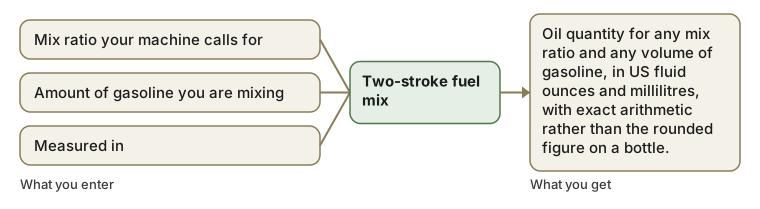
Pick the ratio your machine specifies, it is on the fuel cap, the engine label or in the manual, then enter how much gasoline you are mixing and in which unit. The result is given in both US fluid ounces and millilitres, because oil bottles and measuring jugs in the same garage frequently disagree about which system they are in.
Mix small quantities, not convenient ones
Mixed fuel has a short working life. The gasoline carrying the oil degrades in exactly the way described on stored gasoline, and thirty days is the commonly quoted limit without stabilizer. A five-liter batch mixed for convenience and used across a season is a saw full of old fuel by August.
Which oil, and why outboard oil is not it
Use a two-stroke oil that names air-cooled equipment. Outboard oils carrying a TC-W3 rating are formulated for water-cooled marine engines running far cooler than a chainsaw or a trimmer does, and automotive engine oil is not a two-stroke oil at all. This is one of the few places where the wrong product in the right quantity does real damage.
The common quantities, worked out
The calculator handles any volume; these are the ones most people mix. Figures are US fluid ounces of two-stroke oil, from the same arithmetic the tool uses.
| Ratio | 1 quart | 1/2 gallon | 1 gallon | 2 gallons | 5 gallons |
|---|---|---|---|---|---|
| 100:1 | 0.32 | 0.64 | 1.28 | 2.56 | 6.40 |
| 80:1 | 0.40 | 0.80 | 1.60 | 3.20 | 8.00 |
| 50:1 | 0.64 | 1.28 | 2.56 | 5.12 | 12.80 |
| 40:1 | 0.80 | 1.60 | 3.20 | 6.40 | 16.00 |
| 32:1 | 1.00 | 2.00 | 4.00 | 8.00 | 20.00 |
| 25:1 | 1.28 | 2.56 | 5.12 | 10.24 | 25.60 |
| 16:1 | 2.00 | 4.00 | 8.00 | 16.00 | 40.00 |
The 50:1 gallon figure is where bottle markings and arithmetic part company: 2.56 fl oz is the exact quantity, and 2.6 is that number rounded up to a graduation you can pour.
Label the can
Two identical red cans, one holding straight gasoline and one holding 50:1, are indistinguishable, and straight gasoline in a two-stroke seizes it. Write the contents, the ratio and the mixing date on tape on the can. It takes ten seconds and removes an entire category of expensive mistake.
Two-stroke oil-ratio arithmetic
The arithmetic
A mix ratio is parts of gasoline to one part of oil by volume, so the oil quantity is simply the fuel volume divided by the ratio.
oil (ml) = gasoline (liters) × 1000 ÷ ratio
oil (US fl oz) = gasoline (US gallons) × 128 ÷ ratio
One US gallon is 3.785411784 liters and 128 US fluid ounces, which is why a 50:1 gallon takes 2.56 oz rather than the 2.6 oz printed on most bottles: the bottle is rounded to the nearest graduation you can pour.
Why the ratio is not a preference
In a two-stroke engine the oil arrives in the fuel; there is no sump and no oil pump. The ratio is how the designer delivers a specific quantity of lubricant per unit of fuel burned. Running leaner than specified starves the bearings.
Running richer than specified does not damage the engine but does foul plugs, build carbon in the exhaust port and muffler, and can make the machine run poorly enough that it gets misdiagnosed as a carburetor fault.
Fuel volume and mixture ratio
- US fluid ounces and US gallons. An imperial gallon is 160 imperial fluid ounces and a different volume entirely.
- The ratio is by volume, which is how every consumer two-stroke oil is specified.
- Mixed fuel has a short shelf life, commonly quoted as 30 days without stabilizer, because the gasoline degrades, not the oil.
Fuel-mixture example
Given: 1 US gallon of gasoline at 50:1.
Work: 128 ÷ 50 = 2.56 fl oz. In metric: 3.7854 L × 1000 ÷ 50 = 75.7 ml.
Result: 2.56 US fl oz: the 2.6 oz bottle marking rounded up to a pourable graduation.
Given: 5 liters of gasoline at 40:1.
Work: 5 × 1000 ÷ 40 = 125 ml. In US units: 5 ÷ 3.7854 = 1.321 gal, × 128 ÷ 40 = 4.23 fl oz.
Result: 125 ml of two-stroke oil.
When the engine calls for different fuel
- If you are not sure which ratio a machine takes, the specified mixture ratio appears on the fuel cap, on the engine label or in the manual. Guessing lean is the expensive direction to guess.
- Never run straight gasoline in a two-stroke engine, even briefly. Seizure can happen in under a minute.
Two-stroke fuel mix: source values
- Standard Specification for Automotive Spark-Ignition Engine Fuel: ASTM International, ASTM D4814. Retrieved 2026-09-02.
Calculator version 1.0.0. Saved results record this version and your inputs, so a later formula change never rewrites an old result.
Two-stroke fuel mix: questions
How much oil do I add to gas for a two-stroke mix?
It depends on the ratio your machine specifies and the volume you are mixing. At 50:1 a US gallon takes 2.56 fluid ounces of oil; at 40:1, 3.2; at 32:1, 4.0. The calculator does any ratio in both fluid ounces and milliliters.
Get the ratio from the fuel cap, the engine label or the manual, and mix only what you will use within about thirty days, because mixed fuel has a short life.
Why does my oil bottle say 2.6 oz per gallon at 50 to 1?
Because 2.6 is 2.56 rounded up to a graduation you can pour on a bottle’s markings. The exact quantity for a US gallon at 50:1 is 2.56 fluid ounces. The small rounding is harmless in the slightly rich direction; the calculator gives the exact figure so you can measure precisely when you want to, and see where bottle markings and the arithmetic part company.
What happens if I get the two-stroke fuel ratio wrong?
The error is asymmetric. Mixing richer than specified, too much oil, fouls plugs and carbons the exhaust port, which is annoying but not destructive. Mixing leaner, too little oil, starves the bearings, and a two-stroke run on straight gasoline can suffer rapid seizure from loss of lubrication; do not start it with unmixed fuel.
That asymmetry is why the ratio is a specification rather than a preference, and why the safe direction to err is slightly rich.
Can I use outboard (TC-W3) oil in my chainsaw or trimmer?
No. TC-W3 outboard oils are formulated for water-cooled marine engines running far cooler than an air-cooled chainsaw or trimmer, and car engine oil is not two-stroke oil at all. Use a two-stroke oil that names air-cooled equipment, mixed at the machine’s ratio.
This is one of the few places where the wrong product in exactly the right quantity still does real damage to the engine.
How long does mixed two-stroke fuel last before it should be discarded?
About thirty days is the commonly quoted limit without a fuel stabilizer added, because the gasoline carrying the oil degrades the same way any stored gasoline does. A five-liter batch mixed for convenience and used across a whole season is old fuel well before summer ends: mix small quantities you'll use within that window instead.
How do I avoid mixing up a can of straight gasoline with a can of two-stroke mix?
Label the can. Two identical red cans, one holding straight gasoline and one holding 50:1 mix, are visually indistinguishable, and straight gasoline run through a two-stroke seizes the engine. Write the contents, the ratio and the mixing date on tape on the can.
It takes ten seconds and removes an entire category of expensive mistake.
How much oil does 2 gallons of gasoline need at a 40:1 ratio?
6.4 US fluid ounces of two-stroke oil. The common ratio-and-volume combinations are worked out in a table, but the calculator handles any ratio and any volume beyond the ones listed there, in both US fluid ounces and milliliters.
Where does my machine's two-stroke mix ratio come from, do I have to guess it?
No, it is on the fuel cap, the engine label, or in the owner's manual, published by the manufacturer for that specific engine. This calculator does the arithmetic once you know the ratio; it does not tell you which ratio your machine requires.
Does a richer-than-specified two-stroke mix ever make sense on purpose?
Some owners intentionally mix slightly richer than the manufacturer's ratio as a margin of safety, since the failure mode of too much oil (fouled plugs, carboned exhaust ports) is far less costly than the failure mode of too little (bearing starvation and potential seizure). This calculator computes the ratio you specify exactly; whether to add a margin above the manufacturer's figure is a judgment call the manual and the guide do not make for you.
Does gasoline's ethanol content affect how two-stroke mixed fuel should be handled?
Yes: mixed fuel degrades the same way stored gasoline does, and ethanol-blended gasoline is more prone to that degradation than ethanol-free gasoline, which is part of why mixed fuel's usable life is measured in weeks rather than months. The full mechanism is covered's ethanol fuel and stabilizer page.
Is a four-stroke engine ever mixed with oil in its fuel the way a two-stroke is?
A conventional sump-lubricated four-stroke uses unmixed fuel and a separate oil supply. Engine cycle alone is not a fuel instruction: STIHL 4-MIX is a four-stroke design lubricated by mixed fuel. Identify the exact engine and use its specified fuel and ratio; a dipstick is an identification clue rather than a universal test.
STIHL’s explanation of mixture-lubricated 4-MIX describes the exception to the usual separate-sump four-stroke arrangement.