Match chainsaw chain: pitch family, gauge and drive links
Match the chain’s pitch family, gauge, drive-link count and approved saw/bar configuration. “18-inch chain” is not a complete order. Standard 3/8-inch and 3/8-inch low-profile share a nominal pitch but are different families. Verify the bar, nose and drive sprocket requirements before fitting a loop.
Measure pitch and gauge as different dimensions
Oregon defines pitch as the span across three consecutive rivets divided by two. Gauge is drive-link thickness where it enters the bar groove. Mark one drive link and count every link once around the loop; do not count cutting teeth instead.
For a measured three-rivet span of 0.650 inch, the calculated pitch is 0.325 inch. A 0.750-inch span gives 0.375, or 3/8 inch. The measurement alone does not distinguish standard from low-profile 3/8; use the actual chain and approved fit information.
| Oregon 91PXL055CK field | Published value |
|---|---|
| Pitch family | 3/8-inch low profile |
| Gauge | 0.050 inch |
| Drive links | 55 |
| Classification | Manufacturer-described low-kickback chain |
The 91PXL055CK listing establishes those values for that product. It does not prove it fits every saw with a similar bar length. Oregon’s profile comparison separately depicts standard and low-profile 3/8-inch designs.
Do not use tension adjustment to force the wrong loop
A loop with the wrong link count may not fit the adjustment range. Wrong gauge or pitch can prevent seating or create unsafe running. Do not run a questionable chain to see whether it settles in.
Inspect the bar and sprocket for the manufacturer’s wear limits. A correctly labeled new loop does not repair a damaged groove or worn sprocket. Keep the approved low-kickback characteristics and other safety parts specified for the saw.
Stop and isolate the engine or battery before handling the chain, use protective gloves, and follow tension checks with the chain at the specified condition. The chain calculator helps interpret measurements; it does not certify fit.
PT-01 · Parts
Chainsaw chain: pitch, gauge and drive links
A replacement chain is ordered by three numbers and none of them is the bar length printed on the saw. Pitch is the distance between drive links, taken as half the span across three consecutive rivets. Gauge is the thickness of the drive-link tang that rides in the bar groove, and it is one of four values that cannot be told apart by eye.
Drive links is a count of the tangs around the loop, which sets the chain’s length and which two nominally identical 18-inch bars will frequently disagree about. Get pitch wrong and the chain will not run on the sprocket; get gauge wrong and it either will not seat or flops in the groove; get the count wrong and it cannot be tensioned at all.
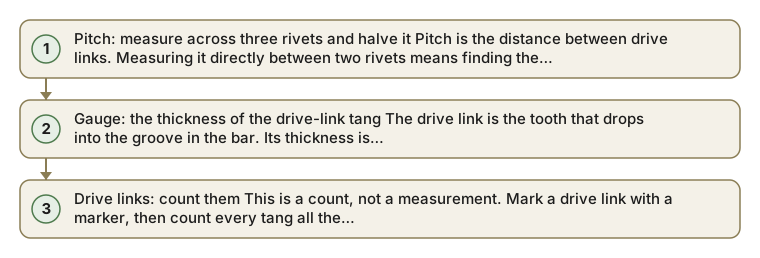
The three numbers, and how each is taken
-
Pitch: measure across three rivets and halve it
Pitch is the distance between drive links. Measuring it directly between two rivets means finding the center of a small round head twice, which is where the error creeps in.
Instead measure from the center of one rivet to the center of the third, with the chain pulled taut, and divide by two. The answer will be close to one of four values: 1/4 in, .325 in, 3/8 in or .404 in.
-
Gauge: the thickness of the drive-link tang
The drive link is the tooth that drops into the groove in the bar. Its thickness is the gauge, and it must match the groove width. The four values in use are .043, .050, .058 and .063 inches (1.1, 1.3, 1.5 and 1.6 mm).
This is usually stamped on the bar; measuring it needs a caliper or a gauge tool, and guessing between .050 and .058 by eye does not work.
-
Drive links: count them
This is a count, not a measurement. Mark a drive link with a marker, then count every tang all the way round the loop until you return to the mark. It is the number that sets the chain’s length, and it is the one people try to substitute the bar’s inch size for.
.325in
A common pitch
From a three-rivet span of 0.650 in.
.050in
A common gauge
The drive-link thickness, matched to the bar groove.
72DL
A drive-link count
Counted round the loop. Not derivable from “18 inch”.
The chain identifier takes the rivet span and the gauge and returns the specification, and tells you when a span does not match any standard pitch instead of quietly rounding it.
Why bar length does not give you the drive-link count
A bar's printed length is the usable cutting length, rounded, and it says nothing about the distance from the nose sprocket to the mounting slot or about the pitch of the chain that runs on it. Two 18-inch bars from different manufacturers, or from the same manufacturer in different chain pitches, routinely take different drive-link counts. That is why "18 inch chain" is not an order, and why a chain that is one link out will not tension.
| Number | What it has to match | Symptom when it is wrong |
|---|---|---|
| Pitch | The drive sprocket and the bar nose sprocket. | The chain will not seat on the sprocket, or rides and jumps under load. |
| Gauge | The width of the groove milled in the bar. | Too thin: the chain flops and cuts crooked. Too thick: it will not go into the groove at all. |
| Drive links | The bar length and the tensioner’s range of travel. | Too few and it will not reach; too many and the tensioner runs out before it is tight. |
Low-kickback classification is part of the specification
Chain is also classified by kickback behavior. Low-kickback chain uses raised depth gauges and shaped tie straps to limit how much wood a cutter can take when the upper quadrant of the bar nose contacts something, and the chain-saw standard ANSI/OPEI B175.1 is what defines the classification and the testing behind it. Aggressive chain cuts faster and behaves differently in a kickback.
Fitting aggressive chain to a saw that came with low-kickback chain is a real change in how the machine behaves in the moment when behavior matters most. If you do not know confidently why you want it, you want the low-kickback chain. The mechanism is on chainsaw kickback.
The parts that wear together
A chain, a bar and a drive sprocket are a wearing set. A new chain on a sprocket with hooked, worn teeth wears quickly and unevenly, and a bar with a widened groove or burred rails lets even a correct chain lean, which is the usual reason a saw cuts on a curve. A common practice is to run two chains alternately and replace the sprocket when the chains are replaced, which keeps the three components at similar wear.
Sharpening geometry is the other half of the story: file angle, depth-gauge height and even cutter length across the chain. A chain filed unevenly cuts in an arc, which is the symptom worked through on a chainsaw that cuts crooked or smokes.
Chainsaw chain: questions
How do I measure chainsaw chain pitch?
Measure from the center of one rivet to the center of the third rivet with the chain pulled taut, then divide by two: measuring between two adjacent rivets forces you to find the center of a small round head twice, which is where the error creeps in. The answer lands close to one of four values: 1/4 inch, .325 inch, 3/8 inch or .404 inch.
What is chain gauge and why must it match the bar?
Gauge is the thickness of the drive-link tang that drops into the groove milled in the bar, and it has to match that groove width. The four values in use are .043, .050, .058 and .063 inch, and they cannot be told apart by eye, so a caliper or a gauge tool is needed. Too thin and the chain flops and cuts crooked; too thick and it will not enter the groove at all.
Why can I not just order an 18-inch chainsaw chain?
Because a bar’s printed length is its rounded cutting length and says nothing about the drive-link count. Two 18-inch bars from different makers, or the same maker in different pitches, routinely take different counts, so "18-inch chain" is not an order: a chain one link out will not tension. Count the drive-link tangs all the way around the loop instead, from a marked link back to the mark.
Is it safe to fit a more aggressive chain than the saw came with?
Only if you know exactly why you want it. Low-kickback chain uses raised depth gauges and shaped tie straps to limit how much the bar tip can grab, a classification defined by the standard ANSI/OPEI B175.1, and swapping it for aggressive chain changes how the saw behaves in the very moment behavior matters most. If you cannot say confidently why you need it, you want the low-kickback chain.
What tool do I need to measure chain gauge accurately?
A caliper or a dedicated bar-gauge tool: the four standard gauges (.043, .050, .058 and .063 inch) are separated by as little as three thousandths of an inch in some cases, a difference no amount of careful eyeballing can distinguish reliably.
What happens if I fit a chain with the wrong gauge for my bar?
Too thin and the drive-link tang flops loosely in the bar's groove, producing a chain that cuts crooked and wanders; too thick and the tang will not seat into the groove at all, so the chain cannot be fitted or tensioned. Neither failure mode is subtle once you try to run the saw.
How many drive links does an average chainsaw chain have?
It varies by bar length and pitch rather than following one standard count: a shorter bar or a coarser pitch needs fewer drive links to complete the loop than a longer bar or a finer pitch. There is no single "average" figure worth quoting; count the actual chain rather than estimating from bar length.
Can I count drive links without removing the chain from the saw?
Yes, though it is easier with the chain slack rather than under running tension: mark a starting link with a marker, then walk your finger or a second marker around the full loop counting each tang until you return to the mark. Removing the chain isn't required for counting, only for taking the actual measurements safely.
Does a used, stretched chain give an accurate pitch measurement?
A chain that has stretched significantly can throw off a pitch reading slightly, since the rivet spacing has moved from its original manufactured distance: pull the chain taut when measuring to minimize this effect, and if the result lands ambiguously between two standard pitches, that stretch is a likely cause worth accounting for before concluding the chain is a nonstandard type.
Is chain gauge the same thing as bar groove width?
They describe the same physical dimension from two sides of the same fit: gauge is the thickness of the chain's drive-link tang, and the bar's groove width is what that tang has to slide into. The two must match; measuring one confirms what the other needs to be.
What is the ANSI/OPEI B175.1 standard, and why does it matter for chain selection?
It is the safety and environmental requirements standard for internal-combustion hand-held chainsaws, and it is the standard that defines low-kickback chain classification specifically: the raised depth gauges and shaped tie straps that limit how aggressively the bar tip can grab material during a kickback event. It is the citable basis for treating chain choice as a safety decision, not just a performance one.
Does chain length ever need to change if I upgrade to a longer bar?
Yes: a longer bar requires more drive links to complete the loop around it, so a chain sized for a shorter bar cannot simply be reused; the drive-link count has to match the new bar's actual length, not just carry over the pitch and gauge from the original chain.