Chainsaw cuts crooked or smokes: inspect the complete cutting system
Stop cutting if the saw pulls sideways, needs extra force or smokes abnormally. Isolate starting power before inspecting the chain, bar and sprocket.
Check the correct chain specification, cutter and depth-gauge condition, tension and lubrication using the saw and chain instructions. Do not force the saw through a curved cut.
Chain, bar and sprocket must match
Oregon’s sharpening guidance calls for the file and guide suited to the actual chain. Unequal cutter condition can affect cutting, but a curved kerf does not prove that cutter length is the only cause. Bar wear, tension, incompatible components and damage also require inspection.
| Component | Decision |
|---|---|
| Chain identification | Match pitch, gauge, drive links and approved family |
| Cutters / depth gauges | Use that chain’s limits and sharpening tools |
| Bar and sprocket | Inspect wear and damage by the applicable procedure |
| Lubrication / tension | Verify the model’s method; do not infer from tank level alone |
One matching dimension is insufficient
For example, a .050-inch chain and .050-inch bar groove agree on gauge only. A chain with the wrong pitch family or drive-link count still does not fit. A new chain that fits poorly is not repaired by filing its cutters.
Use the chain identification guide to read the markings. A bar’s nominal cutting length does not uniquely select drive-link count.
Oil remaining does not prove a failed oiler
Oregon advises checking the oil reservoir when refueling and ensuring the cutting system receives oil. It does not make equal fuel- and oil-tank depletion a universal pass/fail test. Adjustable oiling, tank capacities and work conditions differ.
Follow the saw’s lubrication check and keep clear of the moving chain. Smoke location, debris and heat are observations, not permission to continue cutting or a definitive oil-pump diagnosis. Use a dealer when the bar or chain may be damaged.
Review kickback reactions before returning to work. Sharpening cannot compensate for an incompatible or unsafe cutting assembly.
TS-07 · Troubleshooting
Chainsaw cuts crooked or smokes
A chainsaw cuts straight only while the cutters on both sides of the chain remove the same amount of wood per pass, so a saw that steers consistently to one side is telling you the geometry has gone. Usually one side hit dirt or a nail, was filed back harder to recover, and is now shorter: the saw curves toward the side that cuts less. The other three causes are depth gauges that have never been lowered across several sharpenings, a bar whose groove has widened so the chain leans, and tension that is wrong in either direction.
Smoking is a separate fault with its own tell: look at what comes out of the cut, because coarse chips mean a sharp chain and fine dust means a dull one or gauges that are too high.
Take the spark plug lead off before touching the chain, and wear gloves. A chain that is sharp enough to work is sharp enough to open a hand while the saw is switched off and lying on a bench.
Cutting on a curve is a geometry problem
A chainsaw cuts straight because the cutters on the left and the right of the chain remove the same amount of wood per pass. When they stop matching, the saw steers toward the side that is cutting less, and it will do it consistently.
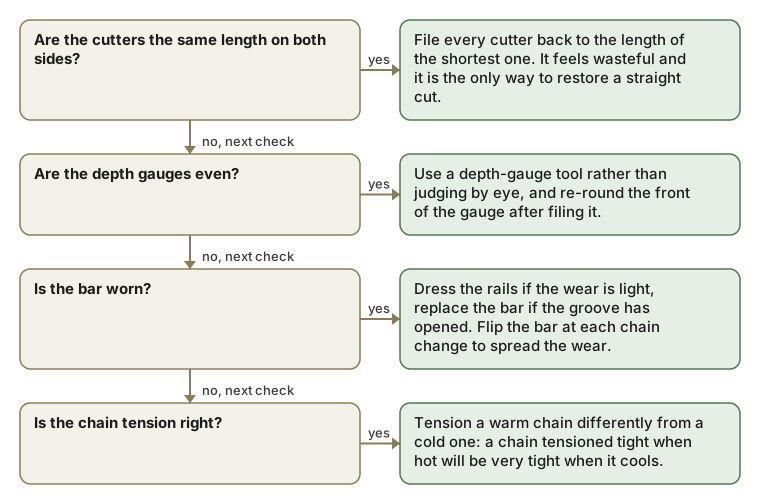
Are the cutters the same length on both sides?
Look along the chain and compare the top plates. If one side is visibly shorter, usually because that side hit dirt or a nail and was filed back harder, that side removes less wood every pass and the saw curves toward it.
If that is it: File every cutter back to the length of the shortest one. It feels wasteful and it is the only way to restore a straight cut.
Are the depth gauges even?
The depth gauge (the raker) in front of each cutter sets how deep that cutter can bite. Uneven gauges produce uneven bite even with perfectly matched cutters, and gauges that have never been touched across several sharpenings leave a chain that rubs rather than cuts.
If that is it: Use a depth-gauge tool rather than judging by eye, and re-round the front of the gauge after filing it.
Is the bar worn?
Check the rails: if the groove has widened or one rail is lower than the other, the chain leans and no amount of sharpening will fix the cut. Stand a straight edge against the side of the bar and the chain: a chain that visibly tilts is a bar problem.
If that is it: Dress the rails if the wear is light, replace the bar if the groove has opened. Flip the bar at each chain change to spread the wear.
Is the chain tension right?
A slack chain wanders and can jump the bar; an over-tight chain binds, heats and wears the bar nose. The usual check is that the chain can be pulled a short way off the underside of the bar and snaps back, and that it still moves freely by gloved hand.
If that is it: Tension a warm chain differently from a cold one: a chain tensioned tight when hot will be very tight when it cools.
Smoking, dust instead of chips, and heat
Two separate faults produce a saw that smokes in the cut, and the sawdust tells you which.
| What comes out of the cut | What it means | What to do |
|---|---|---|
| Coarse chips, the size of rice grains | The chain is sharp and biting correctly. This is what a working saw produces. | Nothing. This is the target. |
| Fine dust, and you have to lean on the saw | The chain is dull, or the depth gauges are too high so the cutters cannot reach the wood. | Sharpen; then check the depth gauges, which is the step people miss after several sharpenings. |
| Smoke from the bar, and the bar is hot | The chain is running dry: the oiler is not delivering, or the oil is too thick for the temperature. | Stop. Check the oil tank, the outlet hole in the bar mounting face and the bar groove, all of which pack with sawdust. |
| Smoke from the wood but a cool bar and coarse chips | Resinous or very dry timber, or a deep cut with limited chip clearance. Often not a fault. | Relieve the cut and let the chain clear itself. |
A bar that has been run dry shows blue heat discoloration near the nose and burrs along the rails. That damage does not reverse: the steel has been tempered by the heat. The cheap check that prevents it: your bar oil tank should empty at roughly the same rate as your fuel tank.
If you finish a tank of fuel with oil left over, the oiler is not working.
Working a suspect saw, in order
-
Check the oil is being delivered
Hold the running saw with the bar nose a hand’s width from a light-colored surface and open the throttle briefly. A visible line of oil should appear. No line means stop cutting.
-
Look at the debris
Chips mean sharp; dust means dull. This tells you whether to sharpen at all before you spend an hour filing.
-
Compare cutter lengths left and right
The single most common cause of a curved cut, and the one that takes the most patience to correct.
-
Check the depth gauges with a tool
Not by eye. After three or four sharpenings they are almost always too high.
-
Inspect the bar rails and groove
If the chain leans, the chain is not the problem. Flip or replace the bar.
-
Check the sprocket
Hooked teeth on the drive sprocket wear a new chain quickly. Sprocket, bar and chain are a wearing set: see chain, pitch and gauge.
Chainsaw cuts crooked or smokes: questions
Why does my chainsaw cut in a curve?
Because the cutters on one side are removing less wood than the other, so the saw steers toward the side that cuts less. Usually one side hit dirt or a nail and was filed back harder, leaving it shorter. File every cutter back to the length of the shortest one, and also check the depth gauges are even and the bar rails are not worn, because a leaning chain on a worn bar produces the same curve.
Why does my chainsaw make fine dust instead of chips?
Because the chain is dull, or the depth gauges are too high so the cutters cannot reach the wood, and after three or four sharpenings the gauges are almost always the missed step. A sharp, correctly gauged chain throws coarse chips the size of rice grains and does not need you to lean on it; fine dust with pressure means sharpen, then lower the depth gauges with a tool rather than by eye.
Why is my chainsaw bar smoking and getting hot?
Because the chain is running dry. The oiler is not delivering, or the oil is too thick for the temperature. Stop cutting and check the oil tank, the outlet hole in the bar mounting face, and the bar groove, all of which pack with sawdust.
A bar run dry develops permanent blue heat marks and burred rails; the everyday check is that the bar-oil tank should empty at roughly the same rate as the fuel tank.
How do I check my chainsaw oiler is working?
Hold the running saw with the bar nose a hand’s width from a light-colored surface and briefly open the throttle; a visible line of oil should be flung onto it. No line means stop cutting and find out why before the bar overheats. The everyday version of the same check is that if you finish a tank of fuel with bar oil left over, the oiler is not delivering as it should.
Why does filing every cutter to the length of the shortest one fix a chain cutting crooked?
Because uneven cutter length means one side of the chain removes less wood per pass than the other, and the saw steers toward the side cutting less: filing all cutters down to match the shortest one restores equal removal on both sides, which is what makes the saw cut straight again, even though it sacrifices some cutter length in the process.
What are depth gauges on a chainsaw chain, and why do they need lowering after repeated sharpenings?
Depth gauges are the raised tabs in front of each cutter that limit how deep the cutter can bite into the wood on each pass. As cutters are repeatedly filed back during sharpening, they get shorter while the depth gauges stay the same height, eventually limiting the cutter's bite so much that the chain produces fine dust instead of chips even though the cutters themselves are sharp.
Can a worn drive sprocket cause a chainsaw to cut crooked?
A worn sprocket more commonly causes chain slack, jumping, or accelerated chain wear rather than crooked cutting specifically: uneven cutter length or a worn bar rail are the more likely causes of a curving cut, but a badly worn sprocket is worth inspecting as part of a broader chain-and-bar health check if the crooked-cutting fix doesn't fully resolve the symptom.
Does bar oil viscosity need to change with the season, the way engine oil sometimes does?
Yes for extreme temperature ranges: a bar oil too thick for cold weather flows poorly and can starve the bar despite a functioning oiler, while summer-weight oil in very cold conditions may not reach the bar tip efficiently. Some manufacturers offer a winter-weight bar oil specifically for this reason; check the oil's own temperature rating rather than assuming one weight works year-round in a cold climate.
What does it mean if only part of the bar rail shows wear, rather than the whole length?
Localized rail wear typically indicates the chain sits unevenly in the groove at that specific point, often from a chain that's been run too loose (allowing it to bounce in the groove) or from repeated cutting concentrated at one section of the bar: inspecting for a groove width that's widened specifically at the worn section helps confirm this before replacing the whole bar.
Is it normal for a chainsaw to produce some smoke when cutting dense, dry hardwood even with a well-oiled chain?
A small amount of friction-generated warmth is normal in dense wood, but genuine visible smoke from the bar or chain is not. It specifically indicates the chain is running hotter than the bar oil can manage, whether from insufficient oil delivery, a dull chain generating excess friction, or both, and should be treated as the oiler-check symptom the guide describes rather than dismissed as normal for hard wood.
Why does a chain need to be re-tensioned periodically, and does loose tension affect cutting quality?
A chain stretches slightly with normal use and heat cycling, and a chain that's too loose can derail from the bar or cut erratically as it bounces rather than tracking smoothly in the groove: checking and adjusting tension is routine maintenance distinct from sharpening, and a loose chain can produce cutting-quality symptoms that look similar to a dull or unevenly filed chain.
Should I suspect the chain or the bar first if a saw both cuts crooked and smokes at the same time?
Check the oiler and bar condition first, since smoking indicates an active thermal problem that can itself distort cutting behavior. A bar running hot from oil starvation can also produce erratic, crooked-feeling cuts as the chain binds slightly in an overheating groove, so resolving the smoking symptom may also resolve what initially looked like a separate crooked-cutting fault.