Choose a pressure washer: flow, supply, nozzle and surface
Choose a pressure washer for the surface, usable flow, water supply and supported accessories. PSI × GPM is a comparison number, not a guarantee of equal cleaning speed or surface safety. Confirm the manufacturer’s inlet requirements and nozzle size before buying a machine your tap cannot supply.
Measure supply against the specified minimum
Simpson’s low-pressure guidance calls for at least 5 GPM at 20 PSI for the machines it addresses. That is more demanding than simply matching a 2.5-GPM pump’s advertised output. Use the actual model’s inlet specification.
For a bucket test, five US gallons delivered in 75 seconds is 5 × 60 ÷ 75 = 4 GPM. It fails that published 5-GPM flow requirement even though it exceeds a hypothetical 2.5-GPM output rating. A bucket test does not establish pressure while flowing; obtain that check separately if needed.
Keep pressure, flow and nozzle identity together
| Item | What to establish |
|---|---|
| Pressure / PSI | Surface and accessory limits; usable operating figure |
| Flow / GPM | Actual output plus sufficient inlet supply |
| Nozzle | Approved orifice and spray angle |
| Pump | Service parts, oil instructions and replacement cost |
| Power source | Outlet/fuel needs, safe access and duty requirements |
At 3,000 PSI × 2 GPM and 2,000 PSI × 3 GPM, both products equal 6,000. That arithmetic cannot prove either machine cleans a given surface equally or faster. Soil, nozzle, distance, chemistry and surface tolerance still matter.
Simpson’s FAQ explains nozzle and supply considerations. Color commonly indicates spray angle, while orifice size must match the pump. An injector’s soap pickup depends on its required low-pressure setup; not every detergent system works identically.
Do not use pressure to compensate for the wrong tool
Test the manufacturer-approved method on an inconspicuous area and follow surface instructions. A narrow jet can damage paint, wood and masonry. Use a rated accessory and compatible hose; a higher maximum rating does not make a weak fitting safe.
CDC warns that spray wounds may look minor and urges prompt medical attention. Never test a pressure leak with a hand or point the spray at a person. Gasoline machines also need safe exhaust placement; battery/electric equipment still has pressure and electrical hazards.
How to size a pressure washer
A pressure washer purchase goes wrong in one direction far more than the other: buying more machine than the job needs, which is a safety and surface-damage problem, not just an overspend. The bands here start from the job, a car and patio furniture need a fraction of the pressure a concrete driveway with years of grime does, and point at electric or gas based on duty cycle and where the work happens, not on which is generally "better." PSI is also only half of what a machine is sold on; the equipment page covers why PSI multiplied by GPM, cleaning units, is the number that predicts how fast a job finishes.
Match the band to the job, not the job to the machine you saw first
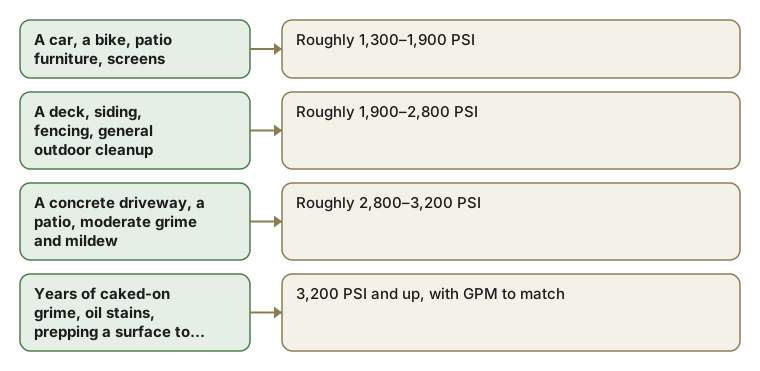
Pressure washers cluster into rough bands by what they are built to clean, and compare the cleaning job first rather than the biggest number on the box. A machine well above what a job needs is not "extra safety margin," it is a tool that strips wood decking and etches soft brick if the operator does not compensate with distance and nozzle choice.
| The job | Rough PSI band | Typical power source |
|---|---|---|
| A car, a bike, patio furniture, screens | Roughly 1,300–1,900 PSI | Electric: corded is fine; low duty cycle, no fuel storage between uses. |
| A deck, siding, fencing, general outdoor cleanup | Roughly 1,900–2,800 PSI | Electric for occasional use; gas if it is a regular chore across a large property. |
| A concrete driveway, a patio, moderate grime and mildew | Roughly 2,800–3,200 PSI | Gas: the flow (GPM) at this pressure usually needs more than a standard outlet circuit supports. |
| Years of caked-on grime, oil stains, prepping a surface to paint or seal | 3,200 PSI and up, with GPM to match | Gas, commercial-duty pump: this is the point where cleaning units, not PSI alone, is the number to compare. |
PSI is only half the machine. Pressure washers in full covers why PSI multiplied by GPM, cleaning units, is the number that predicts how fast a job gets done, and the nozzle calculator turns your machine's own rating plate into the correct nozzle and an exact cleaning-units figure.
When the cleaning job exceeds an electric model’s capacity
Electric pressure washers are quieter, need no fuel storage, and are adequate for most residential jobs under about 2,000 PSI. They lose the case on two things specifically: sustained high-flow work, where a standard household circuit limits the motor before the pump is the limits, and any job away from an outlet, where a cord run defeats the convenience that was the point of buying electric. If the job is a driveway every spring and nothing else, either works; if it is a monthly or seasonal business use, or a property with no convenient outlet near the work, gas earns its extra weight and its fuel-storage requirement.
How much water your supply can deliver
A machine rated at 3.0 GPM is only that fast if the tap and hose can deliver 3.0 GPM to it: time filling a five-gallon bucket and multiply to check your own supply before assuming a higher-GPM machine will finish faster. A supply that cannot keep up causes the pump to cavitate, which reads as pulsing pressure and is diagnosed in full on pressure washer has no pressure.
A high-pressure stream at close range can inject water under the skin through what looks like a pinhole, and it is a surgical emergency that does not look serious for the first few hours. Buying more machine than a job needs is a safety decision as much as a budget one. The highest band above is not the "better" choice for a car or a deck.
How to size a pressure washer: questions
What PSI pressure washer do I need for a driveway?
Roughly 2,800–3,200 PSI for a concrete driveway with moderate grime, more if you are removing years of caked-on staining rather than doing routine seasonal cleaning. A car, bike or patio furniture needs far less, roughly 1,300–1,900 PSI, and using a driveway-rated machine on those surfaces risks stripping or etching them.
Is an electric or a gas pressure washer better for home use?
Electric covers most occasional residential jobs under about 2,000 PSI well, with less noise and no fuel storage. Gas earns its extra weight and maintenance for sustained high-flow work, frequent or business use, or any job away from a power outlet, since a standard household circuit limits an electric motor before the pump reaches its own operating limit.
What size pressure washer do I need for a house exterior?
Siding work generally wants moderate pressure and good flow rather than maximum PSI: roughly 1,900–2,800 PSI with a wide-fan nozzle, since the goal is rinsing a large area evenly rather than stripping a small one aggressively. Cleaning units, PSI multiplied by GPM, predicts how fast the job finishes better than PSI alone.
Why does my pressure washer seem underpowered for its rated PSI?
Most often the water supply, not the machine: a pump cannot exceed what the tap and hose deliver, and an undersized supply causes cavitation that reads as pulsing, weak pressure. Time filling a bucket of known volume and compare it to the machine’s rated GPM before assuming the pump itself has failed.
How much PSI do I need to clean concrete?
Roughly 2,800–3,200 PSI for a concrete driveway or patio with ordinary grime, and toward the higher end or into commercial-duty territory for years of caked-on staining. Pair it with enough GPM to rinse the loosened dirt away: PSI alone strips the surface faster than it clears it if flow is too low.
How much GPM do I need for a pressure washer?
GPM matters as much as PSI once the job is bigger than a single panel. It is what carries loosened dirt away and covers ground, which is why PSI multiplied by GPM, cleaning units, predicts job speed better than PSI alone. For most residential work, 1.5–2.5 GPM is the practical range; confirm your own water supply can deliver a machine’s rated GPM before buying toward the top of that range.
Is there a pressure washer that doesn’t need a hose?
A small number of battery-powered pressure washers draw from an open container, a bucket or an integrated tank, instead of a pressurized hose line, which is useful where no spigot is nearby. They trade that convenience for much lower PSI and GPM than a hose-fed machine and a limited runtime per charge, so they suit light jobs like patio furniture or a car rather than a driveway. The overwhelming majority of pressure washers, including every gas machine, require a continuous water feed at a rated flow rate and cannot run from a bucket.
Do pressure washers need to be connected to an outside tap?
Yes: a pressure washer needs a continuous water feed at or above its rated GPM, which in practice means an outdoor spigot with a garden hose, not an indoor tap sized for a sink. Confirm your outside tap can deliver the machine’s rated flow (time filling a five-gallon bucket) before assuming it will; an undersized supply starves the pump and reads as pulsing, weak pressure rather than a hose problem.
Is there a pressure washer nozzle size chart?
The standard is a color-and-angle chart rather than a size chart: red is 0 degrees, yellow 15, green 25, white 40, and black is the low-pressure soap nozzle. Every colored nozzle in a set for one machine shares the same orifice size and differs only in spray angle: narrower concentrates more force on less area. See pressure washers in full for the complete chart and where each nozzle belongs.
Which pressure washer nozzle should I use to wash a car?
The green 25-degree nozzle is the general-purpose choice for a car: wide enough to avoid concentrating force on paint or trim, which the narrower red and yellow nozzles can damage. Finish with the white 40-degree nozzle for a gentle final rinse, and use the black soap nozzle separately to apply detergent, since it is the only one with an orifice large enough for the detergent injector to draw.
What pressure washer tip do I need for a car?
The green 25-degree tip, for the same reason a car needs the general-purpose nozzle rather than a concentrated one: enough angle to spread force across paint and trim instead of etching a line into it. "Tip" and "nozzle" name the same part; both terms are used interchangeably across manufacturers.
How much PSI is needed for a pressure washer to clean concrete or a driveway?
Roughly 2,800–3,200 PSI is needed for ordinary grime on a concrete driveway or patio, and toward the higher end or into commercial-duty territory for years of caked-on staining. GPM matters alongside PSI: flow is what rinses the loosened dirt away, so a high-PSI, low-GPM machine strips a surface faster than it clears it.
How much GPM is needed for a pressure washer?
For most residential work, 1.5–2.5 GPM is the practical range needed. GPM matters as much as PSI once a job is bigger than a single panel, because it is what carries loosened dirt away and covers ground. Confirm your own water supply can deliver a machine’s rated GPM before buying toward the top of that range; an undersized tap starves the pump regardless of what the machine is rated for.
What is the best time of year to buy a pressure washer?
Late summer through fall, after the peak spring-and-early-summer cleaning season, is when retailers are clearing current-model inventory ahead of the next season’s stock. Buying in spring, right before you need it, guarantees availability of the current lineup but at the point of highest demand.
What is the best time to hire (rent) a pressure washer or electric pressure washing equipment instead of buying?
Any time the job is a one-off rather than a recurring chore, a single move-out cleaning, prepping one surface before painting, renting avoids owning a machine that then sits idle most of the year.
Pressure washers
A pressure washer is sold on pressure and does its work on flow. Pressure breaks the bond between the dirt and the surface; flow carries the dirt away and covers ground. That is why two machines with very different headline numbers can do the same work: 3,000 PSI at 2.0 GPM and 2,000 PSI at 3.0 GPM are both 6,000 cleaning units, and the second one will rinse a driveway noticeably faster.
The other three things worth knowing before buying are that the nozzle colors are spray angles rather than sizes, that detergent will only siphon through the large-orifice black nozzle, and that the pump type, axial or triplex, decides whether the machine is repairable in five years or disposable.
PSI sells it, GPM finishes it
Pressure removes the bond between the dirt and the surface. Flow carries the dirt away and covers the area. A machine with high pressure and low flow strips a small patch beautifully and takes all afternoon to do a driveway; a machine with moderate pressure and good flow does the same driveway in an hour.
Multiply them and you get cleaning units, which is the comparison that survives the marketing:
PSI
Pressure at the nozzle
Breaks the bond between dirt and surface.
GPM
Flow in gallons per minute
Carries the dirt away and covers ground.
PSI × GPM
Cleaning units
3,000 × 2.0 and 2,000 × 3.0 are the same 6,000, and the second one rinses faster.
The nozzle calculator works both the cleaning-unit figure and the orifice size your machine needs, which is the part most owners never check.
The nozzle color is an angle, not a size
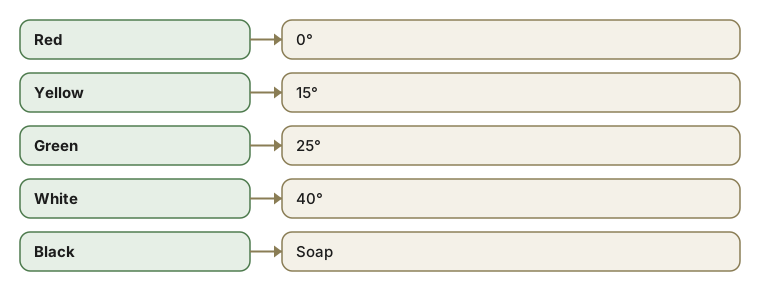
A pressure washer's nozzles are color-coded by spray angle: red is 0 degrees, yellow 15, green 25, white 40, and black is the low-pressure soap nozzle. All of the colored nozzles in a set for one machine share the same orifice size and differ only in how wide the fan is. Narrower means more force concentrated on less area, which is why a red 0-degree nozzle carves a line into decking and should almost never be used on anything a homeowner owns.
The black soap nozzle is the exception: it has a much larger orifice, which drops the pressure at the pump enough for the detergent injector to draw. That is why soap only siphons with the black nozzle fitted, and why a machine that "will not pick up detergent" is usually a machine with the wrong nozzle on it.
| Nozzle | Angle | Where it belongs |
|---|---|---|
| Red | 0° | A concentrated jet. Rust or caked material on steel or concrete, briefly. Never on wood, siding, or a vehicle. |
| Yellow | 15° | Stripping paint, heavy grime on hard surfaces, preparation work. |
| Green | 25° | The general-purpose nozzle: concrete, brick, patio furniture, most driveway work. |
| White | 40° | Rinsing, siding, vehicles, anything where the surface matters more than the dirt. |
| Black | Soap | Large orifice, low pressure. The only nozzle that lets the detergent injector draw. |
Axial and triplex pumps: the repairability question
Most domestic machines use an axial cam pump, in which the pistons run parallel to the driveshaft. It is compact, cheap, and normally a sealed assembly, when it fails, the economics usually point at a whole pump rather than a rebuild. A triplex pump has three pistons driven by a crankshaft, runs cooler and slower, is serviceable, and is what commercial machines use.
If you intend to keep a machine for a decade, the pump type is a larger factor in that than the engine is.
Whatever the pump, the failure to avoid is running it dry or in bypass. When the trigger is released the pump recirculates water instead of stopping, and that water heats up. Leaving a machine idling in bypass for several minutes cooks the seals, which is why manuals ask you to stop the engine if you are pausing for more than a minute or two.
A high-pressure stream can inject water and contamination under the skin through what looks like a pinhole. An injection injury is a surgical emergency and it does not look like one for the first few hours. If it happens, go to an emergency department and say the words "high pressure injection injury".
Where the water comes from
A pressure washer cannot draw more water than it is fed. If the supply hose or the tap cannot deliver the machine's rated flow, the pump cavitates: the symptom is pulsing pressure, a rattling pump and eventually damage.
Before blaming the machine for weak output, time how long the supply takes to fill a bucket of known volume and compare it against the rating plate. That measurement resolves the complaint on a pressure washer with no pressure more often than any part does.
Pressure washers: questions
What is more important on a pressure washer, PSI or GPM?
Both, and the plain comparison is the two multiplied together as cleaning units. Pressure breaks the bond between the dirt and the surface; flow carries the dirt away and covers ground. That is why 3,000 PSI at 2.0 GPM and 2,000 PSI at 3.0 GPM are both 6,000 cleaning units and do the same work, and the second one, with more flow, rinses a driveway noticeably faster.
What do the pressure washer nozzle colors mean?
They are spray angles, not sizes: red is 0 degrees, yellow 15, green 25, white 40, and black is the low-pressure soap nozzle. All the colored nozzles in a set for one machine share the same orifice and differ only in fan width. Narrower concentrates more force on less area, which is why the red 0-degree tip can carve a line in decking and should almost never be used at home.
Why will my pressure washer not pick up detergent?
Almost always the wrong nozzle. Detergent only siphons with the black soap nozzle fitted, because its much larger orifice drops the pressure at the pump enough for the injector to draw. A machine that "will not pick up soap" is usually one with a high-pressure colored nozzle on it, and fitting the black nozzle resolves the complaint without any parts at all.
What is the difference between an axial and a triplex pump?
An axial cam pump, used on most domestic machines, runs its pistons parallel to the driveshaft; it is compact, cheap and usually a sealed assembly, so a failure tends to mean a whole new pump. A triplex pump has three pistons on a crankshaft, runs cooler and slower, and is serviceable, which is what commercial machines use. If you plan to keep a machine a decade, the pump type matters more than the engine.
Why does my pressure washer pulse or lose pressure?
A pressure washer cannot draw more water than it is fed, so a supply hose or tap that cannot deliver the rated flow starves the pump and it cavitates: the symptom is pulsing pressure and a rattling pump. Before blaming the machine, time how long the supply takes to fill a bucket of known volume and compare it against the rating plate; the feed is the cause more often than any part.
What size pressure washer do I need?
Size it in cleaning units, PSI multiplied by GPM, against the job rather than the PSI figure alone. Light residential jobs like patio furniture and vehicles are well served under about 2,000 cleaning units; a driveway or a deck generally wants 2,000 to 3,000; stripping paint or heavy commercial-grade cleaning pushes higher, where flow (GPM) matters as much as pressure for covering ground quickly. Buying on PSI alone is the common mistake, because two machines with the same PSI and very different GPM finish a job at very different speeds.
What PSI and GPM do I need to clean a driveway or concrete?
Most concrete driveways clean well in the 2,000 to 3,000 cleaning-units range (PSI times GPM), with flow doing more of the actual work of rinsing loosened dirt away than pressure alone. Higher PSI than that risks etching softer or older concrete, especially at close nozzle distance with a narrow-angle tip, so more pressure is not automatically the safer or faster choice on this surface.
How much does a pressure washer cost?
Price tracks PSI and GPM rating, pump type (axial for residential, triplex for commercial-grade use) and power source far more than brand: a light-duty electric unit sits at one price band, a gas machine with a triplex pump at a considerably higher one. The cleaning-units target for your job is what to settle first, then compare current prices for machines at that rating.
What pressure washer should I buy?
What is answerable here is the class decision: settle the cleaning-units target for your job first (see the sizing guidance above), decide between electric (lighter, no fuel, less powerful) and gas (more powerful, more maintenance), and check the pump type if you intend to keep the machine for a decade.
Do I need a pressure washer buying guide before I choose a nozzle?
Settle the machine first, using cleaning units against your job, then treat the nozzle as a separate decision: the pressure washer nozzle calculator works out the exact orifice size and the nearest commonly stocked one from your pump’s rated flow and working pressure, which is a different question from which machine to buy.
Belt-drive or direct-drive pressure washer, which is better?
Direct-drive, where the engine crankshaft turns the pump directly, is lighter, cheaper and standard on nearly every residential machine. Belt-drive, where a belt and pulley step the engine speed down to the pump, runs the pump slower and cooler under sustained load, which is why it appears on commercial-duty and larger gas machines built for long daily run times rather than occasional weekend jobs. For typical residential use the direct-drive design is not a compromise; belt-drive earns its extra weight and cost specifically on duty cycle.
What size pressure washer do I need for a 2-story home exterior?
The height changes technique more than it changes machine size: a wide-fan nozzle and moderate pressure (roughly 1,900–2,800 PSI) still apply, but reaching a second story safely means a wand extension or working from a ladder with the trigger controlled at ground level where possible, not simply buying more PSI to compensate for distance. More pressure at range does not fix reach; it just makes an already awkward angle more dangerous on siding and windows.
What type of pressure washer do I need: electric or gas?
Electric covers most occasional residential jobs under about 2,000 PSI well, with less noise, no fuel storage and generally an axial pump. Gas earns its extra weight and maintenance for sustained high-flow work, frequent or business use, or any job away from a power outlet, since a standard household circuit limits an electric motor’s output before the pump itself becomes the limits, and gas machines more often carry the serviceable triplex pump worth having if you plan to keep the machine for a decade.
How many watts or amps does an electric pressure washer use?
Most residential electric pressure washers draw somewhere in the 1,200 to 1,800 watt range, roughly 10 to 15 amps on a standard 120-volt household circuit, which is also why a standard circuit caps how powerful an electric unit can be before the pump becomes the limiting factor rather than the motor. Check the machine’s own nameplate rating before running it on an extension cord or a shared circuit with other loads.
What size surface cleaner attachment do I need for my pressure washer?
Match the surface cleaner’s rated PSI and GPM to your machine’s own rating rather than buying by diameter alone: an attachment rated below your pressure washer’s output is wasted capacity, and one rated above it will not spin at full speed. For reach, a two-story home’s siding is a job for extension wands and a wide-fan nozzle rather than a surface cleaner, which is a flat-surface tool (driveways, patios, decks) and is not designed to be used vertically or overhead.
Do electric pressure washers need oil?
The electric motor itself never needs oil. That is true regardless of pump type. Whether the pump needs an oil check depends on which pump is behind it, not on the power source: most electric residential machines use a sealed axial pump with no oil service at all, while a smaller number of higher-end electric and most gas commercial-grade machines use a serviceable triplex pump that does have an oil level to check.
Check the machine’s own manual for a pump oil sight glass or fill plug before assuming either way.