Pressure washer has no pressure: check inlet supply before pump parts
Verify the actual inlet flow and pressure requirements, water connection and correct nozzle before suspecting the pump. Low pressure, pulsing and detergent mode can have different causes.
Stop for leaks or damaged pressure parts. Never check a high-pressure leak with a hand, run the pump dry or change an unloader setting by guesswork.
Use the inlet requirement, not just rated output
Simpson’s low-pressure guidance specifies at least 5 GPM at 20 PSI for the described supply. A washer rated to discharge 2.5 GPM does not therefore accept a 2.6-GPM supply just because the two numbers are close.
A five-gallon bucket filled in 75 seconds shows 5 ÷ 1.25 = 4 GPM in that flow test. It falls 1 GPM below the cited minimum. An open bucket test still does not establish the available inlet pressure while flowing.
Record the nozzle and behavior
| Check | Limit of the observation |
|---|---|
| Supply and inlet screen | Use approved inspection and cleaning |
| Correct nozzle / orifice | Color alone does not establish every manufacturer’s specification |
| Pressure pulse | Air, restriction and other faults still need diagnosis |
| Engine slows with trigger | Evaluate load and engine condition as well as the pump |
Simpson’s FAQ specifies its black low-pressure nozzle for detergent application. Low pressure in that mode can be expected. A nozzle that fits the quick connector can still have the wrong orifice for the pump.
Do not turn a control adjustment into a diagnosis
An unloader or internal valve fault needs the pump’s test procedure and proper pressure equipment. Similar symptoms do not justify increasing pressure or replacing the unloader automatically. Bypass and dry-run limits also vary; use the machine’s instructions for pauses and shutdown.
Depressurize and isolate by the actual manual before disconnecting components. A hose can retain dangerous pressure after the engine stops. Use the nozzle calculation to understand orifice sizing and pump storage guidance to prevent another freeze-related failure.
TS-08 · Troubleshooting
Pressure washer has no pressure
Before anything is taken apart, prove the water going in. A pressure washer cannot pass more water than it is fed, and an inadequate supply is the most common cause of weak or pulsing output by a wide margin: it also produces exactly the symptoms that get blamed on the pump. Find the machine’s rated flow on the plate, fill a bucket of known volume from the supply hose with the tap fully open and time it, and compare.
If the supply cannot comfortably exceed the rating, the pump is starving and no replacement part will change that. While you are there, pull the small inlet screen where the hose meets the pump, because that is the second most common cause and it costs nothing to check.
Release the pressure before disconnecting anything: stop the engine or motor, then squeeze the trigger until the flow stops. A hose that still holds pressure will whip when it is uncoupled.
The bucket test, before you take anything apart
A pressure washer cannot pass more water than it is fed, and an inadequate supply is by far the most common cause of weak or pulsing output. Measuring the supply takes two minutes and removes the largest single possibility.
-
Find the machine’s rated flow
On the rating plate, in gallons per minute. This is the number the supply has to beat.
-
Fill a container of known volume from the supply hose
A five-gallon bucket, timed, with the tap fully open and the hose connected exactly as you use it.
-
Work out the actual flow
Gallons divided by minutes. If the supply cannot comfortably exceed the machine’s rating, the machine is starved and the pump will cavitate no matter what you replace.
-
Check the inlet filter while you are there
There is a small screen where the hose connects to the pump. It blocks with grit from the supply and it is the second most common cause.
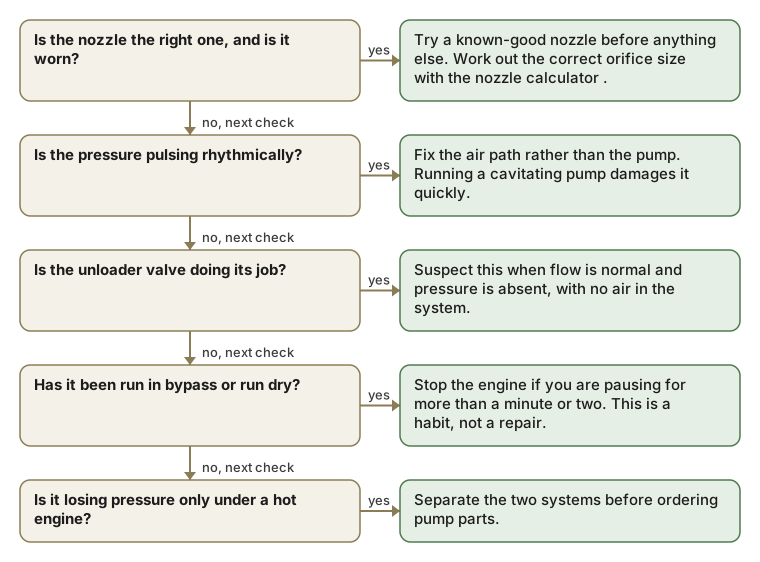
The sequence after the supply is proved
Is the nozzle the right one, and is it worn?
Fitting the black soap nozzle leaves the machine at low pressure by design: that is what allows the detergent injector to draw. A worn orifice on any nozzle passes more water at lower pressure, which is why an older machine gradually feels weaker. Nozzles are cheap and are a consumable.
If that is it: Try a known-good nozzle before anything else. Work out the correct orifice size with the nozzle calculator.
Is the pressure pulsing rhythmically?
Pulsing is the signature of air in the pump, or of the pump being starved. Air comes from a loose inlet fitting, a split supply hose or an inlet filter that is partly blocked. Purge the system by running water through with the trigger held open and the engine off until the flow is steady.
If that is it: Fix the air path rather than the pump. Running a cavitating pump damages it quickly.
Is the unloader valve doing its job?
The unloader diverts flow back to the pump inlet when the trigger is released. A worn or stuck unloader can leave the machine permanently in bypass, full flow, no pressure, or cause chattering. It is a serviceable part on most machines.
If that is it: Suspect this when flow is normal and pressure is absent, with no air in the system.
Has it been run in bypass or run dry?
With the trigger released the pump recirculates water, and that water heats. Several minutes in bypass cooks the seals; running dry does the same faster. Damage from this is cumulative and is the usual reason a pump fails early.
If that is it: Stop the engine if you are pausing for more than a minute or two. This is a habit, not a repair.
Is it losing pressure only under a hot engine?
On a gasoline machine, an engine losing power will drop pump speed and therefore pressure. If the engine note falls when the trigger is pulled, the problem is the engine, not the pump: go to surging and mixture faults.
If that is it: Separate the two systems before ordering pump parts.
Matching the symptom to the system
| What it does | Where the fault is | First thing to check |
|---|---|---|
| Steady but weak pressure from the start | The nozzle, or the machine was never rated for what you expected. | A known-good nozzle of the correct orifice size. |
| Pressure that pulses rhythmically | Air in the pump, or the pump being starved. | The supply flow and the inlet screen: the bucket test above. |
| Full flow and no pressure at all | The unloader valve stuck in bypass. | Whether flow is normal with the trigger open; if it is, look at the unloader. |
| Pressure that fades as the engine works | The engine, not the pump: pump speed follows engine speed. | Whether the engine note drops when you pull the trigger. |
Detergent that will not draw
Almost every "the soap function does not work" complaint is a nozzle. The detergent injector works on a pressure drop, and only the large-orifice black nozzle drops the pressure enough for the siphon to start. The other causes, in order of likelihood, are a blocked or perished siphon tube, a detergent too thick to draw, and an injector that has furred up because it was never rinsed with clean water after use.
Rinsing the detergent system with clean water at the end of every session takes thirty seconds and prevents most injector failures. Detergent left standing in the injector is the cause, and by the time the symptom appears the fix is much less pleasant.
Winter, and the failure that ends pumps
Water left in a pump over a freeze expands and cracks the head. That single event ends more pressure washers than wear does, and the prevention is a pump antifreeze or storage compound run through the machine before the first frost. It is covered on winter storage, and it is the item most owners of this particular machine skip.
Pressure washer has no pressure: questions
How do I know if weak pressure-washer output is the water supply?
Do the bucket test before taking anything apart. Find the machine’s rated flow on the plate, fill a container of known volume from the supply hose with the tap fully open and connected as you use it, and divide gallons by minutes. If the supply cannot comfortably exceed the rating, the pump is starving and no replacement part will fix it.
Check the small inlet screen where the hose meets the pump too.
Why does my pressure washer pulse?
Pulsing is the signature of air in the pump or the pump being starved. The air comes from a loose inlet fitting, a split supply hose, or a partly blocked inlet filter. Purge the system by running water through with the trigger held open and the engine off until the flow is steady, and fix the air path rather than the pump: running a cavitating pump damages it quickly.
My pressure washer has full flow but no pressure. What is wrong?
Suspect the unloader valve, which diverts flow back to the pump inlet when the trigger is released. A worn or stuck unloader can leave the machine permanently in bypass, full flow, no pressure, or cause chattering. It is a serviceable part on most machines, and this is the fault to look at when flow is normal, there is no air in the system, and pressure is simply absent.
Why will my pressure washer not draw detergent?
Almost always the nozzle. The detergent injector works on a pressure drop, and only the large-orifice black soap nozzle drops the pressure enough for the siphon to start: a colored high-pressure tip will not. After that, the causes in order are a blocked or perished siphon tube, a detergent too thick to draw, and an injector furred up because it was never rinsed with clean water after use.
How should I test a gas pressure washer before the first job of the season?
Run it briefly on water alone before ever pulling the trigger under load: connect the water supply and confirm flow through the machine first, then start the engine and squeeze the trigger to confirm the engine holds a steady idle and pressure builds rather than pulsing. That short sequence catches a stale-fuel no-start, a starved water supply, and a pump left in bypass all before you are standing in front of a car or a deck relying on it working.
What is the bucket test, exactly, and why does it come before any other diagnostic step?
It's finding the machine's rated flow on its data plate, then timing how long the actual water supply takes to fill a container of known volume with the tap fully open, and dividing gallons by minutes to get real supply flow. It comes first because if the supply can't match the rated flow, no amount of pump or unloader-valve repair fixes weak pressure: the problem is upstream of the machine entirely.
Why does trapped air make a pressure washer pulse?
Because air is compressible and water is not: a pump alternately drawing air and water produces an inconsistent, pulsing output as it cycles between compressing the compliant air pocket and pushing incompressible water, rather than the smooth, steady flow it produces when the intake is fully purged of air and only handling water.
Can running a pressure washer with an air leak or starved supply damage the pump permanently?
Yes: running a cavitating pump (one alternately drawing air and losing prime) damages internal components relatively quickly, since the pump isn't designed for that intermittent, uneven loading. This is why the page recommends fixing the air path or supply issue immediately rather than continuing to run the machine through a pulsing symptom.
Why does only the black soap nozzle allow detergent to draw, and not the colored spray nozzles?
The detergent injector works by creating a pressure drop that siphons detergent from its container, and only the black nozzle's much larger orifice drops pressure enough to create that siphon effect: any of the colored high-pressure nozzles maintain too much pressure for the injector to draw detergent at all, regardless of spray angle.
Does a worn unloader valve always cause full flow with no pressure, or can it cause other symptoms too?
A worn or stuck unloader can produce more than one symptom depending on exactly how it fails: permanently stuck in bypass produces the full-flow-no-pressure pattern the guide describes, while a partially sticking unloader can instead cause chattering or pressure that surges and drops rather than staying uniformly absent.
How often should the detergent injector and siphon tube be rinsed to prevent clogging?
After every use involving detergent: the guide notes that an injector left un-rinsed after detergent use is one of the causes of a furred-up injector that eventually stops drawing detergent at all. Running clean water through the system briefly after finishing a soap application prevents residue from drying and accumulating inside the injector and tube.
Does testing on water alone before the first job of the season also catch a worn nozzle?
Not fully: running the machine on water alone confirms engine idle stability, water flow, and whether pressure builds at all, but a worn nozzle passing slightly more water at slightly lower pressure than a new one may not be obvious in that short test. Comparing pressure feel against memory of the machine's performance when the nozzle was newer, or checking the nozzle's physical orifice, catches that specific wear pattern.