Air and fuel filters: identify the element before cleaning
Identify the actual filter and its service instructions before washing, oiling or using compressed air. Paper, foam and felt elements have model-specific exceptions.
Match fuel filters to the approved part, flow direction and fuel-delivery system. Similar shape or hose size alone does not prove compatibility.
Four instructions that cannot be merged
| Source / element | Instruction distinction |
|---|---|
| Cited Honda GX120/160 paper element | Permits air from inside, no more than 30 PSI |
| Cited Toro TimeCutter paper element | No compressed air or washing liquids |
| Cited Kawasaki FR foam element | Wash/dry; do not oil |
| Cited STIHL FS56 felt element | Do not wash |
The Honda GX instructions limit compressed-air pressure and direction. The Toro manual expressly prohibits that cleaning method for its paper element. A generic “all paper filters” rule would give the wrong procedure for at least one of them.
Likewise, the Kawasaki service manual says not to oil the relevant elements, while the FS56 felt-filter instructions do not permit washing. Use the actual element’s directions and replace damaged media or seals.
A pressure limit is not a target to exceed
In the cited Honda instruction, 30 PSI is the ceiling. A 90-PSI shop line is three times that number before any regulator adjustment. This comparison does not authorize compressed air on a filter whose manual prohibits it.
Fuel delivery needs a qualified part
Match the model-specific fuel-filter specification and indicated direction. Gravity-fed and pumped systems can require different restrictions. A universal clear filter with the same hose size is not proof of suitability.
Work with the engine cool and fuel controlled by the manual’s procedure. Do not clamp brittle hose with improvised tools, open a hot fuel cap as a test or fish a pickup out with a sharp wire that can damage the line.
A dirty filter is one possible cause of poor running, not a complete diagnosis. Look for damaged intake seals or hose leaks during the authorized inspection and correct them before operating.
PT-05 · Parts
Air and fuel filters
The air filter is the cheapest part on the machine and has the largest single effect on how it runs, because an engine meters fuel against the air it draws: restrict the air and the mixture goes rich, the machine loses power, the plug blackens and it may stop idling. Outdoor equipment works at ankle height inside its own dust cloud, so the service interval that suits a car is far too long here. There are three types and they are serviced three different ways: foam is washed and lightly oiled, paper is tapped out and eventually replaced but never washed or blown out, and a dual-element setup is a foam pre-cleaner over a paper element where owners routinely service one and forget the other.
Three kinds of air filter, serviced three different ways
| Type | Where you see it | Service |
|---|---|---|
| Foam | Small engines, trimmers, older mowers, and as a pre-cleaner wrapped around a paper element. | Washable. Wash in warm soapy water, dry completely, then oil lightly with engine oil and squeeze out the excess. A dry foam element filters very little; an over-oiled one restricts airflow and runs the engine rich. |
| Paper (pleated) | Most four-stroke mower and generator engines. | Not washable. Tap it out gently against a hand; replace when tapping stops helping or when it is oily. Washing a paper element or blowing it out with compressed air ruptures the pleats and the damage is invisible. |
| Dual-element | Better machines and commercial equipment. | A foam pre-cleaner over a paper element. Service the foam often and the paper rarely. Owners frequently service one and forget the other exists. |
Compressed air is the standard wrong answer for a paper element. It is fast, it looks effective, and it blows holes through the media that let dust straight into the engine. If an element is dirty enough to want an air line, it is dirty enough to replace.
Why the cheapest part has the largest effect
An engine meters fuel against the air it draws. Restrict the air and the mixture goes rich: the machine loses power, blackens plugs, uses more fuel and sometimes will not idle. Outdoor power equipment works in the dustiest position available, at ankle height, inside its own cloud of clippings, so the interval that suits a car is far too long here.
The practical rule is that if you have never looked at it, look now, and that a filter which is visibly gray rather than white is already affecting how the machine runs. This is the cause behind a large fraction of the symptoms on surging and hunting.
The in-line fuel filter, and which way round it goes
Most small machines carry a small in-line fuel filter in the line between tank and carburetor. Two things about it catch people out. First, it has a direction: an arrow or a taper indicates flow, and fitted backwards it filters into the wrong side of the element and blocks quickly.
Second, most small engines are gravity-fed with no fuel pump, so a partly blocked filter starves the engine at load while behaving perfectly at idle, which presents as a machine that runs beautifully until you ask it to work.
-
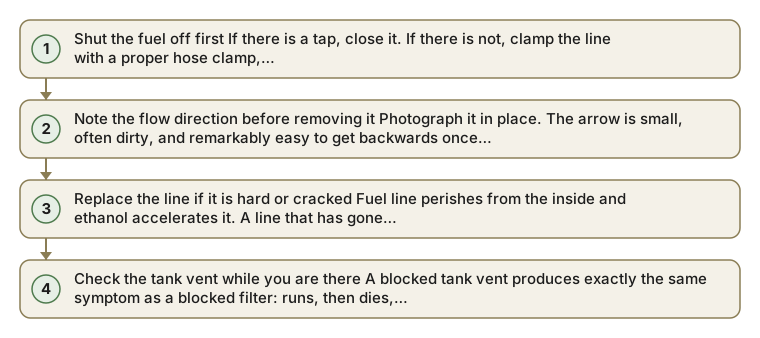
Shut the fuel off first
If there is a tap, close it. If there is not, clamp the line with a proper hose clamp, not pliers, which crush and crack aged fuel line.
-
Note the flow direction before removing it
Photograph it in place. The arrow is small, often dirty, and remarkably easy to get backwards once the old filter is off the bench.
-
Replace the line if it is hard or cracked
Fuel line perishes from the inside and ethanol accelerates it. A line that has gone hard is a leak waiting to happen next to a hot engine, and it is a two-dollar part.
-
Check the tank vent while you are there
A blocked tank vent produces exactly the same symptom as a blocked filter: runs, then dies, then starts again after you loosen the cap. That test takes ten seconds and is described in engine starts then dies.
The one on a two-stroke that lives inside the tank
Chainsaws, trimmers and handheld blowers usually put the filter inside the fuel tank on the end of a flexible pickup line, so it can move to the fuel wherever the machine is held. Two things follow. It is easy to forget, because you cannot see it without fishing it out with a hooked wire through the filler.
And when the pickup line hardens with age it stops moving, so the machine runs in one orientation and starves in another. A symptom that gets blamed on the carburetor for months.
Air and fuel filters: questions
Can I clean a paper air filter with compressed air?
No: it is the standard wrong answer. Compressed air blows holes through the pleated media that let dust straight into the engine, and the damage is invisible. Tap a paper element gently against your hand to clear it, and replace it when tapping stops helping or when it is oily.
If an element is dirty enough to want an air line, it is dirty enough to replace.
How do I service a foam air filter?
Wash it in warm soapy water, dry it completely, then oil it lightly with engine oil and squeeze out the excess. A dry foam element filters almost nothing, and an over-oiled one restricts airflow and runs the engine rich, so the light oiling and the squeeze both matter. On a dual-element setup the foam pre-cleaner is serviced often and the paper element behind it rarely.
Should I let my air filter dry on its own before refitting it?
Fully air-dry a washed foam element before oiling and refitting it: refitting one still wet dilutes the oil coating unevenly and can trap moisture against the carburetor intake. A few hours in open air, or overnight, is enough; do not use heat to speed it up, since it can shrink or warp the foam.
Why does my small engine run fine at idle but die under load?
Most small engines are gravity-fed with no fuel pump, so a partly blocked in-line fuel filter starves the engine at load while behaving perfectly at idle. A blocked tank vent produces the identical symptom: runs, dies, then restarts after you loosen the cap. Both are cheap to check, and the in-line filter has a flow direction that blocks quickly if it is fitted backward.
Where is the fuel filter on a chainsaw or trimmer?
Inside the fuel tank, on the end of a flexible pickup line so it can move to the fuel wherever the machine is held. That makes it easy to forget, because you cannot see it without fishing it out through the filler with a hooked wire, and when the pickup line hardens with age the machine runs in one orientation and starves in another: a symptom often blamed on the carburetor for months.
How do I know which direction to install an in-line fuel filter?
Most in-line filters have an arrow molded or printed on the housing indicating the direction of fuel flow, from the tank toward the carburetor. Installing one backward restricts flow the same way a partly clogged filter does, producing the identical under-load-only symptom the guide describes for a blocked filter.
How often should an air filter be replaced on outdoor power equipment?
A paper element is typically replaced on an annual or roughly 100-hour schedule alongside the spark plug, though heavy dust or debris conditions call for more frequent checks regardless of the calendar. A foam pre-cleaner in a dual-element setup is serviced far more often, every few uses in dusty conditions, since it is designed to be the sacrificial, frequently cleaned stage.
What happens if I run an engine with no air filter installed at all?
Unfiltered dust and debris enter directly with the intake air, accelerating wear on the piston, rings and cylinder bore in a way that is often invisible until compression loss or hard starting shows up much later. This is a damaging shortcut, not a harmless temporary fix, even for a single short use.
Can a dirty air filter cause an engine to be hard to start, not just run poorly once running?
Yes: a sufficiently restricted air filter changes the air-fuel mixture enough to make cold starting difficult in addition to causing rough running once the engine is going, since the choke or primer's enrichment assumes a certain amount of air is reaching the carburetor.
Is a dual-element air filter (foam plus paper) better than a single paper element?
It offers a practical maintenance advantage rather than a fundamentally different filtration outcome: the foam pre-cleaner catches the bulk of coarse debris and is quick and cheap to service often, which extends the life of the paper element behind it. A single paper element filters adequately on its own but needs replacing, not just cleaning, more often in dusty conditions without that first stage.
Does a fuel filter ever need replacing even if the engine seems to run fine?
Yes: a partially restricted filter can produce a symptom that only appears under load (a gravity-fed engine dying when it needs peak flow) while behaving normally at idle, so "runs fine" at idle is not proof the filter is clear. Replacing it on the manufacturer's schedule, or when a load-dependent stalling symptom appears, catches this before it becomes a persistent no-start.
Is a paper air filter ever washable, or is foam the only washable type?
A standard pleated paper element is not washable: water damages the paper media's structure and its ability to filter correctly, even if it appears to dry out fine afterward. Only foam elements are designed for the wash-dry-oil service cycle; a paper element that's too dirty to improve by tapping should be replaced, not washed.