Lawn-equipment wheels and tires: fit, cold pressure and wear
Match the tire, wheel and hub to the equipment’s approved size, load and mounting arrangement. Set cold pressure by the actual machine’s instructions; front and rear specifications can differ. A sidewall or catalog pressure is not automatically the correct operating target, and wobble is not proof of a failed bearing alone.
Read the whole size and assembly
The Carlisle catalog lists size 13x5.00-6 with additional dimensions, rim and load data. The nominal name describes approximately 13-inch diameter, five-inch section width and a six-inch rim. It does not establish hub length, axle diameter or bearing fit.
| Part of the assembly | Match |
|---|---|
| Tire | Approved size, type and load/speed use |
| Rim | Tire mounting approval and condition |
| Hub / axle | Bore, length, offset and retention |
| Bearing / bushing | Exact dimensions, seal and service type |
| Pressure | Machine instruction and tire/rim limits |
Cold pressure: use the actual axle instruction
The cited TimeCutter SW manual specifies 13 PSI for the rear drive tires and gives a separate caster-tire instruction. It calls for cold checks and warns that unequal pressure can cause an uneven cut. It does not say to set all four tires to one number.
A rear tire at 20 PSI is seven PSI above that model’s 13-PSI instruction, about 54 percent higher. That is a comparison with one manual, not a recommended pressure for another mower or a direction to exceed any component limit.
Separate a leak from structural damage
Inspect accessible valve and bead areas using the tire maker’s permitted method. Do not assume a slow leak is always at the bead, and do not recommend an external plug for every puncture. Sidewall, rim or bead damage needs a qualified repair assessment.
Never overinflate to force a bead to seat. Rusted, bent or incompatible wheels can fail under pressure. Mounting and seating work needs appropriate equipment and instructions.
For wobble or noise, inspect the approved axle retention, hub, bearing or bushing with the machine safely supported. Do not shim away unexplained play or grease a sealed bearing through an improvised hole.
PT-08 · Parts
Wheels, tires and bearings
Lawn and garden tires are sold by a three-number size such as 13x5.00-6: the overall diameter in inches, the section width, and the diameter of the rim it fits, after the dash. The rim number must match the wheel exactly, and the other two decide how the tire fits under a deck or fender. Four tire types cover almost every machine: tubeless and tubed pneumatics, semi-pneumatic, and flat-free.
Pressure comes from the manual, with the sidewall figure as a ceiling. A wheel that wobbles or runs hot has a worn bearing or bushing, and a tire that goes soft overnight usually leaks at the bead or the valve, not through a puncture.
Never inflate a tire to seat a bead beyond the maximum pressure moulded into the sidewall. A small tire on a rusted or bent rim can fail violently, and a tire that will not seat at the printed maximum needs to be taken to a shop, not pumped harder. Chock the machine, and support it on stands, never on a jack alone, before a wheel comes off.
How to read the size printed on a lawn and garden tire
Most mower, tractor and cart tires carry a size such as 13x5.00-6. The first number is the overall diameter of the inflated tire in inches. The middle number is the width of its section, also in inches.
The last number, after the dash, is the diameter of the rim it fits. So the tire in that example is about thirteen inches tall, five wide, on a six-inch rim. The rim number must match the wheel exactly.
The other two set how the tire fits under a fender or deck and how the height of the machine changes when it is fitted.
Some sizes are written in the metric or a hybrid style, and a few carry a ply rating or a letter for the tread pattern. The three numbers above are the ones that decide fit. Where the old tire has worn smooth, read the size from the rim's stamp or from the sidewall on the inside face, or measure the rim and the section.
Diameter
Overall height
Sets ride height and clearance. A change of an inch or more alters cut height and gearing.
Width
Section width
Sets the footprint and whether it clears the frame or the fender.
Rim
Rim diameter
The number after the dash. It has to match the wheel, or the tire will not fit at all.
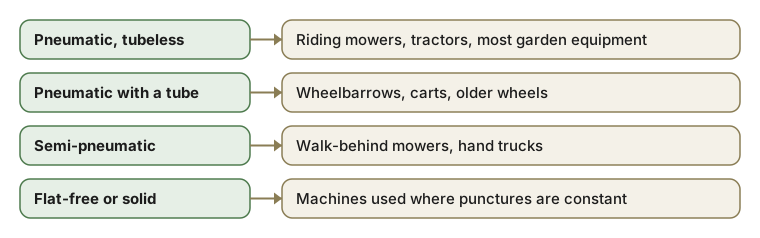
Four kinds of tire, and what each is for
| Type | Good for | What to know |
|---|---|---|
| Pneumatic, tubeless | Riding mowers, tractors, most garden equipment | Air-filled and softest riding. Slow leaks come from the bead or a valve stem more often than from a puncture. |
| Pneumatic with a tube | Wheelbarrows, carts, older wheels | A tube can be patched or replaced without dismounting the wheel from the machine. |
| Semi-pneumatic | Walk-behind mowers, hand trucks | A hollow rubber tire with a fixed shape. Cannot go flat, but rides firmer and cannot be adjusted. |
| Flat-free or solid | Machines used where punctures are constant | Never goes flat, but weighs more, rides harder and costs more. Not every rim accepts one. |
Pressure: use the sidewall as a ceiling and the manual as the target
Outdoor equipment tires run at a small fraction of car-tire pressure, and the range that works is narrow. The number moulded into the sidewall is a maximum for the tire, not a recommendation. The machine's manual gives the pressure for the load and the job, which is often lower, and it is usually different front and rear.
Too high and the tire skips and cuts the lawn unevenly. Too low and the bead can break loose from the rim, or a tire wears on its edges. Check the pressure cold, with a gauge that reads at the low end, since a car-tire gauge is rarely accurate there.
Wheel bearings, bushings and hubs
A wheel turns on a bearing, a bushing or a plain axle. Small mower and cart wheels often have a plain plastic or bronze bushing that wears and lets the wheel wobble, while riding-mower front wheels commonly run on greased bearings in a hub. A wheel that wobbles, squeaks, or runs hot to the touch has a worn or dry bearing.
Spin it by hand: it should turn smoothly and quietly, without grinding or side play.
Grease reachable bearings on the schedule in the manual, and replace a bearing or bushing that has play rather than shimming it, because a worn one lets the wheel wear the axle too. Deck and caster wheels that run all day carry the greatest load and fail first.
Flat tires, and what to do about a slow leak
A tire that goes soft overnight is almost always leaking at the bead, where rubber meets rim, or at the valve. Spray soapy water round the bead and the stem, and the bubbles show where. Rust or old rubber on the rim's bead seat is the usual cause on an older wheel: clean it with a wire brush and reseat the tire.
A puncture in a tubeless tire can be plugged from the outside, and a sealant helps in a pinch, but a cut sidewall means a new tire. If flats are a regular event where the machine works, a flat-free tire is the remedy to consider.
Tires and wheels are also a common reason for a mower that cuts unevenly or pulls to one side. Check that all four are at the same pressure, that they have equal wear, and that a wheel is not wobbling on a worn bushing before adjusting the deck.
Wheels, tires and bearings: questions
What do the numbers on a lawn mower tire mean?
A size such as 13x5.00-6 gives the overall diameter of the inflated tire in inches, the width of its section in inches, and after the dash, the diameter of the rim it fits. So it is about thirteen inches tall and five wide on a six-inch rim. The rim number has to match the wheel exactly.
The first two decide how it fits under a deck or fender.
What pressure should I run in a mower tire?
Use the figure in the machine's manual, which often differs front and rear, and treat the maximum moulded into the sidewall as a ceiling only. Outdoor equipment runs at a small fraction of car-tire pressure. Too high and the tire skips and cuts unevenly; too low and the bead can break loose or the edges wear.
Check cold, with a gauge that reads accurately at the low end.
Why does my mower tire go flat overnight?
Almost always a leak at the bead where the rubber meets the rim, or at the valve stem, not a puncture. Spray soapy water round the bead and the stem and watch for bubbles. Rust or old rubber on the bead seat is the usual cause on an older wheel.
Clean it with a wire brush and reseat the tire, or replace the valve if it leaks.
What is a flat-free tire, and is it worth it?
A solid or foam-filled tire that cannot go flat. It suits machines that pick up punctures constantly, but it weighs more, rides harder and costs more than a pneumatic tire, and not every rim accepts one. If a machine gets a flat every few weeks where it works, it is worth considering.
For an occasional flat, a plug or a sealant is cheaper.
Can I put a bigger tire on my riding mower?
Only within the clearance of the frame, the fender and the deck, and it changes the height and the gearing. A tire an inch or more taller alters cut height and the drive ratio, and a wider one can foul the frame. Keep the rim diameter identical.
If you change the overall diameter, change it on both sides equally.
How do I know if a wheel bearing is worn?
Lift the wheel clear and spin it by hand. It should turn smoothly and quietly. Side play, a wobble, a squeak or a rough, grinding feel means the bearing or bushing is worn or dry.
A wheel that runs hot to the touch after use has the same problem. Grease reachable bearings on the manual's schedule and replace one that has play.
What is the difference between a bearing and a bushing?
A bearing rolls, on balls or rollers in a race, and runs freely with grease. A bushing is a plain sleeve, of plastic or bronze, that the axle slides in. Many small mower and cart wheels use bushings, and riding-mower front wheels often use bearings.
A bushing wears and lets the wheel wobble, and is replaced when it does.
Why does my mower pull to one side?
Check the tires before the deck. Unequal pressure, uneven wear or a wheel wobbling on a worn bushing all make a mower pull. Set all four to the same pressure and look for a wheel with side play.
On a hydrostatic machine, the drive linkage and fluid are on a separate page. Only after the wheels check out is it worth adjusting the deck.
Are tubeless and tubed lawn tires interchangeable?
Sometimes, but not always. A tubeless tire has to seal against the rim, and a tube goes in a tire built to take one. A tubeless tire can accept a tube as a repair on many rims, and a tubed rim cannot hold a tubeless tire if the bead seat is poor.
Check the rim and the tire markings before swapping the type.
How do I seat a tire bead safely?
Clean and lubricate the bead and the rim, then inflate slowly and stop at the maximum pressure moulded into the sidewall. If the bead has not seated by then, do not pump harder: take the wheel to a shop. A small tire on a rusted or bent rim can fail violently.
Wear eye protection and keep your face away from the sidewall.
Can I plug a punctured mower tire?
On a tubeless tire, a puncture in the tread can be plugged from the outside with a repair kit, and a sealant will help in a pinch. A cut or a puncture in the sidewall cannot be repaired and the tire is replaced. A tube tire is patched or its tube replaced.
After any repair, check the pressure again the next day.
Should I grease the wheels on my walk-behind mower?
If the wheel has a grease fitting or an accessible axle, a small amount of grease on the schedule in the manual keeps a plain bushing turning freely and keeps water out. Wipe away the excess, since grease that collects grass and dust makes a paste that wears the bushing. Plastic wheels with no fitting are simply replaced when they wobble.