Choose a snow blower by surface, clearance and snow load
Choose a snow blower for the surface, access width and snow you must remove. Stage count describes the mechanism, not a universal performance ranking. Ground-contact single-stage machines need the surface permitted by their manual; use a multi-stage machine on gravel only where its manual permits it and its shoes are correctly adjusted.
Surface instructions decide before engine size
The Toro Power Clear 721 manual describes a single-stage rotor with wear-indicator holes in its blades. The cited Ariens Deluxe manual instead gives different skid-shoe setup for hard versus uneven/gravel surfaces: two 3 mm spacers versus two 22 mm spacers under the scraper ends. Those are model-specific instructions, not settings for every snowblower.
| Design | What to check |
|---|---|
| Single stage | Permitted surface, rotor wear and traction behavior |
| Two stage | Auger/impeller condition and specified skid/shoe setup |
| Three stage | Additional feed mechanism and task-specific performance |
| Any stage | Actual overall width, access, discharge route and controls |
A larger number of stages does not establish faster clearing in every snow condition. Compare a demonstration or a documented test with similar snow density and depth. Rocks and buried debris can damage any of these machines; a two-stage mechanism is not permission to ingest stones.
Estimate passes, then measure storage and gates
For a 12-foot-wide driveway, a 24-inch clearing width with two-inch overlap requires seven straight passes: one full-width pass plus six 22-inch advances. A 28-inch machine under the same assumption needs six passes. Turning space, drifts and the plow bank can change the real job.
Clearing width is not necessarily the machine’s overall width. Measure the narrowest route with gates fully open and include handles, wheels and any accessories. Avoid buying a machine that cannot reach the work or be safely stored.
Use its actual start and clearing procedures
There is no universal “primer instead of choke” rule. Follow the model’s cold-start directions; machines can require both, neither or a different control sequence. Do not repeatedly prime a machine that is already flooded.
CPSC’s snowthrower safety alert warns against clearing with hands. Stop, isolate power as directed, wait for movement to stop and use the clean-out tool. A running engine or stored energy in a jam can injure fingers even when the auger appears blocked.
Inspect the applicable recall status and controls before the season. The Ariens service guide includes its current recall lookup; Toro service differences distinguish the two cited designs.
How to size a snow blower
"Snow thrower" and "snow blower" describe the same equipment class in ANSI/OPEI B71.3. Choose clearing width for the number of passes and the narrowest gate on your route; choose stage for snowfall depth and whether the surface is paved or gravel. The size bands below are starting points for those measurements.
Is a "snow thrower" a different machine from a "snow blower"?
No: the two names are used interchangeably for the same category of equipment, including by the safety standard that governs it (ANSI/OPEI B71.3 titles the whole class "snow throwers"). Some retailers and manufacturers use "thrower" specifically for smaller single-stage machines and "blower" for the class generally, but that split is not consistent enough to shop by. If a listing draws a hard line between the two terms, read the stage and clearing-width specification rather than trusting the name.
Clearing width against your own driveway, not a review
Estimate passes by dividing the driveway width by the effective clearing width, allowing some overlap. Then measure gates, walks and the space beside parked cars. A wider intake saves passes only where the machine can reach the entire route.
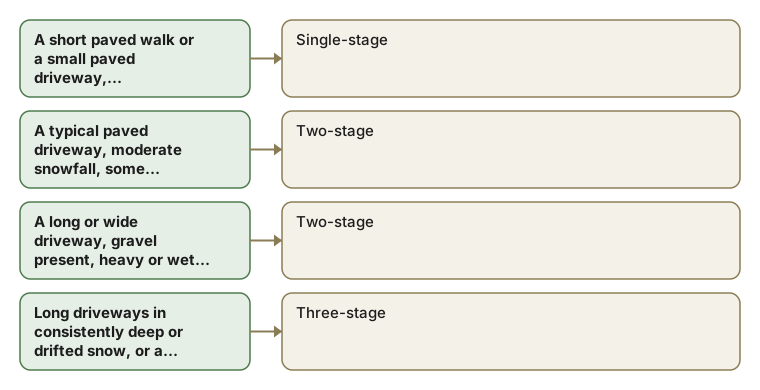
| Situation | Stage | Typical clearing width |
|---|---|---|
| A short paved walk or a small paved driveway, light-to-moderate snowfall | Single-stage | Roughly 18–22 in. |
| A typical paved driveway, moderate snowfall, some drifting | Two-stage | Roughly 24–28 in. |
| A long or wide driveway, gravel present, heavy or wet snow | Two-stage | Roughly 28–30 in. |
| Long driveways in consistently deep or drifted snow, or a shared/commercial area | Three-stage | Roughly 30 in. and up |
The mechanism behind each stage, what changes physically, and why pavement contact is the dividing line, is covered in full on single-stage, two-stage and three-stage snow throwers, compared. Match the machine’s stage, clearing width and intake height to the surface and the snow you need to clear.
How much snow justifies owning one
The useful size depends on the area cleared, snow density and frequency of use. The practical signal most owners use is frequency: if a season regularly delivers snowfall heavy enough that a shovel takes real time on more than a handful of occasions, a machine pays for itself in time within the first season or two. In regions with only occasional light snow, a single-stage electric machine or a shovel remains a better match for that workload than an underused two-stage machine taking up garage space.
Compare snow throwers by clearing width and snowfall workload
Compare clearing width, intake height and stage first. For warranty coverage, check the specific model’s written terms, including residential versus commercial use and the availability of a nearby servicing dealer. A warranty period alone gives little evidence of durability.
Throw distance: real, but not something this site ranks
Throwing distance changes with snow density, wind and chute position as well as the machine. Compare manufacturer claims only when their test conditions are given and comparable. For your driveway, the useful question is whether the chute can place snow beyond the cleared path without aiming toward people, windows or traffic.
How to size a snow blower: questions
Is a snow thrower the same thing as a snow blower?
Yes: the terms are used interchangeably for the same equipment class, including in the governing safety standard, ANSI/OPEI B71.3, which titles the class "snow throwers." Some sellers use "thrower" loosely for smaller single-stage machines, but that split is not consistent enough to shop by; check the stage and clearing width instead of the name.
What size snow blower do I need for my driveway, and how big of one is that?
Match clearing width to your driveway’s width or a clean fraction of it: roughly 18–22 in. for a short paved walk or small driveway, 24–28 in. for a typical paved driveway, and 28 in. and up for long, wide or gravel-surfaced driveways with heavier snow. A too-narrow machine means multiple passes every storm; a too-wide one may not clear a gate or a gap beside a parked car.
What type or kind of snow blower do I need: single-stage, two-stage or three-stage?
Single-stage suits a short, smooth, paved surface with light snowfall only, since its auger touches the ground and cannot be used on gravel. Two-stage covers most residential driveways with moderate snowfall and occasional drifting well. Three-stage earns its cost specifically on long driveways in consistently deep or heavily drifted snow, where its accelerator’s faster intake, not extra throwing power alone, is what saves time.
Which snow blower throws snow the farthest?
Within a class, more engine power generally throws farther; comparing specific machines means reading each one’s own rating plate.
How much snow requires and justifies use of a snow blower (snowblower) instead of shoveling?
There is no fixed published threshold. It depends on how much surface you clear and how often. The practical signal most owners use is frequency: if a typical season delivers snow heavy enough that shoveling takes real time on more than a handful of occasions, a machine usually pays for itself in time within a season or two.
How do I compare snow throwers by warranty or durability?
Warranty length and durability by brand aren't tracked here. Compare those features within the stage and size the job requires. What is consistent across the category, and worth checking on any specific warranty, is that a two-stage or three-stage machine carries more serviceable parts (gearbox, impeller bearings, skid shoes) than a single-stage machine’s simpler design, so read what the warranty covers on those parts specifically rather than comparing length alone.
What is the best month or time of year to buy a snow blower?
Buying in fall, right before the first storm, guarantees you get the current lineup but at the point of highest demand and lowest stock.
Does a wider snow blower always clear a driveway faster?
Choose a width that fits every required gate, gap and narrow section with room to steer. If a machine is wider than a gate, that part of the route needs another access path or a different clearing tool. Measure the tightest access point before choosing the wide end of a size band.
Do I need a two-stage snow blower if my driveway is paved and I never see gravel?
Not necessarily on pavement alone: a single-stage machine is built for exactly that surface and light-to-moderate snowfall. The decision to move up to two-stage should be driven by snowfall weight and drifting rather than surface type alone, since a paved driveway with consistently heavy, wet snow still benefits from a two-stage machine's greater capacity even without a gravel concern.
Is electric start worth paying extra for on a snow blower?
For most owners, yes: a cold engine on a subzero morning is exactly the scenario where a recoil pull cord is hardest to start, and electric start removes that specific difficulty at the moment it matters most. It adds cost and weight from the extra battery and starter motor, which is the trade-off to weigh against how reliably the machine needs to start on the coldest mornings.
Should I buy a snow blower with a heated handle grip?
It's a comfort feature rather than one that changes clearing capability, so its value depends entirely on how long a typical session runs and how cold conditions typically are: worth the added cost for someone clearing a long driveway by hand in cold climates, less relevant for a short walk cleared in a few minutes.
Compare
Single-stage, two-stage and three-stage snow throwers, compared
One mechanism becomes two, then three, and the reason is what the auger is allowed to touch.
"Single-stage," "two-stage" and "three-stage" describe how many separate mechanisms move snow from the ground to the discharge chute, and ANSI/OPEI B71.3, the safety specification that governs snow throwers as a class, has to account for the difference because each additional stage changes where a hand can reach a moving part. That safety distinction tracks the performance distinction closely enough that it also helps compare clearing capacity: the same auger-versus-impeller mechanism that decides where a guard has to sit also decides whether the machine can survive contact with a buried rock, and whether it can keep up with a foot of wet, drifted snow rather than just a light dusting. The specification comparison is the shopping version of the same safety classification, not a separate marketing scheme layered on top of it.
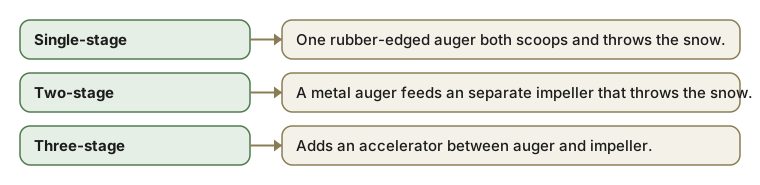
| Stage | Mechanism | Surface contact | Matches |
|---|---|---|---|
| Single-stage | One rubber-edged auger both scoops and throws the snow. | The auger itself touches the pavement. | Paved, level surfaces; light-to-moderate snowfall. |
| Two-stage | A metal auger feeds an separate impeller that throws the snow. | Adjustable skid shoes hold the auger above the surface. | Gravel or uneven surfaces; heavier, wetter snow. |
| Three-stage | Adds an accelerator between auger and impeller. | Same skid-shoe clearance as two-stage. | Deep or drifted snow, where faster intake matters most. |
Why pavement contact is the dividing line that matters
A single-stage machine's auger has to touch the ground to pick snow up, which is why it is built for pavement and why it will chip a gravel driveway's surface if used there. A two-stage or three-stage machine's auger rides above the surface on adjustable skid shoes, with an impeller doing the work of throwing what the auger feeds it, which is also why a two-stage machine survives contact with a buried rock or a piece of gravel that would stop or damage a single-stage auger outright.
What a third stage buys you
A three-stage machine adds an accelerator, a smaller, faster-spinning auger between the main auger and the impeller, whose only job is to feed snow into the impeller faster than the impeller alone could draw it in. The performance difference over a two-stage machine shows up specifically in deep or heavily drifted snow, where intake speed rather than throwing distance is the bottleneck; on an ordinary few inches of snow, a two-stage machine clears at essentially the same rate.
Clearing width and horsepower are separate questions
Stage, clearing width and engine displacement are three different specifications that get shopped together but do not have to move together. A wider two-stage machine is not automatically a three-stage machine, and a bigger engine on a two-stage unit does not turn it into a three-stage one. Stage is what the mechanism is; width and displacement are how much of it you bought.
Single-stage, two-stage and three-stage snow throwers, compared: questions
Can I compare snow throwers by price?
What is comparable here is stage against surface and snowfall, which is the part of the price that is justified: a two-stage or three-stage machine costs more than a single-stage one because it carries a separate impeller, gearbox and skid-shoe assembly the single-stage machine does not need.
How do snow thrower warranties compare across stages and brands?
What is consistent across the category is that a two-stage or three-stage machine carries more serviceable, wear-prone parts under warranty, gearbox, impeller bearings, skid shoes, than a single-stage machine’s simpler auger-and-engine design, so check coverage for the gearbox, bearings and wear parts as well as the warranty term.
What features should I compare between snow thrower models?
Stage first (see the equipment comparison), then intake height against the compacted bank a municipal plow leaves, then clearing width against your longest run: in that order, because stage and intake height determine whether the machine can handle your surface and snow load at all, while width only sets how many passes it takes once it can.
Why does a single-stage snow thrower risk damaging a gravel driveway?
Because a single-stage machine's auger is the part that both scoops and throws snow, and it has to touch the surface directly to pick snow up: on gravel, that direct contact chips or scatters loose stones along with the snow. A two-stage or three-stage machine's auger instead rides above the surface on adjustable skid shoes, so it never touches gravel or a paved surface underneath.
Does a three-stage snow thrower clear an ordinary few inches of snow faster than a two-stage one?
Not meaningfully: the accelerator a third stage adds only helps feed the impeller faster than the impeller alone could draw snow in, and that advantage only shows up specifically in deep or heavily drifted snow. On a typical light snowfall, a two-stage machine clears at essentially the same rate as a three-stage one.
Do clearing width and engine size tell me anything about a snow thrower's stage?
No: stage, clearing width and engine displacement are three separate specifications shopped together but not linked to each other. A wider two-stage machine is not automatically a three-stage machine, and a larger engine bolted to a two-stage unit does not turn it into a three-stage one; stage is strictly about which mechanisms move the snow.
What is the difference between an auger and an impeller on a snow thrower?
The auger is the front spiral mechanism that gathers snow; the impeller is the fan that throws the gathered snow out through the discharge chute. A single-stage machine's auger does both jobs itself; a two-stage or three-stage machine splits the work, with the auger feeding a separate impeller that does the throwing.
Why does ANSI/OPEI B71.3 classify snow throwers by stage instead of by size or engine power?
Because the safety concern the standard addresses, where a hand can reach a moving part, depends on the mechanisms that gather and discharge snow. A single mechanism auger, versus an auger plus impeller, versus an auger plus accelerator plus impeller, each present a different hazard layout that the standard has to account for directly.
What is a shear pin, and does every stage of snow thrower have one?
A shear pin is an intentionally weak pin connecting the auger to its drive shaft, designed to break before the gearbox does when the auger strikes something solid. Two-stage and three-stage machines, whose augers can safely contact buried obstacles thanks to skid-shoe clearance, rely on this pin as their protection; a single-stage machine's simpler design generally has less gearbox to protect in the first place.
Can I retrofit a single-stage snow thrower to behave like a two-stage machine?
A two-stage machine has separate gathering and discharge mechanisms. Adding an accessory does not convert a single-stage auger into that layout. Adjustable skid shoes, a separate impeller, and the gearbox connecting them are built into the machine from the factory; there is no aftermarket conversion that adds a genuine second stage to a single-stage unit.
Is a two-stage snow thrower always better than a single-stage one?
Not for every situation: a single-stage machine is lighter, less expensive, and perfectly matched to a paved, level surface with light-to-moderate snowfall, which describes many residential driveways. The extra capability a two-stage machine offers (gravel tolerance, heavier snow) is only worth its added cost and weight if your actual surface or snow load needs it.
Snow blowers
The stage count on a snow blower is not a trim level, it is a description of the machine. A single-stage unit has one rubber-edged auger that both collects and throws the snow, and because that auger touches the ground it pulls the machine along and confines it to smooth paving: on gravel it throws stones. A two-stage unit separates collection from throwing, rides on skid shoes clear of the surface, drives its own wheels and therefore works on gravel and rough ground.
A three-stage unit adds an accelerator to feed the impeller faster in deep wet snow. Choose on the surface first, then on the compacted bank the plow leaves across the end of your drive, which is the load that defeats machines.
One stage, two stages, three stages
The stage count describes how snow gets from the ground to the chute, and it is the whole specification. A single-stage machine has one rubber-edged auger that both picks up snow and throws it, and that auger contacts the ground, which is what propels the machine forward and also what limits it to smooth, paved surfaces. Run one on gravel and it throws the gravel.
A two-stage machine separates the jobs. A steel auger gathers snow and feeds it to a separate high-speed impeller that throws it, and the auger housing rides on adjustable skid shoes so the auger never touches the surface.
That is why a two-stage machine works on gravel and on an uneven drive, and why it needs its own drive wheels. It gets no propulsion from the auger.
A three-stage machine adds an accelerator between auger and impeller to feed the impeller faster, aimed at deep, heavy snow and long drives.
| Type | Surfaces | Suits | Hard limit |
|---|---|---|---|
| Single-stage | Smooth paving and concrete only | Short drives, moderate snowfall, storage space at a premium | Auger touches the ground. Gravel and loose surfaces are out. |
| Two-stage | Paving, concrete, gravel, uneven ground | Most drives; the default answer where snow is a regular event | Heavier, wider, needs storage. Shear pins are a service item. |
| Three-stage | As two-stage | Deep, wet, plow-bank snow and long drives | More moving parts and cost for a gain you only see in heavy snow. |
Clearing width, intake height and why the second number matters
A snow blower is quoted as, for example, twenty-four inches wide with a twenty-inch intake height. Width sets how many passes the drive takes; intake height sets what the machine can eat in one bite. The bite that defeats most machines is not the snowfall itself.
It is the compacted bank the municipal plow leaves across the end of the drive, which is denser than anything that fell from the sky. If that bank is your real problem, intake height and the impeller's ability to move wet, dense snow matter far more than clearing width does.
Shear pins are a designed sacrifice
A two-stage auger is attached to its shaft by shear pins made to break when the auger hits something solid, so the gearbox and the belt survive instead. A broken shear pin presents as an auger that no longer turns while the impeller still does, and it is a five-minute roadside repair if you have spares in the garage and a lost evening if you do not.
Replace a shear pin only with the correct part. A bolt from a jar is stronger than the pin it replaces, which means the next impact goes into the gearbox instead. This is the most common expensive mistake in the class, and it is invisible until the repair bill.
Never clear a clogged chute with your hand, and never with the engine running. The auger and impeller store energy in a jam; when the obstruction moves, they turn. Stop the engine, remove the key, wait for everything to stop, and use the clearing tool the machine came with.
Starting and running one, in the order that works
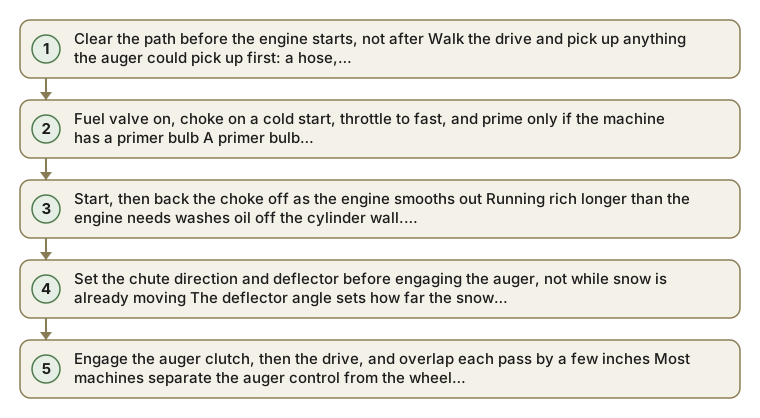
The sequence is the same across single-, two- and three-stage machines because it follows the same cold-engine problem every small four-stroke has: the cylinder is cold, the fuel is cold, and the choke exists to enrich the mixture until that changes.
-
Clear the path before the engine starts, not after
Walk the drive and pick up anything the auger could pick up first: a hose, a doormat, gravel loosened by frost. The auger cannot tell the difference between snow and any of those, and most of what a machine "throws through a window" started as debris in its path.
-
Fuel valve on, choke on a cold start, throttle to fast, and prime only if the machine has a primer bulb
A primer bulb pushes raw fuel into the intake and is a substitute for using the choke, not an addition to it: pressing both floods a cold engine. If the machine has no primer, the choke alone is the whole cold-start procedure.
-
Start, then back the choke off as the engine smooths out
Running rich longer than the engine needs washes oil off the cylinder wall. Once it idles evenly on its own, the choke should be open.
-
Set the chute direction and deflector before engaging the auger, not while snow is already moving
The deflector angle sets how far the snow throws and the chute rotation sets which direction: both are safer and easier to judge with the machine standing still. Never point the chute at a person, a vehicle, or a window; deflected ice and gravel travel a long way.
-
Engage the auger clutch, then the drive, and overlap each pass by a few inches
Most machines separate the auger control from the wheel drive so the auger can be run stationary to clear a jam without the machine moving. Overlapping passes rather than leaving a thin uncleared strip is what keeps the next pass from having to eat a ridge instead of loose snow.
Working technique matters more than horsepower on deep or wet snow: clearing in two lighter passes rather than forcing one pass through a full-depth load keeps the impeller from choking, and clearing before traffic compacts the snow into a denser layer is easier on the machine than clearing the same snowfall the next morning. Throwing with the wind rather than into it keeps the discharge from blowing straight back at the operator.
The seasonal problem
A snow blower is the machine that sits unused for eight months and then has to start on the worst morning of the year. That makes fuel management the entire maintenance story: stabilized fuel or an empty carburetor, a fresh spark plug before the season rather than during it, and a machine started and run under load once in the autumn instead of tested for the first time in a storm.
The specifics are on bringing a machine out of storage and ethanol, stabilizer and what happens to gasoline. A machine that runs but will not throw is worked through in snow blower will not throw.
Snow blowers: questions
What is the difference between a single-stage and two-stage snow blower?
A single-stage machine has one rubber-edged auger that both collects and throws the snow, and because that auger touches the ground it pulls the machine along but confines it to smooth paving. A two-stage machine uses a steel auger feeding a separate high-speed impeller, rides on skid shoes clear of the surface and drives its own wheels, which is why it works on gravel and uneven ground.
Can I use a single-stage snow blower on a gravel driveway?
No. Its single auger contacts the surface to move the machine, so on gravel it picks up and throws the stones along with the snow. A gravel or uneven drive needs a two-stage machine, whose auger rides above the surface on adjustable skid shoes and never touches it, leaving the gravel where it belongs while it clears the snow above it.
Should snow-blower width or intake height decide the size?
For most people the intake height and the impeller’s ability to move dense snow matter more, because the load that defeats machines is the compacted bank a municipal plow leaves across the end of the drive, not the fresh snowfall. Clearing width only sets how many passes the drive takes, so size on the plow bank you will face rather than on the snow that fell.
My snow blower runs but the auger stopped turning, what broke?
Usually a shear pin. Two-stage augers are fastened to their shaft with pins made to break when the auger hits something solid, sacrificing themselves to save the gearbox and the belt. It shows up as an auger that no longer turns while the impeller still does, and it is a five-minute repair if you keep the correct spare pins on hand in the garage.
Can I replace a snow blower shear pin with a regular bolt?
Never. An ordinary hardware-store bolt is stronger than the pin it replaces, so the next impact drives its full force into the gearbox instead of breaking the pin: turning a five-minute roadside fix into an expensive repair. Use only the manufacturer’s specified shear pin, and keep spares where you will find them in a storm.
Why will my snow blower not start after sitting all summer?
Almost every winter no-start is a fuel problem created the previous autumn: gasoline left in the carburetor oxidizes and varnishes the small passages over the idle months. Store it with stabilized fuel or an empty carburetor, fit a fresh spark plug before the season rather than during it, and run it once under load in autumn instead of testing it for the first time in a storm.
What size snow blower do I need?
Size it on clearing width and, more importantly, intake height against the surface and the snowfall you get, not against the deepest storm on record. A single-stage machine under about 20 inches suits a short, smooth, paved driveway with light snowfall. A two-stage machine in the 24 to 30 inch range with a taller intake handles gravel, longer drives and the compacted bank a municipal plow leaves at the end of it, which defeats an undersized machine far more often than fresh snow depth does.
How much do snow blowers weigh?
A single-stage machine typically weighs 25 to 50 pounds; a two-stage machine, carrying a separate impeller, gearbox and often a larger engine, generally runs 150 to 250 pounds or more on wider models. The engine size and clearing width on a specific machine’s spec sheet move this figure more than brand does.
Should I buy a gas or electric snow blower?
A corded or battery electric single-stage unit suits a short, light-snowfall driveway well, with no fuel mixing and much less noise. Gas remains the better choice for gravel, longer drives, or any property that regularly sees the compacted bank a municipal plow leaves, because two-stage machines built for that load are gas-powered almost without exception.
What snow blower is best for a long gravel driveway?
A two-stage or three-stage machine specifically, never a single-stage one: the single-stage auger contacts the surface directly and will pick up and throw loose gravel along with the snow, while a two-stage or three-stage auger rides above the surface on adjustable skid shoes. On a long drive, prioritize intake height and engine size for the compacted plow bank over clearing width alone.
What is a good snow blower buying guide?
Settle stage first (see the stages comparison page) against your surface, pavement can use single-stage, gravel needs two-stage or three-stage, then size clearing width and intake height against your longest run and the compacted bank a municipal plow leaves, not against the deepest storm on record.
Which snow blower or snow thrower handles wet, heavy snow best?
Intake height and impeller power matter more than any single spec, because wet snow packs into a dense mass that a smaller intake or a light impeller simply cannot process at the same rate as dry, fluffy snow: a three-stage machine’s accelerator, which speeds intake specifically, earns its keep here more than in dry-snow conditions. Buy on stage and intake height for the wettest snow your region sees, not the average storm.
How many decibels is a snow blower, and how loud is that in practice?
The mechanism is consistent: a two-stage or three-stage machine’s larger gas engine and impeller run louder than a single-stage electric unit, and running one before or after typical quiet hours is restricted in some municipalities regardless of the machine’s own noise level. A unit’s own published decibel rating at a stated distance, where the manufacturer provides one, is the number to compare, not a marketing claim of "quiet." Check local ordinances if early-morning clearing is part of your routine.
What tire size does a snow blower use?
It varies with the machine’s size class rather than following one standard: a compact single-stage electric unit often runs on small plastic or foam wheels since it has no real traction demand, while a two-stage or three-stage gas machine runs pneumatic tires sized up with the machine for traction in snow, sometimes with an aftermarket studded or paddle-tread option for icy conditions. Check the sidewall of the tire currently on the machine, or its parts diagram, for the exact size before ordering a replacement.
How many hp (horsepower) is a 208cc, 243cc or 254cc snow blower engine, and does that number matter?
There is no fixed cc-to-horsepower conversion, because the relationship itself is not fixed: compression, valve timing, RPM and how a maker tested and rated the engine all move the horsepower figure independently of displacement, and 208cc, 243cc and 254cc are all common engine sizes across different snow blower classes and manufacturers with different published horsepower for the same displacement. Displacement in cc is the number worth comparing directly across machines; treat any cc-to-horsepower conversion you see quoted as a rough approximation, not a specification.
What oil should I use for my snow blower?
Check the engine’s own manual for the specified SAE grade and API service category (see oil grades and service categories for how to read both), but the general pattern across the class is a straight SAE 30 or synthetic 5W-30, and synthetic multigrade is the more common recommendation specifically because a snow blower has to start reliably at temperatures well below what a summer mower ever sees: a straight-30 oil thickens enough in real cold to make cold starting noticeably harder.
What is a commercial-size snow blower, and do I need one?
"Commercial" describes duty cycle and construction: heavier gearboxes, larger engines, wider clearing paths (often 30 in. and up) and parts built for daily use, rather than a fixed size threshold. A homeowner clearing one driveway rarely needs commercial-duty construction even on a long or gravel drive; it earns its cost on a property being cleared for multiple buildings or on a genuine commercial route, where daily run time, not any single storm, is what wears a residential-duty gearbox out early.
What counts as a medium or mid-size snow blower?
A two-stage machine in roughly the 24–28 in. clearing-width band is the practical middle of the category: above the smaller single-stage machines built for a short paved walk, and below the 28-in.-and-up two-stage or three-stage machines sized for long, wide or gravel driveways with heavier snow. The sizing equipment comparison matches width and stage to your actual driveway rather than a size label, which is the more reliable way to shop it.