Choose a pole saw by controlled reach and the branch drop zone
Choose a pole saw only for branches you can cut from a stable position outside the fall path and electrical hazards. Shaft length is not the same as usable vertical reach. The branch can swing or split as it releases; a longer pole does not make an unsafe overhead job suitable for an untrained operator.
Working angle changes reach
For a hypothetical ten-foot shaft held at 45 degrees above horizontal, the shaft adds about 7.1 feet of vertical reach. If the grip is four feet above ground, its geometric tip height is about 11.1 feet. At the same angle it also projects about 7.1 feet horizontally.
| Quantity | Calculated value |
|---|---|
| Angle above horizontal | 45 degrees |
| Vertical shaft component | About 7.1 feet |
| Assumed grip height | 4 feet |
| Geometric tip height | About 11.1 feet |
This calculation does not approve a working angle or cut. The actual manual governs posture, reach and control. Do not stand directly under a limb or add a ladder to extend a pole saw beyond its intended use.
Plan the branch before the chain
The STIHL pole-pruner safety manual addresses electrical contact, falling objects and safe handling. Work near electrical lines belongs with the utility and qualified line-clearance personnel. Do not estimate that a pole or tree branch is insulated.
Identify branch size, tension and what it could hit before starting. A branch that could damage a building, strike a person or fall unpredictably needs a qualified assessment. The tool’s ability to reach the wood does not establish that you can control the result.
Compare configured weight and cutting gear
Compare the complete tool including the approved pack or fuel and the fitted bar/chain. Gas, battery and corded formats do not have a universal ranking of reach or carrying weight.
Use the specified chain, tension and bar-oil checks. Stop and isolate power before cleaning or adjustment; a chain can cause injury even when stationary. Keep the cover fitted for transport and store the pole where it cannot fall or become an overhead contact hazard.
Pole saws
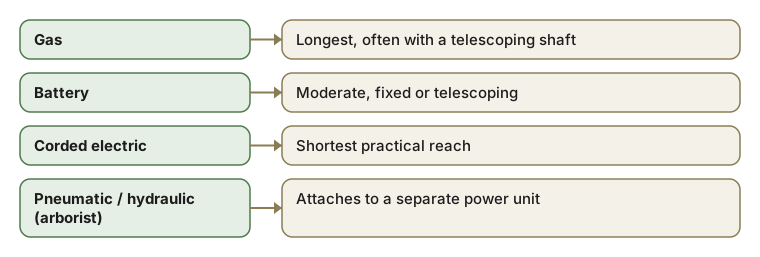
A pole saw puts a small chainsaw cutting head, bar, chain and oiler, on the end of a pole so overhead limbing can be done from the ground. The bar is short on purpose, almost always at or under 10–12 inches, because the job is limbing rather than felling and a longer bar at the far end of a pole adds weight and mechanical advantage against you exactly where control is hardest to hold. Gas gives the longest reach and the heaviest far end; battery trades some reach for the lightest tool per foot of reach; corded electric gives unlimited runtime over the shortest practical distance.
A pole saw extends a running chain overhead. Plan the falling-branch zone, keep the pole and branches clear of electrical lines, and use the utility for work near those lines.
A chainsaw on a pole, with one number capped on purpose
A pole saw is a small chain-saw cutting head, bar, chain and an oiler, mounted on an extension pole so branches can be reached from the ground instead of from a ladder. The bar is short by design, almost always at or under about 10–12 inches, because the machine's job is limbing overhead branches rather than felling anything, and a longer bar on the end of a pole adds weight and reach exactly where control is hardest to keep.
| Drive | Typical reach | What it trades |
|---|---|---|
| Gas | Longest, often with a telescoping shaft | Heaviest at the far end from the operator, and the two-stroke fuel problem this whole cluster shares. |
| Battery | Moderate, fixed or telescoping | Compare total carried weight and the battery energy needed for the session. |
| Corded electric | Shortest practical reach | Unlimited runtime, but the cord and the outlet limit where it goes. |
| Pneumatic / hydraulic (arborist) | Attaches to a separate power unit | This class requires professional equipment and working methods. |
Reach is the pole length plus arm reach, and manufacturers publish it as a single figure that assumes the pole is used at a comfortable working angle rather than straight overhead: holding any pole tool directly above the body for more than a few cuts is a fatigue and control problem before it is anything else.
The bar oiler is not optional up there
Every part of the chain lubrication story on the chainsaw page applies here, bar and chain oil, checking the oiler is feeding before cutting, and never running the saw dry, with one addition: on a pole, a dry or dulling chain is harder to notice by sound and feel than it is on a saw held at waist height, so checking the cut itself (dust instead of chips is the tell) matters more than it does on a handheld saw.
What a pole saw cannot do safely, which is most of what people try to use it for
| The work | Fits a pole saw | Why |
|---|---|---|
| Limbing small overhead branches from the ground | Yes: this is the design case | Short bar, light cutting head, operator stays on the ground. |
| Any branch over your head and near a power line | No | A pole is a conductive path if it or the branch contacts a line. This is a utility-company or line-clearance-arborist job, full stop. |
| Felling, or any cut where the branch could fall toward you | No | A pole gives no ability to judge or control fall direction from directly underneath it. |
| Anything above the height the pole was rated for, extended and reaching further | No | Standing on a ladder to extend a pole saw’s reach combines the two hazards the tool exists to avoid. |
Never use a pole saw, or any pole tool, near a power line. Overhead lines are not reliably insulated, contact does not require touching the wire directly, and the outcome is frequently fatal. Call the utility for branches near electrical lines.
Falling debris is the other hazard: cutting overhead means the cut piece falls toward the operator by default. Clear the drop zone and plan how the branch can swing when released. Keep both feet on stable ground with an escape route.
Do not operate from a ladder.
- Outdoor Power Equipment, Internal Combustion Engine-Powered Hand-Held Pole Pruners, Safety and Environmental Requirements: Outdoor Power Equipment Institute / ANSI, ANSI/OPEI B175.7.
- Outdoor Power Equipment, Internal Combustion Engine-Powered Hand-Held Chain Saws, Safety and Environmental Requirements: Outdoor Power Equipment Institute / ANSI, ANSI/OPEI B175.1-2012 (with A1-2014).
- Control of Emissions from New, Small Nonroad Spark-Ignition Engines and Equipment: U.S. Government Publishing Office (eCFR), 40 CFR Part 1054.
Pole saws: questions
How long should a pole saw bar be?
Short on purpose: almost every pole saw bar is at or under about 10 to 12 inches, because the job is limbing overhead branches rather than felling, and a longer bar at the far end of a pole adds weight and mechanical advantage against you exactly where control is hardest to hold. If a branch needs a bar longer than that, it usually needs a different tool or a different person entirely.
Why does my pole saw chain dull so quickly?
On a pole, the oiler and the cut are both harder to monitor than on a handheld saw held at waist height. Dust instead of chips coming out of the cut is the tell that the chain is dulling or the bar is running dry, and it is easier to miss overhead. Check the oiler is feeding before cutting, the same maintenance a handheld chainsaw needs.
Is gas, battery or corded better for a pole saw?
Gas gives the longest reach with the heaviest cutting head at the far end of the pole. Battery trades a little reach for the lightest tool per foot of reach, with runtime set by the pack’s watt-hours rather than the tool. Corded electric gives unlimited runtime over the shortest practical distance, limited by the cord and the outlet.
Can I use a pole saw near power lines?
No. A pole is a conductive path, contact does not require touching the wire directly, and the outcome is frequently fatal. Call the utility for branches near electrical lines.
This is the one hazard the entire pole-saw category is built around avoiding.
Can I extend a pole saw’s reach by standing on a ladder?
No: that combines the two hazards a pole saw exists to separate. The tool is built so the operator stays on the ground while cutting overhead; adding a ladder to reach higher puts the operator back underneath a falling cut piece with reduced footing and balance, which is exactly what the pole is meant to prevent.
What does "reach" mean on a pole saw's published specification?
It's the pole length plus arm reach, published as a single figure that assumes a comfortable working angle rather than holding the tool straight overhead: the real usable reach at a safe, controlled angle is less than the published number would suggest if you tried to use every inch of it directly above your body.
Is a pole saw a substitute for hiring a professional arborist?
Only for its specific design case: limbing small overhead branches from the ground within the pole's rated reach. Anything involving felling, a branch that could fall toward the operator, work near a power line, or reach beyond what the pole safely provides is professional or utility-company work regardless of how capable a homeowner's pole saw seems.
Does a telescoping pole saw lose cutting power as it's extended further?
No: the drive mechanism (whether gas, battery, or electric) powers the chain the same way regardless of pole extension; what changes with a longer extension is the lever arm and control difficulty, not the chain's cutting speed or force. Operator fatigue, footing and control limit how safely an extended pole can be used.
What is the pneumatic or hydraulic pole saw category mentioned as professional equipment?
These are arborist-grade pole saws that attach to a separate power unit (a compressor for pneumatic, a hydraulic pump often mounted on a bucket truck or similar equipment) rather than carrying their own engine or battery on the pole itself: a professional line-clearance category rather than something a homeowner would typically own or need.
How do I know if a branch is close enough to a power line that I should call the utility instead of using my pole saw?
If there is any ambiguity about whether the branch or a pole saw at full extension could reach the line, the safe answer is to call the utility company rather than estimate the distance yourself. Overhead lines are not reliably insulated and contact does not require direct touching, so the margin for a wrong guess is effectively zero.
Does a pole saw need chain lubrication maintenance more or less often than a standard chainsaw?
The same oiler maintenance applies, checking the oiler is feeding, keeping the bar's oil outlet and groove clear of sawdust, but it needs checking more vigilantly on a pole saw because the visual and auditory signs of a starved chain (dust instead of chips, an off sound) are harder to notice with the cutting head held overhead and at a distance.
Can a pole saw's cutting head be removed and used as a standalone handheld chainsaw?
This depends entirely on the specific model. Some pole saw systems are modular, with a cutting head that detaches from the pole and attaches to a separate handheld body, while others are a fixed, integrated pole-mounted unit with no standalone use. Check the specific product's design rather than assuming either configuration.