Choose a chainsaw by cutting task, weight and approved bar
Choose a chainsaw for the cuts you can safely make, then select a manufacturer-approved bar and chain for that saw. Compare ready-to-use weight and control, not bar inches alone.
Pitch, gauge and drive-link count must match the cutting system. Trees under tension, overhead limbs and uncertain felling conditions need trained help.
Write down the job before comparing saws
Record typical wood diameter, cutting frequency, access, and whether the work is ground-level bucking or tree work. Husqvarna’s buying guidance separates experience, wood size and use frequency when choosing a saw. More displacement cannot compensate for an unsafe work plan.
| Decision | Check before buying |
|---|---|
| Can you control its weight? | Handle a safe demonstration configuration; account for battery/fuel and cutting gear |
| Will the cutting system fit? | Approved bar mount, pitch, gauge and drive links |
| Can it finish your session? | Task-specific runtime or fuel plan, not unloaded run time |
| Can you maintain it? | Available chain, bar, sprocket and qualified service |
Powerhead weight is only part of carrying weight
The STIHL MS 162 specifications lists 1.8 cubic inches displacement and 9.9 pounds without fuel, oil, guide bar or chain. The published 9.9-pound number therefore is not the weight of a fueled saw ready to cut. Battery saw comparisons likewise need to include the specified pack.
For a hypothetical 10-pound powerhead with three pounds of cutting gear and fluids, the working total is 13 pounds: 30 percent above the bare figure. Weigh or obtain the actual configured total rather than applying that example to a particular product.
Bar oil remaining is not a fault diagnosis
A gasoline saw’s fuel mixture and bar oil serve separate systems. Battery and corded saws also need cutting-system lubrication. Check oiling by the manufacturer’s procedure; different tank sizes and adjustable delivery mean a remaining oil volume alone does not prove a failed oiler.
Keep the approved guard, chain brake and low-kickback cutting equipment. They reduce risks without making kickback impossible.
Read kickback prevention and protective clothing before using the saw. Use the chain specification guide when ordering consumables.
How to size a chainsaw
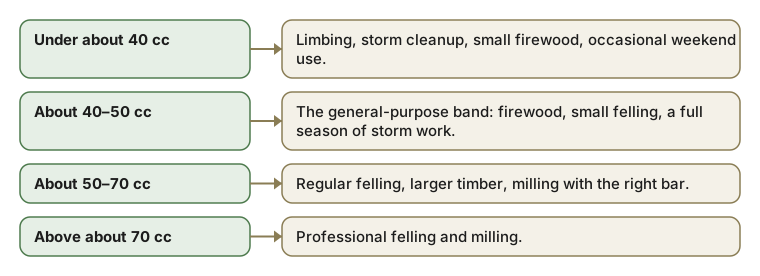
A chainsaw is sold on bar length, which describes the largest cut the saw can make and says nothing about whether the engine can pull a full-length cut without bogging or how the saw feels after an hour of work. The purchase decision runs the other direction: match engine displacement to the work first, limbing and storm cleanup, general firewood and small felling, or regular felling of larger timber each sit in a different size band, then let the bar length follow from what that engine can pull. The chain itself, specified by pitch, gauge and drive-link count rather than the bar’s inch figure, is what gets bought repeatedly for the life of the saw, and confirming a replacement chain is available belongs in the decision before the saw does.
Bar length is what the box sells; displacement against the work is what decides it
A chainsaw's bar length tells you the largest single cut the saw can make, roughly, timber a little under the bar's own length, and nothing about whether the engine can pull a full-length cut without bogging, or how tired your arms are after an hour. Matching displacement to the actual job first, then choosing a bar the engine can pull, is the order that avoids the common mistake: a long bar bolted to a small engine, which cuts slower in the wood, not faster, because the chain drags and the operator pushes to compensate: the exact posture that produces kickback.
| Engine size | The work it suits | What happens outside that |
|---|---|---|
| Under about 40 cc | Limbing, storm cleanup, small firewood, occasional weekend use. | Bogs and heats in sustained felling cuts; owners respond by pushing, which is where kickback comes from. |
| About 40–50 cc | The general-purpose band: firewood, small felling, a full season of storm work. | Most domestic saws sit here and most owners are correctly served by it. |
| About 50–70 cc | Regular felling, larger timber, milling with the right bar. | Heavier to hold: weight, not power, is what limits an afternoon. |
| Above about 70 cc | Professional felling and milling. | More saw than most occasional-use ownership needs, and priced and weighted accordingly. |
Full technical detail, the same displacement bands worked in depth, plus weight and vibration tradeoffs, is on chainsaws. This page exists for the buying decision specifically: size the engine to the work first, then let the bar length follow from what the engine can pull.
The chain is what you are committing to buy, repeatedly
A bar length on the box does not specify a chain. Pitch, gauge and drive-link count together do, and those three numbers, not the inch figure printed on the saw, are what a replacement chain is ordered against for the life of the machine. Before buying, confirm a replacement chain for the exact bar-and-saw combination is available and not a discontinued or oddball fitment; the chain identifier and the chain page cover the three measurements in full.
Gas, corded or battery, the same tradeoff as elsewhere, with one addition
The gas-versus-battery tradeoff for a chainsaw runs the same way it does for a trimmer or blower, unlimited runtime and the most power against a lighter, maintenance-free tool with a battery ceiling on hard, sustained cutting, with one class-specific addition: a chain brake and low-kickback chain are standard safety features on both fuel types, and neither substitutes for bar-length and displacement being matched to the work in the first place. See chainsaw kickback for the mechanism, and Nominal battery energy and compatible tools for the platform math if a battery saw is on the table.
Chainsaw kickback happens faster than a reaction time allows and is the class's defining injury. A saw sized correctly for the work, fitted with low-kickback chain, and used with proper stance and grip reduces the risk; no purchase decision eliminates it. Read chainsaw kickback before the first cut on a new saw, not after.
How to size a chainsaw: questions
What size chainsaw do I need to cut firewood?
The 40–50 cc general-purpose band handles most firewood processing and small felling comfortably, and it is where most domestic saws sit for good reason. A saw under 40 cc will process firewood but bogs on sustained cutting sessions; anything above 50 cc is more saw and more weight than the job usually needs.
What size chainsaw do I need for cutting down trees?
Size the engine to the diameter and hardness of what is being felled, not to a single all-purpose number: the same 40–50 cc general-purpose band that handles firewood also handles most small-to-medium tree felling, while trunks well beyond a bar’s length or dense hardwood in volume call for the 50cc-and-up band with a longer bar to match. Bar length only tells you the largest single cut the saw can make; the engine has to be able to pull a full-length cut in that wood without bogging, which is the actual limit on tree work.
Does a longer bar or blade mean a more powerful saw?
No: bar length and engine displacement are independent, and a long bar on a small engine is slower and more dangerous than a short bar on the same engine, because the chain drags in the cut and the operator pushes to compensate. Size the engine to the work first, then choose a bar (sometimes loosely called the "blade," though the cutting component is the chain riding on that bar) the engine can pull at full speed through a complete cut.
Why does the chain matter more than the bar length when buying?
The bar length on the box does not specify a replacement chain. Pitch, gauge and drive-link count do, and those three measurements are what you order against for the life of the saw. Confirming a chain is available for a given bar-and-saw combination before buying avoids ending up with an oddball fitment.
Is there a chainsaw file size chart by chain pitch?
File diameter tracks pitch consistently enough across the industry to give as a starting chart, though the chain’s own packaging is the source to confirm against: 1/4 in. pitch commonly takes a 5/32 in. round file, .325 in. pitch a 3/16 in. file, 3/8 in. low-profile chain (a smaller chain sold under the same pitch name for lighter saws) a 5/32 in. file, standard 3/8 in. pitch a 7/32 in. file, and .404 in. pitch a 7/32 in. file. Pitch alone does not tell you which chain variant you have, low-profile and full-profile chain of the same nominal pitch are not interchangeable, so check the chain’s own marking or the saw’s manual before buying a file.
What size chainsaw do I need for an Alaskan mill?
More engine than the same bar length needs for ordinary felling and bucking. An Alaskan mill attachment turns a chainsaw into a ripping saw, cutting along the grain rather than across it, which draws far more sustained power than a crosscut of the same length. As a rough starting point, saws used for milling commonly run 60cc and up, well above the 40–50cc general-purpose band that handles firewood and small felling comfortably, and the mill manufacturer’s own bar-length-to-displacement guidance should be checked before buying rather than assumed from felling figures.
What is the best time of year to buy a chainsaw?
Chainsaws see less of a sharp seasonal inventory swing than snow blowers or mowers, since firewood, storm cleanup and felling demand run closer to year-round, but late fall through winter, after the main storm-cleanup and firewood-processing season, is when a retailer is more likely to be clearing current-model stock rather than restocking for peak demand. Pricing isn't tracked here: treat this as a selection and availability pattern, not a savings guarantee.
What is the difference between a homeowner-grade and a professional-grade chainsaw at the same displacement?
The displacement band tells you the work the engine can handle, but build quality, vibration dampening, and expected service life before a major rebuild are what typically separate a homeowner-grade and professional-grade saw of similar displacement: a professional saw is built to run many more hours per year and generally costs more accordingly, even at the same cc figure.
Does a heavier chainsaw always mean more cutting power?
Not directly: weight in the 50–70cc band mainly reflects a bigger engine, a longer bar, and more robust construction for sustained professional use, but weight itself doesn't cut wood; displacement and chain speed do. A heavier saw in that band is harder to hold for an extended session, which the guide identifies as the actual limiting factor at that size, separate from raw cutting capability.
Should I buy a chainsaw with anti-vibration handles even for occasional use?
Anti-vibration handles reduce hand-arm vibration exposure, which matters most for sustained daily professional use but still benefits an occasional user during longer sessions: it's a comfort and long-term health feature rather than one that changes cutting capability, so its value scales with how many hours per year the saw runs.
Does bar length need to match the engine displacement band exactly, or is there flexibility?
There's meaningful flexibility within a displacement band: the same 40–50cc engine can typically pull a range of bar lengths depending on the wood being cut, but going toward the longer end of what an engine can pull means slower cuts and more chain drag in dense or wide material, which is exactly the "long bar on a small engine" mistake the guide describes.
Is a battery chainsaw a reasonable choice for the general-purpose 40-50cc-equivalent work band?
Yes, for many owners: higher-voltage battery chainsaws now deliver output comparable to the 40-50cc gas band for firewood processing and small felling, trading gas's unlimited runtime for a lighter, maintenance-free tool with a battery ceiling on hard, sustained cutting. Whether that trade favors battery depends on session length the same way it does for any other handheld tool.
Chainsaws
A chainsaw is advertised on bar length and owned on three completely different numbers. Bar length tells you the largest cut the saw can make in one pass and nothing else, not whether the engine can pull that cut, and not what chain will fit. The measurements that matter every time you buy a chain are pitch, gauge and drive-link count, and none of them can be worked out from the bar’s printed inch size.
Beyond the chain, the decisions are displacement matched to the work you do, weight you can hold at chest height for an hour, and two safety systems, the chain brake and low-kickback chain, that are engineered to a standard rather than fitted as features.
Bar length is the least useful number quoted
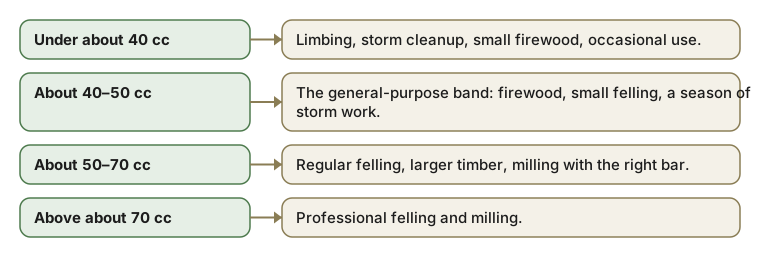
Saws are advertised by bar length, and bar length tells you the largest cut the machine can make in one pass: roughly, a bar handles timber up to a little less than its own length. What it does not tell you is whether the engine can pull a full-length cut, whether a replacement chain will fit, or how the saw behaves. A long bar on a small engine is slower and more dangerous than a short bar on the same engine, because the chain slows in the cut and the operator pushes.
The numbers that decide a purchase are displacement against the work, weight you will hold at chest height for an hour, and the three chain measurements you will be buying for the life of the saw.
Pitchin
Distance between drive links
Half the span across three rivets. 1/4, .325, 3/8 or .404 in.
Gaugein
Drive-link thickness
Must match the bar groove: .043, .050, .058 or .063 in.
Linkscount
Drive links in the loop
A count, not a measurement. The bar’s inch size does not give it.
Those three, together, are how a chain is ordered, and none of them is the bar length on the box. The chain identifier turns the measurements into the specification, and the chain page explains what each one is and where people get it wrong.
Matching displacement to the work
| Engine size | The work it suits | What happens outside that |
|---|---|---|
| Under about 40 cc | Limbing, storm cleanup, small firewood, occasional use. | Bogs and heats in sustained felling cuts. Owners respond by pushing, which is where kickback comes from. |
| About 40–50 cc | The general-purpose band: firewood, small felling, a season of storm work. | Most domestic saws sit here and most owners are correctly served by it. |
| About 50–70 cc | Regular felling, larger timber, milling with the right bar. | Heavier to hold. The weight, not the power, is what limits an afternoon. |
| Above about 70 cc | Professional felling and milling. | Rarely the right domestic answer; the running costs and the handling both scale. |
The two safety features that are engineered, not advertised
The chain brake is a band that clamps the clutch drum, stopping the chain in a fraction of a second. It is triggered by the front hand guard being pushed forward, either by hand or through contact with the operator's wrist during a kickback, and on many saws also by inertia when the bar rotates fast enough. It is not a parking brake and it is not optional: it should be engaged whenever you carry the saw more than a step.
Low-kickback chain has raised depth gauges and shaped tie straps that limit how much wood a cutter can take when the upper quadrant of the bar tip contacts something. The chain-saw standard, ANSI/OPEI B175.1, is what defines this classification and the kickback testing behind it.
Replacing a low-kickback chain with an aggressive one changes how the saw behaves in exactly the moment when behavior matters. The mechanism is on chainsaw kickback.
Two fluids, and only one of them is fuel
A chainsaw takes gasoline premixed with two-stroke oil in the fuel tank, and separate bar and chain oil in a second tank feeding an automatic oiler. Filling the wrong tank is common and the consequences are asymmetric: bar oil in the fuel tank means a strip-down; mixed fuel in the oil tank means a bar that runs dry and a wrecked chain and sprocket.
The oil tank should empty at roughly the same rate as the fuel tank. If you finish a tank of fuel with bar oil left over, the oiler is not delivering: check the outlet hole in the bar mounting face and the groove, both of which pack with sawdust.
A bar that has been run dry develops blue heat marks at the tip and burrs on the rails; that damage is permanent. The fuel mix calculator covers the other tank.
Chainsaw injuries are concentrated in the left hand, the left leg and the head, in that order, and they are the injuries protective equipment is specifically designed for. Cut- resistant trousers or chaps, gloves, eye and hearing protection and a helmet are the equipment, and the reason they are not optional is that a saw does not stop when it reaches skin.
- Outdoor Power Equipment, Internal Combustion Engine-Powered Hand-Held Chain Saws, Safety and Environmental Requirements: Outdoor Power Equipment Institute / ANSI, ANSI/OPEI B175.1-2012 (with A1-2014).
- Control of Emissions from New, Small Nonroad Spark-Ignition Engines and Equipment: U.S. Government Publishing Office (eCFR), 40 CFR Part 1054.
Chainsaws: questions
How do I know which chain fits my chainsaw?
By three measurements taken off the saw, none of which is the bar length on the box: pitch (the spacing of the drive links, found as half the span across three rivets), gauge (the drive-link thickness, which must match the bar groove), and the drive-link count around the loop. Order a chain on all three; the chain identifier turns your measurements into that specification.
Why is bar length the least useful number on a chainsaw?
Bar length only tells you the largest cut the saw can make in one pass; it does not tell you whether the engine can pull a full-length cut, whether a replacement chain will fit, or how the saw handles. A long bar on a small engine is slower and more dangerous than a short one, because the chain bogs in the cut and the operator responds by pushing, which invites kickback.
What size chainsaw do I need?
Match displacement to the work. Under about 40 cc suits limbing, storm cleanup and occasional small firewood; roughly 40 to 50 cc is the general-purpose band most homeowners are correctly served by; 50 to 70 cc handles regular felling and larger timber at the cost of weight. Above about 70 cc is professional territory that is rarely the right domestic answer given the handling and running costs.
What do the chain brake and low-kickback chain do?
The chain brake is a band that clamps the clutch drum and stops the chain in a fraction of a second, triggered by the front hand guard or, on many saws, by inertia during a kickback. Low-kickback chain has raised depth gauges and shaped straps that limit how much wood the bar tip can grab. Both are defined by the chainsaw standard ANSI/OPEI B175.1 rather than fitted as marketing features.
What happens if I put fuel in the bar-oil tank or oil in the fuel tank?
The two mistakes have very different costs. Bar oil in the fuel tank means a strip-down to clean it out. Mixed fuel in the bar-oil tank means the oiler feeds fuel instead of oil, the bar runs dry, and the chain and sprocket are wrecked: a bar run dry develops permanent blue heat marks and burred rails.
The oil tank should empty at roughly the same rate as the fuel tank.
What type of sharpener do I need for a chainsaw?
A round file sized to the chain’s pitch (see below) handles hand sharpening on any saw and is the cheapest and most portable option, though it takes practice to hold a consistent angle. A bar-mounted guide clips onto the bar and constrains the file to the correct angle and depth automatically, which is worth it for anyone who sharpens often but gets it wrong by hand. A powered bench or chain grinder removes material fastest and is the most consistent, but it is a purchase that only pays off sharpening multiple chains regularly rather than one saw occasionally.
What size round file do I need to sharpen my chain?
File diameter follows the chain’s pitch, not the saw or the brand: 1/4 in. pitch generally takes a 5/32 in. file, .325 in. pitch takes a 3/16 in. file, 3/8 in. pitch (the most common on domestic saws) takes a 5/32 in. file on low-profile chain or 7/32 in. on full-profile chain, and .404 in. pitch takes a 7/32 in. file. Confirm the pitch stamped on the drive link, the same measurement used to order a replacement chain, rather than guessing from bar length.
Which way does a chainsaw chain go on the bar?
The cutting edge of each tooth faces forward, toward the bar’s nose, along the top of the bar: a chain fitted backward will not cut and can kick the saw back violently if run. Most bars have a directional arrow stamped near the mount to confirm orientation, and the cutters’ hook shape is the visual check if the arrow has worn off: it should curve forward and slightly upward along the top edge.
How often does a chainsaw chain need to be sharpened?
Sharpen at the first sign the saw is cutting slower or producing fine powder instead of coarse chips rather than on a fixed schedule: a chain that hits dirt or a single nail dulls in seconds, while one used only on clean wood can go many hours. A quick touch-up with a few strokes per tooth as soon as cutting slows keeps a chain sharp far longer than letting it go fully dull and needing a heavier regrind.
Can I put a longer bar on my chainsaw than the one it came with?
Only up to the maximum the manufacturer publishes for that model, which is a mount and oiler-capacity limit, not a wish. A powerhead is rated for a bar-length range because the clutch, sprocket and oil pump are sized to feed and drive a chain of a given length under load; a bar longer than the rated maximum starves for oil, bogs the engine and cuts slower than the shorter bar it replaced, not faster. The saw’s manual or the manufacturer’s parts lookup by model number states the maximum, and it is worth checking before buying a bar longer than the one already on the saw.
Is the chain brake the same thing as the throttle lockout or the on/off switch?
No: these are three separate safety mechanisms with different jobs. The chain brake stops a moving chain within a fraction of a second, triggered by the hand guard or by inertia during kickback. A throttle lockout prevents the throttle trigger from being squeezed accidentally unless a separate interlock is also pressed.
The on/off (or stop) switch simply kills engine ignition. None substitutes for either of the others.
Does a chainsaw's bar wear out, or only the chain?
The bar wears too, independent of the chain: the groove that guides the chain widens over time, particularly if the bar has ever run dry of oil, and the rails can develop burrs that snag a chain even when the chain itself is sharp and correctly tensioned. A bar showing a widened groove or damaged rails should be replaced even if paired with a brand-new chain.