Brush-cutter blades: verify the whole approved configuration
Choose a brush cutter as a complete approved configuration: powerhead, cutting attachment, deflector or limit stop, handle and harness. A straight shaft and a blade that bolts on are not enough. Match the attachment to the growth and use the actual machine’s instructions for blade thrust, clearing distance and handling.
One parts chart controls several decisions
The STIHL FS 91/91 R manual has a combined attachment/deflector/handle/harness chart. Its purpose is to identify an allowed combination, not separate options that can be mixed at will.
| Component | Confirmation needed |
|---|---|
| Cutting attachment | Listed type, size and approved machine |
| Deflector / limit stop | Specified protection for that attachment |
| Handle | Required control arrangement |
| Harness | Required type and release setup |
| Mounting hardware | Approved thrust plate, fasteners and procedure |
The STIHL catalog distinguishes circular-saw-blade configurations with a bicycle handle and double shoulder harness from loop-handle versions. An FS model and its R variant require separate attachment approval, even when they share engine parts.
Grass and woody growth need different plans
Describe the material you need to clear before choosing an attachment. Thick grass, brambles and woody stems are not one interchangeable task. Do not infer a safe stem diameter from a generic blade description or push an attachment beyond its permitted material.
For example, owning the powerhead and a correct-diameter blade still leaves four checks in the chart: guard, handle, harness and mounting arrangement. If any is unconfirmed, the conversion is incomplete. An adapter advertised as universal cannot supply that approval.
Stop for a cracked blade or abnormal vibration
Retain required eye, face, hearing and foot protection and the prescribed bystander area. Blade thrust can occur on contact with hard material; a harness is not a substitute for the correct cutting technique.
Stop, isolate power and wait for all motion before inspection or removing tangled growth. Sharpen or replace only as the manufacturer directs. Engine lubrication also varies: the STIHL service guide distinguishes mixed-fuel four-stroke designs from ordinary two-strokes.
Brush cutters (clearing saws)
A brush cutter, also called a clearing saw, looks like a string trimmer with a longer rigid shaft, a bigger engine, a shoulder harness and a right-angle gear head. What sets it apart is that it can swing a metal blade as well as line: a two or three-tooth blade for tough grass, a brush knife for heavy stems, or a saw blade for small woody growth. The trade is a hazard a trimmer does not have.
A blade that meets something solid can throw the machine sideways, so the correct cutting sector, a guard matched to the head, and the harness matter more than the engine. Choose a brush cutter for thick, woody or large-area growth, and a trimmer for edges and light weeds.
A brush cutter with a metal blade can throw the whole machine sideways the instant the blade meets something solid. Wear a face shield, eye and hearing protection, sturdy boots and long trousers, use the harness, and keep everyone else at least the distance the manual gives. Stop the engine before you clear a jam or touch the blade.
A string trimmer that can take a blade
A brush cutter, also called a clearing saw, looks like a string trimmer with a longer reach and a bigger engine. What sets it apart is the head. A trimmer swings nylon line.
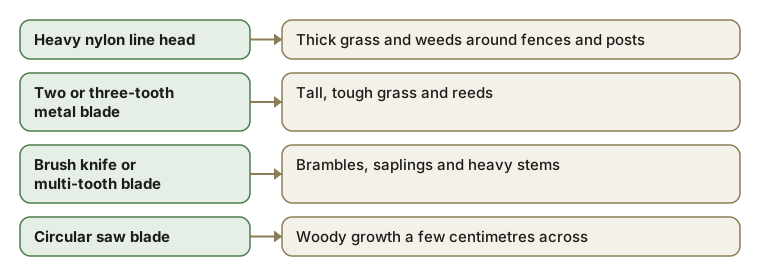
A brush cutter can swing a heavy line head, or a metal blade: a two, three or four-tooth blade for tough weeds and grass, a brush knife for heavy stems, or a circular saw blade for woody growth of small diameter. The shaft is rigid and straight, usually with a two-handed loop or bicycle handle and a shoulder harness, and the drive at the bottom is a right-angle gear head, not a bare spindle.
| Head | Best for | What to know |
|---|---|---|
| Heavy nylon line head | Thick grass and weeds around fences and posts | The gentlest choice. Throws debris, but does not kick like a blade. |
| Two or three-tooth metal blade | Tall, tough grass and reeds | Cuts faster than line. Needs a blade guard and sharpening. |
| Brush knife or multi-tooth blade | Brambles, saplings and heavy stems | Cuts stems the size of a finger to a thumb. Highest blade-thrust risk. |
| Circular saw blade | Woody growth a few centimeters across | Works like a small saw. Kicks back, and is for experienced users only. |
Blade thrust is the hazard to understand
When a spinning blade hits something solid, such as a stump, a post or a stone, it can stop or bite, and the machine is thrown sideways or back toward the operator. A blade turns in one direction, so the same contact acts differently depending on which part of the blade meets the object. The manual shows the correct cutting sector, and the parts of the blade to keep away from solid objects.
Learn it before the first cut. The harness matters here: it holds the machine at a set distance and lets you shed it in a fall.
Use only blades and heads the manufacturer approves for the machine, and a guard of the right type for the head that is fitted: a deflector for a line head, a blade guard for a blade. A guard fitted for a line head is the wrong guard for a blade.
Choosing between a trimmer and a brush cutter
A string trimmer suits lawn edges, light weeds and small areas. A brush cutter earns its weight and its price where the growth is thick or woody, where the area is large, or where a day's work leaves a trimmer struggling. The engine is bigger, often in the 25 to 50 cc range, the shaft is rigid, and the harness spreads the load.
Battery brush cutters exist for lighter work. The ergonomics matter as much as the power: a machine that is too heavy or badly balanced will tire the operator, and a tired operator is the danger.
Head
Line or blade
Sets what the machine can cut, and the guard that goes with it.
Harness
Fitted before starting
Carries the weight and controls the machine if the blade thrusts.
Guard
Matched to the head
A line guard on a blade, or no guard, is a common cause of injury.
Care and maintenance
The engine is the same two-stroke design as on a trimmer, with the same demands: fresh mixed fuel, a clean air filter and a sound spark arrestor screen. The parts that are particular to a brush cutter are the gear head, which needs grease at the interval in the manual, and the blade, which should be sharpened evenly and replaced when cracked, bent or worn thin. Check the blade for cracks before each use.
Balance a sharpened blade, since an unbalanced one vibrates and loosens fasteners.
Brush cutters (clearing saws): questions
What is the difference between a brush cutter and a string trimmer?
A string trimmer swings nylon line and suits edges and light weeds. A brush cutter has a longer rigid shaft, a bigger engine, a shoulder harness and a right-angle gear head, and can swing a metal blade as well as heavy line, so it cuts thick, woody or large areas of growth. The blade is also what adds a hazard a trimmer does not have.
What blade should I use on a brush cutter?
Match it to the growth: a heavy line head for thick grass and weeds, a two or three-tooth blade for tall, tough grass and reeds, a brush knife for brambles and heavy stems, and a circular saw blade only for small woody growth by an experienced user. Use only blades the manufacturer approves for the machine, with a guard made for that type of head.
What is blade thrust?
When a spinning blade hits something solid, such as a stump, a post or a stone, it can stop or bite, and the machine is thrown sideways or back toward you. The manual shows the correct cutting sector and the parts of the blade to keep away from solid objects. Learn it before the first cut, and use the harness so the machine is held at a set distance.
Do I need a harness on a brush cutter?
Yes. The harness carries the weight, spreads the load across the shoulders and holds the machine at a set distance, and on a good design it lets you shed the machine if you fall. A brush cutter used without its harness is heavier, harder to control and more dangerous when the blade thrusts.
Can I put a metal blade on a string trimmer?
Not unless the manufacturer says the machine is built for it. A trimmer's guard, shaft and gear are designed for line, and fitting a blade to one that is not approved can break it or injure you. Metal blades belong on a brush cutter with a rigid shaft, a proper gear head and a blade guard.
What engine size does a brush cutter have?
Petrol brush cutters commonly run from about 25 to 50 cc, larger than most string trimmers, on the same two-stroke design that needs mixed fuel. Battery models handle lighter work. Compare the power, weight and balance, since a machine too heavy or badly balanced tires the operator, and a tired operator is the danger.
How do I sharpen a brush cutter blade?
Sharpen each tooth evenly with a file at the angle the maker gives, and remove the same amount of metal from every tooth so the blade stays balanced. An unbalanced blade vibrates and loosens fasteners. Replace a blade that is cracked, bent or worn thin, and check it for cracks before each use.
Which brush-cutter guard belongs with a line head or rigid blade?
A deflector guard suits a line head and stops debris, while a blade needs a blade guard, which is a different shape and holds the cutting area clear. A guard fitted for a line head is the wrong guard for a blade. Fitting the wrong one, or none, is a common cause of injury.
Use the one the manual specifies for the head fitted.
How often does a brush cutter gear head need grease?
On the interval in the manual, and it commonly needs a small amount of the right grease at the gear head. Too little wears the gears, and too much can leak into the clutch. The engine care is the same as on a trimmer: fresh mixed fuel, a clean air filter and a sound spark arrestor screen.
Is a brush cutter safe to use on a slope?
With care. Footing matters more than usual because the blade thrust can throw you off balance, so wear grip boots, keep both feet planted and work across the slope where you can. Do not cut where you cannot see the ground, since a hidden stump or stone is exactly what triggers thrust.
Keep others well away.
How far away should bystanders stay when a brush cutter is running?
At least the distance the manual gives, which is commonly several meters, and further when cutting with a blade. A brush cutter throws stones, twigs and cut material at speed, and a blade that catches can throw the machine. Stop the engine if anyone comes within the safe distance, and clear the area of pets and children first.
Can I use a brush cutter to cut small trees?
Only with the right head and within the limit the manufacturer sets. A saw blade on a brush cutter can cut woody stems a few centimeters across, but it kicks back, and the machine is not a chainsaw. For anything larger, use a chainsaw with full protective clothing.
Never cut a stem thicker than the blade is rated for.