Choose a string trimmer and reload the approved head
Choose a string trimmer that handles your access, working time and approved cutting line. Use the line diameter, head and guard listed for that machine.
A straight shaft does not automatically authorize a metal blade, and a thicker line is not a universal upgrade. Leaf-blower selection has a separate airflow and runtime comparison.
Head design changes how you reload
ECHO’s Speed-Feed 400 specification accepts up to 20 feet of 0.095-inch line. Its loading instructions use one continuous piece, centered through the head, then wound by the knob with about five inches exposed on each side. They do not require cutting two separate pieces or dismantling the spool.
For an example 20-foot length, the two five-inch exposed tails total ten inches, leaving approximately 19 feet 2 inches inside before accounting for the path through the head. The rated line quantity belongs to that head; use another head’s own capacity and winding direction.
Similar names can conceal different mounting threads
The 2023 Husqvarna 128CD/128LD manual lists 3/8 RH for the 128CD and M10L for the 128LD, with different guards. A head sold as “universal” still needs the correct adapter, thread direction and approved application.
| Choice | Evidence needed |
|---|---|
| Line diameter | Machine/head approval, not weeds alone |
| Bump or quick-load head | Actual reload procedure and replacement availability |
| Blade capability | Explicit approved configuration with guard, handle and harness |
| Battery or gasoline | Working-time evidence for the actual load |
| Shaft shape | Reach and handling; not proof of attachment approval |
Keep blade conversion a separate decision
Do not bolt a metal blade onto a line-only trimmer. Use only the manufacturer-approved attachment and safety configuration. If woody stems require a brushcutter, compare a rated machine and training needs rather than assuming a heavier line will do the work.
Stop and isolate power before clearing tangled vegetation or servicing the head. Follow eye/hearing protection and bystander-clearance instructions. Check a worn head for the manufacturer’s replacement indicators; do not keep running a cracked cover.
For air volume, nozzle choice and battery runtime, use the leaf-blower guide. Shared battery packs do not make a blower and trimmer the same tool.
How to choose a string trimmer
A trimmer is sold on engine or motor size but performs on line diameter and head type: thin line for a clean cut on grass, thick line or a rigid blade for woody weeds that snap thin line repeatedly. It also covers when a quick-load head is worth paying for and when a fixed-line head is simply the right level of complexity for how often the machine gets used.
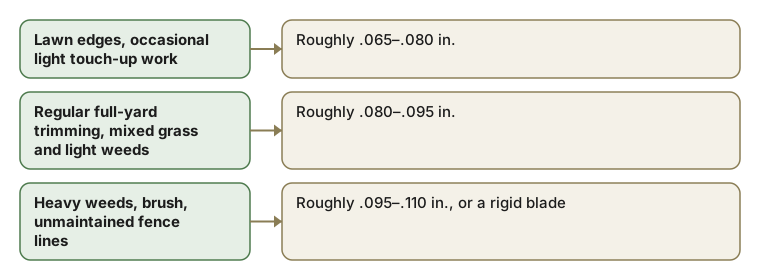
Line diameter and head type do more than the engine does
A trimmer's cutting performance is set far more by line diameter and head type than by engine displacement or motor voltage. Thin line (roughly .065–.080 in.) cuts grass cleanly with the least drag and the least noise; thicker line (roughly .095–.110 in. and up) survives woody weeds and edge work that snaps thin line repeatedly. A fixed-line or bump-feed head keeps things simple for occasional use; a quick-load head reloads in seconds and matters far more once the trimming is a weekly chore rather than a monthly one.
| What you are cutting | Line diameter | Note |
|---|---|---|
| Lawn edges, occasional light touch-up work | Roughly .065–.080 in. | Lightest drag on the motor or engine; the quietest option. |
| Regular full-yard trimming, mixed grass and light weeds | Roughly .080–.095 in. | The general-purpose middle band most residential trimmers ship with. |
| Heavy weeds, brush, unmaintained fence lines | Roughly .095–.110 in., or a rigid blade | Above roughly .110 in. line snaps repeatedly: a brushcutter blade is the plain upgrade instead. |
A rigid blade instead of line, on a machine rated for it, turns a trimmer into a brushcutter for woody stems and saplings: a different harness and shield configuration, not a different machine, and it is covered in full on string trimmers and brushcutters.
Where gas still wins on this specific tool
The general gas-versus-battery trade-off applies to trimmers, but this tool has one wrinkle that pushes it toward gas more than a mower or a blower does: a trimmer is used at full throttle continuously rather than in bursts, which draws a battery pack down faster relative to its rated runtime than light-duty use does. For a small yard trimmed for twenty minutes, that rarely matters. For a large property trimmed for an hour or more at a stretch, a gas trimmer's minute-long refuel still beats carrying spare packs for most owners: see gas vs. battery for your yard for the full scenario table.
Thrown debris, not the line itself, is the injury this tool is built around preventing: a spinning line at full speed throws small stones and debris hard enough to break skin or an eye. Eye protection is not optional equipment for a trimmer, regardless of how light the job looks.
How to choose a string trimmer: questions
Is there a trimmer line size chart by job?
By job rather than by brand: roughly .065–.080 in. for lawn edges and light touch-up, .080–.095 in. for regular full-yard trimming with mixed grass and light weeds, and .095–.110 in. or a rigid blade for heavy weeds and brush, where thinner line snaps repeatedly rather than cutting cleanly. Match the diameter to the toughest material you cut regularly, not the lightest.
When should I use a brushcutter blade instead of trimmer line?
Once you are regularly cutting woody stems, saplings or heavy brush that snaps .110 in. line within a few passes. A rigid blade on a machine rated for it, with the correct harness and shield, handles that material cleanly where line simply cannot.
Is gas or battery better for a string trimmer specifically?
Trimmers run at full throttle continuously rather than in bursts, which draws a battery pack down faster relative to its rated runtime than light-duty tools. For a small yard trimmed briefly, that rarely matters; for a large property trimmed for an hour or more at a stretch, gas’s minute-long refuel still beats carrying spare packs for most owners.
Which trimmer head is the easiest to load?
A quick-load head, which takes pre-cut lengths of line without unwinding a spool, is the easiest and fastest to reload. It matters far more once trimming is a weekly chore than for occasional use. A fixed-line or bump-feed head is simpler mechanically and fine for infrequent use, but reloading it means rewinding a spool by hand.
What weed eater line size chart should I use?
The same job-based bands apply whether the tool is called a trimmer or a weed eater: roughly .065–.080 in. for lawn edges and light touch-up, .080–.095 in. for regular full-yard trimming, and .095–.110 in. or a rigid blade for heavy weeds and brush. There is no single universal size chart across every head design, because a head’s own rated maximum line diameter, printed on the head or in the manual, sets the practical ceiling regardless of what the vegetation would otherwise call for.
What is the best way to trim along a chain-link fence without damaging it?
Line, not a rigid brushcutter blade, near a chain-link fence: a spinning blade that catches the wire can kick back hard, where line simply deflects off it. Run the trimmer parallel to the fence rather than directly against it where possible, and expect faster line wear at that edge than elsewhere in the yard, since the fence itself abrades the line on every pass.
Does trimmer shaft length matter as much as line diameter for choosing the right tool?
Shaft length affects operator comfort and reach, a straight shaft reaches further under shrubs, a curved shaft is lighter for edging, but it doesn't change what the tool can cut the way line diameter does. Match line diameter to the vegetation first, then pick shaft type based on the specific reach and comfort needs of your yard.
Do I need a dedicated brushcutter, or can a trimmer with a blade attachment do the same job?
A trimmer rated for a rigid blade attachment, with the correct harness and shield fitted, handles the same woody-stem work a dedicated brushcutter does. They are largely the same underlying tool with different configurations, not two separate categories of machine. Check that your specific trimmer model is rated to accept a blade before buying one, since not every trimmer head and shaft combination is built for the added torque.
Is a two-stroke or four-stroke engine better for a gas string trimmer?
Two-stroke remains the more common choice for handheld trimmers because of its better power-to-weight ratio, which matters more on a tool held at arm's length than on a wheeled machine: four-stroke handheld trimmers exist specifically for owners who want to avoid mixing fuel, trading a small weight and complexity increase for that convenience.
How long does a spool of trimmer line typically last?
It depends heavily on line diameter and what's being cut rather than a fixed duration: thinner line cutting clean grass lasts many sessions, while thicker line cutting against a fence or hitting stones and hard edges wears or breaks much faster. Keeping spare pre-cut line or a spare spool on hand avoids a mid-job interruption regardless of which diameter you've chosen.
Does a heavier-duty trimmer engine or motor mean I can use thicker line without upgrading anything else?
Not necessarily: the trimmer head itself has a rated maximum line diameter separate from the engine or motor's power, and exceeding that rating can overload the head's feed mechanism even if the engine has power to spare. Check the head's own rated maximum before buying thicker line than what it was designed to feed.
String trimmers and blowers
A string trimmer’s capability comes from the line before it comes from the engine: diameter and shape decide what the machine cuts and how often the line breaks, and fitting line heavier than the head was designed for overloads a small engine rather than upgrading it. The same machine, with a rigid blade fitted in place of the line head, is a brushcutter. A different tool for woody stems and heavy brush that needs a harness and a blade-rated shield the line-only configuration does not.
Both are two-stroke, which means the fuel ratio is a specification and stale fuel is the usual failure. Leaf blowers share the fuel platform and the small-engine problems but are specified on entirely different numbers, covered on their own page.
The trimmer: line diameter does more than displacement
A string trimmer cuts with a length of nylon monofilament traveling fast enough to sever a stem. What that line can cut is set mostly by its diameter and shape, and only then by the engine turning it. Thicker line resists breaking against fences and curbs and cuts heavier growth; it also loads the engine more, and fitting line thicker than the head is designed for is a reliable way to overheat a small engine and wreck a head.
| Line diameter | What it handles | Machine it suits |
|---|---|---|
| 0.065–0.080 in | Grass edges, light trimming, tidy borders. | Battery and light electric trimmers. |
| 0.080–0.095 in | General domestic trimming including tougher weeds. | Most domestic gasoline and larger battery machines. |
| 0.095–0.105 in | Heavy weeds, long grass, semi-commercial use. | Larger gasoline trimmers with a straight shaft. |
| 0.105–0.130 in | Brush and dense growth, commercial duty. | Commercial machines rated for it. Not a domestic upgrade. |
The two mechanical choices are the shaft and the head. A straight shaft drives the head through a solid or flexible cable inside a straight tube, reaches under shrubs and hedges, and takes brushcutter attachments.
A curved shaft is lighter and better balanced for trimming lawn edges and is not built to carry the same attachments. The head is either bump-feed, which advances line when you tap it on the ground, or automatic, which advances on its own and uses more line than you expect.
Loading the head: the procedure that is the same across almost every bump-feed head
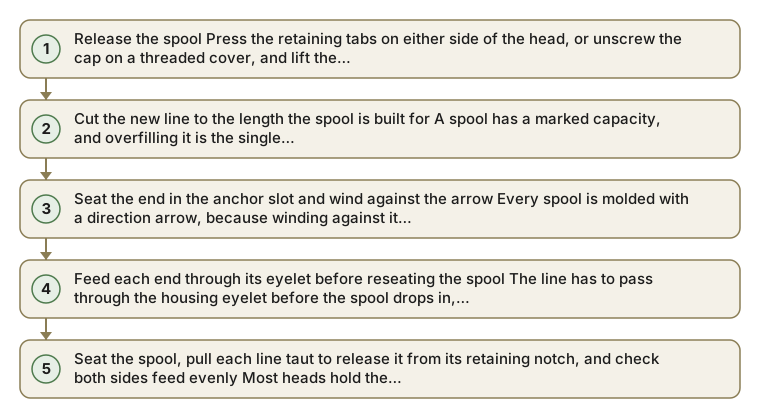
The mechanism is nearly identical across brands even though the plastic around it is not, because a bump-feed spool is a spring-loaded reel doing one job: storing a fixed length of line and releasing a set amount when the internal spring is compressed and released by striking the head on the ground. Fitting new line is a five-step procedure, not a five-part number:
-
Release the spool
Press the retaining tabs on either side of the head, or unscrew the cap on a threaded cover, and lift the spool out. Note which way the old line was wound: most heads reverse direction between the two line channels, and a spool loaded backward feeds erratically or not at all.
-
Cut the new line to the length the spool is built for
A spool has a marked capacity, and overfilling it is the single most common cause of a head that will not feed: the coils bind against each other under spring tension. If the head takes two lines, cut two equal lengths rather than one long piece folded in half; a folded line unbalances the head at speed.
-
Seat the end in the anchor slot and wind against the arrow
Every spool is molded with a direction arrow, because winding against it puts spring tension the wrong way and the line will not release when the head is bumped. Wind tight, flat coils: a loose wind tangles the moment the spool is loaded back into the housing.
-
Feed each end through its eyelet before reseating the spool
The line has to pass through the housing eyelet before the spool drops in, not after. A spool seated first traps the end inside the housing and the head has to be stripped down again to fix it.
-
Seat the spool, pull each line taut to release it from its retaining notch, and check both sides feed evenly
Most heads hold the wound line in a small notch until the first bump releases it. Pulling now, on the bench, confirms the wind was correct before the machine is running.
A head that will not feed after reloading is almost always one of three things: line wound against the arrow, the spool overfilled past its marked capacity, or dirt and grass packed into the retaining notches so the spring cannot compress. A head that feeds too much line on every bump, flinging the machine into a longer cutting radius than intended, usually has a worn or broken retaining notch and needs the spool, not the line, replaced.
Attaching a blade instead of a line
A straight-shaft trimmer built to take attachments can usually swap the string head for a rigid metal or plastic blade, which turns it into a brushcutter: the machine for woody stems, saplings and heavy brush a line simply wraps around and stalls on rather than cuts. The same standard that covers grass trimmers covers this configuration, because the machine and the drivetrain are the same; only the cutting attachment and the working technique change.
A blade attachment needs a harness, not just a handle. The reaction torque from a rigid blade striking something solid is far higher than a length of line ever produces, and a harness is what keeps that reaction from twisting the machine out of your hands. It also needs the shield rated for a blade rather than the lighter line-only shield, because a thrown fragment from a metal blade carries far more energy than a thrown fragment of nylon line.
A blade attachment can throw a fragment, or the whole blade, with enough force to cause a serious injury at a distance most owners underestimate. Clear the work area of anyone else, check the blade for cracks before every use, a cracked blade fails at speed, not at rest, and never run a blade attachment without the harness and the blade-rated shield fitted.
Leaf blowers
Handheld and backpack blowers share the trimmer's small two-stroke engine and its fuel problem, but they are specified on airflow rather than a cutting attachment: CFM, MPH and the blowing force that combines them. That is different enough content to warrant its own page: see leaf blowers for what the two headline numbers mean, why neither predicts whether a machine clears wet leaves, and backpack against handheld against wheeled.
What these machines have in common, and why it matters
Trimmers and handheld blowers are the classic small two-stroke machines: fuel and lubricant arrive together in the tank, there is no oil sump, and the fuel-to-oil ratio is a specification rather than a preference. Both are also the machines most likely to sit for months with fuel in them, and both are therefore the most likely to arrive at a repair shop with a carburetor full of varnish.
Running one on straight gasoline seizes it, usually within a minute. Running one lean on oil does the same more slowly. Get the ratio from the fuel cap or the label and use the fuel mix calculator for the quantity, including the part people get wrong, that the 2.6 oz printed on an oil bottle is 2.56 oz rounded up to a graduation you can pour.
Both classes throw material. A trimmer flings stones and glass at the height of a window and an eye; a blower does the same with grit. Eye protection is the minimum, and hearing protection matters more than owners think.
These are among the loudest machines a homeowner operates, held next to the head, for an hour at a time.
- Outdoor Power Equipment, Internal Combustion Engine-Powered Hand-Held Grass Trimmers and Brushcutters, Safety and Environmental Requirements: Outdoor Power Equipment Institute / ANSI, ANSI/OPEI B175.3-2013.
- Control of Emissions from New, Small Nonroad Spark-Ignition Engines and Equipment: U.S. Government Publishing Office (eCFR), 40 CFR Part 1054.
String trimmers and blowers: questions
What size trimmer line should I use?
Match the line to both the work and the machine. Roughly 0.065 to 0.080 inch suits grass edges and light borders on battery and electric trimmers; 0.080 to 0.095 inch is general domestic trimming on most gasoline machines; heavier line handles brush but only on commercial machines rated for it. Fitting line thicker than the head was designed for overloads and overheats a small engine rather than upgrading it.
Should I get a straight-shaft or curved-shaft trimmer?
A straight shaft reaches under shrubs and hedges, drives the head through a solid or flexible cable in a straight tube, and accepts brushcutter attachments. A curved shaft is lighter and better balanced for trimming lawn edges but is not built to carry the same attachments. Choose the straight shaft if you want reach or a brushcutter, and the curved one if edging comfort is the whole job.
What is the difference between CFM and MPH on a leaf blower?
CFM is the volume of air moved and MPH is its speed at the nozzle, and neither alone tells you whether the blower will lift a wet leaf mat. High speed with low volume is a narrow jet that moves one leaf at a time; high volume with low speed is a broad push that will not lift anything stuck down. The figure that combines them is blowing force in newtons, which only some manufacturers publish.
Which blower number tells me if it will move wet leaves?
The blowing force in newtons, where a manufacturer publishes it, because moving a wet leaf mat is about the momentum of the air, volume and speed together, rather than either figure on its own. When only CFM and MPH are given, treat a high value in one and a low value in the other with suspicion, since it usually means the machine is optimized to win one specification rather than to do the work.
Why do trimmers and blowers fail after being stored?
Both are small two-stroke machines that sit for months with fuel in them, so both arrive at repair shops with carburetors full of varnish from stale gasoline. Running one on straight gasoline with no oil seizes it within about a minute, and running it lean on oil does the same more slowly, so get the fuel-to-oil ratio from the cap or label and mix it correctly every time.
How much does a string trimmer weigh?
A curved-shaft electric or battery trimmer is generally the lightest, often under 10 pounds; a straight-shaft gas trimmer that can carry a brushcutter attachment typically weighs more, in the 10 to 15 pound range, because of the solid drive shaft and larger engine. The battery pack itself adds weight a spec sheet sometimes lists separately from the bare tool, so check whether a quoted figure includes it.
Should I buy a gas or battery string trimmer?
A battery trimmer covers most residential edging and trimming well now, with no fuel mixing and far less noise; a gas straight-shaft trimmer still wins for all-day commercial use or when a brushcutter attachment is needed for heavier growth, because pack swapping adds up to real downtime over a full working day that a fuel can does not.
What is the best string trimmer to buy?
What is answerable here is shaft type (straight for reach and attachments, curved for lighter edging comfort) and power source (gas for all-day commercial use, battery or electric for most residential work), which settle the class before brand becomes the question.
Is a 4-cycle (4-stroke) trimmer or blower better than a 2-cycle one?
A 4-stroke handheld engine runs on straight gasoline with its own oil sump, so there is no fuel-to-oil ratio to mix and no blue-smoke exhaust, but it is heavier for the same power because it carries that separate oil sump. A 2-stroke is lighter and can run in any orientation, which is why most handheld tools, trimmers, blowers, chainsaws worked overhead or on their side, are still built as 2-strokes despite the mixed-fuel maintenance. Neither is universally "better"; a 4-stroke suits someone who wants to skip fuel mixing and does not mind the extra weight.
Is a "weed eater" the same thing as a string trimmer?
"Weed eater" is a genericized brand name used loosely for the whole string trimmer class, the way "Kleenex" stands in for facial tissue: it is not a separate machine or a different mechanism. Everything about line diameter, shaft type and brushcutter attachments applies to a machine sold or described either way.
Can I put a blade on my trimmer instead of string?
Only on a straight-shaft machine specifically rated for a brushcutter blade attachment, with the correct harness and blade guard fitted: a curved-shaft trimmer or a straight shaft not rated for it should never be fitted with a rigid blade. Once cutting is routinely going through woody stems or heavy brush that snaps trimmer line within a few passes, a rated machine with a blade attachment is the correct upgrade rather than persisting with heavier line.
How many watts does a corded electric string trimmer use?
Most corded electric trimmers draw somewhere in the 350 to 600 watt range, roughly 3 to 5 amps on a standard 120-volt circuit: modest enough that circuit capacity is rarely the limiting factor, unlike a pressure washer or a shop tool. The practical limits is the cord itself: reach and cord gauge over distance, not the household circuit.
Should I soak weed eater string or trimmer line in water before use?
Yes, for a modest but real benefit: nylon trimmer line that has dried out over storage becomes brittle and snaps more readily against resistance, and soaking a spool in water for a few hours to overnight before use restores some flexibility and reduces breakage in the first few minutes of a job. It is a low-cost habit worth forming for line that has sat in a garage over winter, not a substitute for replacing line that is visibly cracked or discolored.
What size string does a Ryobi, Echo, Ego, Homelite, Milwaukee, Stihl, Worx or Dewalt trimmer hold, and how much does each weigh?
The head itself states its rated maximum line diameter, and the general job-based bands above (thin line for edges, thicker line or a blade for brush) apply to any brand’s machine equally; weigh a specific listed model on its own spec sheet rather than a category assumption.
How much compression should a weed eater have?
The correct compression-PSI reading is engine-specific and comes from the manufacturer, not a class-wide number. What matters diagnostically is a comparison against that engine’s own healthy baseline (or a same-model machine known to run well), not an absolute figure. A compression test that reads meaningfully low against either reference points at worn rings, a valve, or a head gasket rather than a fuel or ignition fault.