Starting-battery replacement: voltage, group, terminals and CCA
Choose a starting battery by the equipment’s required voltage, approved physical size and terminal layout, chemistry and cranking specification. A group code does not establish CCA or capacity. Keep cable reach, hold-down and charger compatibility in the decision; do not stretch cables across the case to fit the wrong terminal arrangement.
Read the individual product rating
Interstate’s SP-35 page identifies a 12-volt U1 battery rated at 300 CCA. Its lawn-and-garden table separately lists U1R variants. Confirm the actual terminal orientation and equipment application rather than selecting by a similar product name.
| Label | Decision |
|---|---|
| Voltage | Electrical system match |
| Group / dimensions | Tray, clearance, hold-down and terminal position |
| CCA | Cold-start current rating under its test |
| Ah / reserve capacity | Stored-charge / discharge-duration specification |
| Chemistry | Equipment and charger approval |
CCA is current, not stored amp-hours. A hypothetical 30Ah, 12V battery has about 360 nominal watt-hours by multiplication; that does not mean it delivers 360 amps for starting, nor that all of its nominal energy is usable without damage.
Do not infer lifespan from one successful start
A mild-weather start does not measure cold cranking performance. Ask for a suitable battery and charging-system test when the machine cranks slowly. Corroded connections, cables or a charging fault can mimic a battery problem.
Use a charger approved for the chemistry and capacity, including its long-term maintenance instructions. A “trickle” or “smart” label alone does not establish that it can remain attached indefinitely. Do not charge a frozen, damaged or leaking battery.
Work safely around stored current and acid
Follow the equipment’s isolation and cable sequence with appropriate eye protection and ventilation. Keep tools, sparks and flames away from terminals and charging gas. Never bridge the posts to test it.
For a fixed generator, use its specified battery and maintenance schedule; a mower-sized case or higher CCA label is not permission to substitute a different chemistry. Return used lead-acid batteries through an appropriate recycling channel.
PT-06 · Parts
Starting batteries and group numbers
A starting battery is described by a group number, and the thing most owners assume it means is the thing it does not. A BCI group number, U1 on most riding mowers, with a terminals-reversed U1R variant, specifies the physical package only: case length, width, height and terminal position. Capacity and cranking ability are separate figures entirely, and the one that matters for starting an engine is cold cranking amps, the current the battery can deliver at eighteen degrees below freezing.
Ampere-hours describes stored energy and barely matters on a machine that starts and then charges. That distinction is why a battery which turned the engine over easily in September can be completely unable to crank it in January.
What a group number does and does not tell you
Starting batteries are described by a BCI group number. U1 is the common one on riding mowers, with variants such as U1R. The group number specifies the physical package: overall length, width and height, and where the terminals are.
It says nothing whatever about capacity or cranking performance.
The R in U1R means the terminals are reversed relative to a plain U1. Two batteries of the same group with opposite terminal layouts will both drop into the tray, and only one of them will let the cables reach without stretching them across the case, which is a short circuit looking for a bump.
Group
The box it comes in
Case dimensions and terminal position. U1, U1R and similar.
CCA
Cold cranking amps
Current deliverable at −18 °C for 30 seconds at a defined voltage. The starting number.
Ah
Ampere-hours
Energy stored. Matters for lights and accessories, not for cranking.
| Number | The question it answers | What it does not tell you |
|---|---|---|
| BCI group number | Will it physically fit the tray, and will the cables reach the terminals? | Nothing about capacity or cranking. Two batteries of the same group can differ substantially in both. |
| Cold cranking amps (CCA) | Can it turn a cold engine over? This is the starting number. | Nothing about how long it will run anything once the engine has stopped. |
| Ampere-hours (Ah) or reserve capacity | How much energy it stores, for lights and accessories. | Very little about starting. A high-capacity battery with low CCA still fails on a cold morning. |
Cold cranking amps is the number that matters, and the one that fades
Cold cranking amps describes current delivered in the cold, which is exactly what starting a cold engine asks for. Ampere-hours describes stored energy and is close to irrelevant for a machine that starts and then charges. This is why a battery that turns an engine over on a warm September afternoon can fail flatly in January: its capacity has degraded, and the January demand is much higher than the September one.
This is the single most common reason a standby generator does not start when it is finally needed, and the reason a riding mower that "was fine in autumn" is dead in spring. A battery in a machine that only ever runs a scheduled exercise cycle is never tested. The cycle proves it can start a warm engine in mild weather, and nothing more.
Charging and storage over the off season
-
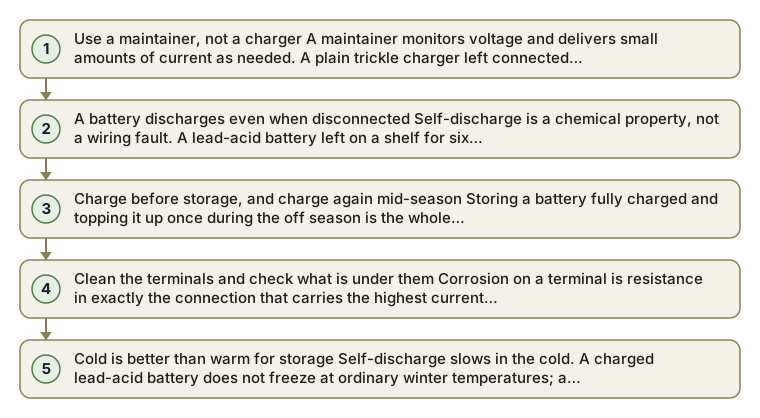
Use a maintainer, not a charger
A maintainer monitors voltage and delivers small amounts of current as needed. A plain trickle charger left connected for months will overcharge a lead-acid battery, boil off electrolyte, and finish it.
-
A battery discharges even when disconnected
Self-discharge is a chemical property, not a wiring fault. A lead-acid battery left on a shelf for six months arrives at spring partly discharged, and a discharged lead-acid battery sulfates: the process that permanently removes capacity.
-
Charge before storage, and charge again mid-season
Storing a battery fully charged and topping it up once during the off season is the whole procedure, and it roughly doubles the working life against the usual alternative of doing nothing.
-
Clean the terminals and check what is under them
Corrosion on a terminal is resistance in exactly the connection that carries the highest current on the machine. Clean, refit tight, and protect. A machine that cranks slowly often has a clean-looking terminal with corrosion under the clamp.
-
Cold is better than warm for storage
Self-discharge slows in the cold. A charged lead-acid battery does not freeze at ordinary winter temperatures; a discharged one can, and freezing destroys it. Charged and cool is the target.
Safety, briefly but seriously
A lead-acid battery vents hydrogen while charging and can produce it in quantity if charged hard. It also contains sulfuric acid, and it can deliver hundreds of amps into a spanner laid across both terminals: enough to weld the spanner in place and rupture the case.
Disconnect the negative terminal first and reconnect it last, so that a spanner touching the machine while you work on the positive terminal completes no circuit. Charge in ventilated space, keep flame and sparks away, and wear eye protection when working near one.
Starting batteries and group numbers: questions
What does a battery group number like U1 tell me?
Only the physical package, overall length, width, height and terminal position, not capacity or cranking power, and two batteries of the same group can differ substantially in both. The R in U1R means the terminals are reversed: both drop into the tray, but only one lets the cables reach without stretching them across the case, which is a short circuit waiting for a bump.
Is cold cranking amps or amp-hours the number for starting?
Cold cranking amps. It measures the current the battery delivers in the cold, which is exactly what starting a cold engine demands. Amp-hours describes stored energy for lights and accessories and barely matters on a machine that starts and then charges from its own alternator.
A high-capacity battery with low cold cranking amps still fails on a freezing morning.
Why was my mower battery fine in autumn but dead in spring?
Because a battery that turns an engine over on a warm afternoon can be unable to crank it in the cold once its capacity has degraded, and the cold demand is much higher. A machine that only runs a scheduled exercise cycle never really tests its battery. The cycle proves it can start a warm engine in mild weather and nothing more, which is why standby generators fail here too.
How should I store a battery over the off season?
Charge it fully first, keep it on a maintainer rather than a plain trickle charger, which overcharges and boils off electrolyte over months, and top it up once mid-season. A lead-acid battery self-discharges on the shelf and a discharged one sulfates, permanently losing capacity, so charged and cool is the target: cool slows self-discharge, and a charged battery will not freeze while a discharged one can.
What does the "R" in a battery group number like U1R mean?
It denotes reversed terminal polarity relative to the base group number's standard layout: both the standard and reversed versions physically drop into the same size tray, but only the correct one for your machine's wiring lets the cables reach the terminals without stretching them across the top of the case, which risks a short circuit if a cable ever contacts the wrong post.
Can I use a higher amp-hour battery than my machine originally came with, as long as the group size fits?
Generally yes for the physical fit and the machine's own charging system, since a higher-capacity battery of the same group size and compatible cold cranking amps simply gives more reserve capacity for accessories, but confirm the machine's charging system can adequately maintain the larger battery's charge, since an undersized charging system paired with an oversized battery can leave it chronically undercharged.
Why does a riding mower or generator battery need a maintainer instead of just disconnecting it for winter?
A lead-acid battery self-discharges even while sitting disconnected, and a battery that drops low enough sulfates: a chemical change that permanently reduces its capacity even after recharging. A maintainer actively counteracts that self-discharge throughout storage, which simple disconnection does not.
Does a battery's cold cranking amps rating degrade with age the same way its capacity does?
Yes, and often faster in practical terms: cold cranking amps is exactly the specification a battery loses first as its internal resistance rises with age, which is why a battery that starts an engine easily in mild weather can fail specifically on the first cold morning, well before it fully stops holding a charge for lights or accessories.
What is the difference between a trickle charger and a battery maintainer?
A plain trickle charger applies a constant low current regardless of the battery's actual charge state, which overcharges a fully charged battery over an extended period and can boil off electrolyte. A maintainer monitors the battery's voltage and cycles its charging on and off to hold it at full charge without overcharging, which is why a maintainer, not a trickle charger, is the correct choice for unattended off-season storage.
How do I know if my riding mower or generator battery has already sulfated and lost capacity?
A battery that struggles to start the engine despite accepting what seems like a normal charge, or one that a multimeter shows at a lower-than-expected resting voltage after a full charge cycle, is showing signs consistent with sulfation. A battery this far degraded is usually more economical to replace than to attempt reconditioning, especially once it has already failed to start an engine in cold weather.
Does every riding mower and standby generator use a lead-acid starting battery?
Lead-acid remains the dominant type for this application, since it delivers the high burst current a starter motor needs and is inexpensive relative to the alternatives, but check your specific machine's manual, since some newer equipment uses AGM (absorbed glass mat) batteries, which are also lead-acid chemistry but sealed and more tolerant of vibration and partial discharge.
How do I test whether a riding mower or generator battery is the cause of a no-start?
A multimeter reading across the terminals is the quickest first check: a resting voltage notably below the battery's rated full-charge voltage points toward the battery, while a normal resting voltage that still fails to crank the engine under load points toward the starter, the cables, or a connection problem instead of the battery itself.