Mower-blade replacement: approved fit, condition and torque
Identify a mower blade by the approved part for the exact deck and serial, then inspect the mounting system and blade condition. Length alone does not establish safe fit. Use the model’s orientation, balancing and fastener instructions; a damaged or bent blade needs replacement rather than improvised straightening.
Torque belongs to the actual assembly
The Toro 20370-series manual specifies 60 foot-pounds (82 N·m) for its blade bolt. The cited TimeCutter SW manual gives 35–65 foot-pounds (47–88 N·m) with its specified curved washer and orientation. These instructions cannot be turned into one universal mower setting.
| Item | Check |
|---|---|
| Approved part | Exact mower, deck and serial |
| Dimensions | Length, thickness, profile and mounting pattern |
| Hardware | Required bolt, washer and adapter |
| Orientation | Sail / blade-edge direction in the manual |
| Fastener | Applicable torque and replacement condition |
For a hypothetical 60-pound-inch instruction, the equivalent is five pound-feet, not 60 pound-feet. The factor of 12 comes from inches per foot. Read the unit on the actual instruction and wrench before tightening.
Inspect the sail as well as the blade edge
The Toro manuals show inspection for cracks, wear and damage. A sharpenable edge does not prove the lift surface or mounting hole remains sound. After an impact, follow the inspection procedure before returning the machine to use.
Use the manufacturer’s balancing method or a suitable service provider. Do not remove uncontrolled amounts of metal to make a damaged blade appear balanced, weld a crack, or heat and straighten a bent blade.
Match the clipping configuration
A bagging, mulching or discharge blade must be approved for the deck and fitted accessories. A high-lift shape is not automatically better, and a mulching label does not supply a missing plug or guard.
Disconnect ignition or remove the battery as directed before working underneath. Support the machine safely and tip only in the permitted direction. Refit guards and stop for vibration or a mounting problem before another mowing test.
PT-02 · Parts
Mower blades: measuring and replacing
A mower blade is the part you will buy most often, and it is specified by four things: overall tip-to-tip length, the shape and size of the center hole, the width and thickness of the steel, and the lift profile of the trailing edge. Length is the one everybody matches and the center hole is the one that causes wrong orders, because star, five-point, six-point, H-pattern and plain round bores all look broadly similar in a photograph taken without a ruler. Lift is the least understood of the four and does more work than most owners realize.
It is the airflow that stands the grass upright before the edge reaches it, which is why an eroded blade cuts badly long before it stops being sharp.
Four measurements, taken off the old blade
| Measurement | How to take it | Why it matters |
|---|---|---|
| Overall length | Tip to tip, in a straight line through the center. | Sets the cutting circle. Too long and it strikes the deck; too short and it leaves an uncut strip between passes. |
| Center hole shape and size | The bore in the middle: round, star-shaped, five-point, six-point, H-pattern, or a bore with outer locating holes. | This is the fitment. A blade of exactly the right length with the wrong center will not mount, or will mount without locating and shear the key. |
| Width and thickness | Across the flat of the blade, and its steel thickness. | Thickness relates to the deck the blade was designed for. A thin blade on a heavy deck flexes and cuts unevenly. |
| Lift and profile | How far the trailing edge is turned up, and whether the cutting edge runs the full length. | Lift is the airflow that stands the grass up before it is cut, and it is what mulching depends on. |
The center hole is where most wrong blades come from, because length is easy to match by eye and the center is not. Photograph the old blade’s center with a ruler beside it before you go to the counter: the shape names in use are not consistent between suppliers, and a photograph settles it in one look.
Standard, high-lift and mulching profiles
A standard blade has a modest upturned trailing edge and is a general compromise. A high-lift blade turns up more sharply, moving more air, which stands wet grass up and drives clippings into a bag: it is what you want for bagging and it loads the engine more. A mulching blade has a curved, longer cutting edge and is designed to hold the clipping in circulation under a closed deck so it is cut several times before it drops.
Fitting a mulching blade to a deck that is not closed does not produce mulching; it produces a blade with less lift and a worse cut. The profile and the deck have to agree, which is the point made on walk-behind mowers.
Sharpening, and the step everybody skips
-
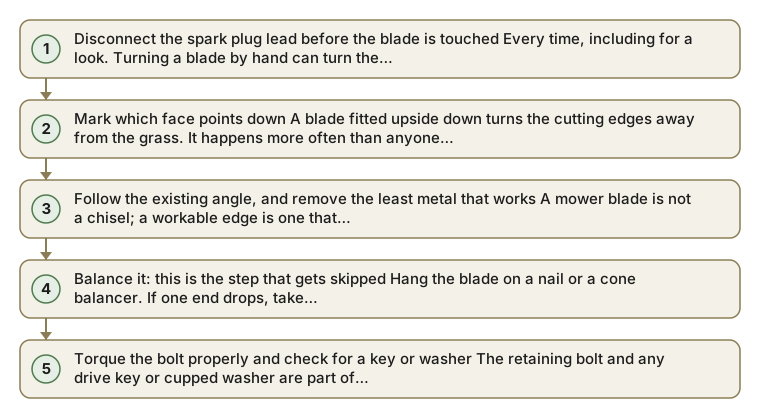
Disconnect the spark plug lead before the blade is touched
Every time, including for a look. Turning a blade by hand can turn the engine over far enough to fire.
-
Mark which face points down
A blade fitted upside down turns the cutting edges away from the grass. It happens more often than anyone admits, and the symptom is a machine that appears to do nothing.
-
Follow the existing angle, and remove the least metal that works
A mower blade is not a chisel; a workable edge is one that cuts cleanly rather than one that shaves. Overheating the steel to blue changes its temper and it will not hold an edge afterwards.
-
Balance it: this is the step that gets skipped
Hang the blade on a nail or a cone balancer. If one end drops, take metal off that end until it sits level. An unbalanced blade spinning at speed vibrates the crankshaft and the deck bearings, and that vibration is what turns a cheap sharpening into an expensive engine.
-
Torque the bolt to its specification and check for a key or washer
The retaining bolt and any drive key or cupped washer are part of the assembly. Reusing a stretched bolt, or omitting a cupped washer that was fitted convex-out, are both ways to have the blade come loose.
When to replace instead of sharpen
A blade is finished when the trailing sail is eroded thin, when the tips are rounded far enough back that the cutting circle has shrunk, when there is a crack anywhere, or when a strike has bent it. A bent blade cannot be straightened back to a safe part: the steel has yielded, and a blade that fails at speed leaves the deck at the speed of the tip. Erosion of the upturned sail is the failure people miss, because the edge still looks sharpenable while the lift that does half the work has gone.
Mower blades: questions
How do I know which mower blade to buy?
By four measurements taken off the old blade: overall tip-to-tip length, the shape and size of the center hole, the width and thickness of the steel, and the lift profile of the trailing edge. Length is easy to match; the center hole is where wrong orders come from, so photograph it with a ruler beside it: star, five-point, six-point, H-pattern and round bores all look similar without one.
What is the difference between a standard, high-lift and mulching blade?
A standard blade has a modest upturned trailing edge and is a general compromise; a high-lift blade turns up more sharply to move more air, which stands wet grass up and drives clippings into a bag; a mulching blade has a longer curved edge that holds the clipping in circulation under a closed deck so it is cut several times before it drops. A mulching blade on an open deck simply cuts worse.
Do I really need to balance a mower blade after sharpening?
Yes: it is the step most people skip and the one that protects the engine. Hang the blade on a nail or a cone balancer, and if one end drops, take metal off that end until it sits level. An unbalanced blade spinning at speed vibrates the crankshaft and the deck bearings, and that vibration is what turns a cheap sharpening into an expensive engine or spindle repair.
When should I replace a mower blade instead of sharpening it?
When the upturned trailing sail is eroded thin, when the tips are rounded far enough back that the cutting circle has shrunk, when there is a crack anywhere, or when a strike has bent it. A bent blade has yielded and cannot be trued back to a safe part. Sail erosion is the failure people miss, because the edge still looks sharpenable while the lift that does half the work has gone.
What size nut holds a lawn mower blade on, and does it thread normally?
The blade bolt or nut size is machine-specific: measure the one currently on it rather than assuming a size, since it varies with spindle diameter across brands and even across a single maker’s own model range. One detail worth checking before assuming a stuck bolt is stripped: some mowers use a left-hand (reverse) thread on the blade bolt specifically so normal blade rotation tends to tighten it rather than loosen it, so a bolt that will not turn the "normal" direction may just need the opposite one tried.
When should I bag lawn clippings instead of mulching them?
Bag when clippings are long, wet, or heavy enough to clump and smother the grass beneath them, rather than by a fixed schedule, since that is exactly the condition a mulching deck cannot process well. For clippings short enough that the one-third mowing rule was followed, mulching returns nitrogen to the lawn and is the better default; switch to bagging for a single overgrown or rain-delayed cut rather than changing the deck setup permanently for an occasional condition.
How should I measure and photograph a mower blade’s mounting hole?
Because star, five-point, six-point, H-pattern and round center-hole shapes look similar enough in a verbal description that a wrong description is easy to give confidently, while a photograph with a ruler for scale removes both the shape ambiguity and the size ambiguity in one image a parts counter can compare against stock.
Does blade thickness matter as much as blade length for fitment?
Yes, along with width: the steel's width and thickness affect how the blade balances and how it interacts with the deck's cutting chamber shape, not just how well it spins. A replacement of the correct length but noticeably different thickness can still cut differently or fail to balance the same way the original did.
Can I sharpen a mower blade myself, or does it need a professional?
Many owners sharpen their own blades with a file, a bench grinder, or a dedicated blade-sharpening attachment, provided they balance the blade afterward: the balancing step, not the sharpening technique, is what most self-sharpened blades skip and what protects the engine and spindle bearings from vibration damage.
How do I safely remove a mower blade to inspect or replace it?
Disconnect the spark plug wire first so the engine cannot accidentally start while your hand is near the blade, then wedge or clamp the blade to keep it from spinning while you loosen the center bolt or nut: check for a left-hand thread first, since forcing the wrong direction on a reverse-threaded bolt can round it off or break a wrench.
Is a bent mower blade dangerous to keep using?
Yes: a bent blade has yielded past its designed shape and cannot be trued back into a safe, balanced part. Beyond the vibration and bearing damage any unbalanced blade causes, a blade that has already bent once under impact has had its metal fatigued in a way that increases the risk of a more serious failure at speed; replace it rather than attempting to straighten it.
Does a riding mower with two or three blades need all of them replaced or sharpened at the same time?
Servicing them together is the practical default even if only one shows obvious wear, since mismatched sharpness or balance across multiple blades on the same deck can produce an uneven cut pattern that's harder to diagnose than a uniformly worn set, but each blade's own condition (cracks, sail erosion, bends) still governs whether it needs replacing versus just sharpening.