Choose a walk-behind mower by access, control and clipping plan
Choose a walk-behind mower that fits the access route, terrain and clipping plan you can maintain. Compare overall width and control with the fitted bag or discharge parts, not deck inches alone. A self-propelled drive can reduce pushing effort but does not make every slope safe.
Decide what happens to the clippings
University of Minnesota Extension explains returning short clippings and distinguishing them from thatch. Use the mower’s approved mulching configuration; a blade advertised as “mulching” does not supply a missing plug or discharge guard.
Under a one-third-removal plan, a three-inch target height means mowing by 4.5 inches: removing 1.5 inches is one-third of 4.5. Cutting six-inch grass to three removes half its height and is a different load and turf decision.
Verify the stop control and the applicable rule
CPSC’s walk-behind mower guidance explains the scope of mandatory 16 CFR Part 1205. The published blade-control requirement specifies stopping normal blade motion within three seconds after control release for covered machines. The legal scope has exceptions; it is not a claim about every commercial mower configuration.
The cited Toro 20370-series manual also makes a daily stop-control check. A failed control needs repair before use. Never tie down a bail or bypass an interlock to keep an engine or blade running.
Try the drive without assuming a universal best axle
| Item | Check |
|---|---|
| Drive | Speed range, release behavior and safe handling |
| Access | Actual overall width and turning room |
| Clippings | Approved bag/discharge/mulch parts |
| Service | Blade access, tip direction and engine identity |
| Terrain | Actual manual limits and stable footing |
Do not choose front- or rear-wheel drive from a blanket slope rule. Operator footing, traction, bag load and model design all matter. Use the prescribed mowing direction and avoid unsuitable wet or steep ground.
For service, stop and isolate ignition or remove the battery as directed. Tip only in the permitted direction. Engine oil, filters and dates follow the actual engine manual; “every mower needs the same annual oil change” is not a valid substitute for model-specific instructions.
For a Toro, the Recycler model and service guide separates engine, oil and blade instructions by the actual machine identifiers.
Walk-behind mowers
A walk-behind mower is chosen on three things and sold on one. The one it is sold on is deck width, and the real limits on that is the narrowest gate or gap the machine has to pass through, not the size of the lawn. The three that decide whether you like owning it are the drive arrangement, push, front-wheel or rear-wheel self-propel, each of which suits different ground, whether the deck is set up to mulch, and how easily the blade comes off for sharpening.
Underneath all of that sits a small four-stroke engine with a small oil capacity and, on most domestic machines, no oil filter, which is why the service interval is shorter than owners expect.
Deck width is limited by your narrowest gate
Walk-behind mowers are sold on cutting width, commonly from about 20 to 22 inches on domestic machines. Wider is faster in open lawn and worse everywhere else: it will not fit between a fence and a shed, it scalps more on uneven ground because the deck spans further between high points, and it is heavier to turn at the end of every pass. Measure the narrowest gap the machine has to pass through before you look at anything else, because that measurement is a hard limit and everything else is a preference.
| Configuration | Suits | What it costs you |
|---|---|---|
| Push, side discharge | Small flat lawns, infrequent cutting, lowest purchase and repair cost. | You provide the propulsion. Clippings land in a row you may have to rake. |
| Self-propelled, rear-wheel drive | Slopes and heavy wet grass; traction stays on the driven wheels uphill. | A drive belt, a transmission and a cable to maintain. Harder to pivot at the end of a pass. |
| Self-propelled, front-wheel drive | Flat ground with many obstacles: tipping the machine onto its rear wheels disengages drive for a turn. | Loses traction uphill and when the bag fills, exactly when you want it. |
| Mulching (often "3-in-1") | Returning clippings to the lawn; no bagging, no raking, and the nitrogen stays. | Needs a mulching blade, a closed deck and frequent cutting. It fails badly in long wet grass. |
What mulching requires
Mulching is not a setting; it is a deck geometry and a blade profile working together. A mulching blade has more cutting edge and a steeper lift curve, and the deck is closed so the clipping is held in the airflow and cut repeatedly before it drops. That only works when the clipping is short and dry.
Cutting a third of the blade height at a time is the rule that makes mulching succeed, and a machine sold as 3-in-1 will still pack the deck solid if you let the lawn get away from you in a wet spring.
The consequence for maintenance is that a mulching deck needs scraping. A layer of packed, dried clipping on the underside of a deck destroys the airflow that lifts the grass upright before the blade reaches it, and the first symptom is an uneven cut that gets blamed on the blade. That symptom is worked through in why a mower cuts unevenly.
The safety control that has to be there
Every walk-behind rotary mower sold in the United States has an operator-presence control: the bail you hold against the handle. The consumer turf care standard, ANSI/OPEI B71.1, requires that releasing it brings the blade to a stop within three seconds. That is the specification behind a part that owners routinely tie down because it is inconvenient, and it is worth knowing what the three seconds is protecting: the time between letting go of a machine and reaching under it.
A blade that keeps spinning for noticeably longer than about three seconds after you release the bail has a brake problem, a seized cable or a modification. That is a repair, not a quirk. Disconnect the spark plug lead before going near the underside of any mower, every time, including for a quick look.
The service that decides how long it lasts
-
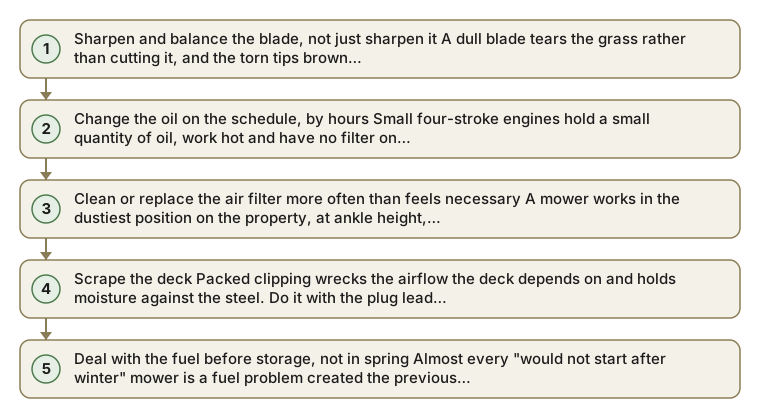
Sharpen and balance the blade, not just sharpen it
A dull blade tears the grass rather than cutting it, and the torn tips brown within a day: the usual reason a lawn looks poor after cutting. An unbalanced blade vibrates the crankshaft and the deck. Details are in mower blades.
-
Change the oil on the schedule, by hours
Small four-stroke engines hold a small quantity of oil, work hot and have no filter on most domestic machines. That combination makes the interval short. Which grade to use is on oil grades.
-
Clean or replace the air filter more often than feels necessary
A mower works in the dustiest position on the property, at ankle height, in its own cloud. A clogged filter enriches the mixture and is a common cause of a machine that starts and then runs badly.
-
Scrape the deck
Packed clipping wrecks the airflow the deck depends on and holds moisture against the steel. Do it with the plug lead off and the machine tipped carburetor-side up, so oil does not run into the cylinder.
-
Deal with the fuel before storage, not in spring
Almost every "would not start after winter" mower is a fuel problem created the previous autumn. See winter storage.
- Consumer Turf Care Equipment, Pedestrian-Controlled Mowers and Ride-On Mowers, Safety Specifications: Outdoor Power Equipment Institute / ANSI, ANSI/OPEI B71.1-2017.
- Control of Emissions from New, Small Nonroad Spark-Ignition Engines and Equipment: U.S. Government Publishing Office (eCFR), 40 CFR Part 1054.
Walk-behind mowers: questions
What deck width should I get on a walk-behind mower?
Match it to the narrowest gap the mower must pass through, a gate, or the space between a fence and a shed, not to the size of the lawn. A wider deck is faster in open grass but scalps more on uneven ground because it spans further between high points, and it is heavier to turn at the end of every pass. The narrow gap is a hard limit; everything else is a preference.
Should I get front-wheel or rear-wheel drive self-propel?
Rear-wheel drive keeps traction on slopes and in heavy wet grass, where weight shifts onto the driven back wheels going uphill. Front-wheel drive is easier to pivot at the end of a pass, because tipping the machine onto its rear wheels disengages the drive, which suits flat lawns full of obstacles, but it loses grip uphill and as the bag fills, exactly when you want it.
Why does my lawn look brown or ragged a day after mowing?
Almost always a dull blade, which tears the grass instead of slicing it and leaves torn tips that brown within a day. Sharpen and balance the blade rather than just sharpening it, since an unbalanced blade also vibrates the crankshaft and deck. A packed, un-scraped deck that has lost the airflow it needs to stand the grass up before the blade arrives produces the same ragged result.
How often should I change the oil in a walk-behind mower?
More often than owners expect. Small four-stroke engines hold little oil, run hot, and on most domestic machines have no oil filter, so the interval is short: follow the engine’s hour-based schedule rather than the calendar. A mower also works in the dustiest position on the property, at ankle height in its own cloud, so its air filter needs cleaning more often than feels necessary too.
What is the bail lever on the mower handle for?
It is the operator-presence control. The consumer turf-care standard ANSI/OPEI B71.1 requires that releasing it bring the blade to a stop within three seconds: the time between letting go of the machine and reaching under it. A blade that keeps spinning noticeably longer has a brake or cable fault and needs repair, not a zip tie holding the bail down against the handle.
How much does a lawn mower weigh?
A push or self-propelled walk-behind typically weighs 60 to 100 pounds, driven mostly by deck width, whether it self-propels, and the size of the fuel tank and bag; a wider commercial-grade deck runs heavier still. The figure on a specific machine’s spec sheet is what to check before lifting one into a trunk or onto a trailer, not a category average.
How much does a lawn mower cost?
Price tracks deck width, self-propel drive, mulching or bagging capability and starting system (pull-cord versus electric-start) more than brand. Settle deck width against your narrowest gate first, then compare current retail prices for machines with the features you need.
Which lawn mower should I buy?
What is answerable here is class and size: deck width matched to your narrowest gate, self-propelled drive if the lawn is more than flat and small, and mulching versus bagging based on how you want the clippings handled.
Do walk-behind mowers need oil?
Yes: nearly every four-stroke walk-behind mower has a separate oil sump, checked and changed on the engine’s hour-based schedule rather than the calendar, and running one low or dry seizes the engine quickly because these small sumps hold very little oil to begin with. A two-stroke handheld tool mixes oil into the fuel instead; a four-stroke mower does not, and treating the two the same way is a common, expensive mistake.
What size lawn mower belt do I need?
Measure the belt on the machine, outside circumference and width, or the part number stamped or printed on it, rather than guessing from deck width or model, because belt length depends on the specific pulley layout of that deck and drive combination. A belt that is close but not exact will ride loose or bind rather than simply fit.
How many decibels (dB) is a lawn mower, and does it matter which one I buy?
The mechanism is straightforward: a gas engine and blade at operating RPM is inherently louder than an electric motor of comparable cutting power, and a well-muffled engine in good repair runs quieter than the same engine with a degraded muffler. If noise is a deciding factor, an HOA quiet-hours rule, a close neighbor, that alone is a real reason to weight the decision toward battery or corded electric.
How many watts does an electric lawn mower use?
A corded electric walk-behind typically draws somewhere in the 1,200 to 1,800-watt range at the motor, which is why most run comfortably on a standard 15- or 20-amp household circuit without tripping it under normal cutting load: heavy, wet or overgrown grass draws closer to the top of that range as the motor works harder. A battery model’s equivalent figure is its motor’s peak draw against the pack’s watt-hour capacity, which determines runtime rather than circuit loading, the same platform math covered on battery and cordless equipment.
What size walk-behind mower deck is a 30-inch model good for?
A 30-inch deck sits at the wide end of the walk-behind class, closer to a lawn tractor’s deck width than a typical push mower’s 20–22 inches: it suits a larger, relatively open lawn where the operator still prefers walking over riding, but it is heavier to push and turn than a narrower deck and needs a wider gate or gap to pass through. Above that width, most owners are better served by a riding mower for the same lawn size.
Is a battery-powered walk-behind mower a good option?
Yes for most residential lawns under an acre: battery walk-behind mowers now cover a full mowing session on higher-voltage platforms, with none of the fuel mixing, pull-cord starting or exhaust maintenance a gas mower needs. The trade-off is runtime on very large or overgrown lawns, where a battery can run out mid-job, and upfront cost, which typically runs higher than an equivalent gas machine before counting fuel and maintenance saved over its life.
What size roller chain does a lawn mower use?
Only some machines use roller chain at all: most walk-behind mowers drive through a belt, not a chain, and roller chain shows up mainly in self-propel drive systems and some riding mower or zero-turn transmissions rather than as a universal mower part. Where a machine does use one, the chain’s own pitch number (stamped on a link or found in the parts manual) is what to order against, the same measure-don’t-guess approach as any other drivetrain part.
What size lawn mower do I need for a half-acre or one-acre lawn?
Under about half an acre, a walk-behind generally makes more sense than a ride-on: the storage space and service cost of a riding mower rarely pay back below that size. Within that range, match deck width to your narrowest gate first: most walk-behinds run 20 to 22 inches, wide enough for a half-acre lawn in a reasonable number of passes, and a self-propelled model is worth the extra cost once the lawn approaches a full acre or carries any slope. Above about half an acre to an acre, a riding mower with a 30 to 38 inch deck starts to make more sense than pushing.
What type of lawn mower should I buy?
Lot size and terrain decide the type before brand does: under about half an acre with flat, obstacle-heavy ground favors a walk-behind, push or self-propelled depending on slope and lawn size; half an acre to about two acres of open lawn favors a riding mower; above roughly two acres with few obstacles is where a zero-turn earns its cost through faster mowing and tighter turns around beds. Gas, corded electric or battery is a separate decision covered on gas vs. battery for your yard, based on session length and noise or fuel-storage preferences rather than lot size alone.
How often should I mow my lawn, every week, or less?
By growth, not a fixed schedule, the one-third rule is the actual guide: never remove more than about a third of the blade height in a single cut, so mow often enough that you are not scalping the lawn to get it back to the desired height. In a fast-growing spring flush that can mean twice a week; in summer heat or a slower-growing season, once a week or less is often enough. Mowing on a calendar rather than by how much the grass has grown is the common mistake behind both a scalped lawn and a clumped, wet clippings mess.
Why does my mower need starting fluid to start?
A healthy small engine should not need starting fluid at all. Needing it regularly is a symptom, not a normal starting step, and usually points at a fuel or compression problem the fluid is masking rather than fixing. See engine will not start for the diagnostic order.
Starting fluid (ether) is also a real safety hazard used incorrectly: it is highly flammable, and spraying it into an engine that then catches on the first compression stroke can cause a backfire through the carburetor.