Uneven mower cut: check blades, tire specifications and deck geometry
Describe the uneven cut, then inspect the mower by its actual blade, tire and deck-leveling procedure. A ridge, strip or torn grass tip is a clue rather than a unique diagnosis.
Stop for vibration, blade impact or damaged parts. Do not reach under a running mower or equalize all tire pressures by assumption.
Establish the measurement conditions first
The cited TimeCutter SW manual requires checking for bent blades before leveling, a level surface and correct tire inflation. It calls for side-to-side leveling before front-to-rear adjustment. Its rear tire setting is 13 PSI, with separate caster guidance.
| Measurement | Instruction in the cited procedure |
|---|---|
| Side-to-side difference | Adjustment required above 5 mm (3/16 inch) |
| Front lower than rear | Adjust when more than 7.9 mm (5/16 inch) lower |
| Blade or mounting damage | Resolve before leveling |
| Another mower model | Use its own geometry and measurement positions |
Suppose the permitted measurement shows a 7-millimeter side difference. That exceeds this manual’s 5-millimeter adjustment threshold by 2 millimeters. It does not identify a worn spindle or prescribe those tolerances for another deck.
Keep the grass pattern as a record
Record whether the fault appears across both directions, only on turns, or in wet or unusually long grass. Note height setting and speed. Several conditions can produce similar strips or clumps; a lawn photograph cannot measure blade straightness or spindle play.
Isolate every starting source and follow support and access instructions before inspecting under a deck. A loose blade or damaged mounting needs correction, not merely sharpening. Do not diagnose a bearing by shaking a blade without the prescribed inspection.
Recheck the actual assembly
Blade profile, orientation, washers and fastening torque belong to the exact model. A blade that looks sharp can still be incompatible or damaged. Use blade fitment and torque examples and the tire guide before ordering parts.
TS-05 · Troubleshooting
Mower cuts unevenly
"Cuts unevenly" is four separate complaints wearing one description, and the pattern on the lawn tells you which one you have before you touch the machine. A ridge or step between passes, always on the same side, is a deck that is not level side to side. Stripes or a washboard running in the direction of travel is deck pitch, or simply going too fast for the grass.
Torn, frayed tips that brown a day later mean a dull blade or a blade that has lost tip speed. Uncut strips and clumps in longer or wet grass mean the airflow under the deck has gone, so the grass never stands up before the blade arrives. Only one of those four is the blade, and the first thing to correct in all of them is tire pressure.
Before anything else: pull the spark plug lead off and tuck it away from the plug, and on a battery machine take the key out. Every step assumes the engine cannot start while your hands are near it. On a machine with a blade, an auger or a chain, that is not a formality.
Four different complaints, four different causes
"Cuts unevenly" covers four distinct patterns, and the pattern tells you where to look. Walk the lawn and decide which one you have before touching the machine.
| What the lawn looks like | What it means | Where to look |
|---|---|---|
| A ridge or step between passes, always the same side | The deck is not level side to side. | Tire pressures first, then the deck hangers. Equalize pressures before adjusting anything. |
| Stripes or a washboard pattern in the direction of travel | The deck is tilted front to back beyond its designed rake, or the ground speed is too high for the grass. | Deck pitch, then slow down. Most decks are designed slightly nose-down; too much and it scalps. |
| Torn, frayed, browning grass tips a day later | The blade is dull or the tip speed has dropped. | Sharpen and balance the blade; check the belt is not slipping and the deck is not packed with clippings. |
| Uncut strips or clumps in longer or wet grass | Airflow under the deck has been lost, so the grass is not standing up before the blade reaches it. | Scrape the deck, check blade lift is not eroded away, raise the cut and go slower. |
Level the deck in the manufacturer’s specified order
-
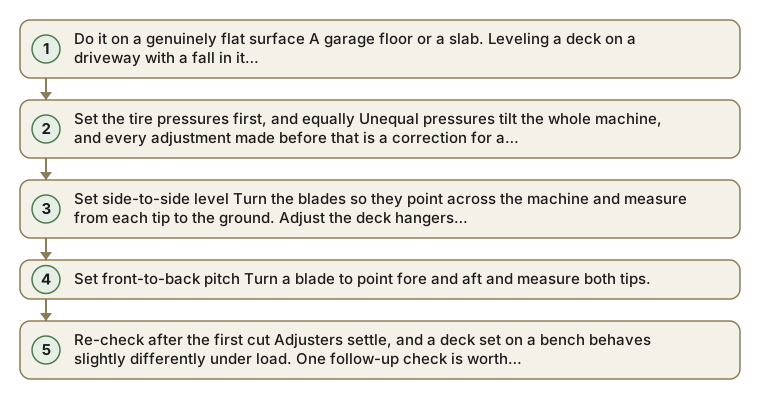
Do it on a flat surface
A garage floor or a slab. Leveling a deck on a driveway with a fall in it produces a deck that is level on a slope and wrong everywhere else.
-
Set the tire pressures first, and equally
Unequal pressures tilt the whole machine, and every adjustment made before that is a correction for a fault you are about to remove. This alone resolves a surprising number of complaints.
-
Set side-to-side level
Turn the blades so they point across the machine and measure from each tip to the ground. Adjust the deck hangers until they match.
-
Set front-to-back pitch
Turn a blade to point fore and aft and measure both tips.
-
Re-check after the first cut
Adjusters settle, and a deck set on a bench behaves slightly differently under load. One follow-up check is worth more than a very careful first attempt.
The blade checks that are worth doing in the same session
With the machine already secure and the plug lead off, look at the blade for erosion of the upturned sail rather than just the sharpness of the edge: a blade with a worn-away lift cuts badly while still looking sharpenable. Check it is not fitted upside down, which does happen and produces a machine that appears to do nothing at all.
And balance it after sharpening, because an unbalanced blade vibrates the spindle bearings that will be the next thing you replace. The detail is on mower blades.
Spindle bearings, and the noise that precedes them
On a ride-on, a deck spindle whose bearing is failing produces a rumble that changes with engine speed, and shortly afterwards an uneven cut as the blade no longer runs true. Check by grabbing the blade at each end with the engine off and trying to rock it vertically: any detectable play at the spindle is a bearing. Catching it at the noise stage is much cheaper than catching it after the shaft has worn.
The one-third rule solves more cutting complaints than any adjustment: never remove more than about a third of the grass height in one pass. Cutting long grass short in a single pass overloads the deck’s airflow, packs the underside, tears rather than cuts, and stresses the lawn. Two passes at descending heights is faster than one pass and a rake.
Mower cuts unevenly: questions
Why does my mower leave a ridge or step between passes?
Because the deck is not level side to side, so one edge cuts lower than the other. Correct the tire pressures first, unequal pressures tilt the whole machine and every adjustment made before that is compensating for a fault you are about to remove, then set side-to-side level on a flat surface by turning the blades across the machine and matching tip-to-ground heights at the deck hangers.
Why does grass turn brown a day after I mow?
Because a dull blade tears the grass rather than slicing it, and the torn tips brown within a day. Sharpen and balance the blade, and check that a slipping deck belt or a deck packed with clippings has not dropped the tip speed, which produces the same tearing on a blade that still looks sharp. A worn-away lift sail also cuts badly while still looking sharpenable.
Why does my mower leave uncut strips or clumps in long grass?
Because the airflow under the deck has been lost, so the grass never stands up before the blade reaches it. Scrape the packed clipping off the underside of the deck, check the blade lift is not eroded, raise the cut and slow down, and follow the one-third rule, never removing more than about a third of the grass height per pass, since cutting long grass short in one pass overloads the deck.
How do I level a mower deck correctly?
On a flat surface, not a driveway with a fall in it. Set the tire pressures equal first; then set side-to-side level by pointing the blades across the machine and matching each tip’s height at the hangers; then set the front-to-back pitch, which most decks specify slightly nose-down so the leading edge cuts and the trailing edge clears. The exact figure is machine-specific and lives in your manual, and re-check after the first cut.
Can a bent blade cause an uneven cut even if it's still sharp?
Yes: a bent blade changes the cutting circle's geometry, so even a sharp edge cuts at an inconsistent height as the bent section passes closer to or farther from the ground than the rest of the blade's arc. This produces a rhythmic unevenness distinct from the general tearing a dull blade causes, and it isn't fixed by sharpening.
Does mowing in the same direction every time cause uneven cutting patterns?
It can produce visible striping or a slight lean in the grass rather than a genuine height inconsistency: this is largely cosmetic rather than a mechanical fault, and varying mowing direction between cuts is a common practice to avoid soil compaction ruts and to keep grass standing more upright, not a fix for an actual uneven-cut mechanical problem.
Why does a mower cut unevenly specifically on hills or slopes even when the deck is correctly leveled on flat ground?
Because deck height relative to the ground changes as the machine's wheels sit at different points on an uneven or sloped surface: a deck leveled and tested on flat ground will naturally ride differently on a slope, which is a terrain effect rather than a mechanical fault with the deck-leveling adjustment itself.
How is mower scalping different from an uneven cut?
Scalping is a specific form of unevenness where the deck contacts high spots or ridges in the lawn's terrain rather than a mechanical deck-level fault: raising the cutting height, or addressing the underlying ground unevenness (a settled area, a mole hill), resolves scalping in a way that adjusting deck level for a flat-ground mismatch does not.
How often should mower blade balance be checked, separate from sharpening?
Balance should be checked every time the blade is sharpened or after any impact with a rock, root, or other obstacle, not on a separate fixed schedule from sharpening, since balance and sharpness are usually disturbed together by the same events (routine wear, an impact, or a sharpening pass that removes uneven amounts of material from each side).
Can worn deck spindle bearings cause an uneven cut?
Yes: worn spindle bearings let the blade wobble slightly off its true rotational plane, which produces an inconsistent cutting height around the blade's circle even if the blade itself is sharp, balanced, and undamaged. A rumble or vibration from the spindle area, worsening over time, often precedes this becoming a visible cut-quality problem.
Does mowing speed affect cut evenness on the same properly leveled deck?
Yes: moving too fast for the grass conditions can outrun the deck's ability to lift and cut grass evenly, especially in thicker or taller growth, producing missed strips or uneven results even on a mechanically sound, correctly leveled machine. Slowing down in denser grass is a simple adjustment worth trying before assuming a mechanical cause.