Mower PTO will not engage: follow the actual interlock diagram
Use the mower’s exact interlock and PTO procedure before tracing an engagement fault. Keep every safety device functional.
With power isolated, inspect permitted belts and connections; unresolved supply, control or clutch faults require the model wiring diagram and test values. A click cannot prove that the blades receive torque.
The seat-switch rule is not universal
The cited TimeCutter SW manual describes SmartPark behavior: rising from the seat in neutral can engage the brake and disengage PTO while the engine remains running. Its prescribed test has multiple distinct steps. A blanket claim that every unoccupied seat must stop the engine would misread this model.
| Check | Question it answers |
|---|---|
| Operating conditions | Are the manual’s required conditions met? |
| Control and supply measurements | Does the correct circuit command reach the clutch? |
| Clutch / belt inspection | Can the specified drive transmit motion? |
| Blade-stop / interlock test | Does the complete safety function pass? |
A click is an observation, not the whole test
For example, a clutch that clicks once with the key on has demonstrated an audible response. That does not measure its supply under load, air gap, friction condition or downstream belt. Do not replace the switch solely because blades remain stationary.
Do not lean near a moving clutch to see whether it engages. Never tape down a seat switch or bridge its connector. A failed safety check takes the machine out of use even if the blades can be made to turn.
Fuse ratings and clutch gaps belong to the model
A blown fuse needs its cause investigated and the specified replacement. A larger fuse can expose wiring to excessive current. Some clutches have adjustment procedures and others do not; a generic gap or bolt-turn count is not a service specification.
Record the exact rider model, fuse identification, display or warning, and whether the fault followed a belt or battery repair. See belt selection for an incorrect replacement concern and starting-circuit checks for a separate no-crank complaint.
TS-12 · Troubleshooting
Riding mower PTO will not engage
A power take-off that will not engage the blades on a riding mower is more often a broken link in the safety interlock chain than a fault in the PTO clutch itself, because the clutch will not receive power at all unless the operator seat switch, the parking brake or neutral position, and every other interlock the model requires all agree first. Work the interlocks before the clutch: confirm full seat contact, confirm the parking brake or drive position the manual specifies, then check for sound or movement at the clutch itself, a dropped or broken belt downstream of it, and finally a blown fuse or failed relay if everything upstream checks out.
Engage the parking brake and confirm the operator seat switch is functioning before testing anything else. Many of the checks below involve the blades being live if the safety interlocks are bypassed. Do not defeat them to test the PTO.
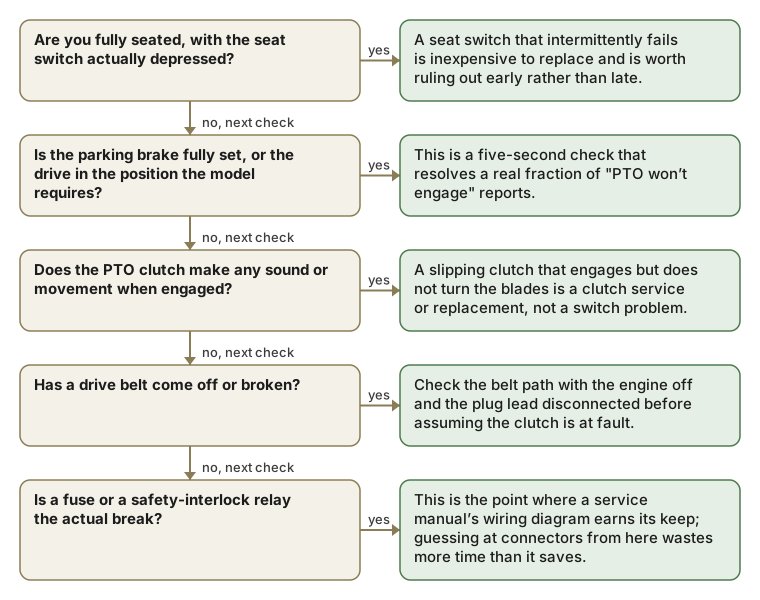
The PTO switch is the last link in a safety chain, not the first thing to suspect
A riding mower's power take-off will not engage the blades unless a chain of safety interlocks all agree it is safe to do so: typically the operator seated, the parking brake set or the drive in neutral, depending on the model. A PTO that will not engage is more often one of those interlocks failing to register than the PTO switch or clutch itself.
1. Are you fully seated, with the seat switch depressed?
The seat safety switch is a common point of failure. It wears, corrodes, or a light operator does not fully depress it. Shift your weight fully onto the seat and try again before suspecting anything electrical.
If that is it: A seat switch that intermittently fails is inexpensive to replace and is worth ruling out early rather than late.
2. Is the parking brake fully set, or the drive in the position the model requires?
Some machines require the parking brake engaged to allow PTO engagement; others require neutral. Check the manual for which condition your model needs rather than assuming.
If that is it: This is a five-second check that resolves a real fraction of "PTO won’t engage" reports.
3. Does the PTO clutch make any sound or movement when engaged?
An audible click or a slight movement at the clutch with no blade rotation suggests the electromagnetic clutch itself is engaging but slipping, often a worn friction surface or the clutch gap needing adjustment. No sound or movement at all points further upstream, at the switch or the wiring to the clutch.
If that is it: A slipping clutch that engages but does not turn the blades is a clutch service or replacement, not a switch problem.
4. Has a drive belt come off or broken?
On machines where the PTO clutch drives the blades through a belt rather than directly, a broken or dislodged belt produces exactly the same symptom as a clutch fault from the operator’s seat: the PTO appears to engage with no cutting result.
If that is it: Check the belt path with the engine off and the plug lead disconnected before assuming the clutch is at fault.
5. Is a fuse or a safety-interlock relay the actual break?
If every mechanical and seating check passes and the clutch still never receives power, a blown fuse in the PTO circuit or a failed interlock relay is the remaining candidate: a multimeter check against the wiring diagram in the manual settles it.
If that is it: This is the point where a service manual’s wiring diagram earns its keep; guessing at connectors from here wastes more time than it saves.
Check, what it points to, and the fix
| Check | What it points to | Fix |
|---|---|---|
| Not fully seated, or the seat switch not depressed | A worn or corroded seat safety switch, or a light operator not fully depressing it | Shift your weight fully onto the seat; replace a switch that fails intermittently. |
| Parking brake or drive not in the position the model requires | An interlock condition the manual specifies is not being met | Check the manual for the exact brake or neutral requirement for your model. |
| Clutch clicks or moves slightly, blades do not turn | A slipping electromagnetic clutch: worn friction surface or wrong gap | Service or adjust the clutch. |
| No sound or movement at the clutch at all | A fault upstream, at the switch or the wiring to the clutch | Trace the wiring with a multimeter against the manual. |
| PTO "engages" from the seat, no cutting result | A dropped or broken drive belt on a belt-driven PTO | Inspect the belt path, engine off and plug lead disconnected. |
| Everything above checks out, clutch never gets power | A blown fuse or a failed interlock relay | Test against the wiring diagram in the service manual. |
Riding mower PTO will not engage: questions
Why will my riding mower PTO not engage?
Check the safety interlock chain before suspecting the clutch: the operator seat switch fully depressed, and the parking brake or neutral position your specific model requires. A PTO will not engage at all unless every interlock the machine checks for agrees first, and a worn or corroded seat switch is a common point of failure.
The PTO clutch clicks but the blades do not turn: why?
An audible click or slight movement at the clutch with no blade rotation suggests the electromagnetic clutch is engaging but slipping, often from a worn friction surface or a clutch gap needing adjustment. If the clutch drives the blades through a belt, check for a dropped or broken belt too: it produces the identical symptom from the operator’s seat.
Does every riding mower require the same interlock condition (parking brake vs. neutral) to engage the PTO?
No: some machines require the parking brake set, others require the drive in neutral, and the specific requirement varies by model. Checking the manual for which condition your specific machine needs, rather than assuming it matches another mower you've owned, is a quick check that resolves a real fraction of reported PTO failures.
Can a broken drive belt produce the exact same symptom as a failed PTO clutch?
Yes, on machines where the clutch drives the blades through a belt rather than directly: a dropped or broken belt looks identical from the operator's seat to a clutch that engages but fails to turn the blades, which is why the guide places checking the belt path in the same diagnostic sequence as inspecting the clutch itself.
What tool do I need to check for a blown fuse or failed interlock relay in the PTO circuit?
A multimeter, checked against the wiring diagram in the machine's service manual: this is the point in the diagnostic sequence where guessing at connectors wastes more time than it saves, since the PTO circuit's wiring path is specific to each model and not something to trace by intuition alone.
Is it safe to bypass a faulty seat switch or interlock temporarily just to mow?
No: these interlocks exist specifically to stop the blades if the operator leaves the seat unexpectedly or the machine isn't in a safe configuration to engage them, and defeating one to work around a fault removes the exact protection that prevents a serious injury. Repair the actual interlock rather than bypassing it.
Why would a PTO clutch engage on some attempts but not others?
Intermittent engagement often points at a marginal connection, a corroded seat switch contact, a loose wiring connector in the PTO circuit, or a clutch gap right at the edge of its adjustment tolerance, any of which can pass current or engage successfully sometimes and fail other times depending on vibration, temperature, or exact seating position.
Does the PTO switch itself ever fail, or is it almost always an upstream interlock?
The PTO switch itself can fail, but the guide's point is that the interlock chain (seat switch, parking brake or neutral position) is the more common culprit and should be checked first, since those interlocks sit upstream of the PTO switch and a failure there produces the identical "won't engage" symptom without the switch itself being at fault.
Can a worn drive belt tensioner cause the same symptom as a PTO clutch problem?
Yes: a worn or weak tensioner may fail to apply enough pressure to fully engage a belt-driven blade system even when the clutch and belt themselves are in acceptable condition, producing a similar "engages but doesn't cut" symptom that's worth checking alongside the belt itself rather than assuming the belt or clutch alone.
Should I inspect the PTO wiring harness for damage from mowing debris or rodents?
Yes, especially on a machine stored in a shed or garage over winter: a wiring harness chewed by rodents or abraded by contact with moving parts can create an intermittent or complete break in the PTO circuit that no amount of switch or clutch adjustment will fix, and it's a visual check worth doing before assuming a more complex electrical fault.