Mower slope limits: degrees, grade and the actual machine
Use the exact mower’s slope limit, mowing direction and terrain restrictions. Degrees and percent grade are different units, and being below a maximum does not guarantee traction or stability.
Wet ground, drop-offs, towing and turning can make a route unsafe. Choose another method when the required conditions cannot be met.
Convert before comparing
| Angle | Percent grade |
|---|---|
| 5 degrees | 8.7 percent |
| 10 degrees | 17.6 percent |
| 15 degrees | 26.8 percent |
| 20 degrees | 36.4 percent |
Percent grade is 100 times rise divided by horizontal run; angle is the arctangent of rise/run. A two-foot rise over ten horizontal feet is 20 percent, about 11.3 degrees. It is not a 20-degree slope.
The cited TimeCutter SW manual prohibits slopes greater than 15 degrees and gives its own travel directions. Do not replace those directions with a blanket rule for all riding or zero-turn machines. A different design or attachment needs its own instruction.
Keep rollover protection in its approved configuration
A Massachusetts FACE investigation describes a fatal zero-turn rollover with the ROPS folded down and operation beyond the cited manual’s slope limit. It is a specific incident, not a failure-rate comparison between mower classes.
The related ROPS safety alert emphasizes an upright structure and seat belt for the described equipment. Follow your machine’s exact ROPS, locking and belt instructions; do not lower a structure merely to mow under an obstacle.
Choose a route with a margin for conditions
Keep away from banks, water and edges that could collapse. A measured slope does not show hidden holes, low traction or an unsupported shoulder. Reassess after rain, excavation or ground changes.
Use approved towing limits and configurations. A cart can change traction, braking and stability; it does not automatically share the mower-alone slope allowance. Never add unapproved weights or wheel modifications to make a hazardous route appear acceptable.
If the manual is missing or the terrain cannot be assessed safely, use a qualified service or another suitable tool. Confidence with the controls cannot replace the machine’s operating limits.
Slopes, rollover and ride-on mowers
A ride-on mower rolling over on a bank is the characteristic serious injury in domestic outdoor power equipment, and the specification that governs it is the maximum operating slope in your machine’s own manual. A number that depends on wheelbase, track width, center of gravity height, tires and what is hanging off the back, and therefore differs between machines that look alike. Two things about slopes catch people regardless of the number.
Human estimation of a gradient is unreliable, which is why many manuals print a slope gauge to sight against the ground. And the correct direction to mow is opposite for the two classes: a ride-on goes up and down because it rolls sideways, while a walk-behind goes across because it can run back over your feet.
Why the number is machine-specific
Stability on a slope is a function of wheelbase, track width, the height of the center of gravity, tire type and pressure, and how much is hanging off the back. Two ride-on mowers that look similar can have different limits, which is why every manual states one and why no general figure can replace it. The manual for your machine is describing the machine you own; this page describes the physics that makes the number matter.
Slope is measured as a rise over a horizontal run, and human estimation of it is unreliable: a bank that feels moderate while standing on it frequently is not. Many manuals include a printed slope gauge to be folded and sighted against the ground for this reason. If yours does, use it once on each bank you mow; the answer is often surprising.
Degrees and percent, side by side
Manuals state a slope limit in degrees, in percent grade, or as a ratio, and the units do not match by eye. Percent grade equals 100 times the tangent of the angle. A 15-degree slope is approximately a 27-percent grade.
Convert before you compare a manual to a bank.
| Angle | Percent grade and rise per 100 feet |
|---|---|
| 5 degrees | 8.7 percent grade: 9 feet of rise in every 100 feet of run. |
| 10 degrees | 17.6 percent grade: 18 feet of rise in every 100 feet of run. |
| 15 degrees | 26.8 percent grade: 27 feet of rise in every 100 feet of run. |
| 20 degrees | 36.4 percent grade: 36 feet of rise in every 100 feet of run. |
| 25 degrees | 46.6 percent grade: 47 feet of rise in every 100 feet of run. |
Why a zero-turn is different on a descent
A zero-turn steers by driving each rear wheel independently. Its front wheels are casters: they follow, they do not steer. On level ground that is an advantage.
On a descent it is the central limitation: steering authority comes only from traction at the two rear wheels, and going downhill transfers weight forward, off exactly those wheels.
The practical consequence is that a zero-turn descending a slope can reach a state where moving the levers does not change direction. Some machines have wheel weights or additional caster options for this. The reliable answer is to treat slopes as the wrong ground for a zero-turn and to use a machine with steered front wheels, which is the point made on choosing between the riding mower types.
| How you mow it | Ride-on | Walk-behind |
|---|---|---|
| Up and down the slope | The standard guidance for a ride-on: it keeps the machine’s narrow dimension across the fall line and avoids the sideways tipping moment. | Not preferred: this is the direction in which a walk-behind can run back over your feet. |
| Across the slope | Avoid. This is the orientation in which a ride-on rolls, and it is the one that feels more comfortable to drive. | The standard guidance for a walk-behind: it keeps you beside the machine rather than below it. |
| Turning on the slope | The highest-risk moment. Turn on level ground where you can, and turn uphill rather than downhill. | Manageable, but keep footing deliberate and never pull the machine toward you on a rise. |
The guidance is opposite for the two classes, and that catches people who own both. A ride-on rolls sideways; a walk-behind runs over feet. Each rule addresses the failure mode of its own machine.
ROPS and the belt
A rollover protection structure works by defining a survival space above the seat. It only does that if you stay in the seat, which is why the seat belt keeps the operator within the space protected by the ROPS. Wearing a belt without a ROPS, or raising a ROPS and not belting, both break it.
The one universal exception: with a folding ROPS in the lowered position, under a low branch, in a shed, the seat belt should not be worn, because there is then no structure to hold you inside. Raise the bar again as soon as the obstruction is passed.
The ground that causes it, not the ground you can see
-
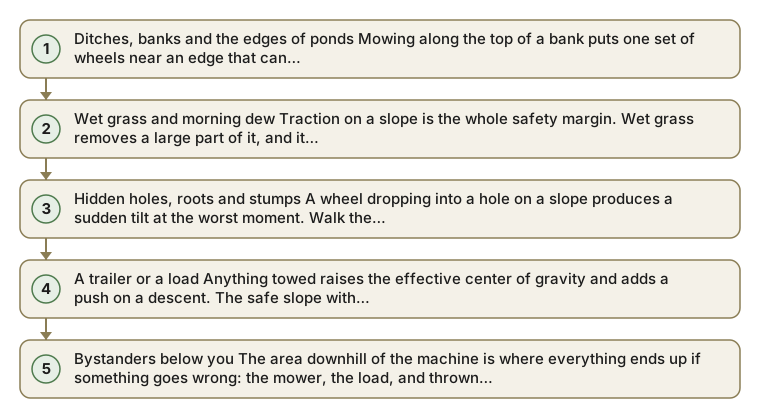
Ditches, banks and the edges of ponds
Mowing along the top of a bank puts one set of wheels near an edge that can give way. Mow up and down, or leave a strip and trim it.
-
Wet grass and morning dew
Traction on a slope is the whole safety margin. Wet grass removes a large part of it, and it removes braking as well as drive.
-
Hidden holes, roots and stumps
A wheel dropping into a hole on a slope produces a sudden tilt at the worst moment. Walk the ground once a season and mark what is in it.
-
A trailer or a load
Anything towed raises the effective center of gravity and adds a push on a descent. The safe slope with a loaded cart is not the safe slope without one.
-
Bystanders below you
The area downhill of the machine is where everything ends up if something goes wrong: the mower, the load, and thrown objects. Keep it clear.
Slopes, rollover and ride-on mowers: questions
What is the safe slope limit for a riding mower?
The maximum operating slope stated in your machine’s own manual, which is machine-specific, it depends on wheelbase, track width, center-of-gravity height, tires and what is towed, so no general figure replaces it. Human estimation of a gradient is unreliable, so if the manual includes a slope gauge, fold it and sight it against each bank; the answer is often steeper than it feels underfoot.
Should I mow a slope up-and-down or across it?
It depends on the machine, and the two rules are opposite. Mow a ride-on up and down the slope, keeping its narrow dimension across the fall line, because a ride-on rolls sideways. Mow a walk-behind across the slope, staying beside the machine rather than below it, because a walk-behind can otherwise run back over your feet.
Owners of both machines get caught out by the difference between the two rules.
Why is a zero-turn mower dangerous on a slope?
Because its front wheels are casters that follow rather than steer, so all steering authority comes from traction at the two rear wheels, and descending a slope transfers weight forward, off exactly those wheels. A zero-turn going downhill can reach a state where moving the levers does not change its direction. Slopes are the wrong ground for a zero-turn; use a machine with steered front wheels instead.
When should I wear the seat belt on a mower with a ROPS?
Whenever the rollover protection structure is raised, because the seat belt keeps the operator within the space protected by the ROPS: the ROPS defines a survival space that only protects you if you stay in the seat. The one universal exception is a folding ROPS in the lowered position, under a low branch or in a shed, when the belt should not be worn, because there is then no structure to hold you inside the machine.
Do zero-turn mowers flip or roll over easily?
Not on flat, open ground, which is what they are built for. Slope angle, traction and the mower’s steering and braking layout affect rollover risk. On a descent a zero-turn’s casters carry no steering authority, weight shifts forward off the driven rear wheels, and it can reach a state where the levers no longer change its direction; from there, a rut, a soft spot or a turn can tip it.
The manufacturer’s stated maximum operating slope in the manual is the real limit, and the plain fix on ground steeper than that is a different machine with steered front wheels, not more careful driving.
Why is a printed slope gauge in a manual more reliable than eyeballing a bank?
Because human estimation of a gradient is unreliable. A bank that feels moderate underfoot is frequently steeper than perceived. A printed gauge, folded and sighted against the actual ground, gives an objective measurement against the manufacturer's stated limit rather than relying on a subjective impression that tends to underestimate the true angle.
Why does towing a trailer or cart change the safe slope for a mower?
Because anything towed raises the machine's effective center of gravity and adds a forward push during a descent, both of which reduce stability margin compared to the mower alone. The safe slope with a loaded cart attached is lower than the safe slope for the same machine without one: the manual's figure for the bare machine doesn't automatically cover a towed load.
Why should turns on a slope happen uphill rather than downhill?
Turning is described as the highest-risk moment on a slope regardless of direction, but turning downhill compounds the loss of traction and control a descent already causes, while turning uphill works with gravity rather than against the machine's reduced steering authority. Where possible, turning on level ground avoids the risk entirely.
Does wet grass affect braking as much as it affects traction on a slope?
Yes: the guide specifically notes that wet grass removes braking as well as drive, meaning both the ability to control speed and the ability to stop are reduced together on wet ground. That combination is part of why traction on a slope is described as the whole safety margin.
Why should a mower stay away from a bank or ditch edge?
Because the edge of a bank can give way under the weight of the machine even when the ground looks solid, putting one set of wheels over a collapsing edge rather than on stable ground: a hazard the operator often cannot see coming since it depends on soil condition beneath the visible surface, not the visible slope angle itself.
Is the maximum slope figure in a mower's manual the same for going up, going down, and mowing across?
The manual's stated maximum is typically a single figure representing the machine's overall stability limit, but the guide's own guidance shows the safe direction of travel differs by machine type (up-and-down for a ride-on, across for a walk-behind), so the single slope number and the direction-specific guidance both need to be followed together, not treated as substitutes for each other.
Why does the seat belt rule on a mower with a ROPS have an exception for a lowered bar?
Because a folding ROPS lowered under a low branch or in a shed no longer provides the survival space the belt is designed to keep you inside. Wearing a belt with no protective structure raised would hold you in place with nothing above you to protect, which is the opposite of the belt's purpose. Raising the bar again once clear of the obstruction restores the system the belt is meant to work with.