Choose a mower by access, slope limits and mowing route
Choose between a walk-behind, tractor and zero-turn after checking access, terrain and the actual model’s operating limits. Deck width alone does not establish gate clearance or time saved. A tractor is not automatically safe on a slope that is unsafe for a zero-turn, and a steering wheel does not identify the whole drive system.
Check the exact steering and attachment design
Toro’s TimeCutter announcement describes both steering-wheel and lever-controlled versions. The SW 4200/5000 manual uses a steering wheel and includes model-specific slope and towing instructions. This contradicts a blanket rule that every zero-turn is operated with two levers.
| Choice | What to verify |
|---|---|
| Walk-behind | Operator effort, propulsion, turning and safe terrain |
| Lawn / garden tractor | Approved attachments, hitch and drive capacity |
| Zero-turn | Control type, traction, approved towing and slope limits |
| Every mower | Overall width, cutting width, service access and storage |
For the cited SW models, the manual prohibits mowing slopes greater than 15 degrees. That maximum is not a guarantee of safety below it: wet ground, drop-offs, obstructions and traction still matter. Use another mower’s own limits and directions rather than transferring that figure.
A wider deck changes straight-line travel, not every minute
On a hypothetical 100-by-200-foot rectangle with six-inch overlap, a 42-inch deck advances three feet per pass and needs 34 lengthwise passes. A 48-inch deck advances 3.5 feet and needs 29 passes. That is about 6,800 versus 5,800 feet of straight cutting travel.
The difference is about 15 percent before turns, obstacles, discharge, speed or emptying a bag. It does not prove a 15-percent reduction in total mowing time. A wider machine that cannot reach part of the yard may require a second tool.
Confirm storage and service before purchase
Measure overall width in the approved transport configuration, including the discharge assembly. Do not remove a required guard to fit through a gate. Compare access for deck cleaning, belt replacement and engine service alongside the written warranty and local repair options.
Use only approved towing equipment at the specified hitch and within all limits. The cited Toro manual warns that a towed load increases stopping distance and slope risk. A garden-tractor label alone does not authorize ground-engaging attachments.
For terrain assessment and rollover protection, use the slope guide and the exact operator manual. Keep children and bystanders out of the mowing area, and never bypass blade or seat interlocks.
For a Cub Cadet tractor, the XT1/XT2 engine and service guide separates the installed engine and maintenance kit from a series-name match.
Compare
Walk-behind, riding and zero-turn mowers, compared
The same safety standard governs all three. Lot size and obstacles are what separate them.
Walk-behind, riding and zero-turn mowers are all governed by the same safety specification: ANSI/OPEI B71.1: because the underlying hazard (a spinning blade close to the operator's feet, or a rollover on a slope) is the same across all three. What separates them for a buyer is lot size, obstacle density and how much of the job is straight-line cutting versus maneuvering around beds and trees, not horsepower or deck material, which get most of the marketing attention but decide comparatively little about which class fits a given property. Get the class right first, the specification comparison is built around the two questions, lot size and obstacle count, that settle it, and the choice inside that class becomes a much smaller decision about deck width and price.
| Type | Typical deck width | Turning behavior | Matches |
|---|---|---|---|
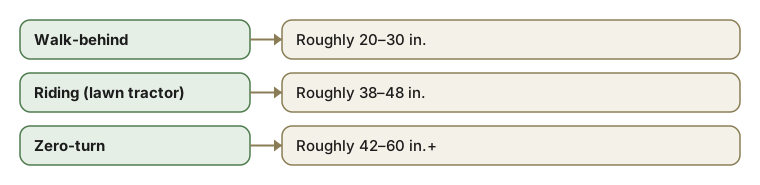
| Walk-behind | Roughly 20–30 in. | Pushed or self-propelled; turns by the operator moving. | Under about a quarter acre, or heavily obstructed lots. |
| Riding (lawn tractor) | Roughly 38–48 in. | A turning radius set by the steering geometry, not zero. | Roughly a quarter to one acre, moderate obstacles. |
| Zero-turn | Roughly 42–60 in.+ | Independent wheel drive lets it pivot in its own footprint. | Over about an acre, especially with many separate obstacles to cut around. |
What "zero-turn" trades for that turning radius
A zero-turn mower's independent-wheel drive is what lets it pivot inside its own length instead of executing a three-point turn at every tree and flowerbed, and on a lot with many separate obstacles that difference dominates total mowing time even more than deck width does. What it trades for that maneuverability is steering feel: lap-bar or dual-lever controls behave differently from a wheel, and most manufacturers recommend practicing on flat, open ground before using one near obstacles or on a slope.
Deck width is a gate-width question before it is anything else
A deck wider than the narrowest gate, gap or path a mower has to pass through cannot reach the ground it is meant to cut, which makes gate width, not lot acreage, the first limits to check before buying a wider deck for the sake of speed. A wider deck is not free time; it needs a place to fit.
Slope is where riding and zero-turn machines diverge most
Zero-turn mowers have a higher center of gravity relative to their wheelbase in the turning direction than a comparable riding mower, and manufacturer operating instructions: required under ANSI/OPEI B71.1: set a lower maximum slope for zero-turn operation than for a conventional riding mower on the same size lot. A slope steep enough for a riding mower is not automatically safe for a zero-turn machine on that same slope.
Walk-behind, riding and zero-turn mowers, compared: questions
What size mower do I need for my lot?
As a starting point: under roughly a quarter acre or a heavily obstructed lot, walk-behind; roughly a quarter to one acre with moderate obstacles, a riding mower; over about an acre, especially with many separate obstacles to cut around, a zero-turn. Treat these as starting bands, not a rule: a quarter-acre lot with a single wide-open expanse and no obstacles mows faster on a riding mower than the acreage alone would suggest, because turning time, not raw area, is what a zero-turn is buying you.
Is a zero-turn mower worth it for a smaller yard?
Only if the lot has enough separate obstacles, trees, beds, structures, that turning time dominates mowing time even at a smaller total area. On an open lot with few obstacles, a riding mower reaches most of the same total mowing time for less cost, since there is little three-point turning to eliminate in the first place.
Can a mower be too big for my property?
Yes, in a specific and easy-to-check way: a deck wider than the narrowest gate, gap between structures, or path on the property cannot reach the ground behind that gap at all, regardless of how much time the wider deck would otherwise save. Measure the narrowest gate before choosing a deck width.
Why are zero-turn mowers so expensive, and why do they cost so much compared to riding mowers?
The independent-wheel steering that gives a zero-turn its turning radius needs two separate hydrostatic drive units, one per rear wheel, plus their pumps, wheel motors and control linkage, where a conventional riding mower needs one drive system and a steering gear. That doubled drivetrain, not the deck or the engine, is the main cost difference between the two classes, and it is also most of what a zero-turn’s maintenance and eventual repair bill covers.
Are walk-behind, riding and zero-turn mowers governed by the same safety standard?
Yes: all three fall under ANSI/OPEI B71.1, because the underlying hazards (a spinning blade close to the operator's feet, or rollover on a slope) are the same across all three classes. Lot size, obstacle spacing, access and slopes determine which mower layout is practical.
Why does slope matter differently for a riding mower versus a zero-turn mower?
A zero-turn mower has a higher center of gravity relative to its wheelbase in the turning direction than a comparable riding mower, so manufacturer operating instructions: required under ANSI/OPEI B71.1: set a lower maximum slope for zero-turn operation than for a riding mower on the same lot. A slope safe for a riding mower is not automatically safe for a zero-turn machine on that same slope.
What controls does a zero-turn mower use instead of a steering wheel?
Lap-bar or dual-lever controls, which drive the two independent rear wheels separately to achieve the pivot-in-place turning radius. These controls behave differently from a conventional steering wheel, which is why most manufacturers recommend practicing on flat, open ground before operating a zero-turn near obstacles or on a slope.
Does a walk-behind mower need less maintenance than a riding or zero-turn mower?
Generally yes in absolute terms, since it has no hydrostatic drive system, transmission, or the larger engine those classes typically carry: fewer serviceable systems means fewer things to maintain. It still shares the same basic engine and blade maintenance every class in this comparison requires.
Can a riding mower handle the same obstacle density as a zero-turn mower without losing much time?
Not as efficiently: a riding mower's turning radius is set by its steering geometry rather than zero, so each obstacle requires a wider maneuver than a zero-turn's pivot-in-place turn. On a lot with many separate obstacles, that difference compounds across the whole mowing session even if the total area is the same.
Does deck width or engine horsepower matter more when choosing between these three mower classes?
Neither is the primary factor: lot size and obstacle density decide the class first, and deck width and horsepower are decisions made within whichever class you land on. A wider deck or bigger engine on the wrong class of mower doesn't change whether that class fits your property's layout.
Is there a mower class between walk-behind and riding for a lot around a quarter to half an acre?
Not as a distinct fourth class on this comparison: a lot in that range is the transition zone where a self-propelled walk-behind and an entry-level riding mower both work reasonably well, and the deciding factor becomes obstacle density and how much you value not walking behind a mower, rather than acreage alone.
Riding and zero-turn mowers
The choice between a zero-turn, a lawn tractor and a garden tractor is a choice about ground, not about budget. A zero-turn pivots about its own axis and removes the second trimming pass around every tree and bed, which is transformative on open, flat lawn. It is also a machine whose front wheels are casters, so on a descent it has no steering authority beyond what its two driven rear wheels give it, which is why it is the wrong answer on slopes and the wrong answer for towing.
A lawn tractor gives up the pivot and keeps steered front wheels. A garden tractor adds the frame and the power take-off needed to pull something through the ground.
Zero-turn, lawn tractor, or garden tractor
The three are not price tiers. A lawn tractor steers with a wheel and a front axle and is a general-purpose machine that will also pull a cart and, with the right attachments, move snow.
A zero-turn drives each rear wheel independently through separate hydrostatic transmissions controlled by two levers, which lets it pivot about its own axis and cut around obstacles without a second pass. A garden tractor is a heavier lawn tractor with a stronger frame and a power take-off, intended to run ground-engaging attachments.
A zero-turn is dramatically faster on open lawn with scattered trees and beds. It is worse on slopes, worse when towing, and it does not steer the front wheels. They are casters, so on a descent the machine has no steering authority beyond what the driven rear wheels provide.
That single fact is behind most zero-turn incidents and most zero-turn regret.
Why it steers with two levers instead of a wheel
Each lever controls one rear wheel's hydrostatic transmission independently: push both forward equally and the machine drives straight; push one further than the other and that side spins faster, swinging the machine toward the slower wheel; push one forward and pull the other back and the machine pivots inside its own footprint, which is the "zero radius" the class is named for. There is no separate steering linkage to fail and no wheel angle to set. The entire turn is the difference between the two ground speeds.
The technique that differs from a wheel-steered machine is timing: because there is no self-centering wheel to return to straight, both levers have to be brought back to the same position in a controlled motion to stop the turn, and new operators tend to overcorrect while learning that. Practicing slow, wide turns on open, flat ground before mowing close to a tree, a bed edge or a slope is standard advice in ride-on manuals for exactly this reason. The pivot that saves a trimming pass on flat ground is the same motion that can catch a drive wheel on a slope, which is why the slope operating procedure governs regardless of how confident the steering feels.
| Your property | What suits it | Why |
|---|---|---|
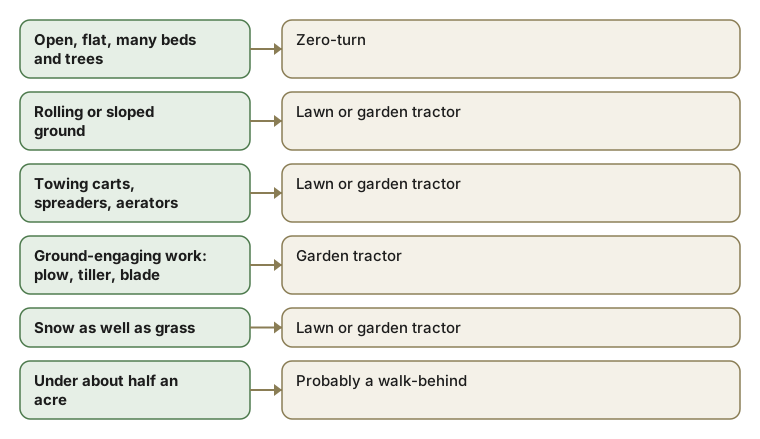
| Open, flat, many beds and trees | Zero-turn | Pivoting around an obstacle removes the trimming pass entirely. |
| Rolling or sloped ground | Lawn or garden tractor | Steered front wheels retain authority on a descent; casters do not. |
| Towing carts, spreaders, aerators | Lawn or garden tractor | A drawbar load on a zero-turn unweights the drive wheels it steers with. |
| Ground-engaging work: plow, tiller, blade | Garden tractor | The frame, the axles and the power take-off are built for a sustained load. |
| Snow as well as grass | Lawn or garden tractor | Blade and blower attachments mount to a front axle. Weight and chains help. |
| Under about half an acre | Probably a walk-behind | The storage space and the service cost of a ride-on rarely pay back below that. |
The slope figure is the specification that matters most
Every ride-on manual states a maximum operating slope, and it is machine-specific. It depends on wheelbase, track width, center of gravity and tire.
It is the number owners are least likely to have read and the one that has the largest consequences, because a ride-on mower rolling over on a bank is the characteristic serious injury in this class of equipment. Slope is covered on its own page: slopes, rollover and ride-on mowers.
Where a rollover protection structure is fitted, the seat belt is part of it. A ROPS without a belt is worse than neither, because the structure defines a survival space that only holds you if you stay in the seat. The one exception every manual makes is a folded-down ROPS.
With the bar folded, the belt should not be worn.
Hydrostatic and gear drive
A hydrostatic transmission uses a variable-displacement pump driving a hydraulic motor, so ground speed is continuously variable with a pedal and the machine can change speed without declutching. A gear transmission has discrete ratios and a clutch. Hydrostatic is easier to drive, more expensive to repair, and, this is the part owners discover late, has a fluid and, on serviceable units, a filter, which many manuals schedule and most owners never touch.
Zero-turns are hydrostatic by definition, with one transmission per rear wheel.
What wears out
On a ride-on, the deck outlasts nothing. Spindles carry sealed bearings that run in grass dust and moisture, and a failing spindle bearing announces itself as a rumble that changes with engine speed and then as an uneven cut. Deck belts are consumables.
The mandrel housings collect packed clipping that holds water against the metal. Everything above the deck, engine, transmission, frame, routinely lasts two or three times as long as the cutting equipment beneath it.
The maintenance that pays back best is routine: level the deck against a known flat surface each season, keep the tire pressures equal side to side because unequal pressures tilt the deck, and grease what has a fitting. An uneven cut on a ride-on is a deck-level and tire-pressure problem far more often than a blade problem, which is the same diagnosis set out on why a mower cuts unevenly.
Riding and zero-turn mowers: questions
Is a zero-turn mower better than a lawn tractor?
Only on the right ground. A zero-turn pivots about its own axis and removes the trimming pass around every tree and bed, which is transformative on open, flat lawn. But its front wheels are casters with no steering authority on a descent, so it is the wrong choice on slopes and for towing, where a lawn tractor’s steered front wheels keep control of the machine.
What is the difference between a lawn tractor and a garden tractor?
A garden tractor is a heavier lawn tractor with a stronger frame, stouter axles and a power take-off built to run ground-engaging attachments such as a plow, a tiller or a blade under sustained load. A lawn tractor handles mowing and light towing well; if you intend to pull tools through the ground rather than across it, that is garden-tractor work and a lawn tractor is not built for it.
What is the most important spec on a riding mower?
The maximum operating slope stated in the manual. It is machine-specific, set by wheelbase, track width, center of gravity and tire, and it is the number owners are least likely to have read, yet a rollover on a bank is the characteristic serious injury in this class. Read it before you buy and treat it as a hard limit rather than a suggestion for cautious drivers.
Do I have to wear the seat belt on a riding mower?
Wear it whenever a rollover protection structure is raised: the belt and the bar work as a pair, defining a survival space that only protects you if you stay in the seat, so a raised ROPS without the belt is worse than neither. The single exception every manual makes is when the ROPS is folded down for low clearance, when the belt should not be worn.
Why does my riding mower cut unevenly?
On a ride-on it is a deck-level and tire-pressure problem far more often than a blade problem. Unequal tire pressures side to side tilt the whole deck so it cuts low on one edge, and a deck that has drifted out of level does the same. Level the deck against a known flat surface each season and set the pressures equal before you suspect the blades themselves.
What size riding mower do I need for my yard?
Match deck width to lot size, then check it against your narrowest gate. As a rough starting point, a lawn tractor with a 30 to 38 inch deck suits up to about half an acre of mowable lawn; 42 to 48 inches suits roughly half an acre to two acres; a zero-turn with a wider deck earns its cost above about two acres of open lawn with few obstacles. A wider deck that cannot fit through a side gate is not a size upgrade, it is a machine you cannot use on part of the property.
How many hours is a lot on a riding mower or zero-turn mower, and how many does one typically last?
It depends far more on maintenance than on the machine, which is why no single hours figure fits either. Neglected fuel and oil can cause service faults even in the same model that another owner stores according to its instructions and services on schedule.
Maintenance records help explain differences in condition between those machines. What determines it: oil changed on the engine’s hour-based interval rather than the calendar, the fuel storage prepared each autumn according to the instructions (see seasonal care), and the deck and spindles kept clean and greased.
An hour meter, where the machine has one, is a far better ownership record than an odometer-style age estimate.
How much does a zero-turn mower weigh?
A residential zero-turn typically runs from around 400 pounds for a compact entry unit toward 800 pounds or more for a wide-deck commercial-grade machine, driven mostly by deck width, frame construction and whether the engine is a single or twin-cylinder unit. That range is wide enough that the figure on a specific machine’s spec sheet, not a category average, is what you should size a trailer or ramp against.
How much does a riding lawn mower weigh?
A lawn tractor generally weighs less than a zero-turn of similar deck width, often in the 350 to 550 pound range, because it carries a simpler steering axle rather than independent-wheel hydrostatic drive. As with zero-turns, deck width and engine size move this figure more than brand does, so check the specific machine’s own spec sheet before sizing a trailer.
How much does a zero-turn mower cost?
Price tracks deck width, engine size and whether the drive is residential or commercial-grade far more than brand. A narrow-deck entry unit sits at one price band, and a wide-deck commercial-grade machine at a considerably higher one. The decision framework on the compare page settles which class fits your lot before you start comparing prices within it.
How much does a riding mower cost?
A lawn tractor is generally priced below a zero-turn of comparable deck width, with engine size, deck width and transmission type (gear versus hydrostatic) driving most of the difference.
How do I choose which riding lawn mower or zero-turn mower to buy?
What is answerable here is the class decision: lot size and obstacle density point toward walk-behind, riding or zero-turn (see the comparison page), and the maximum operating slope in a specific machine’s manual is a hard limit to check before anything else, including price.
Is there a zero-turn mower comparison chart?
What is is the class-level comparison (deck width, turning behavior and slope rating) on the mower-types comparison page, which is the part of the decision that holds true regardless of brand.
How fast do zero-turn mower blades spin?
Blade tip speed, not raw RPM, is what a cut-quality standard regulates, and it typically runs in the same general range across residential zero-turns regardless of deck width: a wider deck spins its blades at a proportionally lower RPM to land on a comparable tip speed. RPM varies by engine and pulley ratio; what stays constant is that tip speed, not RPM alone, is what determines cut quality.
What tire size does a zero-turn mower use?
It varies with deck width and drive type rather than following one standard size: a compact residential unit typically runs smaller front caster tires and mid-size rear drive tires, while a wide-deck commercial-grade machine runs larger tires on both ends for stability and traction. Check the specific machine’s own tire size before ordering a replacement rather than assuming one size fits the class.
What size riding or zero-turn mower do I need for 1, 2 or 3 acres?
As a starting point: a lawn tractor with a 30 to 38 inch deck suits up to about half an acre to two acres of open lawn, and a zero-turn with a wider deck earns its cost above roughly two acres of open ground with few obstacles, so a 1-acre lawn generally sits in lawn-tractor territory, while 2 to 3 acres is where a zero-turn’s speed and turning radius start to pay for themselves. Obstacle density (beds, trees, a narrow gate) matters as much as raw acreage; a heavily obstructed acre mows more like a smaller open lot.
What size trailer do I need for a zero-turn mower?
A single-axle utility trailer in the 5×8 to 6×10 range handles most residential zero-turns with room for ramps and a bit of cargo, but check two figures on the specific machine before anything else: overall length including any bagger or attachment, and loaded weight against the trailer’s rated capacity: a wide-deck commercial-grade unit can weigh 800 pounds or more before adding fuel and a full bagger. What matters more than trailer size for safe loading is ramp angle: a ramp too steep for a zero-turn’s low deck clearance can hang up the machine mid-load.
Is a zero-turn mower a good choice for 5 acres?
Yes, comfortably: 5 acres sits well past the roughly two-acre point where a zero-turn’s turning-radius advantage starts paying for itself over a lawn tractor, and it is squarely in the range these machines are built for. At that size the bigger questions become deck width against your gate and gap widths, and session length against the fuel tank or battery capacity, not whether the class itself fits.
How does zero-turn mower blade speed compare to a riding mower’s?
Both are built to the same safety-standard framework, and manufacturers size the pulley ratio to land on a comparable blade tip speed on either machine regardless of deck width or class: a wider zero-turn deck spins its blades at a proportionally lower RPM to reach the same tip speed as a narrower one. What stays constant across the comparison is that tip speed, not raw RPM, is the number that determines cut quality.
How is a battery-powered zero-turn mower’s battery sized?
By watt-hours, the same platform math that applies to every battery tool: voltage names the platform and amp-hours rates one pack, but only watt-hours (volts multiplied by amp-hours) compares stored energy across brands. A battery zero-turn typically runs several packs together to reach the energy a wide commercial-grade deck needs for a full mowing session, which is why these machines are priced and specified closer to a small equipment fleet than to a single handheld tool.
Do riding mowers have a CVT?
Some do, though not always under that name. A hydrostatic transmission, common on both riding mowers and zero-turns, gives continuously variable speed without discrete gears, the same functional idea as a CVT, using hydraulic pumps and motors rather than a belt-and-pulley system. A separate mechanism, a variable-diameter pulley belt drive, achieves a similar continuously variable effect on some self-propelled walk-behind mowers.
Check the specific machine’s drivetrain description rather than assuming either mechanism from the "CVT" name alone.
Why is a replacement battery not compatible with my riding mower?
Almost always case size or terminal orientation, not voltage: nearly every riding mower and lawn tractor uses a 12-volt starting battery, but the U1 group covers several physical case sizes, and a battery that is electrically identical can still fail to fit the tray or reach the cables if its terminals are on the wrong side or its case is a different length. Match the group number and terminal layout on the old battery’s label, not just the voltage, before ordering a replacement.
How many hours is too many on a used riding mower?
There is no fixed cutoff, because maintenance history matters more than the number on the hour meter: a well-maintained machine at 800 hours can be a better buy than a neglected one at 300. What is worth checking on any used machine, hours aside: does it have service records or visible evidence of regular oil changes, does the deck show rust-through rather than surface rust, and does it start and idle smoothly rather than needing a fight. A missing or clearly disconnected hour meter is itself a reason to be more cautious, not less, about an unverifiable hours claim.
How many volts is a riding mower or lawn tractor battery?
12 volts, essentially universally, for the starting battery on a riding mower or lawn tractor with an electric-start gas engine: the same voltage as a car battery, though in a smaller U1-class case. That is a separate question from a battery-powered mower’s drive platform voltage (20V, 40V, 60V and so on), which runs the whole machine rather than just cranking a gas engine and follows the amp-hour and watt-hour platform math covered on battery and cordless equipment.
How many CCA (cold cranking amps) does a riding mower battery need?
Most riding mowers and lawn tractors use a small U1-class starting battery, and published ratings for that battery group commonly fall in roughly the 230 to 360 CCA range depending on the specific battery: the same class-level range regardless of which mower it starts, since it is the battery’s own rating that matters, not the mower’s brand. Check the battery currently on the machine or its manual for the exact rating rather than assuming a single number fits every model.
Can I jump-start a riding mower with my car?
Yes, both being 12-volt systems, but connect in the standard jump-start order: positive to positive first, then negative to a solid ground point on the mower’s engine block rather than directly to the dead battery’s negative terminal, to keep a spark away from the battery itself. Never run the car’s engine at more than idle while connected, since a mower’s smaller charging system was not built for the higher amperage a revving car alternator can push.
How often should I change the oil in a riding mower or zero-turn mower?
On the engine’s hour-based schedule rather than the calendar: commonly an initial change within the first 20 to 30 hours (break-in), then roughly every 50 to 100 hours or once a season, whichever comes first, but check the specific engine’s manual for its exact figure. A machine that sits most of the year but is run occasionally should still be changed on the calendar side of that schedule, since oil degrades over time independent of hours run.
What is the smallest size zero-turn mower available?
Entry-level residential zero-turns commonly start around a 32–34 in. deck, narrower than the wide commercial-grade decks most people picture with "zero-turn": useful on a smaller lot with enough separate obstacles that the turning-radius advantage still pays off even at a smaller total area. Below roughly that width, a walk-behind or a compact riding mower is usually the more practical choice; check the comparison page’s lot-size table for where the class starts earning its cost.
What size shed do I need to store a riding mower?
Add roughly 2 feet of clearance beyond the mower’s own footprint on the access side for turning it in and out, and check the door width against the machine’s widest point (usually the deck or the rear wheels on a zero-turn) before the interior square footage: a shed with plenty of floor space but a narrow door is still unusable. An 8×10 or 10×12 shed comfortably fits most single riding mowers plus basic yard tools; a wide-deck commercial-grade zero-turn or a shed also holding a trailer needs more.
What type of riding mower is best for hills?
None of them are built to make a hill safe. The number that matters is the specific machine’s maximum operating slope, stated in its own manual and set by wheelbase, track width, center of gravity and tire, not by whether it is a lawn tractor or a zero-turn. In general, a zero-turn’s casters have no steering authority on a descent, which makes a lawn tractor’s steered front wheels the safer choice on a property with real slope, but read the actual slope rating before buying either type for hilly ground.
Do riding lawn mowers have power steering?
Some higher-end lawn tractors offer it as an option, and it reduces steering effort on a wide-tire machine the way it does on a car, but it is not standard across the class. Most lawn tractors use a manual steering gear, and a zero-turn does not use a steering wheel at all, so "power steering" as a term does not apply to it the same way. Check a specific machine’s own listing rather than assuming either class defaults to it.
What is the best time of year to buy a riding lawn mower or a zero-turn mower?
Buying in spring guarantees the current model year is fully in stock but at the point of highest seasonal demand.