Is a robotic mower right for the boundary, slope and schedule?
A robotic mower fits only if its navigation, boundary clearances, slope limits and available mowing hours match the whole property. Get the exact model’s installation plan and test difficult areas. A lift sensor does not make it safe to mow around children or pets, and a claimed area rating cannot compensate for inaccessible zones.
Interior slope and boundary slope are different ratings
Husqvarna’s slope-installation guidance lists 50 percent inside the work area but 25 percent at the boundary for 320 NERA, 430X NERA and 450X NERA. These are grade percentages, not degrees, and are specific to the named models.
| Grade | Rise per 10 horizontal feet | Approximate angle |
|---|---|---|
| 25 percent | 2.5 feet | 14.0 degrees |
| 50 percent | 5 feet | 26.6 degrees |
A 30-percent boundary section exceeds a 25-percent boundary limit even though it is below the 50-percent interior figure. Move the boundary or change the installation only as the actual manual permits. Do not choose the larger number simply because the machine can climb it elsewhere.
Test the navigation at the hardest edge
The 2025 NERA manual covers installation choices and virtual-boundary mapping. Satellite correction, reference requirements, wireless coverage and passages vary by configuration. Do not apply a universal one-meter passage rule or assume every wire-free model needs the same infrastructure.
For wire systems, the boundary wire is not a direct tracing of the blade’s edge. Use the specified offset at walls, paths and drop-offs. A virtual boundary likewise needs its prescribed setbacks; sensors are not permission to omit a physical barrier where the manual requires one.
Keep people and maintenance in the schedule
Set mowing hours so people and animals are outside the active area. Include charging, weather restrictions, blade inspections and edge trimming in the plan. Stop and disable the machine as directed before lifting, cleaning or changing blades.
For a used machine, check serial-specific recalls. The 2022 U.S.
Husqvarna notice concerns certain Automower 435X AWD and 535 AWD machines for a battery fire hazard. It is not a recall of every Automower or proof that an unlisted model has no other campaign.
Ask the installer to document difficult zones and any separate manual mowing still required. A successful demonstration on a flat open patch does not establish reliable coverage of the rest of the yard.
Is a robotic mower right for your yard?
A robotic mower’s blade does the same job a walk-behind mower’s blade does at lower power and in much smaller bites, which means the fit question for your specific yard has almost nothing to do with the blade and almost everything to do with the boundary system that tells the mower where its territory ends. A yard with complex boundaries, many beds, narrow passages, irregular edges, is usually better served by perimeter wire, the more predictable approach once installed; an open yard with a clear sky view and boundaries that change occasionally suits a wire-free GPS/RTK system, whose core dependency is exactly what heavy tree cover or nearby buildings degrade. Either system needs a genuine U.S. safety certification (ANSI/OPEI 60335-2-107) that stops the blade on lift or tilt, and either one commits you to a frequent-short-session mowing schedule rather than a weekly cut: a real fit question beyond the boundary system alone.
The question is the boundary, not the blade
A robotic mower's blade does the same job a walk-behind mower's blade does, at lower power and in much smaller bites. Whether one of these fits your yard has almost nothing to do with the blade and almost everything to do with the boundary system, the part that tells the mower where its territory ends, and how well your property suits the installation that system needs.
| Your yard | Fits best | Why |
|---|---|---|
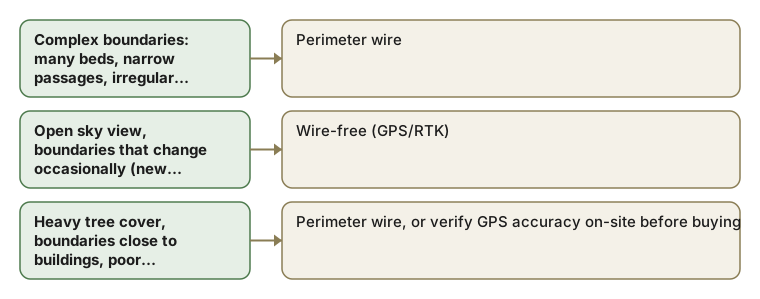
| Complex boundaries: many beds, narrow passages, irregular edges | Perimeter wire | Staked or buried wire is the more predictable approach at complex boundaries once installed, at the cost of the installation labor and a wire to protect from a spade or trimmer. |
| Open sky view, boundaries that change occasionally (new beds, a fence moved) | Wire-free (GPS/RTK) | Boundaries are edited in an app rather than dug up, but accuracy depends on a clear view of the sky. Dense tree cover or nearby buildings can degrade it. |
| Heavy tree cover, boundaries close to buildings, poor satellite visibility | Perimeter wire, or verify GPS accuracy on-site before buying | A wire-free system’s core dependency, sky visibility, is exactly what this yard lacks; do not assume it will work without checking. |
Setting the boundary well, walking the perimeter, setting a margin outside every hard edge, and routing narrow passages so the mower does not get stuck, matters more to how well the machine performs than any spec on the box, and it is the same installation work regardless of which system is chosen. Full detail on both systems and the setup steps is on robotic mowers.
The certification that is not optional
Because the blade is exposed underneath a low-riding deck and the machine runs unattended, a robotic mower sold for the U.S. market should carry ANSI/OPEI 60335-2-107 certification: the standard requiring the blade to stop within a defined short interval when the mower is lifted or tilted, and requiring the machine to detect and respond to an obstacle rather than push through it. A machine without that certification is not meeting the applicable safety specification for the class, regardless of price or features.
Lift-and-tilt sensors make a robotic mower safe to work near unattended; they do not substitute for supervision around children and pets that have not learned to treat it as a moving machine. Keep the charging dock and active mowing area away from where small children play, and never reach under the deck while it is powered, the same rule as any mower.
The schedule is part of the fit, not an afterthought
A robotic mower is designed for frequent short sessions, several passes a week, removing a small fraction of blade height each time, not a weekly full cut. That schedule is why these mowers mulch clippings invisibly into the turf with no raking, and it is also a real commitment: a property where the mower cannot complete its frequent-pass schedule (heavy shade slowing growth unevenly, a charging dock that is hard to route to from every zone) is a worse fit than the boundary-system question alone suggests.
Is a robotic mower right for your yard: questions
Is a robotic mower a good fit for a yard with a lot of trees?
It depends on the boundary system, not the trees directly. A wire-free GPS/RTK system depends on a clear view of the sky, which heavy tree cover degrades. Perimeter wire, or a wire-free system verified on-site first, is the safer choice for a heavily wooded yard.
Does a robotic mower need a certain kind of certification to be safe?
Yes: a machine sold for the U.S. market should carry ANSI/OPEI 60335-2-107 certification, which requires the blade to stop within a defined short interval when the mower is lifted or tilted, and requires it to detect and respond to an obstacle rather than push through it.
How often does a robotic mower run?
Several short sessions a week rather than one weekly cut, removing a small fraction of blade height each time. That schedule is what lets clippings mulch invisibly into the turf, and it is a real commitment. A property where the mower cannot complete frequent passes is a worse fit than the boundary question alone suggests.
What is the difference between perimeter wire and GPS/RTK boundary systems, mechanically?
Perimeter wire is a physical wire, staked or buried around the mowing area, that the mower detects and stays inside of. Editing a boundary means physically moving the wire. A GPS/RTK system instead uses satellite positioning (RTK for higher precision) to know its location relative to a boundary map, which is edited in an app rather than dug up, but that positioning depends on a clear view of the sky to work accurately.
Can I install a perimeter wire system myself, or does it need a professional?
Many owners install perimeter wire themselves, since it's largely a matter of staking or burying wire along a planned route and connecting it to the charging station: the setup work (walking the perimeter, setting margins outside hard edges, routing narrow passages) is the same regardless of whether you or a professional does the physical installation.
Does rain affect a robotic mower's ability to operate?
Most robotic mowers are designed to operate in light rain and are weather-resistant, though very heavy rain or standing water can affect either boundary system's sensors or simply make mowing counterproductive on saturated turf. Check the specific model's weather rating rather than assuming universal rain tolerance across all robotic mowers.
How does a robotic mower handle slopes compared to a conventional mower?
Robotic mowers have their own published slope limits, generally lower than a comparable gas riding mower's rated maximum, because their smaller wheels and lighter weight reduce traction on an incline: check the specific model's slope rating against your yard's actual grade rather than assuming it matches a conventional mower's capability.
Does a robotic mower need Wi-Fi or cellular connectivity to function?
Basic mowing operation typically does not require connectivity: the mower navigates using its boundary system regardless of network access. App-based features like scheduling changes, GPS boundary edits, and theft-tracking notifications generally do require a connection, so a property with poor Wi-Fi or cellular coverage may lose some convenience features while basic mowing still works.
What happens if a robotic mower is stolen while operating unattended?
Many models include PIN-code locks, GPS tracking, and alarms that activate if the mower is lifted or moved outside its expected area. These are separate features from the lift-and-tilt blade-stop safety sensor, addressing theft rather than the operator-safety hazard. Check which anti-theft features a specific model includes if the mower will operate somewhere accessible to the public.
Can a robotic mower handle a lawn with a steep or uneven micro-terrain, like small mounds or drainage dips?
Within its rated slope limit, yes, but small mounds or dips that exceed that limit locally, even if the overall yard grade is gentle, can cause the mower to stall, get stuck, or trigger a safety cutoff. Walking the specific terrain during boundary setup, not just checking the overall average slope, catches these local trouble spots before they cause repeated interruptions.
Does a robotic mower eliminate the need to ever manually edge or trim the lawn?
No: most robotic mowers cut close to but not directly against hard edges, fences, and obstacles, leaving a strip that still needs a trimmer to finish. It reduces but typically doesn't eliminate the manual edging and trimming work a conventional mowing routine also requires.
Does the size of my lawn have a practical upper limit for a single robotic mower?
Yes: each model has a rated maximum area it can maintain on its mowing schedule, and a lawn beyond that rating either needs a more capable (and more expensive) model or multiple units working different zones. Check a specific model's rated coverage area against your actual lawn size rather than assuming any robotic mower scales to any property.
Robotic mowers
A robotic mower’s blade does the same job a walk-behind mower’s blade does, at lower power and in much smaller bites: what decides how well one of these works on a given property is the boundary system, the part that tells the mower where its territory ends. Perimeter wire, staked or buried, is the older and more predictable approach at complex boundaries; wire-free systems using satellite positioning remove the wire but depend on a clear view of sky. Either way, the installation work, walking the perimeter, setting a margin outside every hard edge, and routing narrow passages so the mower does not get stuck, matters more than any spec on the box, and it is certified to its own dedicated safety standard rather than the one that governs walk-behind mowers.
The boundary system is the product, not the blade
A robotic mower's cutting deck is a small, low-power rotary blade doing the same job a walk-behind mower's blade does at a fraction of the tip speed and torque, taking frequent light passes instead of one full-height cut. What differentiates these machines, and what most of the buying decision and nearly all of the installation effort goes into, is how the mower knows where its territory ends. Two approaches are in current use.
| System | How it works | The tradeoff |
|---|---|---|
| Perimeter wire | A low-voltage wire, staked to the surface or buried a few inches deep, carries a signal the mower senses to stay inside it and find its charging dock. | Installation labor and a wire to protect from a spade or a trimmer. Once installed, it is the more predictable of the two at complex boundaries. |
| Wire-free (GPS/RTK plus vision or ultra-wideband) | The mower builds or is given a map of the area using satellite positioning, often corrected by an on-site reference station for centimeter-level accuracy, sometimes combined with cameras or sensors that detect obstacles directly. | No wire to bury or maintain, and boundaries are edited in an app rather than dug up. Accuracy depends on a clear view of the sky and a correctly sited reference station; dense tree cover or nearby buildings can degrade it. |
Setting the boundary well is most of the job
-
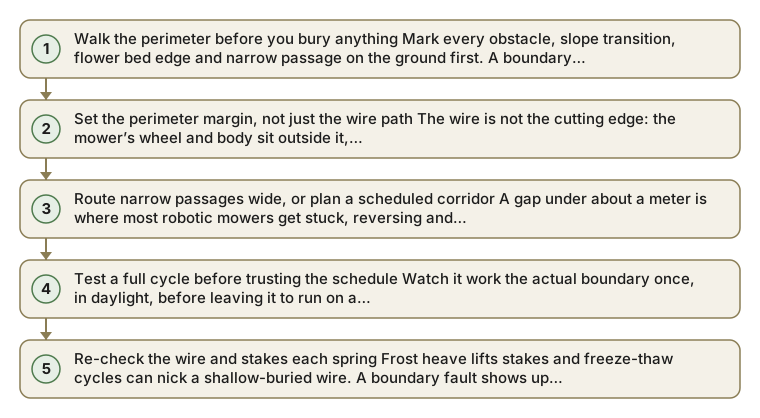
Walk the perimeter before you bury anything
Mark every obstacle, slope transition, flower bed edge and narrow passage on the ground first. A boundary wire is expensive to move once it is pegged or buried, and the mower will follow it exactly, mistakes included.
-
Set the perimeter margin, not just the wire path
The wire is not the cutting edge: the mower’s wheel and body sit outside it, and the blade further out still. Running the wire flush with a hard edge means the mower body overhangs the edge on every pass.
-
Route narrow passages wide, or plan a scheduled corridor
A gap under about a meter is where most robotic mowers get stuck, reversing and re-approaching repeatedly. Either route the wire around the pinch point or schedule that corridor for a time when it is not blocked by anything.
-
Test a full cycle before trusting the schedule
Watch it work the actual boundary once, in daylight, before leaving it to run on a timer unattended. This is when a stake works loose, a signal dead zone near underground metal shows up, or a slope exceeds what the mower can climb.
-
Re-check the wire and stakes each spring
Frost heave lifts stakes and freeze-thaw cycles can nick a shallow-buried wire. A boundary fault shows up as the mower stopping mid-lawn with an error rather than as a visible break, so check it before the season rather than after a failure.
The safety requirement that is not optional
Because the blade is exposed underneath a low-riding deck and the machine operates unattended, robotic mowers are certified to a dedicated standard rather than the general walk-behind mower standard: ANSI/OPEI 60335-2-107, the U.S. national adoption of IEC 60335-2-107. It requires the blade to stop within a defined short interval when the mower is lifted or tilted beyond a set angle, and it sets requirements for the machine to detect and respond appropriately when it encounters an obstacle rather than pushing through it. A machine sold without that certification for the U.S. market is not meeting the applicable safety specification for the class.
A robotic mower's lift and tilt sensors are what make it safe to work near unattended, but they do not replace supervision around children and pets that have not learned to treat it as a moving machine. Keep the charging dock and active mowing area away from where small children play, and treat the deck exactly as you would a walk-behind mower's: never reach under it while it is powered.
What the schedule optimizes for
Unlike a walk-behind or riding mower, a robotic mower is typically set to run in short, frequent sessions rather than one weekly cut: several passes a week, removing a small fraction of blade height each time. That schedule is not a convenience feature; it is what keeps the clippings small enough to mulch invisibly into the turf without raking, and it is the reason these mowers are usually specified with much smaller blades and motors than a walk-behind machine of the same deck width. Running one on a once-a-week schedule to save battery defeats the design and produces the same clumping problems as any mower cutting too much height in one pass.
Robotic mowers: questions
Do robotic mowers need a buried wire?
Not necessarily. A perimeter wire, staked to the surface or buried a few inches deep, is the older and more predictable approach at complex boundaries. Wire-free systems using satellite positioning, often corrected by an on-site reference station for centimeter-level accuracy, remove the wire entirely and let you edit boundaries in an app, at the cost of depending on a clear view of the sky.
How close to the lawn edge should the boundary be set?
Not flush with a hard edge. The wire or mapped boundary is not the cutting edge: the mower’s wheels and body extend beyond it, and the blade further still. Running the boundary right at a hard surface means the mower body overhangs the edge on every pass.
Set a margin that keeps the whole machine inside the usable turf.
Are robotic mowers safe to leave running unattended?
They are certified to a dedicated standard, ANSI/OPEI 60335-2-107, that requires the blade to stop within a defined short interval if the mower is lifted or tilted beyond a set angle, and sets requirements for detecting an obstacle rather than pushing through it. That does not replace keeping small children and pets away from the active mowing area and charging dock: treat the deck as you would any mower’s.
Why does a robotic mower cut so often?
Because the schedule is the design, not a convenience setting. Frequent short passes remove a small fraction of blade height each time, which keeps clippings small enough to mulch invisibly into the turf without raking. Running one on a once-a-week schedule to save battery defeats that and produces the same clumping problems as any mower cutting too much height in one pass.
How many amp-hours does a robotic mower battery need?
There is no single figure, because amp-hours only compares packs on the same voltage platform: watt-hours (volts multiplied by amp-hours) is the number that predicts runtime and lot coverage across brands and platforms, the same platform math that applies to every battery tool. A larger lot or one with dense obstacles needing more frequent short passes calls for more watt-hours of capacity, or a shorter charge-and-return cycle, rather than a specific amp-hour target.
What is the difference between a perimeter-wire and a wire-free robotic mower in terms of installation effort?
Perimeter wire requires staking or burying a physical wire along the entire boundary before the mower can operate, which is more upfront labor. A wire-free system requires walking the perimeter to build or confirm a map, generally less physical labor but still requiring the same careful attention to margins and narrow passages that any boundary setup needs.
Why does dense tree cover specifically degrade a wire-free robotic mower's accuracy?
Because wire-free systems depend on satellite positioning (GPS/RTK), which requires a sufficiently clear view of the sky to triangulate an accurate position: dense tree cover blocks or reflects those signals the same way it would degrade any GPS-based device, reducing positioning accuracy exactly when the mower needs it to stay inside a defined boundary.
What happens if a robotic mower's boundary wire is accidentally cut by a spade or trimmer?
The mower typically detects the loss of the boundary signal and stops with an error rather than continuing to operate past where the boundary should be. This is one of the reasons the guide recommends checking the wire and stakes each spring, since a cut or nicked wire from a freeze-thaw cycle shows up as an error mid-lawn rather than a visible break you'd notice by looking.
Does a robotic mower need a different blade replacement schedule than a walk-behind mower?
Yes: because a robotic mower cuts almost every day in small passes rather than once a week, its blades encounter cutting cycles far more frequently, which can mean more frequent blade replacement by calendar time even though each individual pass removes much less material than a walk-behind mower's full-height cut.
Can a robotic mower's charging dock be placed anywhere within the mowing boundary?
The dock generally needs a flat, accessible location the mower can reliably navigate to and dock with automatically, and manufacturer guidance typically specifies clearance requirements around the dock and may recommend against placing it in direct sun or in a location the mower has to cross difficult terrain to reach: check the specific model's dock placement guidance rather than choosing purely by convenience.
Does a robotic mower work on a lawn with multiple disconnected sections?
Many models support this through a scheduled corridor or a secondary wire loop connecting separate lawn sections, letting the mower travel between zones at designated times: check whether a specific model supports multi-zone or disconnected-area mowing before assuming any robotic mower handles a lawn split by a driveway or path.
Does frost or heavy dew affect a robotic mower's operation the way it does a walk-behind mower?
Many robotic mowers include rain and moisture sensors that pause mowing during wet conditions, since cutting wet grass produces the same clumping and uneven-cut problems on a robotic mower as on any other mower: check whether a specific model's sensors also account for heavy dew or frost, not just active rainfall, if morning conditions are consistently damp on your property.