Spark-plug replacement: fit, heat range, gap and installation
Use the engine-approved plug designation, then verify thread, reach, seat, gap and installation instructions. A plug that starts threading is not proof of fit.
Wrong diameter, pitch, reach or torque can damage the head or engine. Heat-range numbers are manufacturer-specific, not a universal cross-reference.
Do not infer a replacement from one matching dimension
| Field | What to match |
|---|---|
| Designation | Engine-approved current replacement |
| Thread / pitch / reach | Exact cylinder-head application |
| Seat | Gasket or taper as specified |
| Heat range | Approved manufacturer cross-reference |
| Gap | Engine/ignition instruction for that plug |
| Installation | Specified torque or turn method and conditions |
NGK’s technical guidance says lower NGK heat numbers are hotter and higher numbers colder. That does not mean moving from a 5 to a 6 plug is an approved upgrade. Other parts of the designation and the actual engine application still matter.
Torque affects heat transfer
NGK’s installation guide explains that insufficient tightening can impair heat transfer and recommends working on a cool engine with clean plug holes. Use the applicable installation specification; do not force resistance or add a washer to change reach.
NGK’s five-point guidance says not to add anti-seize or lubricant to its plugs and warns it can alter tightening behavior by up to 20 percent. A dry-thread specification is not automatically valid after lubrication.
For a hypothetical 20 N·m instruction, 20 percent is 4 N·m. That arithmetic shows the scale of a specification change; it is not a correction factor to apply after adding lubricant. Follow the product’s own instruction instead.
A used plug is evidence, not a complete diagnosis
Deposits or wetness can support an inspection but do not uniquely identify a carburetor, oil or ignition fault. Some manuals prohibit cleaning plugs and require replacement under defined conditions. Do not transfer a generic wire-brush routine to every plug.
For model-specific quantities and plug names, use the engine lookup. Stop before testing spark around open fuel or removing a hot plug from an aluminum head.
PT-03 · Parts
Spark plugs: reach, thread and heat range
A spark plug is specified by four dimensions and only one of them can hurt the engine. Thread diameter is self-correcting: the wrong one will not screw in. Seat type, flat with a gasket or tapered without, decides whether it seals.
Hex size only decides whether your socket fits. Reach, the threaded length from the seat to the tip, is the dangerous one: a plug that is too long puts threads and an electrode into the combustion chamber, where the piston may strike it and where the exposed threads carbonize so badly that removing the plug later takes the threads out of an aluminum head with it. Heat range is the fifth specification and describes the plug rather than the engine: how fast it sheds heat from its own tip.
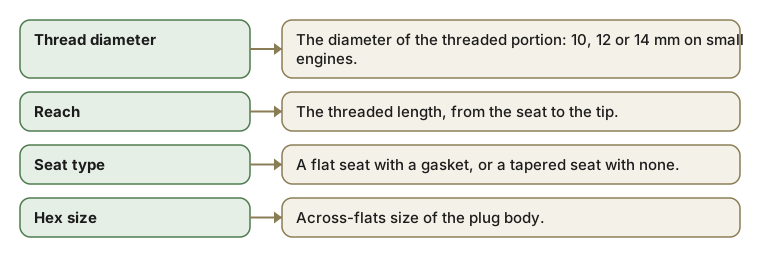
Four dimensions, and the one that damages engines
| Dimension | What it is | What happens when it is wrong |
|---|---|---|
| Thread diameter | The diameter of the threaded portion: 10, 12 or 14 mm on small engines. | It simply will not thread in. This is the harmless error. |
| Reach | The threaded length, from the seat to the tip. | Too long and the plug protrudes into the chamber, where the piston can strike it or the exposed thread carbons up. Too short and the spark sits up a hole, misfiring, while carbon builds on the unused thread. |
| Seat type | A flat seat with a gasket, or a tapered seat with none. | A tapered plug in a flat-seat head does not seal and sits at the wrong depth. |
| Hex size | Across-flats size of the plug body. | Not a fitment issue, but it decides whether your socket fits in the recess. |
Reach is the one that damages an engine. A plug that is too long can be struck by the piston, and even where it clears, the exposed threads sit in the combustion chamber and coke up so the plug becomes difficult to remove and the threads in an aluminum head come out with it. If you take one thing from the guide: match the reach exactly.
Heat range is about the plug, not the engine
Heat range describes how quickly the plug conducts heat away from its own firing tip into the cylinder head. A cold plug moves heat away fast and suits an engine run hard; a hot plug retains more heat at the tip, which keeps it clean at light load.
The plug has to run hot enough to burn deposits off its own insulator and cool enough not to become an ignition source in its own right. Too cold for the duty and it fouls; too hot and it can pre-ignite the mixture, which is damaging. The scale is not shared between manufacturers, a higher number means colder in some ranges and hotter in others, so a heat-range number is only meaningful within one maker's system, and cross-referencing is what the interchange charts at a parts counter exist for.
Gap by engine
The correct gap depends on the engine and its ignition system: 0.028 to 0.031 inch (0.7 to 0.8 mm) is common on small Honda, Kawasaki and Briggs & Stratton air-cooled engines, and the exact figure for each is in the plug table on that engine's page in the engines section. A plug gapped to the wrong number gives a hard-starting machine that gets blamed on the carburetor.
Use the engine model and type to find its matching manual and confirm the plug and gap: Equipment identification before ordering parts covers getting those. Note that plugs are not reliably gapped correctly in the box, so it is worth checking with a feeler gauge even on a new one.
Reading a used plug
The plug is the cheapest diagnostic instrument on the machine, because its firing end is a record of what has been happening in the cylinder.
| Appearance | Usually means | Where to look next |
|---|---|---|
| Light tan or gray, dry | Normal combustion. | Nothing. Clean, re-gap and refit, or replace on schedule. |
| Dry black soot | Running rich, or long periods at idle and light load. | Air filter first, then choke, then carburetor. See mixture symptoms. |
| Wet and oily | Oil reaching the chamber, or a flooded engine, or a two-stroke mixed too rich. | Ratio on a two-stroke; on a four-stroke, whether the machine was tipped the wrong way. |
| Wet with fuel | Flooded: fuel is arriving and not igniting. | Spark test. See engine will not start. |
| White, blistered, eroded electrode | Running too hot: lean mixture, wrong heat range, or an air leak. | Stop using it until the cause is found; this is the condition that damages pistons. |
| Bridged or heavy deposit between electrodes | Carbon or oil deposits shorting the gap. | A two-stroke run rich, or an engine burning oil. Replace the plug and address the cause. |
Remove a plug only from a cool engine. Aluminum heads and steel plugs expand at different rates, and a plug pulled from a hot aluminum head is how thread damage happens. Clean the recess before removal so grit does not fall into the cylinder.
Spark plugs: questions
Which spark plug dimension matters for fitment?
Reach, the threaded length from the seat to the tip, is the one that can damage the engine. Too long and the plug protrudes into the chamber where the piston can strike it and the exposed threads coke up so badly they pull out of an aluminum head on removal; too short and the spark sits up a hole and misfires. Thread diameter is self-correcting, since the wrong one simply will not screw in.
What does spark plug heat range mean?
It describes how fast the plug sheds heat from its own firing tip into the cylinder head: a cold plug moves heat away quickly and suits an engine run hard, while a hot plug retains heat and stays clean at light load. Too cold for the duty and it fouls; too hot and it can pre-ignite the mixture, which is damaging. The number scale is not shared between makers, so it is only meaningful within one brand’s system.
What spark plug gap do the common small engines use?
Briggs & Stratton, Kohler and Kawasaki small engines are almost universally specified at 0.030 in (0.76 mm); Honda GC and GCV engines run slightly narrower, 0.028-0.030 in (0.7-0.8 mm); and the 212cc Predator/clone engines common in go-karts and pressure washers follow the same 0.030 in figure. These are the manufacturer-published figures for the large majority of current small engines, not a universal constant: confirm against the emissions label on your specific engine or its manual before gapping a plug, since a build-date or displacement variant can differ. A plug gapped to a plausible-sounding number instead of the specified one makes a hard-starting machine that gets blamed on the carburetor.
What can a used spark plug tell me about my engine?
Its firing end is a record of the cylinder. Light tan and dry is normal; dry black soot means running rich, usually a blocked air filter; wet and oily means oil reaching the chamber or a two-stroke mixed too rich; wet with fuel means flooded; and a white, blistered, eroded electrode means running too hot: the condition that damages pistons, so stop using it until you find the cause.
What size socket do I need for a small engine spark plug?
Almost every small engine uses one of two standard spark plug hex sizes: 13/16 in. (equivalent to 21mm) is by far the most common on lawn and garden four-stroke engines, and 5/8 in. (16mm) appears on some smaller engines. A dedicated spark plug socket, deep enough to clear the ceramic insulator and fitted with a rubber insert to hold the plug, is worth the few dollars over an ordinary deep socket, which can crack the insulator.
How often do spark plugs need changing or need replacing on outdoor power equipment?
Most manufacturers specify a plug replacement in the annual or roughly 100-hour service interval, whichever comes first, alongside the air filter and oil: check the machine’s own manual for its exact figure. Replace one sooner, regardless of schedule, if it is fouled, eroded, or if the engine has been hard to start; a plug is cheap enough that waiting for the calendar date on a machine already showing a symptom rarely makes sense.
What lawn mower spark plug size do I need?
Reach, not the socket size, is the dimension that specifies a mower’s plug and it is machine-specific: pull the old plug and match it, or check the engine’s own label or manual, rather than assuming a size. What is consistent across nearly every walk-behind and riding mower engine is the hex size the plug wrench needs: 13/16 in. (21mm) on almost all of them, with 5/8 in. (16mm) on some smaller engines.
What weed eater spark plug size do I need?
The same two-dimension answer as any other small engine: reach is machine-specific and has to come from the old plug, the engine label or the manual, while the wrench size is standardized enough to predict: 5/8 in. (16mm) is the common hex size on most handheld two-stroke trimmer and blower engines, smaller than the 13/16 in. size typical of a mower engine.
What spark plug socket size does a snow blower need?
The same class-level hex size as a mower engine, since most snow blower engines are similar-displacement air-cooled four-strokes: 13/16 in. (21mm) fits almost all of them, with 5/8 in. (16mm) on some smaller single-stage machines. Reach and gap remain machine-specific, from the engine’s own label or manual, the same as any other small engine.
What spark plug size, gap or price does a Honda, Snapper, Troy-Bilt or generator engine need?
The socket size is still predictable from the class above (13/16 in. for most mower-class and generator-class four-stroke engines, 5/8 in. for smaller ones); reach and gap have to come from the engine’s own label, its manual, or the plug currently in it.
Is a resistor spark plug required, or can I use a non-resistor plug instead?
Check the engine's own specification rather than assuming either is interchangeable: a resistor plug suppresses radio-frequency interference that some ignition and electronic systems (including certain fuel-injected or electronically governed small engines) depend on, and substituting a non-resistor plug on an engine that specifies resistor can cause erratic running on models with sensitive electronics, even though the plug fits and gaps identically.
Does a more expensive iridium or platinum spark plug perform better in small engines than a standard copper one?
The main advantage of iridium and platinum plugs is a longer service life from a finer, more wear-resistant electrode, not necessarily better performance while both are in good condition: for the roughly 100-hour or annual replacement interval most small engines call for, a correctly specified standard copper plug performs the job the engine was designed around, and the premium plug's main benefit is relevant mainly to equipment run for far longer between services than typical residential use.