Surging and hunting: check the load, fuel and governor system
Surging is a repeated rise and fall in engine speed under conditions where speed should be steady. Check the equipment’s operating mode, changing load, approved fuel and accessible intake condition first. Do not alter governor springs, defeat a limiter or increase maximum speed to hide the symptom.
Decide whether the load is changing
An inverter generator in its approved economy mode can change engine speed with electrical demand. That response differs from continuous hunting under an unchanged load. Follow the manual’s mode and test instructions rather than assuming every audible speed change is a carburetor fault.
For a hypothetical 500-watt appliance cycling on and off, the demand alternates between zero and 500 watts. Record that cycle before comparing engine speed. It is not evidence of a fixed-load test, nor does it establish that the generator can start a different motor.
Why the governor moves
Briggs’ governor explanation describes a system that adjusts throttle position as load changes. Movement can be a response to uneven engine output; both governor condition and fuel metering still require their own tests.
| Item | Useful observation |
|---|---|
| Fuel | Correct grade and condition; no visible leak |
| Air filter | Condition judged by its own cleaning/replacement procedure |
| Linkage | Visible damage, missing parts or interference with engine stopped |
| Operating mode | Manual-approved mode and load for testing |
Briggs’ generator rough-running guidance includes fuel and air-filter problems among the possible causes. Filters have different care instructions: a washable foam element does not authorize washing or oiling every paper, felt or foam filter.
Partial choke is a clue, not a repair
A change with choke position can help a technician investigate mixture, but several mixture-related causes remain possible. Running partly choked can also conceal another fault. Restore the prescribed setting and have unresolved fuel metering or governor problems tested.
Use carburetor repair guidance after diagnosis. A governor adjustment needs the actual engine’s speed specification and test equipment; a generic turn count cannot establish a safe operating speed.
TS-03 · Troubleshooting
Surging, hunting and a rough idle
A small engine holds its speed with a mechanical governor that senses engine speed and moves the throttle to compensate. That is a feedback loop, and a feedback loop oscillates when the thing it controls stops responding smoothly, which is exactly what a slightly lean mixture does. The engine slows, the governor opens the throttle, the extra air leans it further, it slows more, then it catches and overshoots.
The rhythmic hunting you hear is therefore a small fueling error amplified by a control system working correctly, which is why surging is nearly always a fuel or air fault and only rarely a governor fault. The quickest test costs nothing: if partly closing the choke steadies it, the engine is running lean.
Before anything else: pull the spark plug lead off and tuck it away from the plug, and on a battery machine take the key out. Every step assumes the engine cannot start while your hands are near it. On a machine with a blade, an auger or a chain, that is not a formality.
What surging is
Small engines hold their speed with a mechanical governor: a flyweight or a vane senses engine speed and moves the throttle to hold it steady against changes in load. That system is a feedback loop, and like any feedback loop it will oscillate if the response it is controlling becomes non-linear.
A slightly lean mixture does exactly that. The engine slows, the governor opens the throttle, the extra air makes the mixture leaner still, the engine slows further, then it catches, overshoots, and the cycle repeats. What you hear as rhythmic hunting is a small fueling error amplified by a control system doing its job.
This is why surging is nearly always a fuel or air fault and almost never a governor fault.
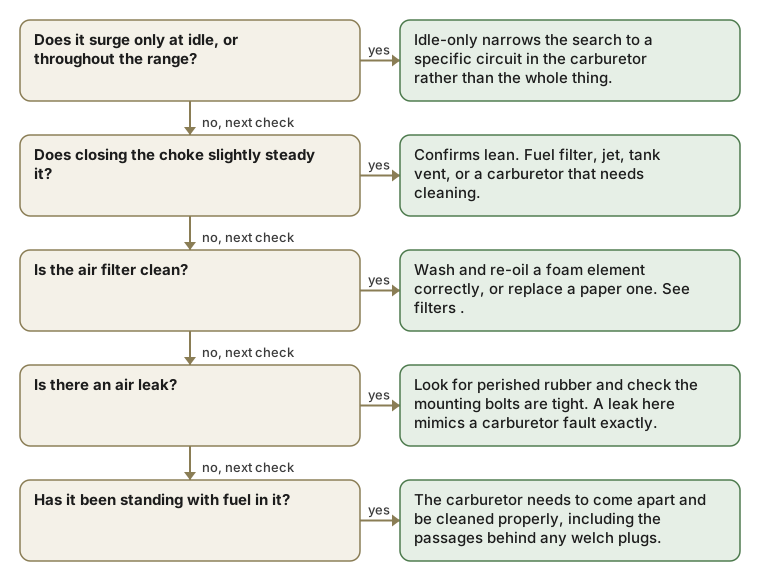
Does it surge only at idle, or throughout the range?
Idle-only surging points at the idle circuit: a very fine passage that is the first thing to block with varnish. Surging across the range points at the main jet, a fuel supply restriction, or an air leak.
If that is it: Idle-only narrows the search to a specific circuit in the carburetor rather than the whole thing.
Does closing the choke slightly steady it?
If partly choking it smooths the engine out, it is running lean and needs more fuel. That is a restriction in the fuel path, not an adjustment problem.
If that is it: Confirms lean. Fuel filter, jet, tank vent, or a carburetor that needs cleaning.
Is the air filter clean?
A blocked air filter makes the mixture rich, which usually causes rough running, black smoke and fouled plugs rather than classic surging, but an over-oiled foam element can do either. Check it because it takes twenty seconds and it is free.
If that is it: Wash and re-oil a foam element correctly, or replace a paper one. See filters.
Is there an air leak?
Air entering downstream of the carburetor leans the mixture without the carburetor knowing. The usual sites are a perished intake boot on a handheld two-stroke, a carburetor mounting gasket, and a cracked primer bulb or its hoses.
If that is it: Look for perished rubber and check the mounting bolts are tight. A leak here mimics a carburetor fault exactly.
Has it been standing with fuel in it?
If yes, this is almost certainly varnish in the carburetor’s fine passages. The idle circuit and the emulsion tube holes are the first to go and they are far too small to clear with a spray can through the throat.
If that is it: The carburetor needs to come apart and be cleaned through its internal passages, including the passages behind any welch plugs.
Rich and lean, told apart
| What you observe | Direction | Usual cause |
|---|---|---|
| Rhythmic hunting; steadies with partial choke | Lean | Restricted fuel path, blocked idle circuit, tank vent, or an air leak. |
| Black smoke, sooty plug, fuel smell, poor power | Rich | Blocked or over-oiled air filter, choke stuck closed, a flooding needle valve. |
| White or blistered plug, overheating, pinging | Dangerously lean | Stop. A lean-running air-cooled engine damages itself quickly. |
| Four-stroking or burbling on a two-stroke at full throttle | Rich (often correct) | Some two-strokes are deliberately set slightly rich at full throttle for cooling. Not a fault to tune out. |
Do not lean out an air-cooled two-stroke to make it sound cleaner. The mixture also carries the lubricant and part of the cooling, and a saw or trimmer leaned out for a crisper note is a saw or trimmer running hotter than its designer intended. If a machine has adjustment screws with limiter caps, those caps set the permitted adjustment range.
When it is not fueling
A minority of surging cases are mechanical. A governor linkage that has been bent during a repair, a governor spring hooked into the wrong hole, or a worn governor shaft bush will all produce oscillation that does not respond to choke at all. The tell is that the engine does not smooth out when you enrich it.
That is the point at which the linkage is worth looking at: and, importantly, the point at which someone else's earlier repair becomes the prime suspect.
Surging, hunting and a rough idle: questions
Why does my small engine rev up and down on its own?
Because a slightly lean mixture destabilizes the governor’s feedback loop: the engine slows, the governor opens the throttle, the extra air leans it further, it slows more, then catches and overshoots. The rhythmic hunting is a small fueling error amplified by a control system doing its job, which is why surging is nearly always a fuel or air fault and only rarely the governor itself.
How do I tell if my engine is running lean or rich?
By what it does. Rhythmic hunting that steadies when you partly close the choke is lean: a restricted fuel path, blocked idle circuit, tank vent or air leak. Black smoke, a sooty plug, a fuel smell and poor power are rich, usually a blocked or over-oiled air filter or a stuck choke.
A white or blistered plug with overheating is dangerously lean; stop, because a lean air-cooled engine damages itself quickly.
Why does my engine surge only at idle?
Because idle-only surging points at the idle circuit specifically: a very fine passage that is the first thing to block with varnish from stored fuel. Surging across the whole rev range points instead at the main jet, a fuel-supply restriction, or an air leak downstream of the carburetor. Narrowing it to idle-only tells you which circuit to clean rather than condemning the entire carburetor.
Can I just adjust the carburetor screws to fix surging?
Rarely, and never by leaning out an air-cooled two-stroke to make it sound cleaner: the mixture also carries the lubricant and part of the cooling, so a saw or trimmer leaned out for a crisper note runs hotter than its designer intended. Limiter caps on the adjustment screws set the permitted adjustment range. Most surging is a restriction to clean, not a mixture to re-tune.
What is the mechanism by which a governor makes a small fueling error visible as surging?
A governor is a feedback loop that adjusts throttle position to hold engine speed steady, when a slightly lean mixture makes the engine slow, the governor opens the throttle to compensate, but the extra air leans the mixture further, slowing the engine more, until it catches and overshoots the other way. The rhythmic rise and fall of surging is that feedback loop oscillating around a fueling error it can't fully correct.
Why does surging often disappear temporarily when partly closing the choke?
Because a lean mixture is the most common surging cause, and partly closing the choke enriches the mixture enough to move it out of the lean condition that's destabilizing the governor's feedback loop: the choke masks the symptom by compensating for the restriction rather than fixing the restriction itself, which is why the guide uses it as a diagnostic clue rather than a repair.
Is surging ever caused by something other than the fuel or air path, could it be electrical?
It's uncommon but possible, an intermittent ignition fault or a failing governor mechanism itself (rather than the fuel condition it's responding to) can produce a similar rhythmic instability.
Does an engine that surges only under load, but idles fine, point at a different cause than one that surges at idle?
Yes: idle-only surging points specifically at the idle circuit, a fine passage that blocks first with stored-fuel varnish, while surging under load or across the full rev range points instead at the main jet, a broader fuel-supply restriction, or an air leak downstream of the carburetor. The load condition under which surging happens is itself diagnostic information.
Can a vacuum leak in the intake manifold or carburetor gasket cause surging?
Yes: an air leak downstream of the carburetor lets in extra unmetered air the carburetor didn't account for, leaning the mixture in a way that behaves similarly to a restricted fuel circuit and can trigger the same governor-driven surging cycle. A cracked or hardened intake gasket is a common source of this kind of leak on an older engine.
What is a limiter cap on a carburetor adjustment screw, and why shouldn't it be removed?
A limiter cap is a plastic collar fitted over a mixture-adjustment screw that restricts how far it can be turned, preventing an owner from adjusting the mixture outside the manufacturer’s tested safe range: removing it to allow a wider adjustment defeats a safety margin built in specifically to prevent the lean-running damage the guide describes.
Should I keep running a surging engine?
It can appear to improve temporarily as an engine warms up or as choke position changes, but the underlying restriction or leak causing it doesn't resolve on its own: a intermittent surging pattern is worth investigating rather than assumed to be a passing phase, since the governor-feedback mechanism the guide describes will keep responding to the same underlying fueling error until it's fixed.