Suspected water in fuel: inspect contamination and prevent recurrence
Keep a machine with suspected contaminated fuel out of use until its fuel system can be inspected safely. Stalling after rain, cloudiness or a fuel odor does not identify water by itself. Do not pour fuel into an open household jar or try to run a separated mixture through the engine to dispose of it.
Rain timing is evidence to record
Note whether the tank cap was loose, the machine or fuel container was exposed, and whether the same container fueled another machine. A shared fuel source helps define the inspection; it does not establish that every affected machine has the same damaged part.
For example, two machines refilled from one can and then running poorly make that can a useful inspection lead. Replacing both carburetors before examining the fuel would skip a common input. A machine that was not refilled still needs its own diagnosis.
Removal and disposal are separate tasks
EPA’s household-hazardous-waste guidance calls for following local collection instructions and keeping incompatible waste separate. A used-oil collection program does not automatically accept gasoline. Ask the local facility about fuel, container and transport requirements before draining.
| Question | Decision |
|---|---|
| Can removal be done by the manual? | Use qualified service if safe access or containment is unavailable |
| Where will waste go? | Confirm a local program accepts that fuel |
| How did contamination enter? | Inspect the correct cap, seal, vent and storage container |
| Did internal damage occur? | Inspect before assuming fresh fuel completes the repair |
A separated layer may require more than topping up. An additive is not proof that contaminated fuel is restored to the engine’s specification. Corrosion, blocked passages or another fault can remain after fuel replacement.
Prevent the next exposure without a universal tank rule
Honda’s mower fuel recommendations distinguish storage periods and preparation methods. Follow the actual model rather than automatically filling every tank nearly full or draining every system the same way.
Use approved, closed fuel containers and the correct cap and vent components. Do not seal a required vent with tape. Continue with fuel-path checks and storage preparation once contamination is addressed.
TS-26 · Troubleshooting
Water in the fuel: how to tell, how to clear it, how to stop it returning
A machine that ran well and then stalls, surges or will not start after heavy rain, a loose cap or a long storage may have water in its fuel. Water does not burn, and a droplet in a carburetor passage as narrow as a needle stops the engine. It gets in as liquid through a cap, vent or can, or from ethanol fuel that has absorbed moisture and separated, leaving a layer at the bottom of the tank.
A sample of fuel in a clear jar settles it in a minute. The cure is to drain the bowl and tank and refill with fresh fuel, then clean the carburetor if it corroded and find the cap, vent or can that let the water in.
Fuel that has been drained from a machine is a fire hazard and a waste product. Drain it outdoors into an approved container, away from any flame, spark or hot surface, with the engine cool. Do not pour it on the ground or down a drain.
Many local waste sites accept it and take it as they take used oil, so ask before you empty a container.
Water in the fuel is a cause of a sudden no-start, and a checkable one
Water in a small engine’s fuel gives a recognizable pattern. A machine that ran well stalls, surges or will not start after heavy rain, after being left with a loose cap, after a long storage with a part-full tank, or after fuel from a can that has stood outdoors. It may fire for a moment and die.
It may run roughly on the fumes it has left, then stop as the water reaches the jet. Water does not burn, and a droplet in a carburetor passage the width of a needle blocks it.
There are two routes in. Liquid water enters through a loose or cracked cap, a vent, or a can that took rain. The other is ethanol.
Ethanol fuel holds a small amount of water dissolved in it, but past a point the mixture separates, and a layer of water and ethanol settles at the bottom of the tank, exactly where the pickup sits. That second route is the one behind most spring failures, and it is why fuel sitting in a tank for months is the usual source.
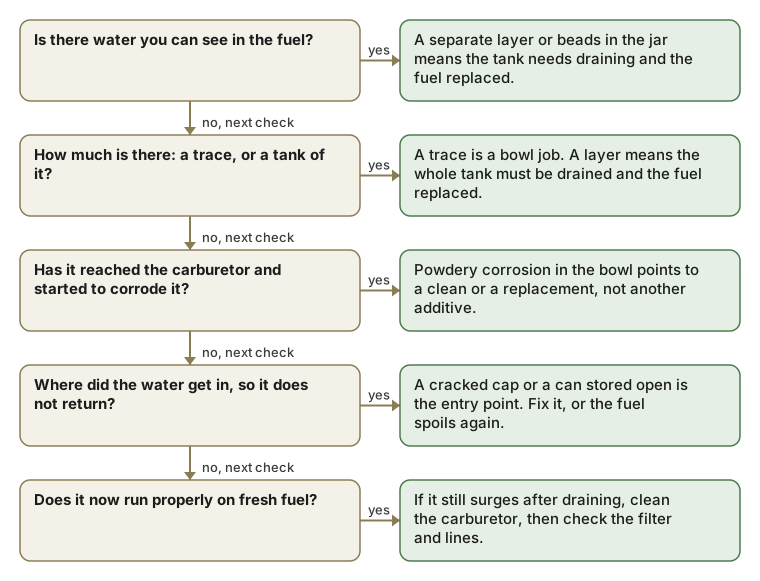
1. Is there water you can see in the fuel?
Draw a sample from the bottom of the tank or the carburetor bowl into a clear jar and let it settle. Water and fuel do not mix in the sample: a distinct layer at the bottom, cloudy or with beads, is water. Petrol floats above it.
A cloudy fuel that does not clear, or one with a sour or varnish smell, is also past its best.
If that is it: A separate layer or beads in the jar means the tank needs draining and the fuel replaced.
2. How much is there: a trace, or a tank of it?
A trace, in the bowl only, is cleared by draining the bowl and refilling with fresh fuel. Water through the tank means draining the tank and the fuel line too, and drying the tank. Additives that claim to absorb water only handle a trace, and they do not cure a separated layer.
Do not run the engine to burn it off, since water passes to the cylinder and the engine runs badly and corrodes.
If that is it: A trace is a bowl job. A layer means the whole tank must be drained and the fuel replaced.
3. Has it reached the carburetor and started to corrode it?
Water sitting in a carburetor leaves white or grey powder, pitting and rust in the bowl and around the jets. Drain the bowl, then remove and clean the bowl and jets and blow the passages clear.
A carburetor that is corroded through, or whose jets do not clear, is a replacement. See the carburetor page.
If that is it: Powdery corrosion in the bowl points to a clean or a replacement, not another additive.
4. Where did the water get in, so it does not return?
Check the fuel cap seal and vent for cracks, the fuel can for a leaking cap, and the way the fuel is stored. A machine kept outdoors with a loose cap, or a can left in the rain, will take on water again. Keep the tank close to full through storage, which leaves less air to carry moisture, or empty it, and store cans capped, upright and under cover.
If that is it: A cracked cap or a can stored open is the entry point. Fix it, or the fuel spoils again.
5. Does it now run as intended on fresh fuel?
Refill with fresh fuel, prime, and start. A machine that runs steadily and holds its speed is fixed. One that still surges or dies has a passage that the water left blocked or corroded.
The fuel line, the filter and the bowl are the next places to look, in that order.
If that is it: If it still surges after draining, clean the carburetor, then check the filter and lines.
What you see, what it means, and the fix
| What you see | What it means | What to do |
|---|---|---|
| Runs, then stalls or will not start after rain or a wet storage | Water has reached the carburetor | Drain the bowl and the tank, and refill with fresh fuel. |
| A clear jar shows a layer or beads at the bottom | Separated water, or water in the can | Discard the fuel properly and drain the tank. |
| Fuel cloudy or smells sour | Old, degraded fuel, with or without water | Replace it. It will not recover. |
| White powder or rust in the bowl | Corrosion from water in the carburetor | Clean the jets, or replace the carburetor. |
| Fuel goes bad again within a season | A cap, vent or can that lets water in | Replace the cap or can, and store the tank nearly full. |
Jar
A clear sample tells you
It costs nothing and it settles the question in a minute.
Drain
The cure is removal
Water does not burn off and additives only handle a trace.
Seal
Find the entry point
A cracked cap or an open can will spoil the next tank too.
Water in the fuel: questions
How do I tell if there is water in my fuel?
Draw a sample from the bottom of the tank or the carburetor bowl into a clear jar and let it settle. Water forms a separate layer or beads at the bottom, and petrol floats above it. Cloudy fuel that does not clear, or fuel with a sour smell, is also degraded.
The test takes a minute and costs nothing.
Why did my engine stop after heavy rain?
Rain can get in through a loose or cracked fuel cap, a vent, or a fuel can left open. Water does not burn, and a droplet in a carburetor passage as narrow as a needle stops the engine. The machine may run for a moment on the fuel it had, then die as the water reaches the jet.
Can ethanol fuel cause water in the tank?
Ethanol fuel absorbs a little moisture from the air and holds it in solution, but past a point the mixture separates. A layer of water and ethanol then settles at the bottom of the tank, where the pickup sits. It is the usual reason a machine that sat for months will not run.
Will a fuel additive remove water from the tank?
Only a trace, and only some of them. Products sold to absorb water handle a small amount dissolved in the fuel, and they do nothing about a separated layer. If a jar test shows a layer or beads, drain the tank and replace the fuel, since an additive is not a cure for that.
Can I just run the engine until the water burns off?
No. Water does not burn, so it passes through the carburetor to the cylinder, where the engine runs badly and can corrode. Running it also carries the water deeper into the system.
Drain the bowl and the tank, refill with fresh fuel, and start again.
How do I drain the carburetor bowl?
Many carburetors have a drain screw at the bottom of the bowl. Loosen it over a container with the fuel valve open, and let the contents out until fuel runs clear. If there is no drain, the bowl comes off, which is a short job on most small engines, and you can see and clean it at the same time.
What should I do with fuel that has water in it?
Treat it as a fire hazard and a waste. Drain it outdoors into an approved container, away from any flame or hot surface, and take it to a local waste facility. Many accept fuel as they accept used oil.
Do not pour it on the ground, down a drain or into the garden.
What does water do to a carburetor?
Water left in a carburetor leaves white or grey powder, pitting and rust around the bowl and the jets, and it blocks the fine passages. Light corrosion is cleaned with the jets removed and the passages blown clear. A carburetor corroded through, or with jets that will not clear, is replaced.
How do I stop water getting into my fuel again?
Check the cap seal and the vent for cracks, keep fuel cans capped, upright and under cover, and buy fuel in the amount you will use within about a month. For storage, keep the tank nearly full to leave less air to carry moisture, or drain it, and treat the fuel if it will sit.
Is water in the fuel the same problem as bad fuel?
They overlap. Old fuel loses its light fractions and forms gum, and it also takes on water, so a machine that has sat often has both. The jar test shows water, and a sour smell or varnish shows age.
The fix for both is the same: drain, replace the fuel, and clean what the fuel touched.
Will a fuel filter stop water?
A standard filter stops dirt, not dissolved or emulsified water, and a plain paper element can even swell and restrict flow when wet. A filter is worth having, but it is not a water defence. The remedy is keeping water out and draining the tank when it gets in.
My engine still surges after I drained the fuel. What next?
A passage that the water left blocked or corroded is the likely cause. Clean the carburetor, jets and bowl, then check the fuel filter and the lines for water and debris, in that order. If it still surges after that, the surging page lists the wider causes.