Fuel lines and bulbs: distinguish purge, primer and shutoff systems
Identify whether the machine uses a purge bulb, a primer or another starting system before interpreting bulb behavior. Inspect permitted hoses, connections and the shutoff setting on a cool, isolated machine.
Stop for leakage. A soft bulb or an apparently open valve does not uniquely identify the failed component.
A purge bulb pulls through the carburetor
ZAMA’s April 2024 bulletin explains that its remote purge system draws fuel through the carburetor and returns it to the tank. It is not a bulb that simply pumps fuel into a float bowl. ZAMA also identifies incorrect routing as a possible reason a purge bulb becomes hard to press.
This diagram describes that system, not every primer. Match the actual machine’s schematic. Do not swap hoses by color or assume a replacement bulb’s port arrangement from its shape.
Three identification checks before parts
| Item | Match before replacement |
|---|---|
| Hose | Approved fuel compatibility, size, routing and connection |
| Bulb | Correct part, direction and system function |
| Valve / vent | Model-specific operation and permitted test |
For example, reversing the supply and return lines creates a different fault from a deteriorated bulb. Buying two new bulbs while retaining the reversed routing would not correct that connection error. Record the original routing and use the authoritative diagram when any previous repair is uncertain.
A bulb that contains air after pressing is not automatically defective. Use the operator manual’s starting instruction and its stated observation; some systems do not require the bulb to remain completely full.
Do not create an open-fuel running test
Never disconnect a hose with the engine running, loosen a hot tank cap or direct spilled fuel into an unapproved jar. A technician can perform the prescribed flow, pressure or vacuum test with appropriate containment and equipment.
If a line leaks or a valve fails its specified check, keep the machine out of use until repaired. See carburetor service choices only after the fault has been located. See fuel compatibility and storage before refilling.
TS-19 · Troubleshooting
Fuel lines, primer bulb and shutoff valve
Stale fuel is the most common cause of a fuel-delivery no-start, but fresh fuel that cannot physically reach the carburetor produces the identical symptom for a mechanical reason instead. Fuel line cracks most often at a sharp bend near a fitting, and a crack on the suction side draws air in rather than leaking fuel out: invisible, but it produces the same lean-running symptom as a carburetor problem. A primer bulb that presses soft and stays soft has a failed check valve or an air leak upstream of it.
And a fuel shutoff valve "checked" by eye rather than by testing actual flow is one of the most common false negatives in this whole cluster. Gummed internally, it can look fully open while barely passing fuel.
Before anything else: pull the spark plug lead off and tuck it away from the plug, and on a battery machine take the key out. Every step assumes the engine cannot start while your hands are near it. On a machine with a blade, an auger or a chain, that is not a formality.
Good fuel, bad path
Stale, varnished fuel is the most common cause of a fuel-delivery no-start, but it is not the only one: fresh fuel sitting in a tank that cannot reach the carburetor produces the identical symptom, and the cause is mechanical rather than chemical. This page covers the physical path between the tank and the carburetor: the parts that hold, prime and shut off fuel rather than the fuel itself.
Fuel lines: where they fail
Rubber fuel line hardens and cracks with age and heat cycling, most often exactly where it bends sharply near a fitting: a crack there can leak fuel outward, which is visible, or draw air inward on the suction side of the line, which is not, and an air leak on the suction side produces exactly the same lean-running or no-start symptom as a clogged passage inside the carburetor. Flex the line gently at every bend and fitting while looking for a crease or a whitened crack line; a line that has gone stiff and glassy rather than pliable is due for replacement regardless of whether a crack is visible yet.
The primer bulb: what it is testing
A primer bulb draws fuel up from the tank into the carburetor bowl before starting, and pressing it does two diagnostic jobs at once: if it fills and holds firm, the check valves inside it and the suction-side line are sealing correctly; if it stays soft, collapses slowly, or will not fill at all after several presses, the bulb's own check valve has failed, or there is an air leak upstream of it on the tank side. A bulb that fills but empties again within a minute or two of sitting, engine off, is leaking back through one of its two one-way valves and needs replacing. It is a small, inexpensive part.
| Part | How it fails | How to check it |
|---|---|---|
| Fuel line | Cracks at a bend, leaking outward or drawing air inward | Flex gently at every bend and fitting; look for a crease or whitening |
| Primer bulb | Stays soft, or fills then empties again while sitting | Press repeatedly and watch whether it holds firm |
| Shutoff valve | Looks open but is gummed nearly shut internally | Disconnect at the carburetor and confirm fuel flows |
The shutoff valve: left part-closed is the common one
Most gravity-fed machines have a simple on/off valve at the tank outlet. Seeing the lever aligned with the ON mark does not establish that fuel can pass through the valve; inspect or test it by the model’s approved procedure instead of dismissing it from its position alone.
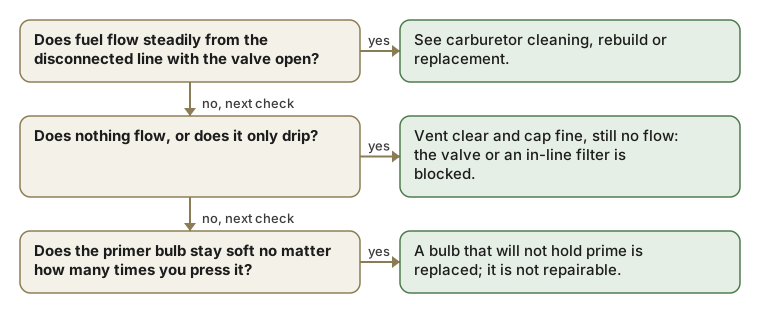
1. Does fuel flow steadily from the disconnected line with the valve open?
Yes means the tank, valve and line up to that point are clear: the fault is downstream, in the carburetor itself.
If that is it: See carburetor cleaning, rebuild or replacement.
2. Does nothing flow, or does it only drip?
Check the tank vent next: a blocked vent creates a vacuum that stops flow exactly like a closed valve does, and loosening the fuel cap to test for it costs nothing.
If that is it: Vent clear and cap fine, still no flow: the valve or an in-line filter is blocked.
3. Does the primer bulb stay soft no matter how many times you press it?
Either the bulb's own check valves have failed, or air is entering the line upstream of it: flex-test the line at every fitting between the bulb and the tank.
If that is it: A bulb that will not hold prime is replaced; it is not repairable.
Fuel lines, primer bulb and shutoff valve: questions
I put fresh fuel in but it still won’t start: what else could it be?
A mechanical problem in the fuel path rather than the fuel itself: a cracked line drawing air on the suction side, a primer bulb that will not hold prime, or a shutoff valve that looks open but is gummed nearly shut internally. All three produce the identical symptom fresh fuel is supposed to rule out.
My primer bulb feels soft and won’t fill: what does that mean?
Either the bulb’s own one-way check valves have failed, or there is an air leak upstream of it between the bulb and the tank. A bulb that fills but empties again within a minute or two of sitting with the engine off is leaking back through one of its valves and needs replacing. It is a small, inexpensive part.
How do I check if my fuel shutoff valve is working?
Disconnect the line at the carburetor end with the valve open and confirm fuel flows into a container: checking that the lever looks like it is pointing to "on" is not the same test. A valve gummed internally can look fully open while barely passing fuel, producing a lean, surging run rather than an obvious no-start.
Why does a fuel line crack most often near a fitting rather than in the middle of a straight run?
Because a sharp bend near a fitting concentrates flex and stress every time the line moves or is handled, while a straight run experiences much less repeated bending: rubber hardens and cracks fastest exactly where it's asked to flex repeatedly, which is why the guide specifically recommends checking bends and fittings first rather than examining the line's full length equally.
Why does an air leak on the suction side of a fuel line produce the same symptom as a clogged carburetor passage?
Because both result in a lean-running condition: an air leak draws in extra unmetered air the same way a partially blocked fuel passage restricts fuel relative to air, and the engine can't distinguish "too little fuel from a blockage" from "too much air from a leak" without a specific diagnostic check for each.
Does the diagnostic sequence for the fuel path differ depending on where fuel flow stops?
Yes: fuel flowing steadily from a disconnected line with the valve open means the tank, valve, and line up to that point are clear, pointing the fault downstream at the carburetor itself; no flow or only a drip points back toward the tank vent, the valve, or an in-line filter, which is exactly why the guide tests flow at a specific point rather than guessing at the whole path at once.
Can a primer bulb be repaired, or does it always need full replacement?
A primer bulb is not repairable. Its one-way check valves are sealed inside the bulb assembly, so a bulb that stays soft or empties after sitting needs full replacement rather than any kind of internal repair. It is a small, inexpensive part, which is part of why replacement rather than repair is the standard approach.
Why is "I checked the shutoff valve, it's on" often not a reliable diagnostic step?
Because checking a valve's position by eye only confirms the lever's orientation, not that fuel is flowing through it. A valve gummed internally can look fully open while barely passing fuel, which is why the guide insists on the disconnect-and-observe-actual-flow test rather than accepting a visual position check as sufficient.
Does a blocked tank vent produce the same symptom as a closed or gummed fuel shutoff valve?
Yes, mechanically similar: both create conditions that stop fuel from reaching the carburetor, a blocked vent through a vacuum building in the tank and a gummed valve through physical restriction, which is why the guide's diagnostic sequence checks the vent (via the ten-second fuel-cap test) right alongside the valve rather than treating them as unrelated possibilities.
What is the difference between a fuel line failing by leaking outward versus drawing air inward?
A crack on the pressure or gravity-feed side of the system leaks fuel outward, which is visible as a wet spot or a fuel smell: an obvious symptom. A crack on the suction side of the line, where the primer or engine vacuum draws fuel, instead pulls air inward, which produces no visible leak but causes the identical lean-running or no-start symptom as an internal carburetor restriction.
Should I replace a fuel line that feels stiff and glassy even if I can't see an actual crack yet?
Yes: a line that has gone stiff and glassy rather than remaining pliable is due for replacement regardless of whether a visible crack has developed yet, since that stiffness itself indicates the rubber has degraded to the point where cracking is imminent under normal flexing during use.
Is it worth replacing all three components (line, primer bulb, shutoff valve) at once on an older machine rather than diagnosing each separately?
On a machine old enough that all three are original and have never been serviced, a preventive replacement of all three inexpensive parts at once can be more time-efficient than diagnosing them individually, but confirming which one is at fault first is still worth doing on a machine where only one component shows obvious age or damage, to avoid unnecessary part costs.