Engine will not start: separate cranking, ignition and fuel faults
First separate an engine that will not turn from one that turns but will not fire. Check its model, required controls, oil level and approved fuel before buying a carburetor or coil.
Stop for a locked mechanism, fuel leak or forceful recoil kickback. A few unsuccessful pulls do not establish a failed part.
What happens during the start attempt?
| Observation | Next decision |
|---|---|
| No rotation or one click | Use the starter, battery or recoil diagnosis |
| Rotates normally, never fires | Check the prescribed start settings and fuel condition |
| Briefly starts, then stops | Use the separate starts-then-dies checks |
| Rope kicks back or engine locks | Stop; inspect recall status and obtain appropriate service |
Briggs’ problem-solving guide lists fuel, spark, intake and compression-related causes. None can be eliminated just by hearing the engine turn. Recoil resistance is affected by a compression-release mechanism and cannot substitute for a specified compression or leak-down test.
Check an applicable recall before another pull
Honda’s 2023 camshaft recall covers certain HRN216 and HRX217K6 mowers and GCV170/GCV200 G5B pressure-washer engines. The hazard includes a starter rope pulling back unexpectedly. A similar symptom on a different machine does not prove the same defect; use the campaign’s model and serial lookup.
For example, a mower with fresh fuel that never rotates has not passed the fuel diagnosis. Its lack of rotation sends you to the starting system first. Replacing a carburetor at that point would not address the observation.
Keep fuel out of improvised tests
Do not pour gasoline into the intake, use a removed air filter as a test setup, or judge ignition from the color of an exposed spark near fuel. Use the manufacturer’s approved ignition tester and procedure.
A spark seen during one cold test also does not establish performance under compression or when hot. Record the actual observation for service. Continue with no-crank diagnosis or a running engine that stalls, according to what the machine does.
TS-01 · Troubleshooting
Engine will not start
Start by separating a no-crank fault from an engine that turns without firing. Briggs’ troubleshooting sequence checks fresh fuel, the air filter, the spark plug and the specified oil level.
Leave the intake assembled for operation and use the model’s approved tests. A brief firing event can make a fuel-delivery fault worth investigating, but it does not establish compression, ignition quality or a clean carburetor by itself.
Follow the fuel path through the tank, valve, line, filter and carburetor rather than replacing a part from that symptom alone.
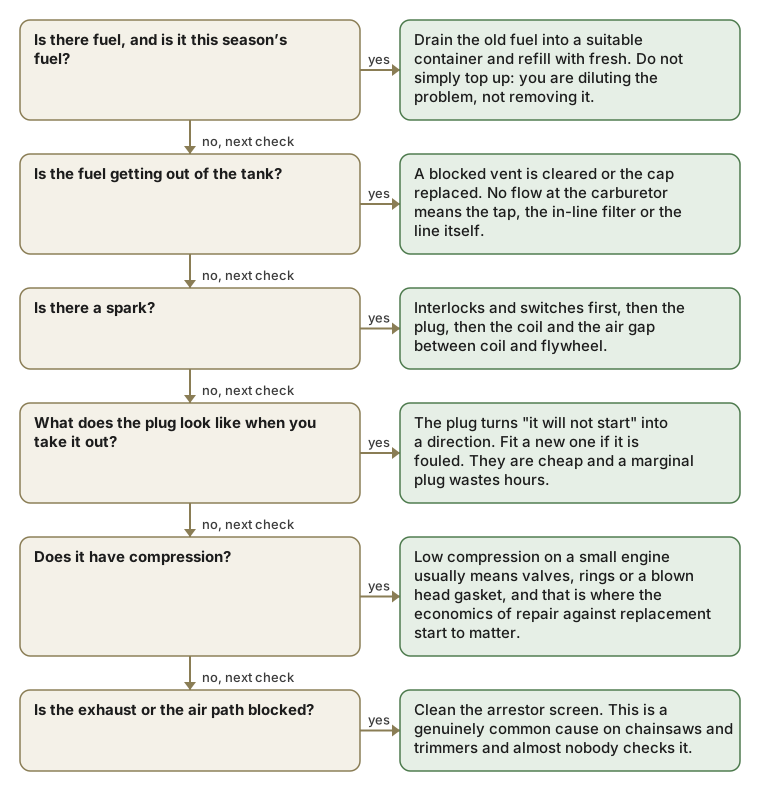
If it does not fire at all, the sequence below works through fuel supply, the tank vent, spark, what the plug looks like, compression and a blocked exhaust, in that order, because that is the order that runs from free to expensive.
Before anything else: pull the spark plug lead off and tuck it away from the plug, and on a battery machine take the key out. Every step assumes the engine cannot start while your hands are near it. On a machine with a blade, an auger or a chain, that is not a formality.
First, the one-minute test that identifies most seasonal machines
After seasonal storage, inspect the fuel supply and maintenance record before assuming the carburetor needs replacement. Check the tank, fuel valve, line and filter for the model’s permitted inspections. Keep the air cleaner installed for running and use the manufacturer’s approved fuel and ignition checks; pouring gasoline or spraying starting fluid into an exposed intake is not this diagnostic procedure.
An engine that fires briefly and stops has achieved some combustion, but the event alone cannot confirm normal compression, consistent spark or the condition of the fuel system. Check the required controls and fuel path, then use the specified ignition and compression procedures if needed. Work through the checks in order instead of treating a momentary start as proof that every other system is sound.
Use starting fluid sparingly and never on a two-stroke you intend to keep. It carries no lubricant, and a two-stroke run even briefly on ether alone is running dry. A squirt of the correct pre-mixed fuel does the same diagnostic job without that risk.
The sequence
1. Is there fuel, and is it this season’s fuel?
Look in the tank rather than trusting a gauge. Then smell it: fresh gasoline smells sharp, stale gasoline smells sour and faintly like varnish. If the machine has been stored since last season, assume the fuel is the fault until proved otherwise.
If that is it: Drain the old fuel into a suitable container and refill with fresh. Do not simply top up: you are diluting the problem, not removing it.
2. Is the fuel getting out of the tank?
Check the tap is open. Then loosen the fuel cap and try again: a blocked tank vent creates a vacuum that stops flow, and this ten-second test finds it. Disconnect the line at the carburetor into a container and see whether fuel runs; on a gravity-fed machine it should flow steadily.
If that is it: A blocked vent is cleared or the cap replaced. No flow at the carburetor means the tap, the in-line filter or the line itself.
3. Is there a spark?
Fit an in-line spark tester between the lead and the plug and crank it. A blue spark that jumps consistently is good; an orange, weak or intermittent one is not. If there is no spark at all, check the kill switch, the operator-presence control and the safety interlocks first: a bail cable that has stretched will earth the ignition and it costs nothing to check.
If that is it: Interlocks and switches first, then the plug, then the coil and the air gap between coil and flywheel.
4. What does the plug look like when you take it out?
Wet with fuel means fuel is arriving and not igniting: go back to spark. Bone dry after several pulls means fuel is not arriving.
Black and sooty means it has been running rich for some time. The full reading is on reading a used spark plug.
If that is it: The plug turns "it will not start" into a direction. Fit a new one if it is fouled. They are cheap and a marginal plug wastes hours.
5. Does it have compression?
With the plug in, the starter cord should resist firmly and rebound. A cord that pulls easily all the way is the symptom of no compression. A gauge turns that impression into a number.
On a four-stroke, check the oil level before concluding anything: some engines have a low-oil shutdown that prevents ignition entirely.
If that is it: Low compression on a small engine usually means valves, rings or a blown head gasket, and that is where the economics of repair against replacement start to matter.
6. Is the exhaust or the air path blocked?
A muffler packed with carbon, a spark arrestor screen blocked solid, or a mouse nest in the intake will all prevent starting. The spark arrestor is a small mesh screen at the muffler outlet on most handheld machines, and it clogs.
If that is it: Clean the arrestor screen. This is a common cause on chainsaws and trimmers and almost nobody checks it.
What each result rules out
The value of testing in order is that each result eliminates a whole branch. This is what each observation buys you.
| What you observed | What it rules out | What is left |
|---|---|---|
| It starts briefly and then stalls during normal operation | Spark and compression. Both are working. | The fuel path only: tank, tap, filter, line, carburetor. |
| Strong blue spark on an in-line tester | Coil, kill switch, interlocks and plug lead. | Fuel and compression. |
| The plug comes out wet with fuel | Fuel delivery. Fuel is arriving. | Ignition, or a flooded engine that needs clearing before it will fire. |
| The plug is bone dry after several pulls | Nothing about ignition, but fuel is not reaching the cylinder. | The fuel path, and possibly a stuck choke or primer. |
| The starter cord pulls easily with the plug fitted | Almost everything else: this is the one result that changes the economics. | Compression: valves, rings or a head gasket. |
| It fires only with the choke closed | Spark, compression and fuel supply to the carburetor. | A restricted circuit inside the carburetor. |
What "it turns over but will not fire" narrows to
Turning over freely means the starting system works and the engine is not seized. What remains is fuel, spark and compression.
When a machine starts briefly and then stops, inspect the normal fuel path from tank to cylinder. A blocked valve, filter, line or carburetor passage can interrupt delivery, but other faults remain possible. Use the model-specific test sequence and compare the result with the stored-fuel guidance before choosing a carburetor repair.
What "it will not turn over at all" narrows to
A machine that will not rotate is a different problem. On a recoil-start machine, check that the blade or auger is not jammed and that the recoil itself has not failed.
Disconnect the drive if you can and try turning the engine by the flywheel. On an electric-start machine, a click and no rotation is usually the battery or the connection to it, which is covered on starting batteries.
A hydrolocked engine, one with liquid in the cylinder, will also refuse to turn. This happens after a machine is tipped the wrong way and oil runs into the bore, or after prolonged flooding. Remove the plug and turn it over slowly with the plug hole pointing away from you and from any ignition source before doing anything else.
Engine will not start: questions
How do I quickly tell if a no-start is a fuel problem?
Begin with the approved fuel, air-filter and spark-plug checks in the engine’s manual. A brief start followed by stalling is consistent with interrupted fuel delivery, but does not prove the health of the ignition or compression system.
Trace the tank, shutoff valve, filter, line and carburetor with the engine stopped and cooled where required. Use only the manufacturer’s approved test setup, keeping the air cleaner assembled for operation instead of adding fuel to an exposed intake.
My engine turns over but will not fire. What does that mean?
Turning over shows that the starting system can rotate the engine; it does not establish normal compression or ignition. Check the required controls, approved fuel, air filter and spark-plug condition first.
A machine that fires briefly and stops may have a fuel-path fault, so inspect the tank, valve, filter, line and carburetor in the specified order. Use an approved ignition tester where the manual requires one, and verify compression by the specified procedure rather than guessing from starter sound.
Why does loosening the fuel cap sometimes let an engine start?
Because a blocked tank vent creates a vacuum as fuel is drawn out, and that vacuum eventually becomes strong enough to stop the fuel flowing. Loosening the cap lets air back in and equalizes it, so the engine runs again. It is a ten-second test that finds a two-minute repair, a clogged vent hole or a failed one-way valve in the cap, which is frequently misdiagnosed as a carburetor fault.
My engine will not turn over at all. What should I check?
A machine that will not rotate is a different problem from one that turns but will not fire. On a recoil starter, check the blade or auger is not jammed and the recoil has not failed, and try turning the engine by the flywheel. On an electric start, a click with no rotation is usually the battery or its connection.
And remove the plug if you suspect a hydrolock: liquid in the cylinder from tipping the machine the wrong way.
What does a brief start followed by stalling establish about fuel, spark and compression?
A brief firing event shows that combustion occurred under those conditions. It does not prove normal compression, reliable spark or correct fuel metering throughout operation.
Investigate the ordinary fuel path through the tank, valve, filter, line and carburetor, then follow the model-specific ignition and compression checks when the first inspections do not explain the stall. Do not repeat an exposed-intake fuel test.
Why should I check the spark plug's condition even after confirming spark with a tester?
Because a spark tester only confirms that spark is present, not that the plug itself is in good condition. A plug that is wet, fouled, or gapped incorrectly can still show a weak or intermittent spark on a tester while being the reason the engine won't fire reliably. Pulling and reading the plug is a separate, complementary check.
Does a clogged spark arrestor screen affect starting the same way a blocked fuel path does?
Yes, in effect: a spark arrestor screen packed solid with carbon restricts exhaust flow enough to prevent the engine from starting or running, producing a no-start or a weak-running symptom that can be mistaken for a fuel or spark fault. It's a commonly overlooked check specifically because it sits at the muffler outlet, out of sight, on most handheld machines.
Is it safe to test for spark on a machine with a chainsaw, mower blade, or auger attached?
Only with those attachments disconnected from rotation or the machine otherwise fully isolated, since cranking an engine during a spark test can cause it to start or the attachment to move: treat a spark test with the same isolation precautions (blade or chain clear, hands away from moving parts) as any other maintenance task on a running or cranking engine.
What should I do if the engine fires only with the choke fully closed?
This points at a restricted circuit inside the carburetor: the mixture is being enriched enough by the choke to overcome a partial blockage in the normal fuel circuit, almost always varnish from stored fuel. The carburetor needs to be taken apart and its passages cleaned rather than adjusted, since the restriction is physical, not a tuning issue.
Can a weak or dying battery cause a no-start on a machine with electric start, even if the engine itself is fine?
Yes: an electric-start machine with a weak battery may click without rotating the engine at all, which looks like a starting-system fault but is a battery or connection problem separate from the engine's fuel, spark, or compression. Check the battery and its connections before assuming the engine itself has a fault.