Stored gasoline: fuel approval, stabilizer dose and age
Use fuel approved for the actual engine and add storage treatment only under its label and the equipment instructions. Stabilizer is not proof that old or contaminated fuel is usable. Ordinary lawnmowers and chainsaws are outside E15 approval; a pump’s road-vehicle availability does not establish equipment compatibility.
E15 availability is not small-engine approval
EPA’s E15 registration guidance identifies engines in nonroad equipment among the excluded applications. Read the pump label and equipment manual. Do not substitute E15 or E85 for gasoline limited to 10 percent ethanol simply because the fuel is on sale.
Measure the actual treatment, not a guessed splash
Gold Eagle’s STA-BIL Storage guidance gives one ounce per 2.5 US gallons. At that product’s stated dose, five gallons require two ounces and one gallon requires 0.4 ounce. Other formulations can use different rates.
| Gasoline quantity | Calculated treatment |
|---|---|
| 1 US gallon | 0.4 US fl oz |
| 2.5 US gallons | 1 US fl oz |
| 5 US gallons | 2 US fl oz |
Use the measuring and fill instructions on the actual container. A storage-duration claim is conditional product guidance, not a guarantee against water contamination, wrong fuel or an uncompleted machine-storage procedure.
The carburetor needs the specified preparation too
Honda’s mower fuel recommendations describe running outdoors for ten minutes after initially adding stabilizer so treated fuel reaches the system. The page also distinguishes storage periods. That procedure applies to its stated equipment and does not override another model’s draining instruction.
Fuel appearance and smell are not a complete condition test. If water or separation is suspected, stop and arrange safe fuel assessment/removal under the manual and local disposal guidance. Do not pour contaminated fuel into a drain or assume shaking restores it.
Ethanol-free gasoline still needs correct storage and freshness. Premixed fuel also must match the engine’s required ratio and its own opened-container instructions. The mix calculator calculates oil quantity; it cannot determine whether stored fuel remains suitable.
Ethanol, stabilizer and stored gasoline
Three separate things happen to gasoline left in a machine, and only one of them is the one people talk about. The light fractions that make an engine start easily evaporate, so old fuel is hard to light even when it looks and smells acceptable. The rest oxidises into gums that concentrate as the volume drops and dry into varnish in the carburetor’s finest passages.
And where the fuel contains ethanol, the ethanol pulls water out of the air breathing in and out of the vented tank: until, past a threshold, the mixture separates into gasoline above and a corrosive water-and-ethanol layer below, sitting exactly where the fuel pickup is. That last one cannot be shaken back together; separated fuel is disposal, not a problem you can dilute.
What degrades
Gasoline is a blend of many hydrocarbons with different volatilities, specified for automotive use under ASTM D4814. Three things happen to it in a vented tank. The light fractions, the ones that make an engine start easily, evaporate, so old fuel is harder to light.
The remainder oxidises, forming gums that concentrate as the volume falls. And where the fuel contains ethanol, the ethanol attracts water out of the air.
1
Light ends evaporate
Old fuel is hard to start on, even when it looks and smells fine.
2
Oxidation forms gums
They concentrate in the carburetor bowl as fuel evaporates, and dry to varnish.
3
Ethanol takes up water
And at enough water content, separates: leaving a corrosive layer at the bottom.
Phase separation, in plain terms
Ethanol mixes with gasoline and it also mixes with water. Given a small amount of water, from humid air breathing in and out of a vented tank across a temperature cycle, the ethanol holds it in solution. Past a threshold it cannot, and the mixture separates into two layers: gasoline above, and a water-and-ethanol layer below.
That lower layer is where the fuel pickup sits. It does not burn as the engine requires, it is corrosive to some metals, and it cannot be re-mixed by shaking the can. Once fuel has separated, the only remedy is disposal.
This is the mechanism behind a machine that has "fuel in it" and will not run at all.
Federal rule prohibits gasoline containing more than ten volume percent ethanol from being introduced into any nonroad engine, vehicle or equipment, which covers every machine. E15 pumps carry a required label for this reason. This is not a manufacturer preference or a warranty position; it is 40 CFR 1090.230.
What a stabilizer does, and what it cannot do
| Question | Answer |
|---|---|
| Does it slow oxidation? | Yes. That is the primary function, and it works: treated fuel forms gums far more slowly than untreated fuel. |
| Does it stop light fractions evaporating? | Partly, in a closed container. In a vented tank on a machine, evaporation continues regardless. |
| Does it reverse fuel that has already gone off? | No. Stabilizer is a preservative added to fresh fuel, not a repair for old fuel. |
| Does it prevent phase separation? | It does not stop water entering. Products that claim to manage moisture do not restore fuel that has already separated. |
| Does adding it to the tank protect the carburetor? | Only if the engine is then run long enough for treated fuel to reach and fill the carburetor. Adding stabilizer and switching the machine off achieves very little. |
Ethanol-free gasoline, and where it is worth the money
Ethanol-free gasoline removes the water-attraction and separation problem entirely. It does not stop oxidation or evaporation, so it is not a substitute for using fuel while it is fresh, but for a machine that inherently sits, such as a generator or a chainsaw used a few times a year, it removes the failure mode that is hardest to recover from. Premixed canned fuel for two-stroke machines takes this further: it is ethanol-free, pre-mixed at a stated ratio, and has a long stated shelf life.
It is expensive per liter and cheap per repair.
A fuel routine that works
-
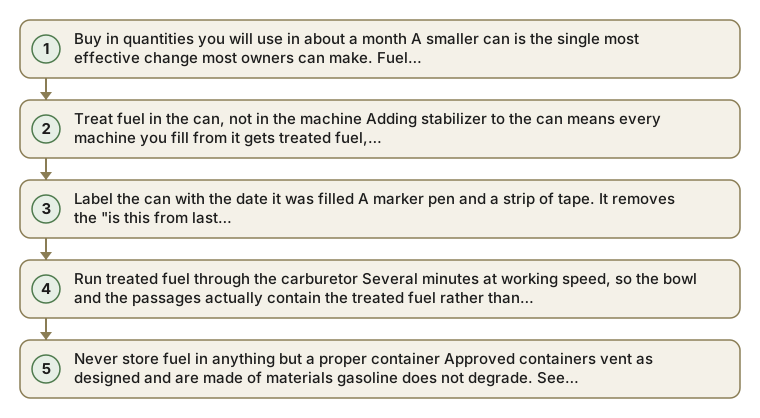
Buy in quantities you will use in about a month
A smaller can is the single most effective change most owners can make. Fuel bought in bulk to save money frequently costs a carburetor.
-
Treat fuel in the can, not in the machine
Adding stabilizer to the can means every machine you fill from it gets treated fuel, and it is mixed throughout the fuel rather than floating on top of what is already in a tank.
-
Label the can with the date it was filled
A marker pen and a strip of tape. It removes the "is this from last year?" question that otherwise gets guessed.
-
Run treated fuel through the carburetor
Several minutes at working speed, so the bowl and the passages contain the treated fuel rather than last month’s.
-
Never store fuel in anything but a proper container
Approved containers vent as designed and are made of materials gasoline does not degrade. See fuel handling and storage.
Two-stroke mixed fuel is a shorter-lived product still
Mixed fuel is gasoline with the same problems plus a second component. The oil does not go off at the same rate, but the gasoline carrying it does, and the mixture can separate slightly on long standing.
The common guidance is to mix only what you will use within about thirty days, and to shake the container before pouring. The fuel mix calculator exists partly so that mixing a small, correct quantity is as easy as mixing a large one.
- Standard Specification for Automotive Spark-Ignition Engine Fuel : ASTM International, ASTM D4814.
- Prohibited activities: gasoline containing greater than ten volume percent ethanol: U.S. Government Publishing Office (eCFR), 40 CFR § 1090.230.
- Final Rule: Regulation to Mitigate the Misfueling of Vehicles and Engines with Gasoline Containing Greater Than Ten Volume Percent Ethanol: U.S. Environmental Protection Agency.
Ethanol, stabilizer and stored gasoline: questions
What happens to gasoline left in a machine over winter?
Three things. The light fractions that make an engine start easily evaporate, so old fuel is hard to light even when it looks fine; the rest oxidizes into gums that concentrate in the carburetor bowl and dry to varnish; and if the fuel contains ethanol, the ethanol pulls water out of the air until, past a threshold, the mixture separates into gasoline above and a corrosive water-and-ethanol layer below.
What is ethanol phase separation and can I shake it back together?
Ethanol mixes with both gasoline and water and holds a little absorbed water in solution: until, past a threshold, it cannot, and the mixture separates into gasoline above and a water-and-ethanol layer below, sitting exactly where the fuel pickup is. That lower layer does not burn as the engine requires and is corrosive, and it cannot be re-mixed by shaking the can. Once fuel has separated, the only remedy is disposal.
Can I use E15 gasoline in my mower or chainsaw?
No. Federal rule 40 CFR 1090.230 prohibits gasoline containing more than ten percent ethanol from being introduced into any nonroad engine, which covers every machine here: that is why E15 pumps carry a required label. It is a legal limit, not a warranty position, and the higher ethanol content worsens exactly the water-absorption and separation problems that end small engines.
What does fuel stabilizer do, and what can it not do?
It slows oxidation, so treated fuel forms gums far more slowly: that is its real function and it works. It does not reverse fuel that has already gone off, does not stop light fractions evaporating from a vented tank, and does not restore separated fuel. It also only protects the carburetor if the engine is then run long enough for treated fuel to fill the bowl; adding it and switching off immediately achieves very little.
Is ethanol-free gasoline worth the extra cost?
For a machine that inherently sits, a generator, or a chainsaw used a few times a year, yes, because it removes the water-attraction and separation failure that is hardest to recover from. It does not stop oxidation or evaporation, so it is not a substitute for using fuel while it is fresh. Canned premixed two-stroke fuel takes it further: ethanol-free, correctly mixed, and long-lived: expensive per liter and cheap per repair.
Do I need fuel stabilizer even if I already use ethanol-free gas?
Yes: ethanol-free gas solves the water-attraction and phase-separation failure, but gasoline of any kind still oxidizes and forms gum over time, and stabilizer is what slows that specific process. The two solve different problems and are worth using together for anything stored longer than a season: ethanol-free gas for the separation risk, stabilizer for the oxidation risk.
Should I add stabilizer to the gas can or directly into the machine's tank?
Treat fuel in the can, not in the machine: adding stabilizer to the can means every machine filled from it gets treated fuel automatically, and it mixes throughout the fuel rather than floating unmixed on top of what is already sitting in a tank.
How long can I keep gasoline before it should be considered too old to use?
There is no single universal figure, since the rate of degradation depends on ethanol content, temperature and how the container is sealed, but the practical guidance the guide gives is to buy in quantities you'll burn within about a month and to label the can with its fill date, removing the "is this from last year?" guesswork entirely.
Does labeling a fuel can with the date change anything mechanically?
No: it changes decision-making, not chemistry. A dated can removes the temptation to assume unlabeled fuel is fresher than it is, which is the actual failure this simple habit prevents: using fuel that has already degraded because there was no easy way to tell how old it was.
Why does running treated fuel through the carburetor matter, rather than just filling the tank with it?
Because stabilizer protects only the fuel it reaches: filling the tank with treated fuel while the carburetor bowl still holds old, untreated fuel leaves that untreated fuel to varnish exactly where damage happens. Running the engine several minutes at working speed pushes treated fuel through the whole system, including the bowl and passages.
Does mixed two-stroke fuel go through the same three-stage degradation as plain gasoline?
It goes through the same underlying gasoline degradation plus an additional complication: the oil component does not degrade at the same rate as the gasoline carrying it, and the mixture can separate slightly on long standing, which is why mixed fuel's recommended usable life (about thirty days) is shorter than plain gasoline's.