Cold-weather starting: fuel, oil chart, battery and actual controls
Start a cold machine using its own fuel, oil and control instructions. Check for leaks, unsafe working parts, correct oil level and a suitable power or battery supply before repeated attempts. Do not use starting fluid as a generic workaround, and never warm an engine in a garage or enclosed space.
Read the temperature chart with the correct unit
The cited older Toro 826LE manual lists SAE 30W above 32°F, SAE 5W30 or 10W between 0°F and 32°F, and SAE 0W30 below 0°F. Those are that manual’s viscosity choices, not a rule for every snowblower.
| Fahrenheit | Celsius |
|---|---|
| 32°F | 0°C |
| 0°F | About −17.8°C |
| −10°F | About −23.3°C |
At −10°F, the temperature is below the manual’s 0°F break point. Confusing0°F with 0°C would select a different chart region. Use the actual engine’s approved product and temperature range before changing oil.
Primer, choke and electric start are model-specific
Honda’s snowblower starting information describes recoil and electric-start arrangements. It does not establish that every machine uses a primer or the same number of pumps. Use the exact manual for cold versus warm controls and starter duty limits.
A pull cord that will not turn the engine needs diagnosis before another harder pull. Ice around a drive or auger also needs the specified shutdown and clearing method. Do not use an open flame or improvised heater to thaw machinery.
Keep exhaust and charging outside the shortcuts
CPSC’s engine-driven-tool guidance warns against indoor and enclosed operation. An open door does not make a garage an acceptable warm-up location. Keep exhaust away from building openings.
For battery starting, follow the approved charger, temperature and installation instructions. Do not bring a leaking or damaged battery into living space to warm it. A cold-weather no-start can have a fault as well as environmental causes; stop and use the appropriate diagnostic sequence.
Starting a small engine in cold weather
A cold engine is harder to start for three reasons. Gasoline vaporises poorly, oil thickens and slows the crank, and a battery loses a large share of its capacity. None of it is a fault, but it removes the margin a marginal plug, stale fuel or a part-charged battery could hide in warm weather.
The remedy is fresh fuel, the right oil grade, a new plug, a full battery kept warm until use, the choke and primer used as the manual says, and a short warm-up before work. Starting fluid works and often causes damage, and should be the last thing tried.
Never start an engine in a closed garage or beside an open door or window that lets exhaust in. Carbon monoxide has no smell and disables a person before they notice. Run the machine outdoors, in the open air, and never leave a warming-up engine unattended.
Why a small engine is harder to start in the cold
Cold does three things at once. Gasoline vaporises poorly, so less of it reaches the cylinder as the mixture that lights. Oil thickens, so the starter cord pulls harder and the engine cranks slower.
And a battery loses a large share of its capacity, which is why an electric-start machine that was fine in October turns over slowly in January. None of it is a fault. It means the machine needs a little more help than it did in spring, and less tolerance for fuel that is past its best.
-
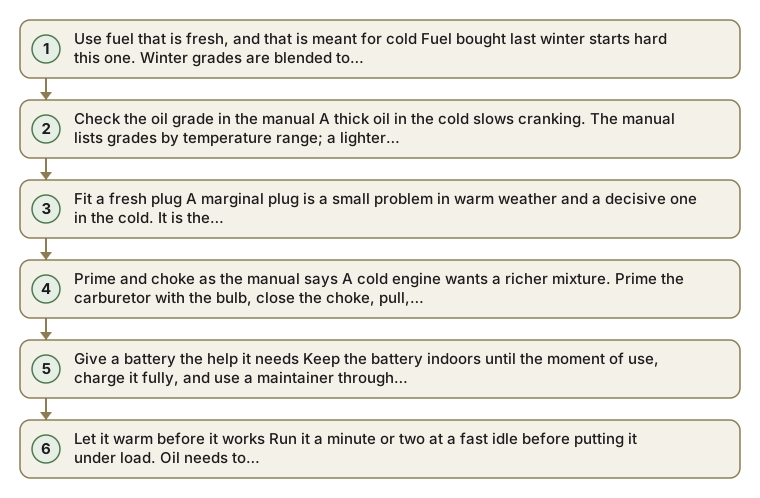
Use fuel that is fresh, and that is meant for cold
Fuel bought last winter starts hard this one. Winter grades are blended to vaporise more easily; stale fuel has lost the light fractions that do the job. See fuel and stabilizer.
-
Check the oil grade in the manual
A thick oil in the cold slows cranking. The manual lists grades by temperature range; a lighter grade or a synthetic in that range turns over more easily.
-
Fit a fresh plug
A marginal plug is a small problem in warm weather and a decisive one in the cold. It is the cheapest variable to remove before winter.
-
Prime and choke as the manual says
A cold engine wants a richer mixture. Prime the carburetor with the bulb, close the choke, pull, and then open the choke gradually as the engine warms, since an engine left choked floods.
-
Give a battery the help it needs
Keep the battery indoors until the moment of use, charge it fully, and use a maintainer through the winter. A cold, part-charged battery cranks slowly and fails.
-
Let it warm before it works
Run it a minute or two at a fast idle before putting it under load. Oil needs to circulate, and a cold engine that is loaded at once wears faster.
Machine by machine
| Machine | The cold-weather problem | What helps |
|---|---|---|
| Snow blower | Fuel that vaporises poorly, thick oil, a hard pull, and a drive that freezes with ice. | Fresh fuel, the primer bulb, the electric start if fitted, and clearing ice from the drive and auger before starting. |
| Portable generator | Cold fuel, a discharged start battery and thick oil; a carburetor that is dry from last use. | Fresh fuel, the choke, a charged battery, and a run under load monthly. See the generator exercise page. |
| Chainsaw | A cold two-stroke can be hard to start and stall on the first throttle. | A little more choke, a warm-up at fast idle, and a fresh mixture at the right ratio. |
| Ride-on or tractor | A battery that has lost capacity and a thick engine oil, on a starter that draws a lot. | A charged battery, the right grade, and short cranks with rests between them. |
| Pressure washer | Water in the pump can freeze and crack it. | Drain it and do not run it when frozen. Water damage is the cost here, not the start. |
Starting fluid, and why to be careful with it
A spray of ether-based starting fluid gets a cold engine to fire, and it is also a common way to damage one. It burns fast and hard, it strips the oil film from a dry cylinder, and it can crack a plastic intake or ignite in a spark. Many manufacturers warn against it on their small engines.
If a machine will not start in the cold, a fresh plug, fresh fuel and a charged battery fix the cause; the spray only covers it.
Fuel
Fresh, and winter grade
Old fuel is the first thing to fail in the cold.
Charge
A full battery, kept warm
The cold takes a large share of a battery’s capacity.
Warm-up
A minute at fast idle
The oil has to reach the top of the engine before the load does.
Starting a small engine in cold weather: questions
Why is my small engine hard to start in the cold?
Cold makes gasoline vaporise poorly, thickens the oil so the crank is slower, and cuts a battery’s capacity. Together they remove the margin that a marginal plug, stale fuel or a part-charged battery could hide in warm weather. It is not a fault, but it exposes the faults that are already there.
Should I use choke when starting in the cold?
Yes, as the manual describes. A cold engine wants a richer mixture, so prime the carburetor, close the choke, and pull. Then open the choke a little at a time as the engine warms, because an engine left choked floods and runs badly.
What oil should I use in cold weather?
The grade the manual lists for the temperature range. A thick oil slows the crank in the cold, and a lighter grade or a synthetic within the range turns over more easily. Do not go outside the range in the manual, since too thin an oil gives poor protection once warm.
Why does my snow blower not start in freezing weather?
Common causes are old fuel, a marginal plug, a weak battery on an electric start, and ice in the drive. Check the fuel is fresh, prime the carburetor, and clear ice from the auger before the cord is pulled. A machine that starts hard only in the cold usually has one of the first three.
Is starting fluid safe to use on a small engine?
It works, and it is also a common cause of damage. It burns fast, strips the oil film from a dry cylinder, and can crack a plastic intake or ignite from a stray spark. Many manufacturers warn against it on small engines.
Fresh fuel, a new plug and a charged battery fix the cause, so use it last.
How long should I let a cold engine warm up?
About a minute or two at a fast idle before putting it under load. The oil has to circulate to the top of the engine, and a cold engine loaded at once wears faster. In hard cold a little longer is fine, outdoors and with the machine attended.
Can I warm up an engine in the garage?
No. Exhaust contains carbon monoxide, which has no smell and disables a person before they notice. Run any engine outdoors in open air, well away from doors, windows and vents.
Warming a machine indoors, even with the door open, is a common cause of poisoning in cold weather.
Why does my electric-start battery turn over slowly in winter?
Cold cuts a battery’s capacity sharply, and thick oil makes the engine harder to turn, so a battery that was fine in autumn cranks slowly. Keep it charged, indoors until use if you can, and on a maintainer over winter. A battery that fails only in the cold is often near the end of its life.
Does a winter fuel grade matter?
Fuel sold in cold seasons is blended to vaporise more easily, so fuel bought last winter or kept in a can through summer starts harder. The simplest step is fresh fuel in a dated can, bought in the quantity you will use within about a month.
Should I use a block heater or other heater on a small engine?
Only equipment made for the machine and fitted as the maker describes. Some larger engines and generators offer a heater, and it helps in hard cold. Never use an open flame, a heat gun near fuel or a heater aimed at the carburetor, since fuel vapour and heat are a fire risk.
Why does a two-stroke chainsaw stall in the cold?
A cold engine wants a richer mixture and stalls when the throttle opens before it has warmed. Give it a little more choke, a warm-up at fast idle, and a fresh mixture at the right ratio. If it still stalls, a fresh plug and a clean air filter come next.
What can I do in autumn so it starts in winter?
Fit a fresh plug, use fresh fuel or a stabilizer, change the oil to the right grade, and run the machine under load once while the weather is mild. Doing this in October means a problem is found while the shops are open and nothing depends on it.