Autumn equipment changeover: retire summer tools and check winter readiness
Make separate autumn lists for equipment entering storage and equipment needed during winter. Use each model’s actual service dates, condition and manual rather than replacing every plug or changing every oil automatically. Resolve recalls, leaks, damaged controls and missing approved parts before the equipment is needed.
Inventory by the next job
| Equipment state | Record before the deadline |
|---|---|
| Summer tool going away | Storage period, fuel plan, cleaning and due service |
| Snowblower returning | Model/serial, recall status, controls and surface setup |
| Portable generator on standby | Safe placement, load plan, cords and due service |
| Water-carrying equipment | Drain/preservation procedure and storage temperature |
| Battery equipment | Approved pack storage and charging instructions |
For a household with two mowers, one trimmer, one snowblower and one generator, there are five separate records. A shared tune-up receipt does not establish that all five received their different required work.
Protect equipment that will sit
Simpson’s winterization guide addresses moisture remaining in the pump and its specified preservation product. Engine fuel treatment does not remove water from the pump. Read the actual model’s storage-temperature requirement too.
Briggs’ maintenance guidance distinguishes EXi Check & Add engines from engines requiring scheduled oil changes. Do not turn “change every oil before storage” into a universal task. Inspect cutting gear and clean by the machine’s permitted method.
Check winter equipment without improvising a test
Check current recall status. For example, Ariens’ attachment-braking campaign list separates affected unrepaired and repaired serials. An oil change or a start demonstration is not the recall remedy.
Follow the manual’s control checks from the operating position. Do not watch an exposed auger close-up, hold a guard open or operate a dry pressure-washer pump to test it.
Plan approved spare parts from exact model/serial lookup. A spare bolt that resembles a shear pin is not necessarily the protective part the machine requires. Keep findings and completed dates together so an unresolved defect is visible before the first winter use.
The autumn changeover
Autumn is the only point in the year when both halves of the equipment set are in play at once, and that makes a single afternoon in October worth more than any other maintenance session. The cutting machines are finishing and need to be prepared for storage according to their instructions, so winter storage does not leave the next startup with stale fuel or neglected service. The winter machines are about to matter and have not been run for eight months, which is what decides whether the first storm is uneventful.
Doing both together has an advantage that is easy to underrate: the parts shops are open, the weather is mild, and nothing yet depends on the machine you are testing. Almost every failure discovered during the first snowfall was discoverable on that Saturday, for an hour instead of a day.
Why this afternoon is worth more than any other
The autumn changeover is the only point in the year when both halves of the equipment set are in play: the cutting machines are finishing and the winter machines are about to be needed. Doing both jobs in one session has an advantage that is easy to underrate. The parts shops are open, the weather is mild, and nothing yet depends on the machine you are testing.
Every failure that gets discovered during the first snowfall was discoverable on a mild Saturday in October, when discovering it would have cost an hour rather than a day.
Half one: the cutting equipment goes away
-
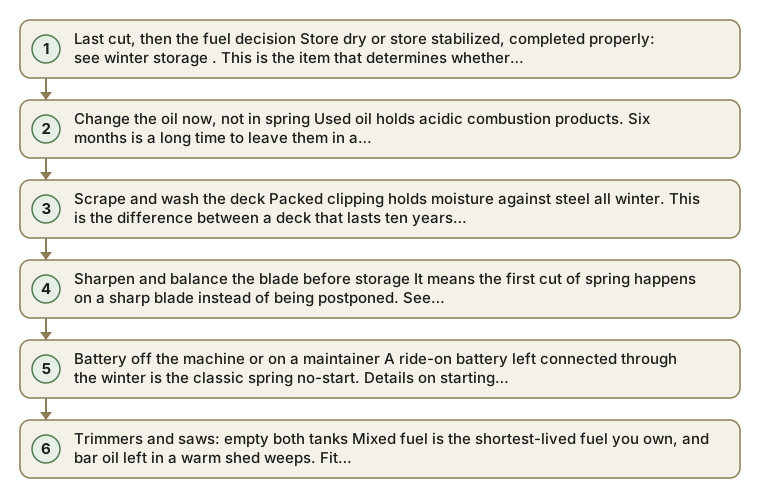
Last cut, then the fuel decision
Store dry or store stabilized, completed according to the storage instructions: see winter storage. This is the item that determines whether spring is uneventful.
-
Change the oil now, not in spring
Used oil holds acidic combustion products. Six months is a long time to leave them in a sump, and the job is the same either way.
-
Scrape and wash the deck
Packed clipping holds moisture against steel all winter. This is the difference between a deck that lasts ten years and one that does not.
-
Sharpen and balance the blade before storage
It means the first cut of spring happens on a sharp blade instead of being postponed. See mower blades.
-
Battery off the machine or on a maintainer
A ride-on battery left connected through the winter is the classic spring no-start. Details on starting batteries.
-
Trimmers and saws: empty both tanks
Mixed fuel is the shortest-lived fuel you own, and bar oil left in a warm shed weeps. Fit the scabbard on the saw.
Half two: the winter equipment gets proved
-
Start the snow blower and run it under load
Not a thirty-second test. Long enough to warm up and hold speed. A machine that stumbles now is a machine you can fix this week.
-
Engage the auger and watch it turn
Check both shear pins are intact and that the auger turns and stops with the control. This is the check that finds a broken pin before the storm rather than during it.
-
Set the skid shoes for your surface
Higher for gravel, lower for concrete. Adjusting them on a warm afternoon is a completely different job from adjusting them in the dark at −8 °C.
-
Fresh spark plug in the winter machines
A marginal plug is a much bigger problem in the cold. This is a cheap variable to eliminate before the season, not during it.
-
Test the generator with a real load in every outlet
Twenty minutes carrying something, with the cords you intend to use. The full method is on bringing a machine out of storage.
-
Freeze-protect anything holding water
The pressure washer pump first. A cracked pump head is the most expensive single consequence of skipping this list.
-
Buy the spares now
Shear pins, a spare belt, a spare plug, a spare shear-pin set for a second machine. The moment you need a shear pin is rarely a moment when a parts counter is open.
Put away
Cutting equipment
- Fuel decision completed
- Oil changed
- Deck scraped
- Blade sharpened and balanced
- Battery on a maintainer
Prove
Winter equipment
- Snow blower run under load
- Auger and shear pins checked
- Skid shoes set
- Fresh plug fitted
- Generator load-tested
Protect
Anything holding water
- Pressure washer pump treated
- Hoses drained and coiled indoors
- Nothing water-filled left unheated
Stock
Before you need them
- Shear pins
- Spare belt
- Spare spark plug
- Fresh stabilized fuel in a dated can
What each omission costs
Every item on the two lists above exists because skipping it has a specific, predictable consequence. These are the ones worth knowing before deciding what to leave out.
| If you skip | What happens | When you find out |
|---|---|---|
| The fuel decision | Varnish in the carburetor’s finest passages. The machine either will not start or will only run choked. | The first warm Saturday in spring, or the first storm. |
| The oil change | Acidic combustion products sit in the sump for six months. | Gradually, as wear. Rarely dramatic and never free. |
| Scraping the deck | Packed clipping holds moisture against steel all winter. | Years later, as a deck that has rusted through. |
| The battery maintainer | A discharged lead-acid battery sulfates and permanently loses capacity. | The first attempt to start in spring. |
| Running the snow blower under load | You test the machine for the first time during a storm. | At 6am, in the dark, with the drive blocked. |
| Freeze-protecting the pressure washer | Water expands in the pump and cracks the head. Usually the end of the machine. | The first hard frost, discovered the following spring. |
| Buying spare shear pins | A five-minute repair becomes a lost day. | A Sunday, with every parts counter closed. |
The one that is easy to skip and expensive to skip
Water left in a pressure washer pump over a freeze cracks the head, and a cracked head is usually the end of the machine. It takes a few minutes and a bottle of pump antifreeze to prevent, and it is the item most often left off an autumn list because the machine has already been put away in September and feels like last season’s problem.
The autumn changeover: questions
What is the most valuable maintenance afternoon of the year?
The autumn changeover, because it is the only point when both halves of the equipment set are in play, the cutting machines finishing and the winter machines about to be needed, and you can do both while the parts shops are open, the weather is mild, and nothing yet depends on the machine you are testing. Almost every first-snowfall failure was discoverable that Saturday, for an hour instead of a day.
What should I do to my snow blower before winter?
Prove it rather than assume it. Start it and run it under load long enough to warm up and hold speed; engage the auger and confirm both shear pins are intact and that it turns and stops with the control; set the skid shoes for your surface, higher for gravel and lower for concrete; fit a fresh spark plug; and buy spare shear pins now, because the moment you need one is rarely a moment a parts counter is open.
Should I change the oil before winter storage or in spring?
Before storage. Used oil carries acidic combustion products, and leaving them in the sump for six months is the avoidable part. The job is the same either way, so doing it in autumn keeps those acids from sitting in the engine all winter.
It also means the machine is ready to run in spring instead of the oil change being a job you discover on the first warm Saturday of the year.
What does skipping each autumn task cost?
Each omission has a predictable consequence: skip the fuel decision and get varnish and a no-start; skip the battery maintainer and get a sulfated battery that fails in spring; skip scraping the deck and get rust years later; skip running the snow blower and end up testing it for the first time during a storm; and skip freeze-protecting the pressure washer and crack the pump head, which usually ends the machine.
Why is buying spare parts like shear pins part of an autumn task list rather than something to buy when needed?
Because the moment a shear pin or belt fails is rarely a moment when a parts counter is open: it tends to happen mid-storm or mid-job. Buying spares during the calm autumn changeover, while shops are open and nothing is urgent, turns a potential lost day into a five-minute repair when the part fails.
Should I check both shear pins on a two-stage snow blower, or is one enough to test?
Check both: a two-stage machine typically has a shear pin (or set) on each side of the auger shaft, and confirming both are intact and the auger turns and stops correctly with the control is the full check. Testing only one side can miss a break on the other, which then surfaces as a failure during the season's first real use.
Does the autumn changeover apply to equipment that doesn't use gasoline, like electric or battery tools?
Partially: the fuel-related half of this changeover (the storage decision, running fuel through a carburetor) doesn't apply to electric or battery equipment, but general care items like cleaning, blade sharpening on electric mowers, and battery maintenance for cordless tools still benefit from the same seasonal attention the guide describes for gas equipment.
What is the single most expensive item on the autumn checklist to skip?
Freeze-protecting the pressure washer pump: water left in the pump over a hard freeze expands and cracks the head, which usually ends the machine entirely rather than causing a repairable fault. It is also the item most often skipped, since the machine typically feels like it was already dealt with when it was put away months earlier.
Should trimmers and saws be stored with a full tank of stabilized fuel, or emptied completely?
Emptied completely, per the guide's guidance: mixed two-stroke fuel is the shortest-lived fuel on the whole site, degrading faster than plain gasoline, so emptying both the fuel tank and the bar-oil tank is the recommended approach for these specific handheld tools rather than the stabilized-fuel method that suits a generator or another machine needed at short notice.
What is the risk of buying spare parts too far in advance, rather than during the autumn changeover specifically?
There is little practical risk to buying earlier, but autumn is the natural moment the guide recommends because it coincides with inspecting the machines that reveal which spares are worth having on hand. A shear pin, belt, or plug bought while checking the actual machine that will need it is a more informed purchase than one made speculatively at any other time of year.