Restart equipment after storage: inspect before starting and testing
Inspect stored equipment before attempting a start. Confirm model identity, recall status, fluid and fuel condition, working attachments and required controls.
Follow its own restart procedure and stop for leaks, recoil kickback or a locked mechanism. Repeated pulling or starting spray does not resolve an unidentified fault.
Inspect the stored machine’s condition
Honda’s engine storage guidance covers fuel, oil, battery and return-to-use steps for its stated engine families. Check for obstruction or damage in accessible cooling and intake areas with power isolated. Do not start with a removed filter or guard to bypass an inspection.
| Check | Decision |
|---|---|
| Recall and safety defect | Complete required remedy before use |
| Fuel and fluids | Use applicable condition / level instructions |
| Cooling and intake | Clear permitted areas and refit required parts |
| Blade, chain, auger or accessory | Inspect with all starting power isolated |
| Controls and drive | Use actual operator-manual checks |
Keep axle pressure and plug care model-specific
The cited TimeCutter manual gives 13 PSI at the rear tires and a separate caster instruction. A spring checklist telling you to equalize all four would be wrong for that setup. Use the prescribed cold pressures before evaluating deck level.
The 20370-series Recycler manual calls for its own blade-stop check and engine service. A generic instruction to wire-brush and refit every old plug can conflict with another manual’s replacement-only directions.
A generator needs more than an engine start
For an example generator supplying a 700-watt appliance, an unloaded start establishes no evidence that the outlet can support that700-watt demand. Use approved loads and the manual’s test procedure, within outlet and cord limits.
CPSC’s outdoor 20-foot and exhaust guidance applies during testing too. Do not test in a garage, connect building wiring through an outlet, or improvise a 240-volt load.
For installed transfer equipment, use the installer’s procedure or qualified service. Record the result and any unresolved fault. A machine that runs for one short demonstration may still need further checks before prolonged use.
Bringing a machine out of storage
The order of these checks matters more than the checks themselves, because each one is designed to find a problem while it is still cheap and to avoid the specific mistake that makes everything harder: pulling repeatedly at a machine that cannot start, which floods the engine, wets the plug, and turns one fault into two. So: establish what is in the tank and drain it if you cannot vouch for it, check the oil on level ground before anything turns, physically remove the air filter and look for a mouse nest, fit or clean the plug, inspect the cutting equipment, equalize the tire pressures, and only then start it. If it has not fired within three or four attempts, stop and diagnose rather than continuing.
Spark plug lead off before you touch a blade, an auger or a chain, including for the checks below that look harmless. On a ride-on, take the key out as well.
Before the first pull
The order matters. Every step below is designed to find a problem while it is still cheap, and to avoid the specific mistake of pulling repeatedly on a machine that cannot start, which floods it, fouls the plug and turns a fuel problem into two problems.
-
1. Decide what is in the tank, and get rid of it if it is old
If you cannot say with confidence that the fuel is from this season, drain it. Topping up old fuel dilutes it; it does not fix it. Use a local fuel-waste collection route; keep the old fuel out of drains.
-
2. Check the oil on level ground before anything else
Low oil on a four-stroke is the one thing that turns a good machine into scrap in a few minutes, and some engines will not fire at all with a low-oil shutdown active. If it was not changed before storage, change it now.
-
3. Look at the air filter, and take it out
Sheds contain mice. A nest in an air box is common, and so is a nest in the recoil housing or under the shroud. A cursory look through the intake does not find either.
-
4. Fit a fresh spark plug, or clean and gap the old one
A plug is the cheapest way to remove a variable, and reading the old one tells you how the machine was running when it was put away. See reading a used spark plug.
-
5. Check the cutting or working equipment
Blade condition and balance on a mower; chain, bar and oiler on a saw; shear pins and skid shoes on a snow blower; nozzle and inlet screen on a pressure washer. Doing this before start-up means the first job is not interrupted.
-
6. Tires, cables and controls
Equalize tire pressures: unequal pressure tilts a deck and is the first cause to eliminate for an uneven cut. Work every control and check the operator-presence controls stop what they are supposed to stop.
-
7. Now start it, with fresh fuel
If it does not start within a few pulls, stop pulling and go to the no-start sequence. Repeated pulling on a machine that will not fire only floods it.
Testing a generator under its intended load
Starting a generator proves the engine runs. It does not prove the machine will do its job, and the difference matters on the night you need it.
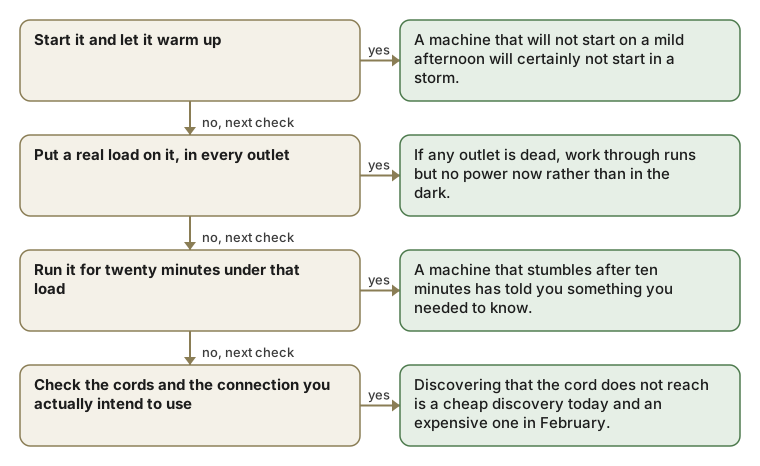
Start it and let it warm up
Outdoors, away from the building: the placement rules apply to a test exactly as they do to real use. See carbon monoxide.
If that is it: A machine that will not start on a mild afternoon will certainly not start in a storm.
Put a real load on it, in every outlet
A heater or a work light in each socket in turn, including the 240 V outlet if you have a suitable load. This is what catches a tripped breaker, a dead outlet and a machine that has lost residual magnetism.
If that is it: If any outlet is dead, work through runs but no power now rather than in the dark.
Run it for twenty minutes under that load
Long enough to reach temperature, to prove it holds speed, and to burn through some of the fuel that would otherwise be sitting still.
If that is it: A machine that stumbles after ten minutes has told you something you needed to know.
Check the cords and the connection you intend to use
Plug in the cords you will use, and confirm they reach and are the right gauge for the load: the cord calculator settles that. If you have an interlock or transfer switch, exercise it.
If that is it: Discovering that the cord does not reach is a cheap discovery today and an expensive one in February.
The two mistakes people make in spring
| Mistake | What it costs |
|---|---|
| Pulling twenty times on a machine that will not fire | It floods the engine, wets the plug and adds a second fault on top of the first. Three or four attempts is the point to stop and diagnose. |
| Spraying carburetor cleaner into the throat and calling it done | The passages that block on a stored machine are internal, the idle circuit, the emulsion tube holes, the pilot jet, and nothing sprayed through the throat reaches them. It provides a few minutes of running and a false conclusion. |
Bringing a machine out of storage: questions
What should I check before starting a mower after winter?
Work in order so problems surface while they are cheap: establish what is in the tank and drain it if you cannot vouch for it; check the oil on level ground before anything turns; physically remove the air filter and look for a mouse nest; fit or clean the spark plug; inspect the cutting equipment; equalize the tire pressures; and only then start it, with fresh fuel and the operator-presence controls confirmed working.
Why should I not keep pulling the cord if it will not start?
Because repeated pulling on a machine that cannot fire floods the engine, wets the plug, and turns one fault into two. Three or four attempts is the point to stop and work the no-start sequence instead. It is one of the two classic spring mistakes; the other is spraying carburetor cleaner into the throat, which never reaches the internal idle passages that block on a stored machine.
How do I test a generator so I know it will work in an outage?
Starting it only proves the engine runs. Load-test it: start and warm it outdoors away from the building, put a real load in every outlet in turn including the 240-volt one, run it twenty minutes under that load to prove it holds speed, and check that the cords and any interlock or transfer switch you intend to use reach and function. A dead outlet or a short cord is cheap to find today and expensive in February.
Why does spraying carburetor cleaner in the throat not fix it?
Because the passages that block on a stored engine are internal, the idle circuit, the emulsion-tube holes, the pilot jet, and nothing sprayed through the throat reaches them. It buys a few minutes of running on the raw fuel it wets, and a false conclusion that the machine is fixed, after which it dies again the moment it has to run on the idle circuit rather than on choke.
Why check for a mouse nest in the air filter box before starting a stored machine?
Because sheds commonly harbor mice, and a nest built in an air box, the recoil housing, or under the shroud can block airflow or interfere with moving parts in ways that a quick visual glance through the intake will not reveal. Physically removing the air filter to check is the only reliable way to catch this before starting the engine.
What should I check on a chainsaw specifically before its first use of the season?
The chain, bar and oiler: confirm the oiler is feeding oil to the bar and chain (run it briefly over a light surface and look for a thrown oil line), check chain tension and sharpness, and inspect the bar for a worn or pinched groove, since a saw that sat all winter with dried bar oil in the oiler passage can start dry even though the bottle is full.
What should I check on a pressure washer before its first use of the season?
The nozzle and the inlet screen: a nozzle can be a residual worn or wrong size from a task done the previous season, and an inlet screen can have accumulated debris over winter that restricts water flow to the pump even before the pump itself is tested. Checking both before starting avoids diagnosing a pump problem that's a supply-side restriction.
Which mower safety controls need testing at spring startup?
Yes: the spring startup sequence explicitly includes working every control and confirming operator-presence controls stop what they're supposed to stop, since these safety systems can develop the same kind of seized-linkage or corrosion issues as any other mechanical part after months of inactivity, and a control that doesn't function defeats its entire purpose.
Can I skip the systematic startup sequence if the machine started fine last fall?
No: the whole point of the sequence is that a machine sitting idle for months develops issues (stale fuel, a mouse nest, a discharged battery, dried bar oil) regardless of how well it ran when it was put away. Starting fine in autumn says nothing about its condition after a full off-season of inactivity.