Generator runs without usable power: check indicators and outlet limits
Disconnect loads safely and read the generator’s output, overload and other warning indications. Follow its prescribed reset and test procedure.
An engine running does not prove correct electrical output, and a failed appliance test does not identify an alternator fault. Stop for damaged cords, burning smell, wet electrical parts or repeated protection trips.
Three observations require different tests
| Observation | Next evidence |
|---|---|
| No usable output at any outlet | Manual indicators and approved outlet checks |
| One load will not start | Actual load, starting demand, cord and outlet limits |
| Protection trips repeatedly | Fault or overload investigation; keep protection functional |
| Engine slows under demand | Load and engine operation as well as electrical tests |
The Honda EU2200i manual distinguishes output and overload indications and gives rated output separately from maximum output. Those procedures apply to the stated model; they do not establish a reset sequence for a conventional alternator or every inverter generator.
Stay within the smallest applicable limit
For example, 1,800 watts at 120 volts is 15 amps for a unity-power-factor load. A 2,000-watt headline does not give a 15-amp outlet, cord or appliance permission to carry more than its rating. Motor starting can also require more apparent power than steady operation.
Use generator sizing and cord voltage drop to examine those inputs. Neither calculation replaces an electrical fault test.
Leave internal energization to qualified service
Do not open a running generator, perform improvised field flashing or use a drill or building supply to energize its outlet. Designs differ and stored electrical energy can remain after shutdown. A lack of output does not uniquely prove lost residual magnetism or a bad regulator.
CPSC’s outdoor 20-foot placement guidance applies to testing too. Building connection requires suitable transfer equipment and qualified installation; a test must never backfeed wiring. A GFCI trip requires investigation, not a move to an unprotected outlet.
TS-04 · Troubleshooting
Generator runs but produces no power
When the engine runs normally and nothing comes out of the sockets, the fault is electrical and downstream of the engine, which is a much smaller problem than it feels like. Three of the five candidates cost nothing to check: a tripped breaker, which on many machines is a push-button that is hard to see; an outlet that is dead by design because of where the 120/240 V selector is set; and an inverter unit reporting an overload or low-oil condition with a light rather than a noise. The fourth is lost residual magnetism, which makes an older conventional generator run perfectly and produce nothing at every outlet.
The fifth, a failed regulator or winding, is a technician’s job with a meter.
Stop and use a qualified electrician when the next check requires electrical work you cannot perform safely. Never open the alternator housing or the control panel of a running generator.
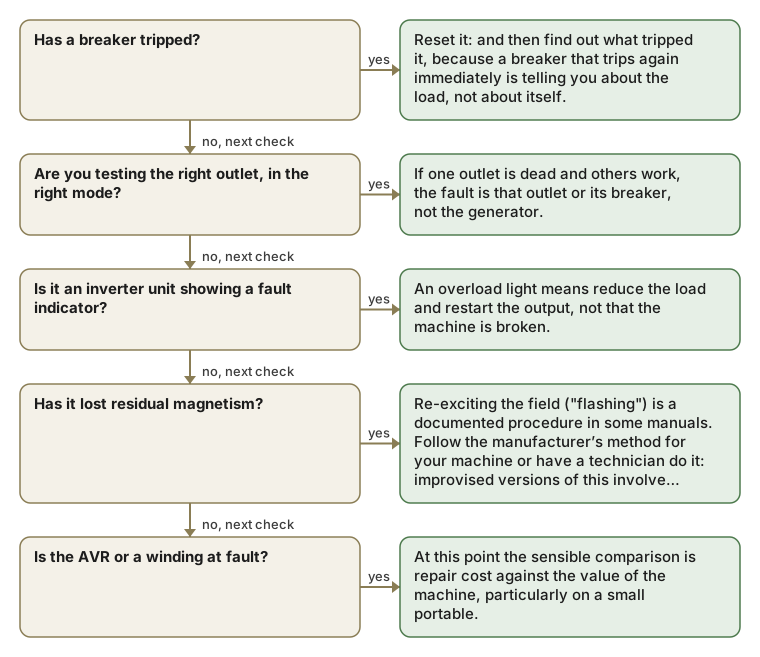
The engine is fine, so this is an electrical fault
A generator that runs normally and produces nothing has an electrical fault downstream of the engine. That is a smaller problem space than it feels like, and the first three checks cost nothing.
1. Has a breaker tripped?
Portable generators have circuit breakers, sometimes one per outlet, and they are frequently push-button rather than switch style, which makes a tripped one hard to see. Press every one. Some machines also have a main breaker separate from the outlet breakers.
If that is it: Reset it: and then find out what tripped it, because a breaker that trips again immediately is telling you about the load, not about itself.
2. Are you testing the right outlet, in the right mode?
Many generators have a selector that switches between 120 V only and 120/240 V, and in one position some outlets are dead by design. Test a known-good load, a lamp, not a sensitive appliance, in each outlet in turn.
If that is it: If one outlet is dead and others work, the fault is that outlet or its breaker, not the generator.
3. Is it an inverter unit showing a fault indicator?
Inverter generators shut their output down for overload, overheat and low oil, and they report it with a light rather than a bang. Read the panel and the manual’s legend before assuming a failure.
If that is it: An overload light means reduce the load and restart the output, not that the machine is broken.
4. Has it lost residual magnetism?
A brushed conventional generator relies on a small residual magnetic field in the rotor to begin generating. A machine stored for a very long time, or one that was run with an overload, can lose it, and then runs perfectly while producing nothing at every outlet. This is the classic "runs but makes no power" fault on older conventional units.
If that is it: Re-exciting the field ("flashing") is a documented procedure in some manuals. Follow the manufacturer’s method for your machine or have a technician do it: improvised versions of this involve mains voltage and get people hurt.
5. Is the AVR or a winding at fault?
If every outlet is dead, the breakers are good, and the machine has not lost residual magnetism, the automatic voltage regulator, the brushes on a brushed machine, or a winding is the remaining candidate. That is a technician’s diagnosis with a meter.
If that is it: At this point the sensible comparison is repair cost against the value of the machine, particularly on a small portable.
Two symptoms that are not "no power"
| Symptom | What it usually means |
|---|---|
| Voltage is present but low, and lights dim or flicker | Engine speed is low, a governor or fueling problem, because output frequency and voltage follow engine speed on a conventional machine. Fix the engine, not the alternator. |
| Output collapses only when a large motor starts | The machine is undersized for the starting surge rather than faulty. Work it out on the sizing calculator. |
| Output is fine at the generator, absent at the appliance | The cord. A long, thin cord drops enough voltage to stall a motor. See the cord gauge calculator. |
| A GFCI outlet trips repeatedly | Moisture in a cord or connector, or a genuine leakage fault in the appliance. It is doing its job; find the wet connector rather than moving to another outlet. |
The check nobody does before an outage
A generator that has sat in a shed for a year should be started and loaded, not just started, before the storm. Running it with a real load for twenty minutes exercises the alternator, confirms the outlets, and burns off some of the fuel that would otherwise be varnishing the carburetor.
It is the same principle as a standby generator's exercise cycle, done by hand. See bringing a machine out of storage.
- National Electrical Code, Chapter 9, Table 8: Conductor Properties (DC resistance at 75 °C) : National Fire Protection Association, NFPA 70, Chapter 9, Table 8.
Generator runs but produces no power: questions
My generator runs but produces no power. Where do I start?
With the three checks that cost nothing. Press every circuit breaker, including any main and the per-outlet push-button ones that are hard to see. Confirm you are testing a live outlet with a known-good load like a lamp, since a 120/240-volt selector can leave some outlets dead by design.
And on an inverter unit, read the panel for an overload or low-oil light, which reports a fault with a light rather than a noise.
What is lost residual magnetism on a generator?
A brushed conventional generator needs a small residual magnetic field in the rotor to begin generating, and a machine stored a very long time or run into an overload can lose it. After which it runs perfectly while producing nothing at every outlet. It is the classic "runs but makes no power" fault on older conventional units.
Re-exciting the field is a documented procedure in some manuals; follow the maker’s method or use a technician.
Why does my generator output drop when a big appliance starts?
Because the machine is undersized for that motor’s starting surge rather than faulty. The surge can be several times the running draw for a moment. Work it out on the sizing calculator: you may need a larger generator or to start fewer things at once.
This is a sizing answer, not a repair, and it differs from a genuine no-output fault where every outlet is dead all the time.
There is power at the generator but none at my appliance: why?
The cord. A long, thin extension cord drops enough voltage under load to stall a motor while the generator itself is fine, so check the cord gauge and length against the load with the cord calculator before suspecting the machine. A GFCI outlet tripping repeatedly is a separate story, usually moisture in a connector or a real leakage fault, and it is doing its job.
What is residual magnetism, and how do I know if my generator has lost it?
A brushed conventional generator needs a small residual magnetic field remaining in the rotor to start generating voltage when the engine spins it: a machine that has lost this field runs perfectly (the engine performs normally) but produces zero output at every single outlet, all the time, which is the specific pattern that distinguishes lost residual magnetism from a wiring or breaker fault affecting only some outlets.
Does an inverter generator ever lose residual magnetism the way a conventional generator does?
No: inverter generators use a different electronic architecture (rectifying to DC and synthesizing AC) rather than depending on a brushed rotor's residual magnetic field, so this specific failure mode is particular to conventional (non-inverter) generators and isn't a fault to check for on an inverter unit showing no output.
Should I check the breakers before or after testing a known-good load at the outlet?
Check breakers first, since it costs nothing and takes seconds: press every breaker firmly, including a main breaker and any per-outlet push-button breakers that are easy to overlook. Only after confirming breakers are set should you move to testing with a known-good load, since a tripped breaker is by far the cheapest and most common explanation for no output.
How does a generator’s 120/240 V selector affect the outlets?
Some dual-voltage generators use a selector that routes the machine's output to either a set of 120-volt outlets or a 240-volt configuration, but not both simultaneously: an outlet that appears dead while the selector is set to the other voltage mode is working exactly as designed, not malfunctioning, which is why confirming the selector position is part of the guide's cheap-first checks.
What does an overload or low-oil light on an inverter generator's panel tell you?
It reports a specific fault condition through a visual indicator rather than through unusual noise or behavior: an overload light means the connected load exceeded the generator's capacity and it shut down protectively, while a low-oil light means the oil-level safety switch cut ignition before the engine could run without adequate lubrication. Reading the panel is a fast, cheap check before assuming a deeper electrical fault.
Is a repeatedly tripping GFCI outlet on a generator a sign the generator itself is faulty?
Not usually: a GFCI trips in response to a detected ground-fault leakage, most often caused by moisture in a connector, a damaged cord, or a faulty connected appliance, and it's functioning correctly by tripping rather than malfunctioning. Check the cords and connected equipment for moisture or damage before suspecting the generator's own GFCI circuitry.
Does running a generator at altitude reduce its output enough to explain a "no power" symptom?
Altitude reduces engine power output due to lower air density, which can reduce a generator's maximum output somewhat, but this typically shows up as reduced capacity under heavy load rather than a complete absence of power at every outlet: a true zero-output-everywhere symptom points more strongly at residual magnetism, a tripped breaker, or a wiring fault than at an altitude effect.
Can a generator's output be fine but a connected transfer switch or interlock be the actual fault?
Yes: if the generator tests fine on its own panel outlets but a house circuit connected through a transfer switch or interlock shows no power, the fault may be in that switching hardware or its wiring rather than in the generator itself, which is a separate diagnosis from the generator-side checks the guide covers and may need an electrician's involvement.