Battery tool loses power or will not charge: read the exact warning
Read the exact pack, charger and tool warning before replacing anything. Verify approved compatibility, seating, supply and temperature instructions.
Stop using damaged, swollen, leaking, unusually hot or smoking equipment. Do not jump-start a tool battery, open the pack or bypass its protection circuitry.
A red light has a model-specific meaning
EGO’s solid-red charger guidance describes a temperature-related charging delay and what to do after the pack returns to its normal range. A red light on a different charger or pack may mean something else. Use the legend for the actual unit.
EGO’s protection guidance gives a 70°C shutdown threshold and 67°C return point for the described battery protection behavior. The difference is 3°C. Those are internal protection values, not target temperatures for charging or permission to heat a pack.
What a compatible swap establishes
| Result | Limit |
|---|---|
| Second pack operates normally | Narrows the issue; first pack, contact or temperature still needs evaluation |
| Both packs show the same problem | Tool, charger, load and conditions remain candidates |
| Problem follows one charger | Check approved supply and charger instructions |
| Pack is damaged or abnormal | Stop; do not continue comparison tests |
A successful swap is useful evidence, not a guarantee that the tool is fault-free under every load. Compare only manufacturer-approved packs in safe condition. An empty charger with no light may also have a different standby behavior from one containing a pack.
Do not force a recovery
A charger’s protection stop is not a reason to connect another battery with wires or a mismatched charger. Let temperature normalize by the manufacturer’s method, without a heater, freezer or immersion. Obtain service if the specified steps do not restore normal behavior.
For smoke, fire or an immediate hazard, move people clear and call emergency services; do not carry a burning pack through a building. For a working but shorter-runtime battery, use the separate replacement decision instead of treating ordinary runtime loss as a confirmed electrical fault.
TS-11 · Troubleshooting
Battery tool loses power or will not charge
A disappointing cordless tool is usually the pack, and there are several distinct ways a pack fails, each with its own tell. A pack that will not charge at all may have locked itself out after sitting fully discharged for months, a real failure mode rather than a "just needs longer" situation. A pack that loses most of its charge while unused needs evaluation for an internal fault.
A pack that only weakens under heavy load while running fine on light work is showing rising internal resistance, the classic sign of age. Cold can temporarily reduce usable lithium-battery capacity even when the pack is healthy. The single test that resolves an argument between "bad pack" and "bad tool" is swapping in a known-good pack from the same platform.
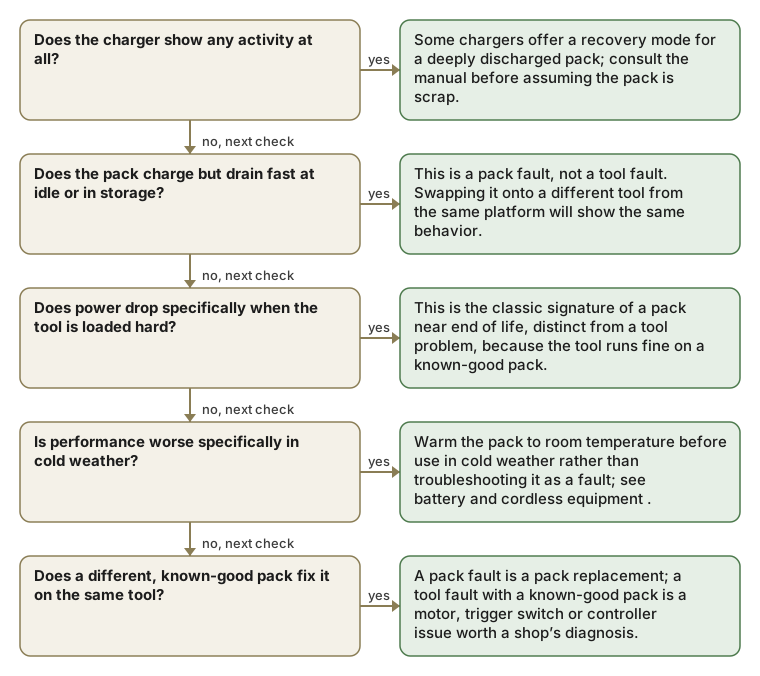
Three separate complaints get reported as "the battery is bad"
A cordless tool that disappoints is usually one of three distinct faults: the pack will not take a charge at all, the tool loses power well before the runtime the platform is capable of, or the tool cuts out under load specifically rather than at idle. Each points somewhere different.
1. Does the charger show any activity at all?
No light, or an immediate fault indicator, with a pack that has sat discharged for a long time can mean the pack’s protection circuit has locked it out below a minimum voltage: a real failure mode for a pack left at zero charge for months, not just a "needs longer" situation.
If that is it: Some chargers offer a recovery mode for a deeply discharged pack; consult the manual before assuming the pack is scrap.
2. Does the pack charge but drain fast at idle or in storage?
All lithium packs self-discharge slowly even unused, but a pack that goes from full to empty sitting on a shelf over a week or two has a cell imbalance or a parasitic drain in the pack’s electronics, a problem that needs diagnosis.
If that is it: This is a pack fault, not a tool fault. Swapping it onto a different tool from the same platform will show the same behavior.
3. Does power drop specifically when the tool is loaded hard?
A pack’s internal resistance rises as it ages and as its temperature rises, and under heavy load that shows up as the tool bogging or the pack’s thermal cutout tripping , while the same pack runs a light job on the same charge without issue.
If that is it: This is the classic signature of a pack near end of life, distinct from a tool problem, because the tool runs fine on a known-good pack.
4. Is performance worse specifically in cold weather?
Lithium chemistry delivers less usable capacity as temperature drops: this is expected behavior of the chemistry, not a fault, and it affects every pack on every platform to some degree.
If that is it: Warm the pack to room temperature before use in cold weather rather than troubleshooting it as a fault; see Battery energy and approved tool fit.
5. Does a different, known-good pack fix it on the same tool?
This is the single test that separates a pack fault from a tool fault definitively. If a borrowed pack from the same platform performs normally, the problem was never the tool.
If that is it: A pack fault is a pack replacement; a tool fault with a known-good pack is a motor, trigger switch or controller issue worth a shop’s diagnosis.
A pack that is hot to the touch after charging, swollen, or that smells sharp and chemical should be taken outside, away from anything combustible, and not charged or used again. Treat it as damaged rather than testing it further.
Battery charging: pack symptoms and fault checks
| Symptom | Cause | Fix |
|---|---|---|
| Charger shows no activity, or an immediate fault light | The pack's protection circuit locked itself out after sitting fully discharged | Check the manual for a recovery-mode charge before assuming the pack is scrap. |
| Charges fine but drains fast at idle or in storage | A cell imbalance or parasitic drain inside the pack electronics | This is a pack fault: replace it; the behavior follows the pack, not the tool. |
| Power drops specifically under heavy load | Rising internal resistance or a thermal cutout as the pack ages | The classic sign of a pack near end of life: replace it. |
| Noticeably weaker performance in cold weather | Normal lithium chemistry behavior, not a fault | Warm the pack to room temperature before use. |
| Tool underperforms on this pack but runs fine on a known-good one | Confirms the pack, not the tool, is at fault | Replace the pack; have the tool looked at only if a good pack does not fix it. |
| Pack is hot, swollen, or smells sharp and chemical | Damaged cell: a fire risk | Take it outside away from combustibles. Do not charge or use it again. |
- Secondary Cells and Batteries Containing Alkaline or Other Non-Acid Electrolytes: Safety Requirements for Portable Sealed Secondary Cells : UL Standards & Engagement / IEC, UL 62133-2 (harmonized with IEC 62133-2, lithium systems).
Battery tool loses power or will not charge: questions
Why will my battery pack not charge at all?
A pack left fully discharged for a long time can trip its own protection circuit and lock itself out below a minimum voltage: a real failure mode, not simply "needs longer on the charger." Some chargers offer a recovery mode for this; check the manual before assuming the pack is scrap.
How do I know if it is the battery or the tool?
Swap in a known-good pack from the same platform on the same tool. If the borrowed pack performs normally, the problem was never the tool. It was the original pack.
This single test resolves the argument faster than diagnosing either component in isolation.
Why does my battery tool lose power only under heavy load?
A pack’s internal resistance rises as it ages, and under heavy load that shows up as the tool bogging or the pack’s thermal cutout tripping, while the same pack runs a light job on the same charge without issue. This is the classic signature of a pack near the end of its life.
Why does a lithium battery lose usable runtime in cold weather?
This is expected chemistry behavior, not a fault: lithium cells deliver less usable capacity as temperature drops, and it affects every pack on every platform to some degree. Warming the pack to room temperature before use in cold weather restores most of the lost capacity, rather than needing any repair or replacement.
What should I do if a battery pack feels hot, looks swollen, or smells sharp and chemical?
Take it outside immediately, away from anything combustible, and do not charge or use it again. This is a genuine fire risk from a damaged cell, and the correct response is to treat it as compromised rather than continuing to test or troubleshoot it further.
Does a pack that has locked itself out from deep discharge always need to be replaced?
Not necessarily: some chargers offer a recovery mode specifically for a pack that has sat fully discharged long enough to trip its own protection circuit, so checking the charger's manual for that feature is worth doing before assuming the pack is permanently unusable.
Is a pack that drains quickly in storage the same fault as one that drains quickly during use?
No: a pack draining fast while simply sitting in storage points at a cell imbalance or a parasitic drain inside the pack's own electronics, a genuine internal fault. A pack that drains normally in storage but loses charge quickly during actual use is more consistent with reduced capacity from age or heavy-load stress, a different failure mode with a different underlying cause.
Can a faulty charger cause symptoms that look like a bad battery pack?
Yes: a charger that fails to deliver a full or correctly regulated charge can leave a pack appearing weak or unable to hold charge even when the pack itself is healthy, which is part of why swapping in a known-good pack on the same charger and tool is a more complete diagnostic than assuming the pack alone is always the variable at fault.
Does every tool on the same battery platform share the same pack degradation pattern?
The pack itself degrades independently of which tool it's used in, since the degradation (cell aging, capacity fade, rising internal resistance) happens within the pack's own cells regardless of the connected tool: a degraded pack will show reduced performance on every tool on that platform, not just the one it seemed to fail on first.
Should I try to repair a swollen or damaged battery pack myself?
No: a swollen, damaged, or otherwise compromised lithium pack is a genuine fire hazard, and attempting to open, repair, or continue using it risks a fire that a professional disposal or replacement avoids entirely. Treat it as scrap for proper battery recycling, not as a repair project.
Why does the manual recommend a specific charger rather than any charger of the same voltage?
Because a battery management system communicates with its matched charger through proprietary contacts and protocols specific to that platform, and a mismatched or generic charger may not correctly regulate charge current or voltage for that specific pack chemistry: using an unmatched charger risks both poor charging performance and a genuine safety issue.
Does a battery tool's trigger switch or motor ever fail in a way that mimics a pack problem?
Yes: a worn trigger switch with intermittent contact, or a motor with a developing internal fault, can produce symptoms (hesitation, reduced power, cutting out) that resemble a failing pack, which is exactly why the known-good-pack swap test is the decisive check: if a borrowed pack fixes it, the tool's own switch and motor are cleared, and if it doesn't, the tool itself needs attention.