When to replace a working tool battery: compare repeatable runtime
Replace a working battery when its verified usable runtime no longer meets the job and a supported replacement makes economic sense. Compare repeated runs under similar load and temperature. Calendar age, charge bars and an unrecorded cycle count cannot predict a remaining service life by themselves.
Keep storage discharge out of the wear calculation
EGO’s BA2242T page describes automatic discharge after 30 days to about 30 percent for storage. A pack showing less charge after sitting can therefore be behaving as designed. Use its actual instructions instead of treating every storage decline as failed cells.
EGO’s indicator guide also distinguishes charge level and working-condition signals. Read the indicator for the exact pack revision; its bars are not a laboratory capacity measurement.
| Keep comparable | Record separately |
|---|---|
| Same tool, attachment and mode | Task and completed work |
| Similar material and load | Runtime to the same approved endpoint |
| Permitted pack temperature | Warnings or unexpected shutdowns |
| Correct full-charge procedure | Pack identity and test date |
A measured decline can guide the purchase
If comparable runs used to complete 30 minutes and now complete 24, the observed runtime is 80 percent of the earlier result: 24 ÷ 30. That is a 20-percent reduction in this task, not proof that every cell has lost exactly 20 percent capacity.
If the job takes 20 minutes, that observed 24-minute runtime may still meet it. A 28-minute job no longer fits the same single-pack session. Compare an approved second pack, replacement pack or different tool setup using current local offers.
Price the supported configuration
A bare tool price may omit the pack and charger. Include those items and confirm compatibility across the tools you own. A more expensive pack with greater stated energy is not automatically permitted in every older tool.
Stop use for damage or abnormal behavior rather than running a capacity experiment. The separate charging and power-fault guide handles active faults. Follow manufacturer storage and recycling instructions; do not open a pack or attempt cell replacement at home.
TS-20 · Troubleshooting
Battery pack lifespan, and when to replace it
This is a different question from a pack that is actively misbehaving, which is covered on the battery-tool-loses-power page. This one is about a pack working normally but aging, and when replacing it is the better call. A lithium pack fades with charge cycles more than with calendar time, so a pack used hard for two years can be more worn than one used occasionally for five.
The fade itself is gradual rather than sudden: shorter runtime under heavy load first, then at idle as it progresses. Because a replacement pack costs a fraction of a new tool, and benefits every tool on the same platform, not just one, this is usually one of the more straightforward repair-or-replace calls on the whole site.
A different question from "why is my pack acting up"
Battery tool loses power or will not charge covers a pack that is misbehaving right now: won't charge, drains fast, weakens under load. This page answers a different, ownership-shaped question: for a pack that is working normally, roughly how long should it last, and when does replacing it make more sense than continuing to use it.
Charge cycles, not calendar time, is what ages a pack
A lithium pack's capacity fades with use: specifically with charge cycles, where one full cycle is one complete discharge-and-recharge regardless of whether it happened in one session or several partial ones added together. UL 62133, the safety standard covering these packs, tests and rates them against defined cycle counts as part of qualifying the cell chemistry, which is why a pack used hard every week for two years can be more worn than one used occasionally for five. Cycle count, not age on the shelf, is the better predictor of remaining capacity.
What capacity fade feels like in use
It does not show up as a sudden failure: that pattern points at a fault, covered on the page linked above. Normal fade is gradual: the same job that used to leave a comfortable reserve on the charge indicator now finishes closer to empty, the tool's runtime on a full charge is noticeably shorter than it was in the first year, and the effect is more pronounced under heavy load than at idle, because a fading pack's rising internal resistance matters more the harder it is asked to work.
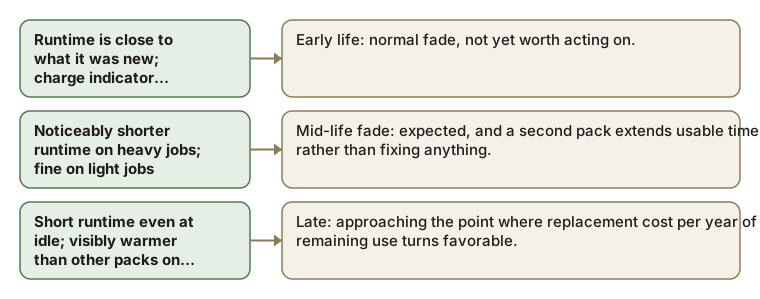
| What you notice | Roughly where the pack is |
|---|---|
| Runtime is close to what it was new; charge indicator behaves normally | Early life: normal fade, not yet worth acting on. |
| Noticeably shorter runtime on heavy jobs; fine on light jobs | Mid-life fade: expected, and a second pack extends usable time rather than fixing anything. |
| Short runtime even at idle; visibly warmer than other packs on the same platform during use | Late: approaching the point where replacement cost per year of remaining use turns favorable. |
The economics of replacing one pack
A single replacement pack usually costs a fraction of a new tool, which makes a fading pack on an otherwise good tool one of the more straightforward repair-versus-replace calls on this whole site: see repair or replace old equipment for the general framework. The one factor specific to battery platforms: if you own several tools on the same platform, a new pack benefits all of them, not just the one that prompted the purchase, which tips the economics toward replacing the pack earlier rather than tolerating reduced runtime across every tool that shares it.
What shortens a pack's life, if you want to slow the curve
- Storing a pack fully charged or fully drained for long periods ages it faster than storing it partially charged.
- Heat is the other major factor: a pack left in a hot vehicle or shed degrades faster than one stored at moderate, stable temperature, independent of how much it is used.
- Charging on a manufacturer-matched charger for that platform avoids the over-current and over-voltage conditions that accelerate degradation; see the platform note on gas vs. battery outdoor power equipment for why packs and chargers are not interchangeable across brands.
- Secondary Cells and Batteries Containing Alkaline or Other Non-Acid Electrolytes: Safety Requirements for Portable Sealed Secondary Cells : UL Standards & Engagement / IEC, UL 62133-2 (harmonized with IEC 62133-2, lithium systems).
Battery pack lifespan, and when to replace it: questions
How many charges does a tool battery last?
It is measured in charge cycles rather than a fixed number of years, and packs are qualified against defined cycle counts under UL 62133 as part of their safety testing. A pack used hard every week for two years can be more worn than one used occasionally for five, because cycle count, not calendar time, is the better predictor of remaining capacity.
How do I know if my battery pack is just getting old versus broken?
Gradual fade, shorter runtime on heavy jobs first, then eventually at idle too, is normal aging. A sudden failure, a pack that won’t charge at all, or one that drains rapidly while just sitting unused, is a fault rather than ordinary aging; see battery tool loses power or will not charge for that diagnosis.
Is it cheaper to buy a new battery pack or a new tool?
A replacement pack almost always costs a fraction of a new tool, and if you own other tools on the same platform, a new pack benefits all of them rather than just the one that prompted the purchase, which tips the economics toward replacing the pack sooner rather than tolerating reduced runtime across every tool that shares it.
How should I store battery packs to make them last longer?
Avoid storing a pack fully charged or fully drained for long periods: partial charge ages it more slowly. Keep packs away from heat, such as a hot vehicle or shed, which accelerates degradation independent of how much the pack is used, and always charge on the platform’s own matched charger.
What is a charge cycle, exactly, and how is it different from just plugging a pack in to charge?
One full charge cycle is one complete discharge-and-recharge, and it counts the same whether it happened in a single continuous session or accumulated across several partial discharges and recharges added together: a pack drained to 50% twice and recharged both times counts as roughly one full cycle, not two separate "charging events."
Why does a pack used hard for two years sometimes wear out faster than one used occasionally for five?
Because charge cycles, not calendar time, are what ages a lithium pack's capacity: a pack used heavily accumulates far more charge cycles in two years than a lightly used pack accumulates in five, so the heavily used pack can be more worn despite its shorter time in service.
What is the first sign that a battery pack is entering the mid-life fade stage rather than still being in early life?
Noticeably shorter runtime specifically on heavy jobs while still performing fine on light jobs: this is the mid-life signature the guide describes, distinct from early life (runtime close to new) and late life (short runtime even at idle, visible warmth during use), and it's the point where owning a second pack starts to extend usable working time.
Does a pack that runs noticeably warmer than other packs on the same platform indicate a problem?
Visible extra warmth during use compared to other packs on the same platform is one of the signs the guide associates with late-stage capacity fade: rising internal resistance as a pack ages generates more heat under the same load, which is a normal aging signature rather than necessarily a dangerous fault, though it's worth distinguishing from the swollen-or-hot-after-charging pattern that does indicate a genuine safety issue.
If I own multiple tools on the same battery platform, does replacing one pack help all of them?
Yes: since packs on the same platform are interchangeable across that manufacturer's tools, a new pack benefits every tool you own on that platform, not just the one whose reduced performance prompted the purchase, which is exactly the factor the guide says tips the economics toward replacing a fading pack sooner rather than tolerating reduced runtime everywhere it's used.
Does charging a pack on a non-matched, generic charger accelerate its degradation?
It can: a charger not matched to the pack's specific platform and chemistry can deliver over-current or over-voltage conditions the pack's own battery management system wasn't designed to handle from that specific charger, accelerating degradation beyond the normal cycle-based aging the guide otherwise describes.
Does a battery safety standard establish its service life?
UL 62133 tests and qualifies packs against defined cycle counts as part of safety certification, but it establishes a tested minimum standard for the cell chemistry rather than predicting the exact cycle life of any specific pack model: actual longevity still varies by how the specific pack is used, stored, and charged, on top of what the standard's testing confirms.
Does buying a higher-capacity (more amp-hour) pack extend its usable lifespan in charge cycles?
Not directly in cycle count, but it can reduce how often the pack needs a full cycle for the same amount of work: a higher-capacity pack completing the same job draws down a smaller percentage of its total capacity per use, which can mean fewer cumulative full-equivalent cycles over the same period of ownership compared to a smaller pack doing the identical job.