Read an engine’s EPA label without mistaking it for lifespan
An EPA emission label identifies certification information; its compliance hours do not predict when the engine will fail. Record the emission family and any manufacture/model-year information, then find the separate engine model/type for parts. Displacement and compliance hours alone cannot establish a replacement engine, plug or service interval.
What the label can establish
40 CFR 1054.135 requires a durable, legible label, with emission-family identification and a compliance period.
It also specifies displacement and manufacture-date information, with exceptions: displacement may be omitted in the stated family circumstances, and the manufacture date may be permanently identified elsewhere.
The certification model year and physical manufacture date answer different questions. Neither proves a retail purchase date or warranty start.
An emission family groups emissions-related characteristics; it is not a guarantee that every service part is interchangeable.
| Class grouping | Listed hour choices |
|---|---|
| Nonhandheld Class I | 125 / 250 / 500 |
| Nonhandheld Class II | 250 / 500 / 1,000 |
| Handheld Classes III–V | 50 / 125 / 300 |
The published federal regulation also provides longer nonhandheld certification periods under specified conditions. Those legal categories should not be converted into a universal durability score across products.
Why a 500-hour label does not mean 500 hours remaining
Suppose a used engine’s label says 500 hours and its meter shows 320. The difference is 180 hours.
It does not establish the engine’s remaining service life. The meter may not belong to the original engine, and maintenance, wear and operating conditions are separate evidence.
When the other plate has disappeared
Photograph the emission label and any stamped model or code. Give both to the manufacturer or parts specialist.
Do not erase or replace a label to make a used engine appear to match a different configuration.
For purchasing, combine the records with service receipts and a condition assessment. A larger compliance-hour figure does not prove higher output, a stronger crankshaft, a longer warranty or a safe engine swap.
Reading the EPA emission control label
This is the most useful label on a small engine and the one owners ignore. What is printed on it is not a manufacturer’s choice: federal rule sets out the required contents, which include the engine’s displacement in cubic centimeters, its emission family designation, the date of manufacture and an emission compliance period expressed in hours. The same rule requires the label to be attached so it cannot be removed without being destroyed, fixed to a part not normally replaced, and readable for the engine’s entire life, which is why it frequently survives on a machine whose model plates have long since weathered off.
Between those items you can establish what the engine is, how old it is, and the emissions-durability period used for its certification.
What the rule requires to be on it
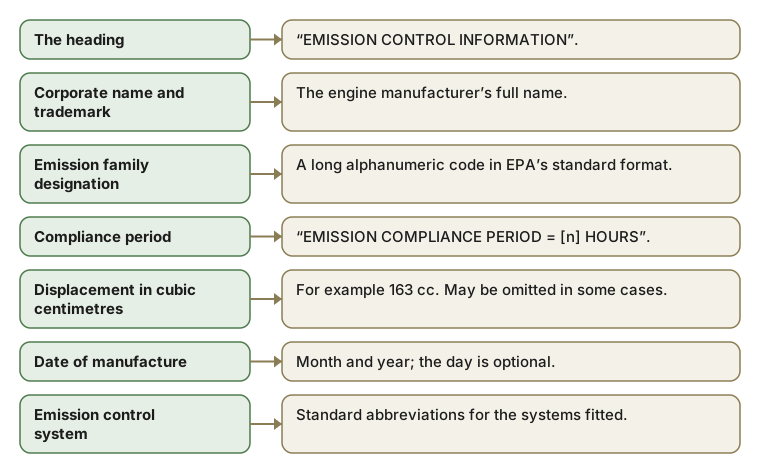
The contents of this label are not a manufacturer's choice. Title 40 of the Code of Federal Regulations, section 1054.135, sets out what must appear on the emission control information label of a small nonroad spark-ignition engine and how it must be attached. The required items are:
| Required item | What it looks like | What you can do with it |
|---|---|---|
| The heading | “EMISSION CONTROL INFORMATION”. | Tells you which of the three plates you are looking at. |
| Corporate name and trademark | The engine manufacturer’s full name. | The engine maker, which is often not the machine’s brand. |
| Emission family designation | A long alphanumeric code in EPA’s standard format. | A precise identifier for this family of engines, useful when the model plate is gone. |
| Compliance period | “EMISSION COMPLIANCE PERIOD = [n] HOURS”. | The emissions-durability period used for certification, expressed in operating hours. |
| Displacement in cubic centimeters | For example 163 cc. May be omitted in some cases. | Engine size, which is what most compatibility questions turn on. |
| Date of manufacture | Month and year; the day is optional. | How old the engine is, independent of when it was sold. |
| Emission control system | Standard abbreviations for the systems fitted. | Whether there is a catalyst in the muffler, which changes how you treat it. |
| The compliance statement | “THIS ENGINE MEETS U.S. EPA EXH REGS FOR [year]”, or EXH/EVP where evaporative rules also apply. | Confirms the model year the engine was certified to. |
The rule also governs the label itself: it must be attached in one piece so it cannot be removed without being destroyed or defaced, secured to a part needed for normal operation and not normally replaced, durable and readable for the engine's entire life, and written in English. That is why this is the label most likely to have survived on an old machine.
The compliance period is a design-life statement
The hours figure is the most interesting number on the label and the least used. It is the useful life the manufacturer selected for certification, chosen from a fixed set of options that depend on the engine's class. The options are not arbitrary; they are set out in the regulation.
| Class | Displacement | Compliance period options |
|---|---|---|
| Class I (non-handheld) | Below 225 cc | 125, 250 or 500 hours (extendable in 100-hour steps to 3,000 for a “Heavy Commercial” designation) |
| Class II (non-handheld) | 225 cc and above | 250, 500 or 1,000 hours (extendable in 100-hour steps to 5,000 for “Heavy Commercial”) |
| Class III (handheld) | Below 20 cc | 50, 125 or 300 hours |
| Class IV (handheld) | 20 cc to below 50 cc | 50, 125 or 300 hours |
| Class V (handheld) | 50 cc and above | 50, 125 or 300 hours |
Two machines on the same shelf, with the same displacement, can carry 125 hours and 500 hours respectively. That is the manufacturer telling you, in a federally required format, what it expects of its own engine. It does not mean the engine stops at that figure, plenty run far longer, but as a comparison between two products it is more informative than any marketing claim, and it costs nothing to read.
Handheld and non-handheld are defined terms, not descriptions. In the regulation, handheld equipment meets specific criteria including being carried by the operator, being designed for multi-positional operation, or being under 16 kilograms with particular attributes. That is why a chainsaw and a trimmer are Class III to V while a mower engine of similar size is Class I.
Why displacement is the practical number
Displacement in cubic centimeters is the figure that most compatibility questions turn on, and it is printed here by rule. It tells you which broad band of engine you have, which constrains the plausible answers for oil quantity, plug size, and whether a replacement engine is a candidate at all. It also settles arguments about horsepower claims, which are measured under several different standards and are not comparable across brands the way a volume is.
What the emission family designation gives you
The family designation is a coded identifier assigned in EPA's standard format. Two engines in the same family share the emission-relevant design characteristics the certification covers. For an owner, its value is straightforward: it is a durable, unique-ish identifier stamped on a label the regulation requires to last, so when a model plate has worn off, the family designation is often what a parts specialist can work from.
If the label mentions a catalyst, treat the muffler differently: a catalytic muffler runs hotter, is not interchangeable with a plain one, and is a real ignition risk on dry grass. That is worth knowing before parking a warm machine.
- How must I label and identify the engines I produce?: U.S. Government Publishing Office (eCFR), 40 CFR § 1054.135.
- What are the exhaust emission standards and useful life periods for small nonroad spark-ignition engines?: U.S. Government Publishing Office (eCFR), 40 CFR § 1054.107 and § 1054.801 (definitions).
- Control of Emissions from New, Small Nonroad Spark-Ignition Engines and Equipment: U.S. Government Publishing Office (eCFR), 40 CFR Part 1054.
Reading the EPA emission control label: questions
What does the compliance period in hours on the label mean?
It is the useful life the manufacturer selected for certification, chosen from a fixed set of options that depend on the engine class. It concerns emissions certification, not a prediction of mechanical lifespan: two machines of the same displacement carrying 125 hours and 500 hours are making different statements about the product. It does not mean the engine stops there, and it must not be read as a warranty or an expected engine-failure date.
What information is required on the EPA emission control label?
Federal rule 40 CFR 1054.135 fixes the contents: the "Emission Control Information" heading, the engine manufacturer’s name, the emission family designation, the compliance period in hours, the displacement in cubic centimeters, the date of manufacture, the emission control systems fitted, and a compliance statement naming the model year. None of it is the manufacturer’s choice of what to print.
How do I find out what year my engine was made?
Read the date of manufacture on the emission control label, which gives month and year and is independent of when the machine was sold. The compliance statement on the same label also names the model year the engine was certified to. Both are printed by federal rule, so they survive on the one label the regulation requires to stay readable for the engine’s entire life.
What does engine displacement in cc tell me?
It is the practical identifier most compatibility questions turn on: engine size, which constrains the plausible answers for oil quantity, plug size, and whether a replacement engine is even a candidate. Unlike horsepower, which is measured under several non-comparable standards, a volume in cubic centimeters compares directly across brands, which is why the rule requires it on the label.
How many horsepower is a given cc engine?
There is no fixed conversion, and none applies, because horsepower depends on compression, valve timing, RPM and how the manufacturer tested it. Two engines of identical displacement from different makers can differ meaningfully in rated power, and horsepower claims themselves have historically been measured under several non-comparable standards. Displacement in cc is the number worth comparing directly across brands; treat any cc-to-horsepower figure you see quoted online as a rough approximation at best, not a specification.
What are the five engine classes (I through V) on the emission label, and what determines which one an engine gets?
Classes I and II cover non-handheld engines, split by displacement at 225 cc; Classes III, IV and V cover handheld engines, split by displacement at 20 cc and 50 cc. "Handheld" and "non-handheld" are legal definitions in the regulation, based on being carried by the operator, designed for multi-positional operation, or being under 16 kilograms with particular attributes, not just a description of how the machine looks.
Can the same compliance-period hour figure mean different things for two different engine classes?
Yes: the available hour options themselves differ by class: a Class I engine chooses among 125, 250 or 500 hours, while a Class III handheld engine chooses among 50, 125 or 300 hours. A 125-hour compliance period means something different relative to its own class's available range depending on which class the engine falls into, so compare within the same class rather than across classes.
What does it mean if the emission label mentions a catalyst or catalytic muffler?
It means the emission control system includes a catalyst, which runs the muffler hotter than a plain one and is not interchangeable with a non-catalytic replacement. It also raises real fire risk on dry grass or brush, since a hot catalytic muffler is a genuine ignition source: worth knowing before parking a warm machine on dry vegetation.
Is the emission family designation the same as the engine model number?
No: the emission family designation is a separate, EPA-standard-format code that identifies engines sharing the same emission-relevant design characteristics under certification, distinct from the manufacturer's own model, type and code numbering. It is valuable specifically because it survives on the durable federal label even when the manufacturer's own model plate has worn away.
Does the emission control label ever get updated or replaced during an engine's life?
No: it is fixed at the point of manufacture, required to remain attached and readable for the engine's entire life. It reflects the engine's original certification, not any later modification, and is not reissued or updated even if the engine is serviced or rebuilt.
Does the emission control label apply to engines used in equipment other than outdoor power equipment?
The specific regulation cited, 40 CFR 1054, covers small nonroad spark-ignition engines generally, a category that includes outdoor power equipment but is defined by engine type and application rather than by product category alone: the labeling requirement follows the engine's classification under the rule, not the specific product it happens to be installed in.