Two-stroke or four-stroke: identify the lubrication system
Use the engine’s manual to identify its lubrication system before fueling. Many two-strokes require oil mixed with gasoline; ordinary four-strokes keep separate crankcase oil.
Some four-stroke designs, including STIHL 4-MIX, use mixed fuel. Counting caps or seeing “four-stroke” is not enough to choose fuel or decide whether oil needs draining.
Two counterexamples prevent a costly mistake
Honda’s GX25/GX35 mini four-stroke engines require no oil mixed into their fuel and have a separate oil supply. They are handheld-capable engines, disproving the idea that every handheld machine is a two-stroke.
The STIHL FS 91/111 instructions describe the mixed-fuel 4-MIX arrangement. STIHL’s U.S. fuel guidance specifies a 50:1 mixture for its gasoline equipment. Do not invent an engine-oil drain interval for a mixture-lubricated machine.
| Design | Fuel decision | Separate oil service |
|---|---|---|
| Typical premix two-stroke | Use its specified mixture | No ordinary engine sump |
| Honda mini four-stroke | Unmixed gasoline per manual | Check its engine oil supply |
| STIHL 4-MIX examples | Manufacturer-specified mixed fuel | No ordinary sump oil-change routine |
A 50:1 example measures gasoline separately
At 50:1, 5 liters of gasoline require 100 milliliters of the specified two-stroke oil: 5,000 divided by 50. The resulting mixture is about 5.1 liters, not five liters including oil. This example is not a replacement for a different model’s stated ratio.
Wrong fuel: stop and identify what entered
If the wrong fuel was added, avoid starting or restarting the engine. Record the product, quantity and whether the engine ran, then follow the manufacturer’s draining and inspection advice. Do not assume smoke or an apparently normal restart proves that no damage occurred.
A chainsaw’s separate bar-oil tank does not make it a sump-lubricated four-stroke. Bar oil serves the cutting chain. Likewise, a pressure-washer pump’s oil is separate from its engine supply.
Before storage, use the actual fuel and engine instructions for that model. Separate sump oil still has calendar and service requirements; calling storage “only a fuel problem” can cause overdue oil service.
Two-stroke and four-stroke
A separate crankcase filler is an identification clue, not a universal test; first identify the engine’s lubrication system in its manual. A conventional sump-lubricated four-stroke keeps its oil in a sump with its own filler and usually a dipstick; a mixture-lubricated two-stroke has no crankcase-oil dipstick, because its lubricating oil arrives dissolved in the fuel at a ratio printed near the cap. That difference is not a detail of engineering trivia.
It decides how the machine is fueled, what happens when the fuel is wrong, whether you can turn the machine on its side, and what has to happen before it is put away for the winter. It also explains why many handheld tools use two-stroke lubrication while many wheeled machines use a separate crankcase; mixture-lubricated four-strokes such as STIHL 4-MIX are important exceptions.
Telling them apart in ten seconds
Inspect the filler labels and then identify the engine in its manual. A separate sump and dipstick indicate a separate oil supply; a mixture-lubricated engine takes oil with the fuel.
The cycle does not settle the question: STIHL 4-MIX has four strokes but uses mixed fuel. A chainsaw’s additional bar-oil cap serves its cutting system and does not identify crankcase lubrication.
2stroke
One tank, no dipstick
Oil is mixed into the fuel. A ratio is printed near the cap.
4stroke
Fuel tank plus an oil sump
A dipstick or an oil filler cap, checked and changed separately.
What the difference is
A four-stroke engine completes intake, compression, power and exhaust in four separate piston strokes across two crankshaft revolutions, and it keeps its lubricating oil in a sump that is isolated from the combustion chamber. A two-stroke does the same work in two strokes and one revolution, using the crankcase itself as part of the induction path, which means the crankcase cannot hold a bath of oil, and the lubricant has to arrive dissolved in the fuel.
Two consequences follow and they run through everything else. First, a two-stroke fires every revolution instead of every second one, so it produces more power for its weight, which is why every machine you hold at arm's length is one. Second, its lubrication is a consumable metered by a ratio you mix by hand, so getting that ratio wrong destroys the engine rather than merely degrading it.
| Question | Two-stroke | Four-stroke |
|---|---|---|
| Lubrication | Oil mixed into the fuel at a specified ratio. | Oil in a sump, changed on a schedule. |
| Getting it wrong | Seizure, often within a minute on straight gasoline. | Gradual wear; low oil usually triggers a shutdown sensor on newer engines. |
| Machines | Chainsaws, trimmers, handheld blowers, some older mowers. | Mowers, generators, pressure washers, snow blowers, tillers, splitters. |
| Storage risk | Mixed fuel degrades; the whole tank is a consumable. | Fuel degrades in the tank and carburetor; oil is fine. |
| Can you tip it over? | Yes: designed for multi-positional use. | Only in the direction the manual allows; oil floods the cylinder otherwise. |
| EPA class on the label | Usually Class III to V (handheld). | Usually Class I or II (non-handheld). |
The four mixed-fuel mistakes
-
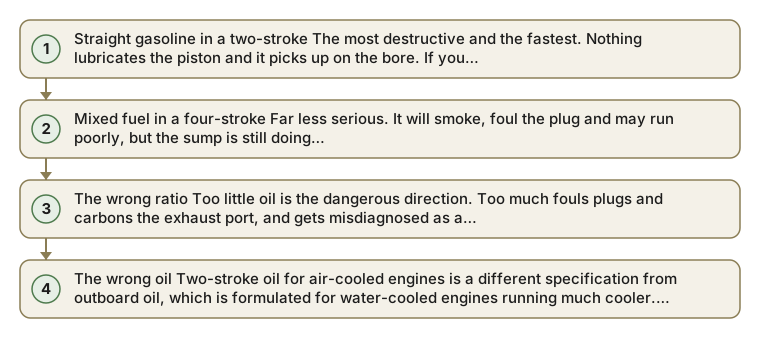
Straight gasoline in a two-stroke
The most destructive and the fastest. Nothing lubricates the piston and it picks up on the bore. If you realize before starting, drain it; if the engine has run, it needs to be looked at.
-
Mixed fuel in a four-stroke
Far less serious. It will smoke, foul the plug and may run poorly, but the sump is still doing its job. Drain it, fit a new plug and move on.
-
The wrong ratio
Too little oil is the dangerous direction. Too much fouls plugs and carbons the exhaust port, and gets misdiagnosed as a carburetor fault. Use the fuel mix calculator and the ratio printed on the machine.
-
The wrong oil
Two-stroke oil for air-cooled engines is a different specification from outboard oil, which is formulated for water-cooled engines running much cooler. Automotive engine oil is not two-stroke oil at all.
Four-stroke handheld engines exist, small four-stroke trimmers and blowers are sold specifically to avoid mixing, and a few use a lubrication system that tolerates any orientation. On those machines the oil is checked and changed like a mower’s, and putting mixed fuel in one is a common and avoidable error. Check for a dipstick before you fill anything.
What this changes about storage
For a four-stroke, storage is a fuel problem only: the oil in the sump is stable and the gasoline is not. For a two-stroke, the fuel is the lubricant, so a tank of eight-month-old mixed fuel is both stale gasoline and separated oil.
Mix what you will use within about a month, and store the machine either dry or on stabilized fuel. Both approaches are set out on winter storage.
Two-stroke and four-stroke: questions
How can I tell if my engine is two-stroke or four-stroke?
Inspect the filler labels and then identify the engine in its manual. A separate sump and dipstick indicate a separate oil supply; a mixture-lubricated engine takes oil with the fuel.
The cycle does not settle the question: STIHL 4-MIX has four strokes but uses mixed fuel. A chainsaw’s additional bar-oil cap serves its cutting system and does not identify crankcase lubrication.
What happens if I run straight gasoline in a two-stroke engine?
It seizes, often within a minute, because nothing lubricates the piston and it picks up on the bore. If you notice before starting, drain the tank; if the engine has already run on it, it needs to be looked at. This is the most destructive and fastest of the mixed-fuel mistakes, which is why the fuel-to-oil ratio on a two-stroke is a specification rather than a preference.
Is it a problem to put mixed fuel in a four-stroke engine?
Far less serious than the reverse. The engine will smoke, foul the plug and may run poorly, but the sump is still lubricating it, so draining the fuel and fitting a new plug usually resolves it. The dangerous direction is too little oil in a two-stroke; too much oil only fouls plugs and carbons the exhaust port and tends to get misdiagnosed as a carburetor fault.
Can I tip a small engine on its side to work on it?
On a four-stroke, only in the direction the manual allows, or oil floods the cylinder and the exhaust. A two-stroke is designed for multi-positional use and can be turned freely, which is part of why handheld machines are two-stroke. Before tipping a mower to sharpen a blade, tip it carburetor-side up so that oil does not run down into the cylinder.
Why do two-stroke engines fire every revolution while four-stroke engines fire every other one?
A four-stroke completes intake, compression, power and exhaust in four separate piston strokes across two crankshaft revolutions, firing once every second revolution. A two-stroke compresses that same work into two strokes and one revolution by using the crankcase itself as part of the induction path, which is what forces the oil to be mixed into the fuel rather than held in a separate sump: there is no room for a bath of oil once the crankcase is doing induction duty.
Do four-stroke handheld tools exist, and how do I tell them apart from a two-stroke one?
Some handheld four-strokes have a separate oil supply, while STIHL 4-MIX uses fuel-mixture lubrication. Both the engine cycle and its required lubrication system matter. Read the engine’s fuel instruction before filling it; do not infer straight gasoline or a mixing ratio solely from the tool being handheld, having valves or carrying a second cap.
Why is a two-stroke engine's power-to-weight ratio better than a four-stroke's?
Because a two-stroke fires every revolution instead of every second one, producing more power strokes per unit time for a given engine speed and weight. This is exactly why every handheld tool you hold at arm's length, trimmers, chainsaws, handheld blowers, tends to be a two-stroke design, where weight matters more than it does on a wheeled machine.
Does a low-oil shutdown sensor exist on two-stroke engines the way it does on some four-stroke ones?
Not in the same form: a low-oil shutdown sensor on newer four-stroke engines monitors the sump's oil level directly. A two-stroke has no sump to monitor, since its oil arrives mixed into the fuel; running too lean a mix doesn't trigger a warning sensor the way low sump oil does on a four-stroke, which is part of why an incorrect two-stroke ratio can cause seizure with no advance warning.
What EPA engine classes on the emission label typically correspond to two-stroke versus four-stroke engines?
Handheld classes III through V (roughly, tools under 50 cc designed to be carried) are usually, but not always, two-stroke, while non-handheld Classes I and II (mowers, generators, and similar wheeled or stationary equipment) are usually four-stroke. The correspondence is a strong pattern rather than a guarantee: the exact engine model and manufacturer’s lubrication instructions settle the fuel requirement; a dipstick alone does not.
Why does mixed fuel degrade faster in storage than plain gasoline does?
Because mixed fuel is both stale gasoline and separated oil at once: the gasoline component degrades the same way any stored gasoline does, while the oil suspended in it can separate out over time, compounding the fuel's overall degradation. That is why mixed fuel's recommended usable life (about a month) is considerably shorter than plain gasoline's.
Is bar and chain oil the same thing as two-stroke oil, since both are used on a chainsaw?
No: they are two entirely separate products serving different purposes. Two-stroke oil is mixed into the fuel and burned as part of combustion; bar and chain oil is a tacky, unmixed oil that goes in its own separate tank and lubricates the moving chain externally as it runs, never entering the combustion chamber at all.
Why does a two-stroke chainsaw need to be filled with two different products at once?
Because it performs two separate lubrication jobs that a four-stroke splits differently: the fuel tank's mixed fuel lubricates the internal engine (piston, bearings, crankshaft), while the separate bar oil tank lubricates the external moving chain against the bar. Filling only one, or filling bar oil into the fuel tank by mistake, leaves the other system unlubricated.
STIHL’s explanation of mixture-lubricated 4-MIX describes the exception to the usual separate-sump four-stroke arrangement.