Toro TimeCutter SW service: oil, filters and calendar limits
For the TimeCutter SW 4200/5000 builds covered by form 3398-979, change engine oil after five hours or one month, whichever comes first. Regular oil and filter service is every 100 hours or yearly. The stated crankcase capacity is 2.4 liters (2.5 US quarts), but the dipstick sets the final level after filling by the manual’s procedure.
The calendar limit is in the procedure
The Toro manual for 74675/74680, serial 316000001 and up lists hour marks in its summary schedule and adds calendar limits in the individual service procedures.
An owner mowing two hours weekly reaches five hours during week three; the first-month limit still applies to a machine used less often.
| Task | Earlier applicable limit |
|---|---|
| Initial oil change | 5 hours or first month |
| Regular engine oil and filter | 100 hours or yearly |
| Check plugs | 100 hours or yearly |
| Replace plugs | 200 hours or 2 years |
| Service paper air element | 100 hours or yearly |
| Replace paper element | 200 hours or 2 years |
Fill gradually, then check the mark
Toro directs an initial fill of approximately 80 percent of specified oil, then gradual additions to Full. For its 2.4-liter figure, 80 percent is 1.92 liters, leaving about 0.48 liter of the nominal quantity for incremental filling and level checks.
Residual oil means the remainder is not an automatic addition.
The manual specifies detergent oil meeting its listed API classes and a viscosity chosen from its temperature chart. Check oil with the engine cold and the machine level.
Do not substitute a different TimeCutter’s capacity or a kit’s bottle quantity.
Foam and paper need different cleaning
Wash the foam element with water and replace damaged foam. Lightly tap the paper element; do not wash it or use compressed air.
An oily film, tears or a damaged seal require replacement. Dusty conditions shorten service intervals.
For plugs, this manual names RN9YC or BPR6ES at 0.76 mm and says not to clean a fouled, worn or cracked plug.
Keep deck-width parts separate from engine consumables: neither an SS/SW advertising label nor a marketplace bundle proves fit.
Before maintenance, park as directed, disengage the blades, stop the engine, remove the key, wait for movement to stop and isolate ignition. Damaged blade controls, guards or blades require correction before mowing.
Toro TimeCutter SW 4200 and SW 5000: oil capacity, spark plug and service intervals
The Toro TimeCutter SW 4200 and SW 5000 hold 2.4 liters (2.5 US quarts) of API SF to SL detergent oil and use a Champion RN9YC or NGK BPR6ES spark plug gapped 0.76 mm (0.030 inch). Toro says to change the oil after the first 5 hours and then, with the filter, every 100 hours or yearly.
Remove the key and disconnect the wire from the spark plug before any maintenance, and check the oil when the engine is cold.
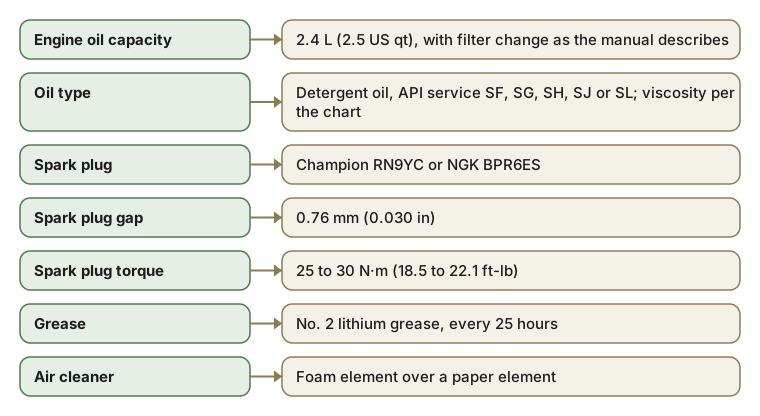
The zero-turn service list, from the manual
The Toro TimeCutter SW 4200 (model 74675) and SW 5000 (model 74680) are residential zero-turn riding mowers. Toro’s manual for serial numbers 316000001 and up gives the crankcase capacity as 2.4 liters (2.5 US quarts) and calls for a detergent oil of API service SF, SG, SH, SJ or SL, with the viscosity taken from a temperature chart in the manual.
| Item | Specification |
|---|---|
| Engine oil capacity | 2.4 L (2.5 US qt), with filter change as the manual describes |
| Oil type | Detergent oil, API service SF, SG, SH, SJ or SL; viscosity per the chart |
| Spark plug | Champion RN9YC or NGK BPR6ES |
| Spark plug gap | 0.76 mm (0.030 in) |
| Spark plug torque | 25 to 30 N·m (18.5 to 22.1 ft-lb) |
| Grease | No. 2 lithium grease, every 25 hours |
| Air cleaner | Foam element over a paper element |
Two details in the manual are easy to get wrong. Toro says not to clean the spark plug at all: replace it if it has a black coating, worn electrodes, an oily film or cracks. And it says not to clean the paper air element with compressed air or liquids such as solvent, gas or kerosene; replace it if it is damaged or cannot be cleaned by tapping.
The Toro TimeCutter SW 4200 and SW 5000 schedule
| When | What |
|---|---|
| After the first 5 hours | Change the engine oil, check the oil level and clean the air intake screen. |
| Before each use or daily | Check the engine oil level, the blades and the grass deflector; clean the front of the machine. |
| Every 25 hours | Grease all the lubrication points, clean the foam element, check tire pressure and the belts. |
| Every 100 hours or yearly | Change the engine oil and the oil filter; replace the foam element; service the paper element; check the spark plugs and the in-line fuel filter. |
| Every 200 hours or every 2 years | Replace the paper element, the spark plugs and the in-line fuel filter. |
| Before storage | Charge the battery and disconnect the cables; change the crankcase oil and filter. |
Parts to buy for the Toro TimeCutter SW 4200 and SW 5000
| Part | Part number | Notes |
|---|---|---|
| Air filter (paper) | 127-9252 | Replaces 136-7806. |
| Engine oil filter | 120-4276 | Change with every oil change. |
| Spark plug | Champion RN9YC or NGK BPR6ES | Gap 0.76 mm (0.030 in). |
| Engine oil | SAE 10W-30 | 2.4 L (2.5 US qt). |
The 42 and 50 inch TimeCutter SS, SW and SWX models with the V-twin engine share these filters, so check your model number at toro.com if a filter does not fit.
2.4 L
Crankcase capacity
2.5 US quarts, API SF to SL detergent oil.
0.76 mm
Spark plug gap
Champion RN9YC or NGK BPR6ES.
100 h
Oil and filter interval
After the first 5 hours; or yearly.
Toro TimeCutter SW 4200 and SW 5000: questions
How much oil does a Toro TimeCutter SW 4200 take?
The crankcase capacity is 2.4 liters (2.5 US quarts). Pour in about 80% first, then add more to reach the Full mark, checking with the engine cold and level.
What oil does the Toro TimeCutter SW 5000 use?
A detergent oil of API service SF, SG, SH, SJ or SL. Toro’s manual gives a temperature chart for viscosity and warns against overfilling.
What spark plug does a Toro TimeCutter SW 4200 use?
Toro lists a Champion RN9YC or an NGK BPR6ES, with the gap set to 0.76 mm (0.030 inch). Tighten it to 25 to 30 N·m (18.5 to 22.1 ft-lb).
Should I clean the TimeCutter spark plug?
No. Toro says not to clean it. Replace it if it has a black coating, worn electrodes, an oily film or cracks; light brown or gray on the insulator means the engine is running as intended.
When do I change the oil on a TimeCutter SW 4200?
After the first 5 hours or first month, then every 100 hours or yearly, whichever comes first, and more often in dusty conditions. Change the oil filter at the same interval.
How often do I replace the TimeCutter air filter?
Clean the foam element every 25 hours, replace it every 100 hours or yearly, service the paper element every 100 hours, and replace the paper element every 200 hours or 2 years.
Can I blow out the TimeCutter paper air element with compressed air?
No. Toro says not to clean the paper element with pressurized air or liquids such as solvent, gas or kerosene. Tap it lightly, inspect it, and replace it if damaged.
What is the Toro TimeCutter oil filter part number?
Toro oil filter 120-4276 fits the TimeCutter SS, SW and SWX V-twin models, including the 74675 (SW 4200) and 74680 (SW 5000). Change it every 100 hours or yearly, when you change the oil.
What is the Toro TimeCutter air filter part number?
Toro paper air filter 127-9252, which replaces 136-7806, fits the TimeCutter SS, SW and SWX V-twin models. Replace the paper element every 200 hours or 2 years, and clean the foam element every 25 hours.
What grease does the TimeCutter use?
No. 2 lithium grease, every 25 operating hours at every lubrication point, after cleaning the fittings.
How often do I replace the TimeCutter spark plugs?
Check them every 100 hours or yearly and replace them every 200 hours or every 2 years, whichever comes first. The in-line fuel filter follows the same schedule.
Which Toro TimeCutter mower models share these service figures?
Models 74675 (SW 4200) and 74680 (SW 5000), serial numbers 316000001 and up, per Toro’s form 3398-979 Rev B. Other TimeCutter models and years may differ.