Chainsaw kickback: avoid nose contact and verify the safety system
Avoid contact with the upper part of the guide-bar nose, keep control with both hands and use the approved cutting system. Kickback can move the bar toward the operator before a reaction is possible. A chain brake and low-kickback chain reduce risk; neither guarantees the brake will activate in every event or prevent injury.
Understand three different reactions
The STIHL chainsaw safety manual distinguishes kickback, pull-in and pushback. Upper-nose contact can rotate the saw up/back; a catch along the lower chain can pull the saw forward; pinching the upper chain can drive it back. Work support and bar position matter for all three.
| Situation | Decision |
|---|---|
| Nose hidden among adjacent limbs | Stop and establish a visible, controlled cutting plan |
| Cut could close on the upper chain | Reassess support and pinch risk |
| Proposed plunge / bore cut without training | Do not attempt the technique |
| Work above safe reach or under tension | Use qualified help or a different approved method |
The brake is a backstop
STIHL’s brake explanation describes QuickStop and the additional QuickStop Plus feature on some models. The feature names do not replace the applicable inspection and operating instructions. Never trigger a kickback as a brake test.
STIHL’s chain-identification guide identifies a green tie strap on its low-kickback loops. That is manufacturer-specific marking, not approval of any green-painted chain or an arbitrary bar/chain substitution.
Keep technique and protective equipment together
Use the prescribed two-handed grip and stance, keeping the body out of the cutting plane. Do not rely on a locked elbow, grip strength or a claimed safe reaction time. Avoid cutting above shoulder height or from a ladder.
Inspect the approved chain, bar, guards and controls before use and service defects before cutting. A sharper chain does not remove kickback risk. Use the protective-clothing guide alongside training and the actual manual.
For storm-damaged trees, suspended limbs, spring poles or uncertain felling conditions, stop and obtain a qualified assessment. A different saw size does not make those hazards disappear.
Chainsaw kickback
Kickback is a specific mechanical event with a specific cause, and knowing the cause is what lets you avoid the situations that produce it. When the chain traveling around the upper quadrant of the bar nose contacts something, it is moving upward and backward relative to the wood at that point, so a cutter that bites there cannot pull the wood into the saw, and the reaction instead drives the bar up and back toward the operator, pivoting about the front handle, in a fraction of a second. Two other reactions get called kickback and are not: pull-in, where the chain on the underside catches and the saw is pulled forward, and pushback, where a closing cut pinches the top of the bar and drives the saw straight back.
Only the first is the one the protections are built around.
The mechanism, precisely
Rotational kickback happens when the chain moving around the upper quadrant of the bar nose contacts something. At that point on the bar the chain is traveling upward and backward relative to the wood. A cutter that bites there cannot pull the wood into the saw, so the reaction drives the bar up and back instead: toward the operator, pivoting about the front handle, in a fraction of a second.
Two other reactions are frequently confused with it. Pull-in happens when the chain on the underside of the bar catches, and the saw is pulled forward away from you. Pushback happens when the chain along the top of the bar is pinched in a closing cut, and the saw is driven straight back toward you.
All three are worth knowing; only the first is what people mean by kickback.
Upper nose
The kickback quadrant
The upper quarter of the bar tip. Contact here drives the bar up and back.
Underside
Pull-in
The saw is pulled forward. Usually from the chain catching in the cut.
Top edge
Pushback
A closing cut pinches the bar and drives the saw straight back.
What each protection does
| Protection | What it does | What it does not do |
|---|---|---|
| Chain brake | Clamps a band around the clutch drum and stops the chain in a fraction of a second. Triggered by the front hand guard moving forward: by your wrist during a kickback, or by inertia on saws with an inertia-activated brake. | It stops the chain. It does not stop the bar arriving. A chain brake reduces injury severity; it does not prevent the event. |
| Low-kickback chain | Raised depth gauges and shaped tie straps limit how much wood a cutter can take at the nose. Classified and tested under the chain-saw standard, ANSI/OPEI B175.1. | It reduces the energy of a kickback, and does not eliminate it. Fitting aggressive chain removes this protection deliberately. |
| Reduced-kickback bar | A small-radius nose gives the dangerous quadrant less area to contact anything. | Restricts the cuts a saw can make. Not appropriate for every task, which is why long-nose bars still exist. |
| Grip and stance | Left thumb wrapped fully around the front handle, elbow slightly locked, body out of the bar’s plane. This is what converts a kickback into a survivable event. | Nothing protects a person standing directly behind the bar with a thumb resting on top of the handle. |
The single most consequential habit is the left thumb. A thumb wrapped around the front handle keeps the saw in your hands and lets the arm absorb the rotation; a thumb laid on top lets the handle rotate out of the grip entirely. It costs nothing and it is the difference between a fright and an injury.
The situations that produce it
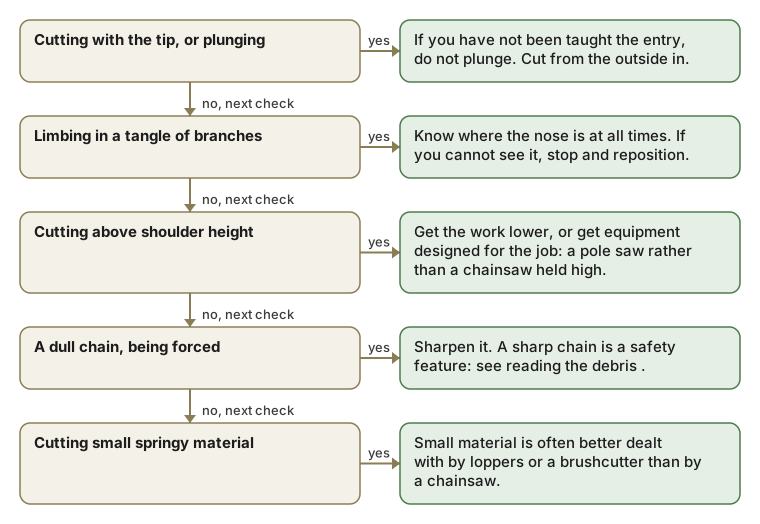
Cutting with the tip, or plunging
Boring or plunge cuts place the bar nose into the wood as part of the cut. They are legitimate techniques and they are taught with a specific entry method, using the lower quadrant of the nose to start the cut, precisely because the upper quadrant will kick.
If that is it: If you have not been taught the entry, do not plunge. Cut from the outside in.
Limbing in a tangle of branches
The classic setting: the operator is watching the branch being cut and the bar nose is somewhere they are not looking, in among other branches.
If that is it: Know where the nose is at all times. If you cannot see it, stop and reposition.
Cutting above shoulder height
A saw above the shoulders cannot be controlled if it kicks, because the arms have no leverage and the bar is already near the head.
If that is it: Get the work lower, or get equipment designed for the job: a pole saw rather than a chainsaw held high.
A dull chain, being forced
A dull chain does not bite, so the operator pushes. Pushing brings the nose into contact more often and with more force behind it, and it also makes the saw harder to hold.
If that is it: Sharpen it. A sharp chain is a safety feature: see reading the debris.
Cutting small springy material
Saplings and springy branches move into the nose and grab. Small material is disproportionately involved in kickback events for exactly this reason.
If that is it: Small material is often better dealt with by loppers or a brushcutter than by a chainsaw.
The equipment, briefly
Cut-resistant trousers or chaps, gloves, eye protection, hearing protection and a helmet. Chainsaw protective clothing works by packing the sprocket with long fibers and stalling the chain, which is a specific engineered response rather than general toughness. Ordinary heavy trousers do not do it.
The saw does not stop when it reaches skin, and the injuries are concentrated in the left hand, the left leg and the head.
Chainsaw kickback: questions
What causes chainsaw kickback?
Contact between something and the chain traveling around the upper quadrant of the bar nose. At that point the chain is moving upward and backward relative to the wood, so a cutter that bites there cannot pull the wood into the saw, instead the reaction drives the bar up and back toward the operator, pivoting about the front handle, in a fraction of a second. It is distinct from pull-in and pushback, which move the saw in other directions.
What is the single most important thing to control kickback?
Wrap your left thumb fully around the front handle. A thumb wrapped around keeps the saw in your hands and lets your arm absorb the rotation; a thumb laid on top lets the handle rotate out of your grip entirely. It costs nothing and it is the difference between a fright and an injury.
Beyond that, keep your body out of the bar’s plane and never cut above shoulder height.
Which way does a chainsaw chain spin, or travel around the bar?
Forward along the top of the bar, away from the engine toward the nose, then back underneath toward the operator: the direction the cutters face on top tells you which way it runs. That upper-quadrant travel at the nose is exactly what makes kickback possible: a cutter there is moving up and back relative to whatever it contacts, which is why the kickback zone is described by that direction of travel, not an arbitrary spot on the bar.
What does the chain brake do in a kickback?
It clamps a band around the clutch drum and stops the chain in a fraction of a second, triggered by the front hand guard moving forward: pushed by your wrist during a kickback, or by inertia on saws with an inertia-activated brake. What it does not do is stop the bar arriving: it reduces the severity of an injury rather than preventing the event, which is why grip and technique still matter as much as the brake does.
Which situations most often cause kickback?
Five. Cutting or plunging with the bar tip without the taught entry method; limbing in a tangle where the nose is somewhere you are not looking; cutting above shoulder height where the arms have no leverage; forcing a dull chain, which brings the nose into contact harder; and cutting small springy material, which moves into the nose and grabs. A sharp chain is itself a safety feature, because a dull one gets pushed.
What is the difference between kickback, pull-in and pushback?
Kickback drives the bar up and back toward the operator when the upper-quadrant nose contacts something. Pull-in happens when the chain on the underside catches, pulling the saw forward away from the operator. Pushback happens when a closing cut pinches the top of the bar, driving the saw straight back.
All three are worth recognizing, but only kickback is what the safety protections (chain brake, low-kickback chain) are specifically built around.
Does a reduced-kickback bar eliminate the risk of kickback entirely?
No: a reduced-kickback bar has a small-radius nose that gives the dangerous upper quadrant less area to contact anything, which reduces the frequency and severity of kickback events, but it doesn't eliminate the mechanism. It also restricts the cuts a saw can make, which is why long-nose bars are still manufactured and used for tasks that need the reach.
What kind of protective clothing stops a moving chain?
Chainsaw-specific chaps or trousers built with long fibers that pack into the sprocket and stall the chain: a specific engineered response, not general toughness from thick fabric. Ordinary heavy work trousers do not do this; the saw does not stop when it reaches ordinary clothing.
Where are chainsaw injuries most commonly concentrated on the body?
The left hand, the left leg and the head, consistent with how a right-handed operator typically holds a saw and where a kicking-back bar travels relative to that grip. This is part of why chainsaw-specific chaps focus coverage on the legs and why head and eye protection matter in addition to hand protection.
Is an inertia-activated chain brake better than one activated only by the hand guard?
An inertia-activated brake can trigger from the sudden rotational force of a kickback event itself, without requiring the operator's wrist to push the hand guard forward, which matters because a kickback happens faster than an intentional hand movement, so a brake that can trigger from the event's own motion adds a layer of protection beyond one that depends entirely on the operator's wrist movement.
Can a properly maintained saw with all safety features still kick back?
Yes: the safety features (chain brake, low-kickback chain, reduced-kickback bar) reduce the frequency and severity of kickback, and grip technique converts an event into a survivable one, but none of them prevents the underlying mechanical mechanism from occurring when the upper-quadrant nose contacts material. Technique and awareness of the situations that produce kickback remain necessary regardless of the equipment fitted.
Why is cutting small, springy material disproportionately involved in kickback events?
Because saplings and springy branches flex and move into the nose of the bar as the cut progresses, bringing material into contact with the upper kickback quadrant even when the operator is not aiming the tip at that material. This makes small springy material a less obvious but elevated risk compared to cutting a large, rigid log.