Chainsaw protective clothing: label, fit, coverage and retirement
Use chainsaw-rated protection suitable for the saw, task and garment instructions, then check fit and condition before cutting. Ordinary work trousers and generic cut-resistant gloves do not establish chainsaw protection. Clothing reduces injury risk; it cannot make unsafe cutting or an unsuitable saw setup safe.
Read the garment’s complete marking
STIHL’s chaps guide describes its gas-chainsaw leg protection using ASTM F1414 testing and F1897 performance standards. It tells readers to check the complete product marking. That stated scope is not permission to assume every garment covers every electric or battery saw.
| STIHL size label | Listed inseam | Listed outseam |
|---|---|---|
| 32 | 29–30 inches | 32–36 inches |
| 36 | 31–32 inches | 36–40 inches |
| 40 | 32–33 inches | 40–44 inches |
A person measuring a 31-inch inseam should not interpret the “32” label as an ordinary trouser inseam. The chart instead places 31–32 inches under size 36, with its separate outseam range. Check actual coverage with boots and the manufacturer’s fitting instructions before buying.
Coverage matters while moving
OSHA’s logging leg-protection guidance describes coverage from upper thigh to boot top for the covered work. STIHL’s fit illustration covers the boot top without dragging onto the toe. Check movement and closures as directed, not only how the garment hangs on a rack.
Follow the saw and task requirements for the rest of the protection. A mesh face screen is not a reason to omit eye protection required by the manual. A toe cap alone does not establish chainsaw-cut resistance.
Care is product-specific
The STIHL guide gives washing instructions and prohibits bleach, fabric softener, ironing and dry cleaning for the described products. Another garment may have different instructions. Do not treat a universal wash recipe as safe for all protective layers.
Follow the manufacturer’s retirement instruction after chain contact, exposed layers or other damage. Do not stitch through protective material or assume an intact-looking outer cover proves it can be used again. Replace or obtain the maker’s assessment before further use.
Chainsaw protective clothing: chaps, helmet, gloves and boots
Chainsaw protective clothing is built against the places a chainsaw injury happens: the left hand, the legs and the head. Chaps or trousers work by tearing open when the chain touches them, so that long loose fibres are dragged into the sprocket and stall the chain, which is why ordinary heavy work trousers do not do the same job. A helmet with a face screen and ear defenders protects the head, eyes and hearing, and cut-resistant gloves and boots cover the hand and the foot.
The label inside a garment names the standard it meets, and a garment the chain has cut is finished, whatever it looks like. None of it stops a kickback: it is the last line.
Protective clothing reduces the injury from a chain that touches you. It does not stop kickback, it does not make a poor technique safe, and it is worth nothing once the saw has cut through it. A garment that has been cut is finished, whatever it looks like.
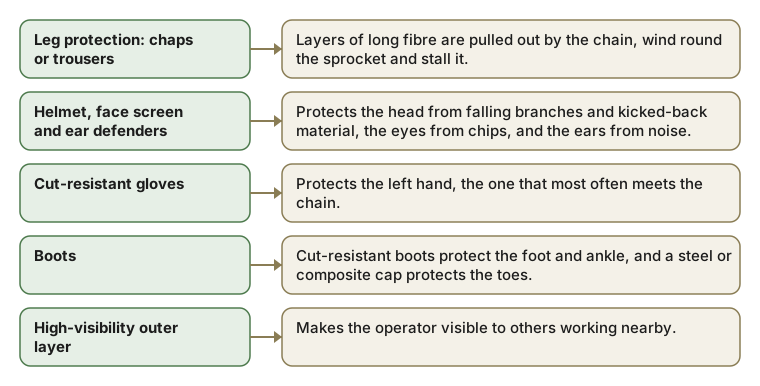
What each piece is for
A chainsaw injury goes to a few places. The left hand, the legs and the head account for most of them. The kit follows the injuries: leg protection, a helmet with a face screen and ear defenders, cut-resistant gloves, and boots.
Each is designed against a specific failure, and the pieces work together.
| Piece | What it does | What to know |
|---|---|---|
| Leg protection: chaps or trousers | Layers of long fibre are pulled out by the chain, wind round the sprocket and stall it. | Chaps cover the front of the legs; trousers cover all round. Only a garment made to a chainsaw standard does this, and heavy work trousers do not. |
| Helmet, face screen and ear defenders | Protects the head from falling branches and kicked-back material, the eyes from chips, and the ears from noise. | A mesh screen stops chips and lets air through; a clear one fogs. Check the date on a helmet, since plastic ages. |
| Cut-resistant gloves | Protects the left hand, the one that most often meets the chain. | Look for a rating for chainsaw use, not just general cut resistance, and fit them so they do not hinder grip. |
| Boots | Cut-resistant boots protect the foot and ankle, and a steel or composite cap protects the toes. | Wear boots rated for a chainsaw with a good ankle and a grip sole, not just work boots. |
| High-visibility outer layer | Makes the operator visible to others working nearby. | Useful when others are on the site, and in low light. |
How chainsaw leg protection works
The protective layers are long, loose fibres, packed between an outer cover and a lining. When the moving chain reaches the garment it tears the cover, and the fibres are drawn out and dragged into the drive sprocket. They clog it and jam the chain.
That takes a fraction of a second, and it happens because the material is designed to be pulled. A garment that was simply thick would be cut through. This is also why sawdust, oil and old age matter: a garment packed with oil-soaked sawdust or worn thin does not behave as it was built to.
Standards grade the result. In Europe, leg protection is classed by the chain speed it is tested against, from class 0 up to class 3, and by where the protection sits: the front of the leg only, or all round. In the United States, a specification from ASTM covers chainsaw leg protection, and the federal logging rules require leg protection for anyone running a chainsaw in logging work.
A label from one of these standards is what separates real protection from a garment that only looks the part.
Type
Front only, or all round
Chaps guard the front of the legs. Trousers with protection all round also guard the back, which matters for climbing and awkward cuts.
Class
Chain speed it is tested to
A higher class is tested against a faster chain. Match it to the saw you use, not to the cheapest garment.
Label
The standard it meets
The tag inside names the standard. No tag means no protection you can rely on.
Fit, care and when to throw it away
Chaps have to be the right length, reaching the boot without dragging, and cinched so they do not slide down or ride up. Wear them over your trousers and check them each time you put them on. Look for cuts, for the outer cover torn, and for fibres exposed.
Keep them clean and free of sawdust and oil, wash them as the label says, and store them dry and away from sunlight.
Retire a garment that the chain has touched, even if the damage looks small, since the layer that would have saved you next time is the one that has been used. Retire one that is worn thin, faded and brittle, or repaired with stitching through the protective layers.
What protective clothing does not replace
No clothing stops a kickback, and none protects against a chain moving at full speed for long enough to cut through. The rest of the protection is the saw itself, with its chain brake and low-kickback chain, and the way it is used.
The kickback page covers that side. The clothing is the last line, worn against the day the first two fail.
Chainsaw protective clothing: questions
What protective clothing do I need to use a chainsaw?
Leg protection (chaps or trousers made to a chainsaw standard), a helmet with a face screen and ear defenders, cut-resistant gloves rated for chainsaw use, and boots with cut protection and a grip sole. Add a high-visibility layer when others are nearby. The kit follows where chainsaw injuries happen: the left hand, the legs and the head.
How do chainsaw chaps work?
They are packed with long, loose fibres. When the moving chain touches the garment it tears the outer cover, and the fibres are drawn out and dragged into the drive sprocket, where they clog it and jam the chain. That takes a fraction of a second.
It works because the material is built to be pulled, not because it is thick, which is why heavy work trousers do not do the same.
Are chaps or chainsaw trousers better?
Chaps protect the front of the legs and are easy to put on and take off. Trousers with protection all round also cover the back, which matters when climbing, cutting from below or working in awkward positions. For ground work with a saw held in front of you, chaps are adequate.
For tree work, trousers with protection all round are the safer choice.
Do ordinary work trousers protect against a chainsaw?
No. Thick denim or canvas is cut through in an instant, because it is not designed to be pulled into the sprocket and stall the chain. Only a garment made to a chainsaw protection standard, with the label inside naming it, does that job.
No label means no protection you can rely on, however heavy the material feels.
What do the chainsaw protection classes mean?
In Europe, leg protection is classed by the speed of the chain it is tested against, from class 0 up to class 3, and by type: protection on the front of the leg only, or all round. A higher class is tested against a faster chain. Choose a class suited to the saw you use, and check the label for the standard it was tested to.
Is chainsaw leg protection legally required?
For logging work in the United States, the federal logging rules require leg protection for anyone operating a chainsaw. Rules for other work, and in other countries, vary, and some employers and insurers require it regardless. For a homeowner it is not usually a legal matter but it is the most important single piece of protective clothing you can wear.
When should I replace chainsaw chaps?
Replace them at once if the chain has touched them, even where the damage looks small, because the layer that would have protected you next time has been used. Replace them if they are worn thin, faded and brittle, or if the protective layers have been repaired with stitching. Cuts, torn covers and exposed fibres mean the garment is finished.
How do I care for chainsaw protective clothing?
Keep it clean and free of sawdust and oil, which can stop the fibres pulling out as designed. Wash it as the label says, dry it away from direct heat, and store it dry and out of sunlight. Look it over each time you put it on for cuts, torn covers and exposed fibres.
Chaps must be the right length and cinched so they stay in place.
Do I need a helmet and a face screen for a small job?
Yes, if the job involves a chainsaw at head height, overhead branches or any risk of falling material. A helmet with a mesh face screen and ear defenders protects the head, the eyes from chips and the ears from noise that can damage hearing within a short time. A mesh screen lets air through and does not fog, unlike a clear one.
What gloves should I wear for a chainsaw?
Gloves with a rating for chainsaw use, not only general cut resistance, and a fit that does not hinder your grip. The left hand is the one that most often meets the chain, so left-hand protection matters most. Some gloves add protection only on the back of the left hand.
Check the label for the standard they meet.
Can protective clothing stop a kickback?
No. Kickback throws the bar toward you faster than clothing can react, and protective equipment only reduces the injury if the chain touches you. The protection against kickback is the saw itself, with its chain brake and low-kickback chain, and how it is used: the bar tip kept away from wood and body clear of the line of the bar.
Are chainsaw boots really necessary?
Boots rated for chainsaw use protect the foot and ankle with cut-resistant layers, and have a steel or composite toe cap and a grip sole. A saw dropped or swung low reaches the foot. Ordinary work boots do not stall a chain.
If you cannot afford the full kit at once, buy the leg protection and the helmet first, then the boots and gloves.