Repair or replace equipment: compare diagnosed costs and scope
Compare a written, diagnosed repair with the replacement you would buy, including fees, parts availability and the condition of the rest of the machine. Check recalls first. Neither age, a single compression reading nor a repair costing half of new equipment automatically settles the decision.
Start with a replacement that can be purchased
Campbell’s Lawn Equipment advertised a Toro 21462 at $499, reduced from $519, when checked October 18, 2026. It is a particular new-mower asking price, not the resale value of an older mower or a guaranteed local total.
A hypothetical $240 repair is about 48 percent of $499. Add an assumed $50 diagnostic charge not credited to the repair, and the repair-side total is $290, about 58 percent. Confirm how the actual shop handles diagnosis, tax and transport before comparing.
Compare the same scope
| Repair side | Replacement side |
|---|---|
| Diagnosed fault and written work scope | Actual model and required accessories |
| Parts availability and delivery date | Stock and delivery / assembly |
| Other known unsafe or worn components | Warranty and service availability |
| Repair warranty and final test | Total price including applicable fees |
A replacement engine, blade or battery must be an approved fit. A cheap part offered for a similar machine is not an available repair until identity and compatibility are confirmed. Ask whether a quoted overhaul also addresses the symptom that prompted it.
Recall and safety can precede the cost choice
Search the CPSC recall database using the exact model and serial and follow the campaign’s remedy. Do not assume an older campaign has expired or that an unavailable part authorizes continued use of an unsafe machine.
A low compression-gauge reading can reflect test conditions or decompression hardware; it is not a universal replacement threshold. Ask for the test procedure and diagnosis before accepting an engine rebuild or buying a carburetor.
For an otherwise sound machine with one confirmed fault and obtainable parts, repair can be reasonable. For multiple unsafe assemblies or unavailable approved replacements, replacing or retiring it may be more practical. Use the evidence for that machine instead of a fixed percentage or hour-life claim.
Repair or replace old equipment
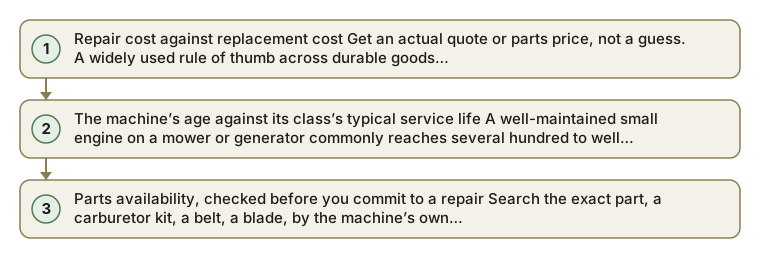
"Is it worth fixing" has a plain answer built from three specific comparisons rather than a feeling: repair cost against replacement cost, the machine’s age against what its class typically delivers in service hours, and whether the part it needs still exists to buy. A single well-diagnosed fault on an otherwise sound machine is usually the cheapest fix available anywhere; low compression usually marks where the economics flip, because it means the engine’s internals are worn in a way no external part repairs, rather than one component that can be swapped and forgotten. Work the three comparisons in order, cheapest first: each one can end the question on its own, so a machine can fail the first comparison and never need the other two.
Three numbers, not a feeling
Decide whether repair is worth its quoted cost by working through three specific comparisons in order. Each one can end the question on its own, which is why doing them in order saves the most time.
-
Repair cost against replacement cost
Get an actual quote or parts price, not a guess. A widely used rule of thumb across durable goods generally is that a repair costing more than roughly half of new-replacement cost rarely makes financial sense, but treat that as a starting heuristic, not a rule, because the next two factors change the answer in both directions.
-
The machine’s age against its class’s typical service life
A well-maintained small engine on a mower or generator commonly reaches several hundred to well over a thousand hours of use before major work is needed, but hours run and storage history matter more than calendar age. A ten-year-old machine that was stored correctly every winter is a better repair candidate than a five-year-old one that was not; see the seasonal cluster for what correct storage prevents.
-
Parts availability, checked before you commit to a repair
Search the exact part, a carburetor kit, a belt, a blade, by the machine’s own model and serial number, found using the same method on the engines page, before assuming it exists. A mechanically sound repair that needs a discontinued part is not available at any price a shop can promise a timeline on.
| What you find | Points toward |
|---|---|
| A single diagnosed fault; parts are in stock; cost is well under half of replacement | Repair |
| Low compression, or a repair quote near or above replacement cost | Replace |
| The needed part is discontinued or only available at near-replacement price | Replace |
| A machine still under recall with an available free remedy | Get the remedy first, then reassess |
What tips the decision toward repair
A single, well-diagnosed fault on an otherwise sound machine, a carburetor gummed by stale fuel, a snapped pull cord, a dead ignition coil, is usually the cheapest and fastest fix available anywhere, often resolvable with the parts-and-measurement pages on this site rather than a shop visit at all. Low compression, by contrast, usually marks the point where the economics flip: it means the engine's internals, rings, valves, or a head gasket, are worn enough that no external part fixes it, and a compression check before committing to any other repair is the single test most likely to save you from throwing money at the wrong problem.
What tips it toward replacement
- A recall exists on the machine and the remedy is unavailable or the machine is past its remedy period: check with checking a recall before spending on anything else.
- The specific part needed is discontinued, or available only from a secondary market at a price close to the machine's own replacement cost.
- The fault is the second or third major failure within a short span: a pattern, not an incident, usually points at broader wear rather than one bad component.
- The class has moved meaningfully since purchase. Battery platforms in particular have closed real gaps on runtime and power in the years since an older gas machine was bought, which can make replacement worth more than the repair math alone suggests.
A machine's own rating label and identification numbers, covered on Find equipment model and engine serial IDs, are what a parts search and a recall check both run on. Find and record them before deciding anything, even if the machine turns out not to be worth fixing; the ten minutes is not wasted either way.
Repair or replace old equipment: questions
Is it worth fixing an old mower or generator?
Usually yes for a single, well-diagnosed fault, a gummed carburetor, a snapped pull cord, a dead ignition coil, on an otherwise sound machine; those are typically the cheapest and fastest repairs available. Low compression is the point where the math usually flips toward replacement, because it means the engine’s internals are worn in a way no external part fixes.
How do I know if a repair costs more than the machine is worth?
Get a written diagnosis and repair quote, then compare the full repair with a comparable replacement and its included equipment. Check parts availability, maintenance history and any other known faults before deciding.
A repair-cost percentage alone cannot establish value: the same repair can be sensible on an otherwise sound machine and poor value when major faults remain. Keep transport, downtime and any stated warranty terms in the comparison.
Should I check for a recall before repairing an old machine?
Check the recall status before committing to a paid repair. Match the manufacturer, exact model and serial or date-code range against the notice.
A covered machine may qualify for the specified remedy, and a stop-use instruction changes whether it should be operated while a repair decision is pending. Recall identity and the listed remedy govern that choice; a machine’s age or a common symptom does not establish coverage.
Does a machine's calendar age matter more than its actual hours of use for this decision?
Hours run and storage history matter more than calendar age alone: a ten-year-old machine stored correctly every winter is a better repair candidate than a five-year-old one that was not, since correct storage is what prevents the fuel-system damage that causes most of the repairs this decision is about.
Why does low compression specifically mark the point where replacement usually makes more sense than repair?
Because low compression means the engine's internals, rings, valves, or a head gasket, are worn enough that no bolt-on external part fixes it; the repair at that point becomes an internal engine rebuild, which frequently costs close to or more than a replacement machine. A compression check before committing to any other repair is the single test most likely to prevent spending on the wrong problem.
Is a pattern of repeated failures more significant than a single expensive repair?
Yes, per the guide's own guidance: the second or third major failure within a short span usually points at broader wear across the machine rather than one bad component, which is a different and generally worse signal than a single well-diagnosed fault on an otherwise sound machine.
Has the battery-versus-gas equipment landscape changed enough to make replacing an old gas machine worth it on its own?
For some classes, yes: the guide notes that battery platforms have closed real gaps on runtime and power since an older gas machine was bought, which can make replacement worth more than the repair math alone suggests, especially if you already own tools on a battery platform that a replacement could share packs with.
Does this repair-or-replace method apply the same way to a $200 trimmer as to a $2,000 riding mower?
The three-comparison method (repair cost vs. replacement cost, age vs. service life, parts availability) applies at any price point, but the "roughly half of replacement cost" repair-cost heuristic matters less at very low price points, where even a full replacement is a modest expense: the age and parts-availability comparisons tend to carry more weight for inexpensive equipment than the cost comparison alone.
What is the first thing to do before deciding anything, regardless of which way the repair-or-replace decision lands?
Find and record the machine's model and serial numbers, since both a parts search and a recall check depend on them: the guide states that the ten minutes spent finding these numbers is not wasted even if the machine turns out not to be worth fixing at all.
Can a machine still under a recall's free-remedy period be a case for repair even if the recall wasn't the fault I was trying to fix?
Yes: if a machine has a recall with an available free remedy, getting that remedy first (regardless of what other fault prompted the repair-or-replace question) is worth doing before spending money on anything else, since it may resolve part of the problem for free or reveal information relevant to the rest of the decision.
Does the repair-or-replace decision change if the machine is used commercially rather than for occasional residential use?
The three-comparison method still applies, but commercial use typically means more hours accumulate faster, shifting the age-versus-service-life comparison sooner, and downtime cost (lost work while a machine is unavailable) becomes a real factor the guide's residential framing doesn't weight as heavily: a commercial user may reasonably choose replacement sooner than the same comparisons would suggest for occasional home use.