Store and handle equipment fuel with the right container and limits
Use an appropriate fuel container, keep it closed and away from ignition sources, and refuel only under the machine’s stopped-and-cooled procedure. Put a portable gas can on the ground before filling. Storage quantity, container requirements and location depend on the applicable local rules; a generic national gallon limit is not enough.
Keep the container out of the vehicle while filling
CPSC’s fuel-container guidance says to fill gas cans on the ground and store fuel in cool, ventilated areas away from children and ignition sources. It warns that escaping vapor can ignite and flash back into the container.
Follow the can’s marked fill limit and instructions. A universal “95 percent full” rule may conflict with the actual container. Do not use an open bucket, drink container or damaged spout, and never add gasoline to a fire.
A local maximum differs from a recommendation
Bluffdale, Utah’s posted guidance describes a 25-gallon residential total for the specified flammable liquids, no more than 10 gallons in an attached garage and none in a basement. It separately recommends limiting that fuel on hand to five gallons. Those numbers belong to its stated jurisdiction and code context.
| Number in the Bluffdale example | Meaning |
|---|---|
| 25 gallons | Stated residential total in that guidance |
| 10 gallons | Attached-garage portion of that total |
| 5 gallons | Separate recommendation for fuel on hand |
Under that stated example, ten gallons in the garage plus 20 elsewhere totals 30, exceeding 25 by five. The garage allowance is part of the total, not an addition to it. Verify the current rule for your own address rather than applying this example nationally.
Label contents and keep fuel tasks separate
Label the actual fuel, mixture ratio where applicable, and date. A red container does not distinguish straight gasoline from premix. Keep approved engine oil and bar/pump lubricants out of the fuel unless the machine expressly requires a mixture.
If fuel leaks or spills, stop, keep ignition sources away and follow the fuel/container safety instructions before restarting. Do not open a hot cap to test a vent or use a running generator while filling a nearby can.
Buy quantities suited to safe storage and actual use. Fuel-stability claims do not override fire rules or make an old damaged container acceptable.
Fuel handling and storage
Gasoline burns as a vapor rather than as a liquid, it produces that vapor readily at ordinary temperatures, and the vapor is heavier than air, which is the part that catches people out. It sinks, collects in low spaces and travels along a floor, so a spill at one end of a garage can find a water heater’s pilot flame at the other. That single property explains most of the handling rules, including the one that seems most inconvenient: a portable container must be filled standing on the ground, never in a vehicle or a truck bed, because fuel flowing through a nozzle builds a static charge that an insulated container cannot shed, and it discharges as a spark exactly where the vapor is.
Vapor is what ignites, not liquid
Gasoline burns as a vapor mixed with air, and it produces that vapor readily at ordinary temperatures. The consequence people underestimate is that gasoline vapor is heavier than air: it flows downhill, collects in low spaces, and travels along a floor to an ignition source some distance away. A spill in a garage can reach a water heater's pilot flame at the other end of the room.
Heavier
Vapor sinks and travels
It collects in low spaces and can reach an ignition source across a room.
Static
A spark is enough
Which is why containers are filled on the ground, never in a vehicle.
Hot metal
An exhaust ignites it
Refuel a stopped, cooled engine, never a hot one, and never a running one.
How much gasoline a home may store
The International Fire Code, in the 2012 edition as adopted in Utah and summarized by the Bluffdale Fire Department, caps residential storage of gasoline at 25 gallons in total, with no more than 10 of those gallons in an attached garage and none in a basement. The department recommends keeping no more than 5 gallons on hand. Local codes differ, so call your own fire department for the limit that applies to you.
| Question | Limit |
|---|---|
| Total stored at a home | 25 gallons of gasoline and white gas combined. |
| Inside an attached garage | No more than 10 gallons of that total. |
| In a basement | None. |
| Containers | Approved types only, and empty containers count as full toward the total. |
| More than 5 gallons | A 2A10BC-rated fire extinguisher, 10 to 50 feet from the storage. |
Filling a container: the rule that surprises people
A portable container must be placed on the ground to be filled, never in a vehicle, in a truck bed, or on a plastic bed liner or tailgate. The reason is static: fuel flowing through a nozzle generates a charge, and a container insulated from ground by a bed liner or a tire can accumulate it until it discharges as a spark at the nozzle. Exactly where the vapor is.
Keeping the nozzle in contact with the container while filling, and filling on the ground, is what prevents it.
-
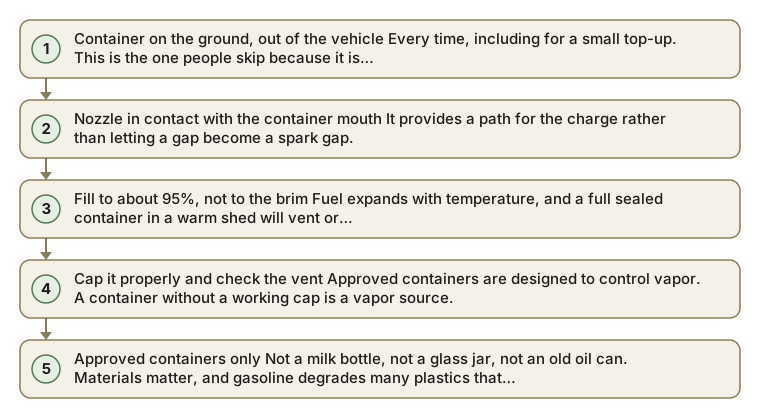
Container on the ground, out of the vehicle
Every time, including for a small top-up. This is the one people skip because it is inconvenient.
-
Nozzle in contact with the container mouth
It provides a path for the charge rather than letting a gap become a spark gap.
-
Fill to about 95%, not to the brim
Fuel expands with temperature, and a full sealed container in a warm shed will vent or bulge.
-
Cap it properly and check the vent
Approved containers are designed to control vapor. A container without a working cap is a vapor source.
-
Approved containers only
Not a milk bottle, not a glass jar, not an old oil can. Materials matter, and gasoline degrades many plastics that look adequate.
Refueling a machine
| Practice | Why |
|---|---|
| Stop the engine and let it cool | A muffler is hot enough to ignite gasoline well after the engine stops. On handheld two-strokes the muffler is a hand’s width from the filler. |
| Refuel outdoors, away from buildings | Vapor released while filling has to go somewhere, and it sinks. |
| Wipe up spills before starting | Fuel on the machine is fuel on a surface that is about to get hot. Move the machine away from the spill as well. |
| Never refuel near an ignition source | Water heaters, pilot lights, cigarettes, a running generator a few feet away, grinding or welding anywhere in the space. |
| Fill on the ground, not on a deck or tailgate | Same static reasoning as filling a container. |
Where fuel may be kept
Store fuel in approved containers, in a detached shed or garage rather than in a living space or a basement, away from any appliance with a pilot light or an ignition source, and out of direct sun. Quantity matters: keeping months of fuel is both a storage hazard and, as stored gasoline explains, a way of guaranteeing that some of it will be stale when it is used.
Local rules govern how much fuel may be stored at a dwelling and in what containers, and they vary. Where a local fire code, a lease or an insurer states a limit, that is the number that applies to you: the guide describes the hazard, not your jurisdiction.
The two-stroke wrinkle
Mixed fuel introduces a labeling problem: two identical red cans, one with straight gasoline and one with 50:1 mix, are indistinguishable. Straight gasoline in a two-stroke seizes it, and the mistake is easy under time pressure.
Label every can with its contents, the ratio and the date it was mixed, in marker, on tape. It takes ten seconds and it removes a expensive category of error: the arithmetic for the mix itself is on the fuel mix calculator.
- Standard Specification for Automotive Spark-Ignition Engine Fuel : ASTM International, ASTM D4814.
- Home fuel storage limits: Bluffdale City Fire Department (Utah), summarizing the 2012 International Fire Code.
Fuel handling and storage: questions
Why must I fill a gas can on the ground and not in my truck bed?
Because fuel flowing through the nozzle builds a static charge, and a container insulated from ground by a plastic bed liner or the tires cannot shed it, so it accumulates until it discharges as a spark at the nozzle, exactly where the vapor is. Setting the container on the ground and keeping the nozzle in contact with its mouth while filling gives the charge a path to ground instead of a spark gap.
Why is gasoline vapor more dangerous than the liquid?
Because gasoline burns as a vapor mixed with air, produces that vapor readily at ordinary temperatures, and the vapor is heavier than air, so it sinks, collects in low spaces and travels along a floor to an ignition source some distance away. A spill at one end of a garage can reach a water heater’s pilot flame at the other, which is why refueling belongs outdoors and away from any pilot light.
Can I refuel a hot engine?
No. A muffler stays hot enough to ignite gasoline well after the engine stops, and on handheld two-strokes the muffler sits a hand’s width from the filler. Stop the engine, let it cool, refuel outdoors away from buildings, wipe up any spill and move the machine away from it before starting.
Refueling a running generator during an outage combines this hazard with carbon monoxide, in the dark, which is worse still.
How should I store gasoline safely, and how much?
In approved containers only, not a milk bottle or glass jar, because gasoline degrades many plastics, filled to about 95 percent to allow for expansion, in a detached shed or garage away from any pilot light or ignition source and out of direct sun. Keep only as much as you will use in about a month; local fire codes, leases and insurers may set a limit, and where they do, that number is the one that applies to you.
Why must a fuel container be filled to only about 95 percent rather than to the very top?
Because gasoline expands with rising temperature, and a container sealed completely full has no room to accommodate that expansion. A full sealed container left in a warm shed will vent, bulge, or in an extreme case fail at a seam, releasing vapor or liquid it was never designed to hold under that pressure.
Does gasoline stored in an approved container still degrade the same way as fuel in a machine's tank?
Yes: the same oxidation and (for ethanol-blended fuel) water-absorption processes covered on the seasonal fuel page apply to gasoline sitting in a storage container as well as fuel sitting in an equipment tank. An approved container protects against leaks and vapor escape; it doesn't slow the chemical degradation of the fuel inside it.
Why is a glass jar specifically dangerous for storing gasoline, beyond not being "approved"?
A glass container can shatter if dropped or knocked, releasing both liquid fuel and a large volume of vapor at once with no controlled venting: approved plastic and metal containers are designed to flex or vent safely under impact or pressure in ways a rigid glass container cannot.
Does the static-charge risk from filling a container in a truck bed apply to filling a machine's tank directly too?
The mechanism is the same (fuel flow generating static charge on an insulated surface), but the practical risk is lower when filling a machine's tank directly on the ground, since the machine itself is typically grounded by contact with the earth the same way a container placed on the ground is. The truck-bed case is specifically dangerous because the bed liner or tires insulate the container from ground.
What should I do if I spill gasoline while refueling a machine?
Wipe up the spill and move the machine away from where it spilled before starting the engine: fuel left on the machine or the ground beneath it is fuel sitting on a surface that is about to get hot, and starting the machine on or near a fresh spill risks igniting vapor from that spill.
Is it safe to smoke near a fuel can that is closed and not actively being used?
No: an approved container is designed to control vapor venting, not eliminate it entirely, so vapor can still escape around a functioning as designed cap and vent in small amounts. Treating any closed fuel container as an ignition-free zone, not just an open one being actively filled, is the safer practice.