Choose and size a generator for the loads and connection
Choose a generator from the loads, their starting demands and the connection you need. Compare continuous ratings on the fuel you will use, then verify transient capability, voltage and outlet limits. Inverter portables and conventional portables still require safe outdoor operation; an installed standby system adds automatic transfer and installation requirements.
Size a stated load scenario
List the input running watts for everything that may operate together. Obtain motor-starting information from the appliance manufacturer or a qualified measurement. Honda’s wattage guide distinguishes approximate running and starting values and tells owners to check their equipment.
For a hypothetical set of 1,800 running watts including a 600-watt motor that needs 1,800 watts to start, one-at-a-time startup needs 1,800 + (1,800 − 600) = 3,000 watts briefly. The running load remains 1,800 watts.
That example assumes the named motor starts alone.
Automatic pumps, refrigeration and thermostats can overlap; do not assume simultaneous starting is impossible. Honda’s power-management guidance describes staggering high-starting loads. A system that cannot enforce that sequence needs a different calculation.
Volts multiplied by amps gives volt-amperes. For AC loads with a power factor below one, that is not necessarily real input watts. Motors and electronic loads also have starting or inrush behavior that a simple running-current multiplication misses.
Choose the operating arrangement
| Format | Decision to verify |
|---|---|
| Conventional portable | Rated output, noise/test load, outlets and transport |
| Inverter portable | Published waveform specification and setting-specific runtime |
| Installed standby | Professional load calculation, transfer, fuel supply and maintenance |
Inverter describes power conversion, not an automatic connection to a house. Standby describes the installed backup arrangement; it is not proof that every circuit can run at once. Use an installer’s load and load-management assessment for the standby system.
Fuel and sockets can reduce usable output
A dual-fuel machine may have a lower propane rating. Size against that rating when using propane. Total generator output does not override the current limit of one receptacle, cord or circuit, and a 120-volt-only machine does not provide a 240-volt pump supply.
Never backfeed through a household outlet. Have an appropriately qualified electrician design any connection to building wiring with approved transfer equipment and required inspection. Use the load calculator and cord calculator as planning aids with their stated limits.
Placement is part of the purchase decision
CPSC’s 2026 guidance says outdoors only, at least 20 feet from homes and buildings, with exhaust away from doors, windows and vents. A CO shutoff does not permit closer placement or use in a garage. Plan a safe site and weather protection that follows the actual manual before an outage.
How to size a generator
A generator purchase is a calculation, not a guess, and it does not require a single manufacturer figure to get right. List the running watts of everything you want on at once, identify the single largest motor in that list, apply a starting multiplier to that one motor, and add headroom: that arithmetic is the whole method, and it is what the generator sizing calculator runs for you. Which type, portable, inverter or standby, fits is a separate question decided by how the power gets used: occasional storm backup, a jobsite, or hands-off whole-house coverage each point at a different machine, for reasons that have nothing to do with which is "better."
The two ratings, and which one you are shopping
A generator is sold on two numbers, running (continuous) watts and starting (surge) watts, and they answer two different questions. Running watts is what has to be available hour after hour for everything you want on at once. Starting watts is a brief allowance for the single largest motor in that list to spin up, because an induction motor draws several times its running current for a second or two as it starts.
Undersize the running figure and the generator cannot carry the load; undersize the starting figure and the largest motor on the list will not start at all, even though everything else runs fine.
-
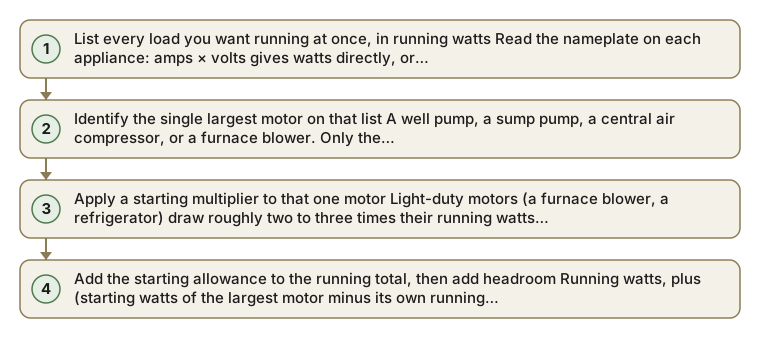
List every load you want running at once, in running watts
Read the nameplate on each appliance: amps × volts gives watts directly, or the nameplate states watts already. Add them up. This total is your running-watt floor.
-
Identify the single largest motor on that list
A well pump, a sump pump, a central air compressor, or a furnace blower. Only the largest one matters for starting watts, because motors virtually never start simultaneously in a home load.
-
Apply a starting multiplier to that one motor
Light-duty motors (a furnace blower, a refrigerator) draw roughly two to three times their running watts for a second or two on start. A hard-starting motor, a deep well pump, a large air-conditioning compressor, can draw substantially more. The generator sizing calculator below works this from the motor type rather than a single fixed number, because the multiplier varies by motor.
-
Add the starting allowance to the running total, then add headroom
Running watts, plus (starting watts of the largest motor minus its own running watts), is the peak the generator must cover for a moment. Running a generator flat out against its rated maximum with nothing in reserve is normal for short peaks but not for the sustained load: leave headroom on the continuous figure for a machine you intend to keep for years.
The generator sizing calculator runs exactly this method from your own load list and motor type. It is the same arithmetic above, worked for you rather than described to you.
Portable, inverter or standby: the use case, not the mechanism
Generator load sizing and connection choices is covered on Compare. What decides which one fits your situation is how the power gets used.
| What you need it for | Fits best | Why |
|---|---|---|
| Occasional storm backup, a few circuits, willing to run extension cords | Portable, conventional | Lowest cost per watt, widely available, no installation. |
| Camping, a jobsite, sensitive electronics, noise matters | Portable, inverter | Clean waveform for electronics, throttles down at light load, quieter: see the portable generators page for the waveform detail. |
| Whole-house backup, hands-off during an outage, away from home often | Standby | An automatic transfer switch starts it and switches the house over with no one present. A cord cannot do that. |
| Frequent outages of several days or more, medical equipment at home | Standby, sized to a load calculation | Sustained running hours favor a machine engineered for continuous duty, installed to NFPA 70 Article 702. |
A generator run in an attached garage, a basement, or near a window or door, even with the door open, can put lethal carbon monoxide into the house. Safety shutoffs do not change the required outdoor placement distance. See generators and carbon monoxide before the first outage.
- Safety and Performance of Portable Generators: Portable Generator Manufacturers Association / ANSI, ANSI/PGMA G300-2018.
- Optional Standby Systems : National Fire Protection Association, NFPA 70 (National Electrical Code), Article 702.
How to size a generator: questions
What is the fastest way to size a generator without a spec sheet?
Add the running watts of everything you want on at once, find the single largest motor in that list, and confirm the generator’s starting-watt rating covers that one motor’s surge at start-up. That arithmetic is the whole method. The generator sizing calculator runs it from your own load list.
Should I buy a portable or a standby generator?
Portable if you are willing to run cords and be present to start it during an outage; standby if you want the house covered automatically, including while you are away, through an automatic transfer switch installed to NFPA 70 Article 702. The mechanism difference is on Compare; the use-case table is the shopping version of that same decision.
Do I need an inverter generator, or is a conventional one fine?
Conventional is fine, and cheaper per watt, for raw backup power where noise and waveform quality do not matter much. Inverter earns its premium specifically when the machine has to sit near the house, run sensitive electronics, or when quiet operation matters: camping and jobsite use are the classic cases.
How much bigger should my generator be than my actual load?
Enough that the largest motor’s starting surge is covered on top of everything else already running, plus a reasonable margin rather than running the machine at its rated maximum continuously. The steps and the calculator both build that margin in rather than leaving it to guesswork.
How big of a generator do I need for a 2,000 sq ft house, or a 3,000 sq ft house?
Square footage does not size a generator. Load does. A 1,200 sq ft house with a well pump and central air can need a bigger generator than a 3,000 sq ft house heated by gas with no well, because the number that matters is what is drawing power, and which single motor has the largest starting surge, not the footprint of the building.
Any figure quoted by square footage alone is a guess with a decimal point. Build your own load list with the generator sizing calculator instead: it takes a few minutes and gives you a real answer for your house rather than a rounded one for an average house that may not be yours.
Is there an easier way to size a generator than listing every appliance by hand?
If the house has a whole-home energy monitor or a utility smart-meter app that shows real-time or peak demand, its recorded peak draw is a genuine, measured number and a useful cross-check against a hand-built load list: real peak use over weeks of normal living, including whichever motors happened to start together, catches combinations a manual list can miss. It is not a replacement for identifying the single largest starting-watt motor by name, because a peak-demand reading only shows a total, not which one device drove it: use the two together rather than either alone.
Should I buy a bigger generator than my calculated load just to be safe?
A modest margin above your calculated running-and-starting total is reasonable, but oversizing dramatically wastes money on a machine sized for a load you'll never draw, and a larger generator also burns more fuel per hour even at partial load. Add the largest motor’s starting demand to the loads that will remain running. Check that the generator can supply both without counting the same starting load twice.
What is the biggest mistake people make sizing a generator by feel instead of by load list?
Sizing against the total wattage printed on the box rather than checking which single appliance has the highest starting surge. A generator can comfortably cover a home's total running wattage and still stall the moment a well pump or air conditioner tries to start, because that one motor's starting demand, not the running total, is what was undersized.
Does the type of generator (portable, inverter, standby) change how I calculate running and starting watts?
No: the running-watts-plus-starting-watts arithmetic is identical regardless of which of the three types you choose; only the engine and alternator design behind that arithmetic differs. Work out your wattage needs first using the load-list method, then choose the type based on how the power will be used.
Can I use a generator sized for occasional storm backup as a primary power source during a long-term outage?
A portable generator sized for occasional backup can run for extended periods mechanically, but the practical limits, refueling every few hours, being present to manage the connection, and running it only outdoors regardless of weather, make it a poor substitute for a sized for the actual load standby system if outages regularly run several days or more, which is exactly the scenario the use-case table routes toward standby instead.
Does altitude affect how I should size a generator?
Engine power output generally decreases at higher altitude due to reduced air density, which can affect a generator's actual delivered wattage compared to its sea-level rating: check the specific manufacturer's altitude derating information if you're at meaningfully high elevation, since the guide's load-list method calculates what you need but doesn't adjust for how altitude affects what a specific machine can deliver.
Should I include future appliances I plan to buy when sizing a generator today?
Building in modest headroom for a specific, planned future appliance is reasonable, but sizing significantly larger for hypothetical future needs trades away the cost and fuel-efficiency benefits of a correctly sized machine today: the guide's method works from your actual current load list, and a larger future need is better addressed by resizing at that point than by overbuying now.
Compare
Portable, inverter and standby generators: three different machines
Not three grades of the same product: three different ways of producing power and connecting it to a building.
A portable, an inverter and a standby generator are not three grades of the same product. They differ in how the waveform is produced, how they connect to a building, and at what point the National Electrical Code stops treating the installation as optional. Conflating them is how people end up buying the wrong machine for how they intend to use it: a portable unit bought to replace a standby installation leaves someone driving home to start it every time the power fails, and a standby system bought where a portable would have done the job spends most of its service life sitting unused on a concrete pad.
The specification comparison lines up the three on the three questions that decide between them, waveform, connection method and code involvement, rather than on wattage, which applies to all three equally and settles nothing about which type to buy.
| Type | Waveform source | How it connects | Code involvement |
|---|---|---|---|
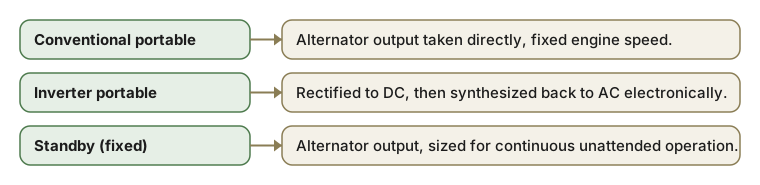
| Conventional portable | Alternator output taken directly, fixed engine speed. | Cords to individual loads, or a manual transfer switch to circuits. | A transfer switch installation is an electrical permit in most jurisdictions. |
| Inverter portable | Rectified to DC, then synthesized back to AC electronically. | Same as conventional: cords, or a transfer switch for circuits. | Same as conventional; the waveform difference does not change the wiring rule. |
| Standby (fixed) | Alternator output, sized for continuous unattended operation. | Permanently wired through an automatic transfer switch (ATS). | NFPA 70 Article 702 and the ATS itself (UL 1008): not a DIY installation. |
The wattage question does not distinguish them
Running-watts-versus-starting-watts is a real distinction (see the Portable generator loads and transfer connections and the sizing calculator), but it applies equally to all three types and does not, by itself, tell you which one to buy. The decision that separates them is whether the generator needs to run unattended while you are away from the property. A portable, by definition, needs a person present to start it, fuel it and manage the connection; a standby unit starts itself on an automatic transfer switch within seconds of a utility outage, whether or not anyone is home.
The point where this stops being a DIY decision
A standby installation is permanently connected to a building's wiring through an automatic transfer switch built to UL 1008, and NFPA 70 Article 702 governs how an optional standby system is installed. Grounding and bonding requirements are Article 250 of the same code. This is inspected work in essentially every jurisdiction, done by a licensed electrician, precisely because the failure mode of getting it wrong is backfeeding a "dead" utility line that a lineworker has every reason to believe is safe to touch.
Nothing is a substitute for that permit and inspection.
A portable or inverter unit connected to house circuits through a manual transfer switch or a listed interlock kit sits in between: still an electrician's job to install correctly, but a smaller, more common project than a fixed standby system with its own concrete pad, automatic transfer switch and permanent fuel line.
Sizing works differently once a unit is standby
A portable generator is sized against a load list you build yourself: the sizing calculator does exactly that. A standby system is sized by an electrician (or the installer's own load calculation) against the panel it is backing up, often the whole panel rather than a chosen subset of circuits, because the automatic transfer switch is wired at the service entrance rather than to individual outlets.
- Safety and Performance of Portable Generators: Portable Generator Manufacturers Association / ANSI, ANSI/PGMA G300-2018.
- Optional Standby Systems : National Fire Protection Association, NFPA 70 (National Electrical Code), Article 702.
- Grounding and Bonding : National Fire Protection Association, NFPA 70 (National Electrical Code), Article 250.
- Standard for Transfer Switch Equipment: UL Standards & Engagement, UL 1008.
- Standard for Safety for Carbon Monoxide (CO) Emission Rate of Portable Generators : UL Standards & Engagement / ANSI, UL 2201, second edition (2018).
Portable, inverter and standby generators: questions
Is an inverter generator worth the extra cost?
It earns the premium when the machine has to sit near a house or power sensitive electronics. The quieter operation and cleaner waveform are real, measurable advantages. A conventional unit is cheaper per watt and available in larger sizes, and is the better value when raw output matters more than noise or waveform quality; see the portable generator page for the running-versus-starting-watts arithmetic behind either choice.
Can I run two inverter generators in parallel?
Only if both units are the same manufacturer’s parallel-capable models connected through that manufacturer’s own parallel kit: the cable and internal synchronization circuitry are not standardized across brands, so two otherwise-identical-looking inverter generators from different makers generally cannot be paralleled safely. Check the specific models’ own documentation before assuming compatibility.
Is there an inverter generator size calculator?
The same generator sizing calculator works for inverter units. The running-versus-starting-watts arithmetic does not change with waveform type, only the engine and alternator design behind it does. Build your load list there regardless of which of the three types in this comparison you end up choosing.
What is the difference between an inverter generator and a non-inverter generator?
A non-inverter (conventional) generator holds its engine at a fixed speed and takes the alternator’s output as-is; an inverter generator rectifies that output to DC and synthesizes the AC waveform electronically, which lets the engine throttle down at light load. That is the whole mechanism behind why inverter units are quieter and more fuel-efficient, and why conventional units remain cheaper per watt.
Is there an inverter generator comparison chart by brand?
What is is the class-level comparison that holds true regardless of brand: waveform, noise and fuel efficiency for inverter against conventional, and the use-case table on the generator buying page for which of the three types, portable conventional, portable inverter, or standby, fits a given situation.
Why is installing a standby generator not a weekend DIY project the way a portable one can be?
Because a standby unit is permanently wired into a building through an automatic transfer switch built to UL 1008, and NFPA 70 Article 702 governs that installation as inspected electrical work in essentially every jurisdiction. Getting it wrong risks backfeeding a "dead" utility line that a lineworker has every reason to believe is safe to touch: a portable unit connected by cords or a manual transfer switch carries a smaller, though still real, version of the same risk.
Does a standby generator get sized the same way as a portable one?
No: a portable generator is sized against a load list you build yourself, which the generator sizing calculator does directly. A standby system is sized by an electrician or the installer's own load calculation against the panel it backs up, often the entire panel rather than a chosen subset of circuits, because its automatic transfer switch is wired at the service entrance rather than to individual outlets.
Does the wattage question, running versus starting watts, decide between portable, inverter and standby?
No, running-versus-starting-watts is a real distinction, but it applies equally to all three generator types and settles nothing about which type to buy. What separates the three is whether the generator needs to run unattended while you're away from the property, which only a standby unit with an automatic transfer switch does.
Can a portable generator be converted into a standby system later?
Not by upgrading the generator itself: a standby system requires its own permanently wired automatic transfer switch built to UL 1008 and the NFPA 70 Article 702 installation that goes with it. A portable unit can be connected through a manual transfer switch or listed interlock kit as an intermediate step, but that remains a manually operated system, not an automatic standby installation.
What is the difference between grounding requirements for a portable generator and a standby system?
A standby system's grounding and bonding requirements fall under NFPA 70 Article 250, enforced as part of the same permitted installation as the transfer switch itself. A portable generator connected by cords generally does not trigger the same fixed-installation grounding review, though its own manual still specifies grounding requirements for safe operation.
Does an inverter generator's cleaner waveform matter for a standby installation the same way it does for a portable one?
The waveform distinction between inverter and conventional generation applies the same way regardless of whether the unit is portable or standby, but most fixed standby systems use conventional alternator output sized for continuous unattended operation rather than an inverter design, since standby units prioritize sustained output capacity over the noise and fuel-efficiency benefits an inverter offers.
Does a carbon-monoxide shutoff standard like UL 2201 apply to standby generators as well as portable ones?
UL 2201 addresses portable generator carbon-monoxide shutoff specifically; a sited according to its installation requirements standby unit is installed outdoors, away from occupied structures, as part of its NFPA 70 Article 702 permitted installation, which is a different mechanism for preventing CO exposure than the automatic engine shutoff a portable unit's UL 2201 certification provides.
Portable generators
A portable generator is sold on two wattage numbers that mean different things, and only one of them is a rating. Running watts is what the machine will produce hour after hour; starting watts is a brief peak available while a motor spins up, and it is the number printed largest on the box. Choosing between machines means comparing the running figures, then checking that the starting figure covers the single largest motor you intend to start.
Beyond the wattage there are four decisions that matter: inverter or conventional, gasoline or dual fuel, which outlets are fitted, and whether the unit carries a carbon monoxide shutoff.
The two wattage numbers, and why only one of them is a rating
Every portable generator carries two figures. Running watts (also sold as rated or continuous watts) is what the machine will produce indefinitely. Starting watts (surge or peak) is what it can produce for a second or two while a motor spins up.
The running figure is the rating; the starting figure is a tolerance. A machine advertised as "5,500 watts" on the front of the box and 4,500 running on the label is a 4,500 watt generator.
This matters because the load that decides your purchase is usually a single motor. A well pump or an air-conditioning compressor can draw several times its running current for the moment it starts, and a generator that comfortably carries the house can still stall the instant the pump kicks in. The generator sizing calculator works both numbers from a load list and reports them separately, because sizing on the total alone is the common and expensive mistake.
| Specification | What it means | What to watch |
|---|---|---|
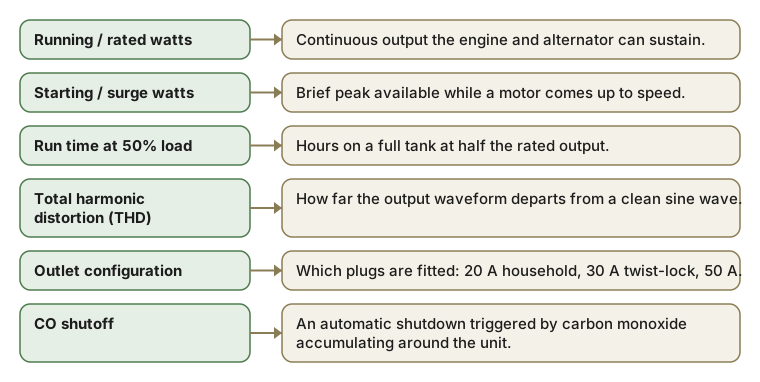
| Running / rated watts | Continuous output the engine and alternator can sustain. | This is the rating. Compare machines on this number only. |
| Starting / surge watts | Brief peak available while a motor comes up to speed. | Marketing leads with it. It cannot run anything for more than a moment. |
| Run time at 50% load | Hours on a full tank at half the rated output. | A different load changes it completely. At full load, expect substantially less. |
| Total harmonic distortion (THD) | How far the output waveform departs from a clean sine wave. | Published by inverter manufacturers, often omitted by conventional ones. Absence is itself informative. |
| Outlet configuration | Which plugs are fitted: 20 A household, 30 A twist-lock, 50 A. | A generator you cannot connect to is not a generator. Check this against your cords and inlet. |
| CO shutoff | An automatic shutdown triggered by carbon monoxide accumulating around the unit. | Present on units built to the current voluntary standards. Not universal on older stock. |
Inverter and conventional units are different machines
A conventional generator turns an alternator at a fixed engine speed and takes whatever waveform comes out. An inverter generator rectifies the alternator output to DC and then synthesises the AC waveform electronically, which decouples engine speed from output frequency. Two consequences follow, and they are the whole reason the category exists.
First, the engine can throttle down when the load is light instead of holding a fixed speed, which is why inverter units are quieter and use less fuel at part load. Second, the waveform is produced rather than inherited, so manufacturers publish a total harmonic distortion figure for it. Conventional units are simpler, cheaper per watt and generally available in larger sizes; inverter units are lighter for the same output and are what people buy when the machine has to sit near a house or run a laptop.
Dual fuel: what propane costs you
A dual-fuel machine runs on gasoline or propane. Propane stores indefinitely, does not gum a carburetor and does not need a stabilizer, which makes it the better fuel for a generator that sits unused for a year at a time. The trade is output: propane carries less energy per unit volume delivered to the cylinder, and manufacturers publish a lower wattage rating for propane operation than for gasoline on the same machine.
Size against the propane figure if propane is what you intend to use, not the gasoline one on the front of the box.
Carbon monoxide from a portable generator has killed people who ran one in an open garage, on a covered porch, or outside a window. It is odorless and the onset is confusing rather than dramatic. Two voluntary standards, ANSI/PGMA G300 and UL 2201, require an automatic shutoff when CO accumulates around the unit, and a 2022 CPSC staff comparison found UL 2201's approach, which combines the shutoff with reduced engine-out CO, more effective than the shutoff alone.
CPSC proposed a mandatory standard in April 2023. A shutoff is a backstop, not a permission: outdoors, well away from the building, is still the only correct place to run one.
Connecting it to the house
There are two legitimate ways to power circuits in a building from a portable generator: a manual transfer switch, or a listed interlock kit on the main panel. Both are installed by an electrician, and both physically prevent the generator and the utility supply from being connected at the same time. That interlock is the point of the exercise.
A generator connected to house wiring while the utility feed is live pushes power back up the service drop and through the transformer, where it can kill a lineworker who has every reason to believe the line is dead.
The third method, a double-ended cord into a wall outlet, is what the two legitimate methods exist to prevent. Everything else is cords: size them with the extension cord gauge calculator, because a long, thin cord starves a motor and heats up doing it.
What a generator needs between outages
Generators fail at the moment of use more often than any other machine here, and almost always for the same reason: fuel left in a carburetor for a year. Gasoline oxidises, the light fractions evaporate and what remains varnishes the small passages in a carburetor bowl.
If you store one with gasoline in it, the fuel needs stabilizer and the machine needs running under load for long enough to circulate it. If you would rather not think about it, run the carburetor dry and store it empty: the approach set out on winter storage.
A generator that has sat for a season and will not start is covered in engine will not start.
- Safety and Performance of Portable Generators: Portable Generator Manufacturers Association / ANSI, ANSI/PGMA G300-2018.
- Standard for Safety for Carbon Monoxide (CO) Emission Rate of Portable Generators : UL Standards & Engagement / ANSI, UL 2201, second edition (2018).
- Safety Standard for Portable Generators (notice of proposed rulemaking): U.S. Consumer Product Safety Commission / Federal Register, 88 FR, published April 20, 2023.
- National Electrical Code, Chapter 9, Table 8: Conductor Properties (DC resistance at 75 °C) : National Fire Protection Association, NFPA 70, Chapter 9, Table 8.
Portable generators: questions
What is the difference between running watts and starting watts?
Running watts (also called rated or continuous) is what the machine produces hour after hour, and it is the true rating. Starting watts (surge or peak) is a brief tolerance available for a second or two while a motor comes up to speed. A unit sold as 5,500 starting and 4,500 running is a 4,500-watt generator; compare machines on the running figure only, then check the starting figure covers your biggest motor.
How many watts of generator do I need for my house?
There is no single number: it depends on what runs at once and, more importantly, on the single largest motor that has to start. Add the running watts of everything you want on together, then confirm the generator’s starting-watt figure covers the biggest motor, such as a well pump or an air-conditioning compressor, at the instant it spins up. The generator sizing calculator works both numbers from a load list.
Are inverter generators worth the extra cost?
They earn it when the machine must sit near a house or run electronics. An inverter unit throttles its engine down at light load, so it is quieter and burns less fuel, and it synthesizes a cleaner waveform with a published total-harmonic-distortion figure. A conventional unit is cheaper per watt and available in larger sizes, and is the better value when raw output matters more than noise or waveform quality.
Can I plug a generator into a wall outlet to power the house?
No. A double-ended cord back-feeds the house wiring and pushes power up the utility line, where it can electrocute a lineworker who believes the line is dead. The only legitimate connections are a manual transfer switch or a listed panel interlock, both installed by an electrician and both built so the generator and the utility supply can never be energized at the same time.
Why does my dual-fuel generator make less power on propane?
Propane delivers less energy per unit reaching the cylinder than gasoline, so manufacturers publish a lower wattage rating for propane operation on the same machine. If propane is the fuel you plan to store and run, size the generator against its propane figure rather than the gasoline number printed on the front of the box, or the unit will fall short when you need it.
Is it safe to run a generator in a garage or on a porch?
No. Carbon monoxide from the exhaust is odorless and accumulates in any partly enclosed space, and it has killed people running units in open garages and under covered porches. Even a unit with an ANSI/PGMA G300 or UL 2201 carbon-monoxide shutoff must be run well away from the building.
The shutoff is a backstop, not permission to run it closer.
What size portable generator is needed for a home?
Size it in running watts, not the larger surge number printed on the box: add the running watts of everything you want on at once, then confirm the starting-watt figure covers your single largest motor, a well pump or an air-conditioning compressor, at the instant it starts. There is no one-size-fits-most answer for a home, because the largest motor in the house sets the floor regardless of total wattage; the generator sizing calculator works both numbers from a load list.
Should I get, or do I really need, an inverter generator, or is a regular one fine?
A "regular" (conventional) generator runs its engine at a fixed speed regardless of load, which is simple and cheaper per watt but louder and thirstier at light load. An inverter generator throttles down when demand is low, so it is quieter and more fuel-efficient, and it synthesizes a cleaner waveform with a published total-harmonic-distortion figure that suits sensitive electronics. Conventional units are available in larger sizes for a given price; inverters earn their premium specifically on noise, fuel use and waveform quality, if none of those three matter for your use, raw output at the lowest cost per watt from a conventional unit is the more plain answer, not a brand.
Do inverter generators have electric start?
Some do and some do not. Electric start is available across both inverter and conventional generators as a step up from recoil pull-start, but it is not universal within either category, and it adds weight and cost specifically from the extra starting battery and starter motor. Check the specific machine’s own listing rather than assuming a class-wide default; a small, portable inverter unit is more likely to skip electric start to save weight than a larger conventional unit is.
Do I need an inverter-style generator for my RV?
For most RV use, yes, and for a specific reason: an inverter generator’s clean waveform (a low total-harmonic-distortion figure) is what modern RV electronics, inverters, converters, sensitive appliance electronics, are built to expect, where a conventional generator’s rougher waveform can cause nuisance faults or, in some documented cases, damage. Weight and noise also matter more for towing and campground quiet hours than they do for home backup, which further favors the inverter category for this specific use even before the waveform question.
How much does a portable generator weigh?
Weight scales with rated output and fuel type, roughly from around 50 pounds for a small inverter unit to well over 200 pounds for a large conventional unit with a full fuel tank, and no single figure covers the category because frame material, fuel-tank size and running-watt rating all move it independently. The number that matters for a given machine is on its own data plate and spec sheet, not a category average.
How much does a portable generator cost?
Price tracks rated running watts, waveform type and fuel system more than brand: a small inverter unit sits at one price band, a mid-size conventional unit at another, and a large dual-fuel or high-output unit at another again, and all three shift with the market. A published number would go stale; use the sizing calculator to settle the running-watt figure you need, then compare current retail prices for machines at that rating.
What is a good guide to buying a portable generator for home use?
Settle the running-watt figure first with the sizing calculator, confirm the starting-watt figure covers your single largest motor, decide whether you need the quieter, lighter inverter category or the cheaper-per-watt conventional one, and check the outlet configuration matches the cords or transfer switch you already have.
Do portable generators need to be grounded, or do I need to ground one myself?
It depends on the connection. A generator run through a installed to the applicable requirements transfer switch or interlock is bonded to the system per NFPA 70, and separate grounding is normally handled by that installation. A generator used stand-alone with cord-and-plug connected equipment generally does not need a separate ground rod under the National Electrical Code’s current generator provisions, but always follow the manufacturer’s own grounding instructions on the unit, which govern regardless of the general rule.
What size generator do I need to run a heat pump?
Size it on the compressor’s starting watts specifically, not the running watts of the house as a whole: a heat pump compressor is a hard-starting motor that can draw substantially more than a light-duty motor like a refrigerator for the second or two it takes to spin up, and undersizing that one figure means the heat pump will not start even though everything else on the generator runs fine. Get the compressor’s locked-rotor or starting-current figure from its nameplate or installer and size the generator’s starting-watt capacity against that number specifically.
How many hours will a portable generator last?
Maintenance drives the real answer more than the machine does. Stale fuel, low oil and a neglected air filter can cause faults before the engine’s other parts wear out.
Compare the storage record and specified service schedule when assessing two otherwise identical generators. What determines it: fuel handled correctly every time it goes into storage (see winter storage), oil and filters changed on the engine’s hour-based schedule, and the unit run periodically under real load rather than left completely idle for a year or more between outages.
How often should I start or run a portable generator, even without an outage?
Running it briefly every month or two under an actual load, not just idling, keeps the carburetor from varnishing with stale fuel and confirms the unit still starts before you need it in an outage. This is the portable equivalent of the automatic weekly exercise cycle a standby unit runs on its own; a portable has no automation to do it for you, so it depends on the owner remembering.
How often does a portable generator need servicing?
On the engine’s hour-based schedule stated in its manual, generally an oil change within the first 20 to 30 hours (break-in) and then roughly every 50 to 100 hours or annually thereafter, whichever comes first, alongside the air filter and spark plug: the same small-engine service pattern as any other machine. A generator that sits idle most of a year but is run occasionally under load should still be serviced on the calendar side of that schedule, since fuel and oil degrade over time independent of hours run.
Is a portable solar generator the same thing as a gas generator?
No: a "portable solar generator" is marketing language for a battery power station: a large battery pack with an inverter and outlets, optionally recharged by a solar panel, with zero combustion, zero exhaust and zero running noise. It has no engine, no fuel, and none of the carbon-monoxide risk covered elsewhere, but it also stores a fixed amount of energy rather than producing power continuously, so its capacity (in watt-hours) rather than a running-watts figure is what limits how long it can carry a load: closer to the battery-and-cordless-equipment platform math than to a fuel-burning generator.
What size is a Predator 3500 or Predator 9500 inverter generator, and how much is a Generac portable?
Brand or model-specific size, spec or price figures for Predator, Generac or any other maker, portable or standby, aren't tracked here: see how we compare machines for why. The running-and-starting-watts method, worked through the generator sizing calculator, gives the wattage figure to shop against regardless of which brand’s specific models you compare it to.
What counts as a mid-size inverter generator?
Roughly 2,000 to 4,000 running watts is the practical middle band: above the sub-2,000-watt class built for camping and light electronics, and below the 5,000-watt-and-up class that starts approaching conventional-generator territory in weight and price. It is a useful sizing shorthand but not a spec to shop on directly; the running-and-starting-watts method above, from your own load list, is what settles the number.
What size generator do I need for a home with 60-amp electrical service?
An older 60-amp panel is itself the limiting factor for how much a portable generator connected through it can realistically deliver, independent of how big a generator you buy. The interlock or transfer switch and the panel’s own rating cap what can safely flow regardless of generator wattage. A load calculation still decides the generator size the same way it does for any panel; on a 60-amp service, confirm with an electrician whether the panel itself needs upgrading before sizing the generator around it, since a bigger generator cannot exceed what an undersized panel is rated to carry.