Generator sizing calculator: running reserve and one-motor start
Add real running watts for the loads operating together, include the selected motor within that total, and choose an assumed starting multiplier and running reserve. The calculator reports continuous demand and one modeled motor start. Verify actual starting VA, power factor and simultaneous starts before selecting equipment.
Calculate two requirements separately
Continuous demand = running total × (1 + reserve). Modeled starting demand = running total − selected motor running watts + selected motor running watts × multiplier. A motor entry greater than the total is rejected instead of silently changed.
For 2,400 running watts including an 800-watt motor, assumed ×3 start and 20-percent reserve: continuous demand is 2,880 watts; modeled start is 1,600 + 2,400 = 4,000 watts. With 3,200 watts of resistive load, no motor and 10-percent reserve, continuous demand is 3,520 watts and the modeled start is 3,200 watts.
VA and watts are different inputs
For a single-phase load, volts × amps gives VA; real watts also depends on power factor. Locked-rotor amps × volts similarly describes apparent starting demand rather than a direct real-watt figure. Do not enter VA as measured watts and assume the result resolves alternator starting capability.
Honda’s generator wattage calculator distinguishes running and starting loads. The EU2200i manual separately states rated and maximum output. Use the actual model, fuel and outlet ratings rather than comparing the result with the largest number on a label.
Check what can start together
The one-motor case is an assumption, not a claim that motors cannot restart together after an outage. Use an appliance load study or qualified assessment where concurrent starts, 240-volt loads or building circuits matter. A reserve percentage does not resolve every starting condition.
Operate portable generators outdoors at least 20 feet from buildings with exhaust away from openings. Follow CO precautions and use suitable transfer equipment for a building connection.
Generator sizing
A generator is sold on two wattage numbers and people size against the wrong one. Running watts is the continuous rating. What the machine will produce hour after hour.
Starting watts is a momentary peak available while a motor spins up, and it is the number printed largest on the box. The trap is that a single motor usually decides the purchase: a well pump or an air-conditioning compressor draws several times its running current for the second or two it takes to come up to speed, so a generator that comfortably carries the whole house can still stall when the pump kicks in. This tool works both numbers from a load list, assumes one motor starts at a time, and reports which of the two is binding.
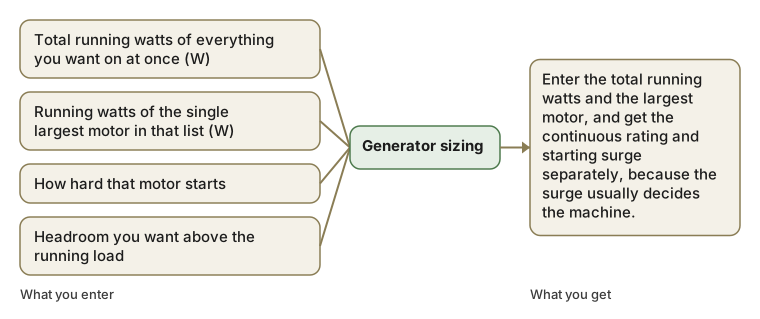
Add up the running wattage of everything you want on at once: the figure a nameplate gives directly, or volts multiplied by amps. Then enter, separately, the running wattage of the single largest motor in that list, and how hard it starts.
Why only one motor is counted as starting
Sizing for every motor starting simultaneously buys a much larger generator than the job needs, because in practice motors do not start together, and where they might, staggering them by hand is free. The calculation therefore assumes the worst single motor starts while everything else is already running, which is the realistic worst case.
If two motors can start together in your setup, add the second motor’s surge to the result by hand rather than inflating the start factor, which would distort the continuous figure as well.
Getting a running figure off a nameplate
| What the plate says | How to convert it | Watch for |
|---|---|---|
| Watts (W) | Use it directly. | Some plates state a maximum rather than a normal running figure. |
| Amps and volts | Multiply them: 15 A × 120 V = 1,800 W. | Use the running amps, not any locked-rotor (LRA) figure printed beside them. |
| Volt-amps (VA) with a power factor | Multiply: VA × power factor = watts. | Without a stated power factor, treating VA as watts is the conservative direction. |
| Locked-rotor amps (LRA) | LRA × volts gives the starting watts for that motor directly. | This beats any multiplier. Use it if you have it. |
| Horsepower (hp) | A rough conversion is 1 hp ≈ 746 W of output, before motor efficiency losses. | Output, not input. The electrical draw is higher and the nameplate amps are the better number. |
Where the start factor comes from
An induction motor draws locked-rotor current until it reaches speed. The multipliers here are planning figures: a resistive load is ×1, a lightly loaded motor around ×2, a typical pump or small compressor around ×3, and a motor starting against pressure, a deep well pump, an air conditioner, ×5 or more. If a nameplate gives locked-rotor amps, that figure times the voltage beats any multiplier on this page.
Generator starting-load arithmetic
The formula
Two separate numbers decide whether a generator can do a job, and a machine is advertised on both.
Continuous running watts is the total of everything on at once, plus the
headroom you chose:
running total × (1 + headroom)
Starting watts is the momentary peak. Only one motor is assumed to start
at a time, because in practice they rarely start together and sizing for simultaneous
start-up buys a much larger generator than the job needs:
(running total − largest motor) + (largest motor × start factor)
Where the start factor comes from
An induction motor draws locked-rotor current until it comes up to speed. The multiplier is a planning figure, not a measurement of your motor: a resistive load is ×1, a lightly loaded motor is around ×2, a typical pump or small compressor around ×3, and a motor that has to start against pressure, a deep well pump, an air conditioner compressor , can reach ×5 or more. If the nameplate gives locked-rotor amps (LRA), that number times the voltage is better than any multiplier here.
Running loads and starting surges
- Only one motor starts at a time. If two motors can start together, add the second motor’s surge by hand.
- Watts are treated as real power. Where a nameplate gives volt-amps and a power factor, the running figure is volts × amps × power factor.
- Altitude and temperature reduce what an engine can produce; many manufacturers de-rate output roughly 3% per 1,000 ft above sea level.
- The result is a size to shop for, not an instruction to load a generator to its limit.
Generator-load example
Given: Fridge, sump pump, furnace blower, a few lights and a laptop: 2,400 W running in total, of which the sump pump is 800 W running and starts standard (×3), with 20% headroom.
Work: Continuous = 2,400 × 1.20 = 2,880 W. Starting = (2,400 − 800) + (800 × 3) = 1,600 + 2,400 = 4,000 W.
Result: Shop for roughly 2,900 running watts and at least 4,000 starting watts: the surge, not the running total, is what rules out a 3,000 W machine.
Given: Two 1,500 W space heaters and lights, 3,200 W running, no motors, 10% headroom.
Work: Continuous = 3,200 × 1.10 = 3,520 W. Starting = 3,200 + 0 = 3,200 W.
Result: A purely resistive load needs no surge allowance at all, so the running number is the one that matters.
When service wiring needs an electrician
- Connecting a generator to house wiring is electrician work. A transfer switch or a listed interlock kit is the only correct method; a double-male cord into a wall outlet is not.
- Carbon monoxide from a portable generator is odorless and has killed people who ran one in a garage with the door open, on a porch, or outside a window.
- If the total you need is above about 8,000–10,000 W, price a permanently installed standby unit before a very large portable one: the fuel, noise and handling of a big portable is often the deciding factor.
Generator sizing: source values
- Safety and Performance of Portable Generators (ANSI/PGMA G300-2018): Portable Generator Manufacturers Association / ANSI, ANSI/PGMA G300-2018. Retrieved 2026-09-02.
Calculator version 1.0.0. Saved results record this version and your inputs, so a later formula change never rewrites an old result.
Generator sizing: questions
How do I calculate what size generator I need?
Add the running watts of everything you want on at once, then enter separately the running watts of the single largest motor and how hard it starts. The tool returns the continuous rating and the starting surge separately and tells you which is binding, usually the surge, because one motor like a well pump or an air-conditioning compressor draws several times its running current for the second or two it takes to come up to speed.
Why does the sizing calculator only count one motor as starting?
Because sizing for every motor starting at once buys a far larger generator than the job needs. In practice motors do not start together, and where they might, staggering them by hand is free. It assumes the worst single motor starts while everything else already runs, which is the realistic worst case.
If two can start together, add the second motor’s surge by hand rather than inflating the start factor.
How do I find an appliance wattage for generator sizing?
From the nameplate. Watts can be used directly; amps times volts gives watts, so 15 A at 120 V is 1,800 W; volt-amps times the power factor gives watts. Use the running amps, not any locked-rotor figure printed beside them: although locked-rotor amps times volts gives that motor’s starting watts directly and beats any multiplier on the page if you have it.
What is the difference between running and starting watts when sizing?
Running watts is the continuous rating the machine sustains hour after hour; starting watts is a brief peak available while a motor spins up. You size so the running total is comfortably covered and the starting figure covers your single largest motor as it starts against everything else already running. The starting requirement is usually the one that decides which machine you need.
What is locked-rotor amps (LRA), and why does it beat the calculator's start-factor multipliers?
Locked-rotor amps is the current a motor draws the instant it starts, before it reaches speed, and multiplying it by voltage gives that motor's starting watts directly. The calculator's multipliers, roughly ×2 for a lightly loaded motor, ×3 for a typical pump or small compressor, ×5 or more for a motor starting against pressure, are planning figures for when you don't have LRA; a nameplate's actual LRA figure is always more accurate than any of them.
How do I convert horsepower to watts for generator sizing?
A rough conversion is 1 hp ≈ 746 W, but that figure is the motor's mechanical output, not its electrical draw: the nameplate amps, once you multiply by voltage, give the better number for sizing because they reflect motor efficiency losses that the horsepower figure alone omits.
What if two motors in my setup might start at the same time?
Add the second motor's starting-watt surge to the calculator's result by hand rather than inflating the start-factor multiplier, since inflating the multiplier would distort the continuous running-watt figure as well as the starting figure. The calculator's default assumption, that only the single worst motor starts while everything else is already running, is the realistic case for most setups, but you know your own equipment better than a general assumption does.
Does the generator sizing calculator account for a generator's fuel type?
No: it works from the load list you enter and returns running and starting watts independent of fuel. A dual-fuel generator's propane rating is typically lower than its gasoline rating, covered on the portable generators equipment page, so size against whichever fuel you plan to run once you have your wattage totals from this tool.
Is a volt-amps (VA) rating the same as watts for generator sizing?
Only when multiplied by the load's power factor: VA on its own overstates the real power a resistive-only conversion would suggest. Without a stated power factor on the nameplate, treating VA as watts directly is the conservative (safer) direction, since it will not undersize the generator.
Why does a well pump or air conditioner need special attention when sizing a generator?
Because both are motors starting against existing pressure or resistance, which the calculator's multiplier table puts at roughly ×5 or more of their running watts: the highest category. A generator that comfortably covers a home's total running load can still stall the instant one of these motors kicks in if the starting figure wasn't checked separately.
Can this calculator size a generator for a job site instead of a home?
Yes: the same two-number approach applies to any load list, whether it's household appliances or job-site tools. Add the running watts of everything that will run together, identify the single largest motor (often a compressor or a large power tool), and enter its starting behavior the same way.