Pressure-washer nozzle calculator: orifice number and flow
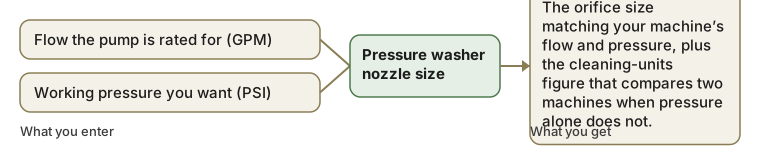
Enter US gallons per minute and the intended pressure in PSI. Nozzle number = GPM × √(4,000 ÷ PSI).
It describes a flow convention, not a hole diameter. Use the result to check the manufacturer’s approved nozzle, connector, pressure and spray angle.
Choose from the chart without rounding smaller
General Pump’s service reference defines the common nozzle-number convention as flow at 4,000 PSI. Its 2021 chart lists flow across pressures and nozzle numbers.
For 4 GPM at 3,000 PSI, the exact number is 4 × √(4,000 ÷ 3,000) = 4.62. Among the tool’s listed sizes, 5.0 is the first at or above that value.
Under the ideal constant-flow model, size 5 gives 4,000 × (4 ÷ 5)² = 2,560 PSI. Size 4.5 would instead model about 3,160 PSI, above the entered pressure.
| Nozzle number | Modeled pressure |
|---|---|
| 4.5 | About 3,160 PSI |
| Calculated 4.62 | About 3,000 PSI |
| 5.0 | 2,560 PSI |
Keep pressure and cleaning claims separate
PSI × GPM is an arithmetic comparison. Two machines at 6,000 by that product do not necessarily clean equally fast or safely. Surface, nozzle geometry, distance and the actual pump operating point matter.
Nozzle color can identify a fan convention in a particular set, but does not establish orifice number or surface safety. Read its markings. The tool declines stock-size advice outside its 1.5-to-10 comparison range; it does not return the nearest unsuitable endpoint.
A larger number is not automatic fitment approval. Never exceed the lowest component rating or change a pressure-control setting to compensate for a nozzle mismatch.
See low-pressure diagnosis for a fault, and stop for any damaged pressure part. Suspected injection injury needs emergency medical attention.
Pressure washer nozzle size
A pressure-washer nozzle size number is not a diameter. It is the flow in US gallons per minute that the orifice passes at 4,000 PSI, which is what makes sizes comparable across brands. Rearranged for the machine you own, the size you need is your flow multiplied by the square root of 4,000 divided by your working pressure.
Getting it wrong matters in both directions: an undersized orifice raises pump pressure, which shows up as a chattering unloader valve, a hot pump and a burst hose long before it shows up as better cleaning, while an oversized one drops pressure and wastes your afternoon. The tool also reports cleaning units, which is pressure multiplied by flow and the plain way to compare two machines.
Enter the flow the pump is rated for, from the machine’s rating plate, and the pressure you intend to work at: either the machine’s rating or a lower working pressure when the task needs a gentler spray.
The color on the nozzle is an angle, not a size
Red is 0°, yellow 15°, green 25°, white 40°, and black is the soap nozzle. Every colored nozzle in a set for one machine shares the same orifice size and differs only in fan width. The black one is the exception.
It has a much larger orifice, which is what drops the pressure enough for the detergent injector to draw, and it is why soap only siphons with that nozzle fitted.
Cleaning units, and why PSI alone misleads
Pressure breaks the bond between the dirt and the surface; flow carries the dirt away and covers ground. A 3,000 PSI machine at 2.0 GPM and a 2,000 PSI machine at 3.0 GPM are both 6,000 cleaning units, and the higher nominal flow can matter for rinsing, but this arithmetic alone does not establish the cleaning time. That is the comparison the marketing does not lead with.
The common machines, worked
| Machine | Exact size | Nearest stock | Cleaning units |
|---|---|---|---|
| 1.5 GPM at 1,600 PSI: small electric | 2.37 | 2.5 | 2,400 |
| 2.0 GPM at 2,000 PSI: large electric | 2.83 | 3.0 | 4,000 |
| 2.5 GPM at 2,800 PSI: domestic gasoline | 2.99 | 3.0 | 7,000 |
| 3.0 GPM at 3,000 PSI: heavy domestic | 3.46 | 3.5 | 9,000 |
| 4.0 GPM at 4,000 PSI: light commercial | 4.00 | 4.0 | 16,000 |
Note the third and fourth rows: a 2,800 PSI machine at 2.5 GPM and a 3,000 PSI machine at 3.0 GPM are one stock nozzle size apart and nearly 30% apart in cleaning units. Pressure alone would have told you they were near-identical.
Nozzles are a consumable
An orifice wears open. A worn nozzle passes more water at lower pressure, which is the usual reason an older machine feels progressively weaker for no apparent cause, and it is a cheaper thing to replace than anything else on the machine.
If output has faded, try a known-good nozzle before you take a pump apart. The rest of that diagnosis is on a pressure washer with no pressure.
Pressure-washer nozzle arithmetic
The formula
A pressure-washer nozzle size number is not a diameter. It is the flow in US gallons per minute that the orifice passes at 4,000 PSI, which is why sizes can be compared across brands. Rearranged for the machine you own:
nozzle size = GPM × √(4000 ÷ PSI)
The second figure, cleaning units, is simply PSI × GPM. It exists because
pressure alone is a poor comparison: a 3,000 PSI machine at 2.0 GPM and a 2,000 PSI machine
at 3.0 GPM do the same 6,000 cleaning units of work, and the lower-pressure, higher-flow one
will rinse a driveway faster.
What the color on the nozzle means
The color is the spray angle, not the size: red 0°, yellow 15°, green 25°, white 40° and black the low-pressure soap nozzle. Angle and orifice size are independent: a set of five nozzles for one machine shares one orifice size and differs only in fan angle. The black soap nozzle has a much larger orifice, which is what drops the pressure enough for the detergent injector to draw.
Rated flow and pressure
- US gallons per minute and pounds per square inch.
- The nozzle-size convention is flow at 4,000 PSI, which is the standard used across the industry.
- A stock size list from 1.5 to 10.0 covers consumer and light commercial machines. Larger orifices exist for industrial equipment.
- The result assumes an unrestricted nozzle. A worn orifice passes more flow and produces less pressure, which is the usual reason an older machine feels weak.
Nozzle-size example
Given: A 4.0 GPM machine to be run at 3,000 PSI.
Work: 4.0 × √(4000 ÷ 3000) = 4.0 × 1.1547 = 4.62.
Result:A 5.0 orifice is the first listed size at or above 4.62; 4.5 would be below the calculated number. Cleaning units: 3,000 × 4.0 = 12,000.
Given: A 2.5 GPM machine at 2,000 PSI.
Work: 2.5 × √(4000 ÷ 2000) = 2.5 × 1.4142 = 3.54.
Result: A 3.5 orifice. Cleaning units: 2,000 × 2.5 = 5,000.
When nozzle or pump ratings do not match
- A nozzle smaller than the calculated size raises pump pressure, which shows up as an unloader valve chattering, a hot pump or a burst hose before it shows up as better cleaning.
- Never point the wand at a person, an animal, or an electrical fitting, and never use a zero-degree nozzle on wood, siding or a vehicle.
Calculator version 1.0.0. Saved results record this version and your inputs, so a later formula change never rewrites an old result.
Pressure washer nozzle size: questions
How do I choose the right pressure washer nozzle size?
The size number is the flow in gallons per minute the orifice passes at 4,000 PSI, so for your machine it is your rated flow times the square root of 4,000 divided by your working pressure. Enter the pump’s rated flow and the pressure you intend to work at and the tool returns the exact size and the first listed size at or above the calculated number. The colored nozzles in a set share that size and differ only in spray angle.
What do the pressure washer nozzle colors mean on the calculator?
They are spray angles, not sizes: red 0 degrees, yellow 15, green 25, white 40, and black the soap nozzle. Every colored nozzle in a machine’s set shares the same orifice size and differs only in fan width. The black one is the exception, with a much larger orifice that drops the pressure enough for the detergent injector to draw, which is why soap only siphons with the black nozzle fitted.
What are cleaning units and why do they matter more than PSI?
Cleaning units are pressure multiplied by flow, and they are the plain way to compare two machines because pressure alone misleads. Pressure breaks the bond between dirt and surface; flow carries the dirt away and covers ground. A 3,000 PSI machine at 2.0 GPM and a 2,000 PSI machine at 3.0 GPM are both 6,000 cleaning units, and that equal product still does not establish the rinsing time, surface safety or nozzle behavior.
Why does my pressure washer feel weaker as it gets older?
Usually a worn nozzle. An orifice wears open over time, and a worn nozzle passes more water at lower pressure, so the machine gradually loses pressure for no apparent reason, and a nozzle is cheaper to replace than anything else on the machine. If output has faded, try a known-good nozzle of the correct size before taking the pump apart looking for a bigger fault.
Why is 4,000 PSI used as the reference pressure for nozzle sizing, when most machines run lower?
It is an industry-wide convention for defining a nozzle's size number, not a claim about your machine's actual pressure. Because every nozzle maker sizes against the same 4,000 PSI reference, sizes stay comparable across brands even though almost no consumer machine runs that high: the calculator converts that reference size to the size appropriate for your machine's real working pressure.
What happens if I use a pressure washer nozzle that is too small for my machine?
An undersized orifice raises pump pressure beyond its design point, which shows up as a chattering unloader valve, an overheating pump, and in the worst case a burst hose: all well before it shows up as noticeably better cleaning. Sizing correctly, or slightly oversized, is safer than undersizing.
What happens if I use a pressure washer nozzle that is too large for my machine?
An oversized orifice drops pressure below what the pump can otherwise deliver, so cleaning performance suffers and the job simply takes longer: a wasted afternoon, but not a mechanical risk to the machine the way undersizing is.
Why does the soap nozzle need a much larger orifice than the other colors?
Because dropping the pressure enough is exactly what lets the detergent injector draw soap from its bottle: the black soap nozzle's much larger orifice is what creates that pressure drop. Soap only siphons correctly with the black nozzle fitted; any of the colored spray nozzles are sized for cleaning pressure, not for drawing detergent.
Can I calculate a custom nozzle size for a pressure washer running below its rated pressure on purpose?
Yes: enter the pump's rated flow and the lower pressure you intend to work at, rather than the machine's maximum rating, and the calculator returns the orifice size matched to that specific combination, since the formula uses your entered working pressure directly rather than assuming you always run at the maximum.
Does a bigger cleaning-units number always mean a pressure washer cleans better?
Generally yes for comparing two machines' cleaning capacity, but the specific split between pressure and flow still matters for the job: a high-pressure, low-flow machine strips paint or breaks up caked mud more effectively than a high-flow, lower-pressure machine with the same cleaning-units total, even though both would rinse an equivalent area equally fast.
Is a worn nozzle dangerous, or just less effective?
Primarily less effective rather than dangerous: a worn nozzle passing more water at lower pressure gradually reduces cleaning performance rather than creating a hazard. The main cost is a machine that seems to be failing when the actual fault is a ten-dollar consumable part.